In Judaism's own words
The One
called “the Name”
Hear, O Israel: the One God, whose own Name is not spoken aloud.
Three faiths · God in Judaism
Next: Why Arabic? →Written from Jewish sources: the Hebrew Bible (JPS 1917), the Mishnah and Talmud, Maimonides. A Jewish reader checks this page before it goes public.
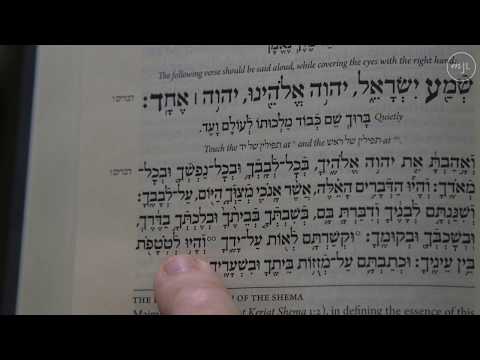
Hear, O Israel
The Shema is Judaism's central statement of who God is. Jews say it morning and evening, and hope to say it with their last breath. Maimonides taught that God is one “in a manner which surpasses any unity that is found in the world”, and has no body. He went further: the truest things we can say about God are what God is not.
Watch
Watch more
A Jewish telling
A Jewish telling
A Name too holy to say
God's personal Name, written with four Hebrew letters (YHWH), is not spoken aloud. In prayer and reading, Jews say Adonai, “my Lord”; in everyday speech, many simply say HaShem, “the Name”. Once, in the Temple, the High Priest spoke it on Yom Kippur, and the people bowed to the ground (Mishnah Yoma 6:2). “Jehovah” and “Yahweh” are Christian scholars' versions; most Jews use neither.
Some of the names of God in Hebrew
| Hebrew | Said | Meaning |
|---|---|---|
| אֱלֹהִים | Elohim | God; plural in form, singular in meaning. A cousin of Arabic Allāh |
| אֱלוֹהַּ | Eloah | God (singular); the closest cousin of Arabic ilāh |
| אֲדֹנָי | Adonai | My Lord: said in place of the four-letter Name |
| הַשֵּׁם | HaShem | The Name: everyday speech, as in Baruch HaShem, “thank God” |
| אֵל שַׁדַּי | El Shaddai | God Almighty; written on the mezuzah at the door |
| שָׁלוֹם | Shalom | Peace: in Jewish law, a name of God (Shabbat 10b). Islam's as-Salām is its twin |
| רַחְמָנָא | Raḥmana | The Merciful One (Aramaic), from the same root as ar-Raḥmān |
| הַקָּדוֹשׁ בָּרוּךְ הוּא | HaKadosh Barukh Hu | The Holy One, blessed be He: compare al-Quddūs |
The Thirteen Attributes of Mercy
These words, said to Moses (peace be upon him) at Sinai, are at the heart of Jewish prayer on fast days and the High Holy Days. The Talmud pictures God wrapping Himself in a prayer shawl to teach Moses this prayer, with a promise that those who say it “will not return empty-handed” (Rosh Hashanah 17b). The word for merciful, raḥum, shares its root with the Arabic raḥmān and raḥīm.
No image
“Thou shalt not make unto thee a graven image” (Exodus 20:4). At Sinai, “ye heard the voice of words, but ye saw no form; only a voice” (Deuteronomy 4:12). Synagogues have no image of God.
How you live sanctifies or profanes the Name
In Jewish teaching, “taking the Name in vain” is about conduct as well as speech. Dishonesty and harshness are ḥillul HaShem, desecrating the Name, counted among the gravest sins (Yoma 86a). Honest, kind behaviour is kiddush HaShem: it sanctifies the Name.
And Islam?
A thousand years ago Rabbi Saadia Gaon translated the Torah into Arabic and wrote “Allah” for God. Maimonides, the most influential medieval rabbi, held that Muslims are strict monotheists, not idolaters, though he did not accept Muhammad ﷺ (peace be upon him) as a prophet. And Jewish tradition remembers Isaac and Ishmael (peace be upon them) burying their father Abraham together (Genesis 25:9).
Everyone has a place with God
Judaism does not ask the world to become Jewish. Righteous people of every nation who keep the seven Noahide laws, Maimonides wrote, are “the pious among the gentiles” and have a share in the world to come.
Watch and listen
Jewish voices on God, in their own words.

Watch more: The One called "the Name"
8 films and talks, chosen for this page. They play here.
Shema: How to Say This Jewish Prayer
myjewishlearning · 2 min
What is the Shema? Intro to the Most Important Jewish Prayer
BimBam · 3 min
The Shema Prayer, Explained
Jewish Learning Institute · 2 min
Jewish Learning Institute: the Shema, explained.
Why do some Jews write the name of God as 'G-d' rather than God?
United Synagogue · 2 min
What Is the Difference between God and Hashem?
Jewish Learning Institute · 46 min
Discovering Sacred Texts: Judaism
British Library · 10 min
The Torah Scroll Explained | Holy Cribs
TrueTube · 2 min
The Way of Kiddush Hashem: The Jewish Task (Ten Paths to God | Unit 9)
The Rabbi Sacks Legacy · 3 min
The Rabbi Sacks Legacy: Kiddush Hashem, sanctifying God's Name.
- More films and talks on F-ILMWatch free