Philosophy This is a question for reasoning, not for experiment.
Sooner or later, usually at bedtime, a child asks it. “If God made everything, who made God?” Parents tend to freeze. It sounds like the question that ends the conversation.
In fact it begins a very old one. A Muslim tradition records that people would one day ask exactly this, and the famous atheist Bertrand Russell said this was the question that first made him doubt, aged eighteen. Richard Dawkins calls it the central argument of The God Delusion. Believers, for their part, say the question rests on a misunderstanding of what they mean by God. Here are both sides, at full strength.
“Say: He is Allah, the One! Allah, the eternally Besought of all! He begetteth not nor was begotten. And there is none comparable unto Him.”
Qur'an 112:1–4 · Pickthall (1930)
Surah al-Ikhlas (Sincerity) is four short lines that most Muslims learn as children. The Prophet Muhammad ﷺ (peace be upon him) said it is equal to a third of the Qur’an (Bukhari 5013). Its third line answers the child’s question directly: God was not born and has no origin.
What science and philosophy show
In everyday life, everything we meet has a cause. A chair has a carpenter; a baby has parents; a star has a collapsing cloud of gas. Science is built on tracing those causes back. So it seems natural to ask the same of God.
But physics adds a twist. According to the general theory of relativity, time is part of the universe, not a stage it sits on. If the universe had a beginning, time may have begun with it. Stephen Hawking compared asking what came “before” the Big Bang to asking what is north of the North Pole: on some models, there is no before. Fifteen hundred years earlier, St Augustine of Hippo made a similar point: God did not create the world in time, he wrote, but created time along with the world (Confessions, Book 11).
That matters for the child’s question. Believers in all three faiths do not say “everything has a cause, so God made the universe”. If they did, the question “who made God?” would knock the argument down. The classical claim is narrower: everything that begins to exist, or that could have failed to exist, needs a cause. God, they say, did not begin and could not fail to exist. So God is the one thing that needs no maker.
Philosophers call such a being necessary rather than contingent. Ibn Sina (Avicenna, 980–1037) put it most famously: every possible thing depends on something else, and the whole chain depends on one Necessary Existent, whose very nature is to exist.
Is that a dodge? This is where the sceptics come in, and the debate is very much alive in universities today.
The arguments, fairly
Only what begins needs a beginner. Believers say God is eternal, not a thing inside time that needs a start. Asking who made the uncreated is like asking who painted an unpainted wall.
Something must be the stopping point. A chain of borrowed money only works if someone actually has money. A chain of borrowed existence only works if something exists by itself. Ibn Sina, Aquinas and Leibniz all argued this way.
Existence is God’s essence. Maimonides argued in The Guide for the Perplexed (I:57) that everything with a cause has existence added to it from outside. In God alone, existence is not added. God does not receive being from anything; God is being. On this view, ‘who made God?’ asks about a thing God is not.
Why stop at God? If something can exist without a cause, the universe itself, or its basic laws, might be that something. Russell said in 1948 that the universe could simply be “just there”. David Hume made the same move in the eighteenth century.
Complexity. Richard Dawkins argues that any God able to design a universe would be more complex than the universe, and so in even greater need of explanation (The God Delusion, 2006).
Does “necessary being” make sense? Philosophers from Hume and Kant to Graham Oppy have asked whether anything can exist by logical necessity, or whether that phrase only sounds like an answer.
Where it stands
This is philosophy, not science, and serious people stand on both sides. Theists reply to Dawkins that classical theism says God is simple, not built of parts, so the complexity objection misses its target. Sceptics answer that a simple mind able to know everything is hard to picture. The conversation continues.
What each faith says
Judaism
“Thus saith the LORD, the King of Israel, And his Redeemer the LORD of hosts: I am the first, and I am the last, And beside Me there is no God.”
Isaiah 44:6 · JPS 1917
When Moses asks God’s name at the burning bush, the answer is Ehyeh asher ehyeh, “I am that I am” or “I will be what I will be” (Exodus 3:14). Jewish teachers have heard in it a God who simply is, who does not come from anything and is not defined by anything.
Maimonides taught that we speak most truly about God by saying what God is not: not made, not limited, not a body, not in time. In the hymn Adon Olam, sung in synagogues around the world, God is “without beginning, without end”. For Jewish thought, the child’s question is a good question with a surprising answer: God is the one reality that was never made.
Christianity
“I am the Alpha and the Omega,” says the Lord God, “who is and who was and who is to come, the Almighty.”
Revelation 1:8 · WEB
The Nicene Creed, said in churches every Sunday, begins: “We believe in one God, the Father, the Almighty, maker of heaven and earth, of all that is, seen and unseen.” Christians hold that God is uncreated and eternal, and that everything else exists because God gives it being.
Christian teaching adds something distinctive here. The Creed says the Son is “begotten, not made”. Christians mean that the Son is eternally from the Father, as light comes from light, without ever having a beginning, and that Father, Son and Holy Spirit are one God. Thomas Aquinas, whose “Five Ways” are still taught in RE lessons, ends each one at a first cause that is itself uncaused, “and this everyone understands to be God”.
Islam
“He is the First and the Last, and the Outward and the Inward; and He is Knower of all things.”
Qur'an 57:3 · Pickthall (1930)
Islam does not treat the question as forbidden; it expected it. The Prophet Muhammad ﷺ said that people would keep asking “who created this, who created that?” until someone asks “then who created God?”, and that when the thought reaches that point, a believer should seek refuge in God and stop (Bukhari 3276; Muslim 134). Muslim scholars read this not as a ban on thinking but as a signpost: the chain of “who made?” has to end somewhere, and the One at the end is not one more link.
Two of the 99 Names say this directly: al-Awwal, the First, before whom there is nothing, and al-Akhir, the Last, after whom there is nothing (Qur’an 57:3). And al-Samad, in Surah al-Ikhlas, means the One everything depends on, who depends on nothing.
Without religion
“Roughly speaking, the word humanist has come to mean someone who … makes their ethical decisions based on reason, empathy, and a concern for human beings and other sentient animals”
Humanists UK, ‘What is humanism?’ · original English
For many non-religious people, this is the question that settles it the other way. If something can exist without a maker, why not the universe itself, or the laws of physics? Richard Dawkins, an atheist, made it the centre of The God Delusion (2006). Others put it more gently. Agnostics, a name the biologist T. H. Huxley coined in 1869, say we may never know what, if anything, lies at the bottom of the chain, and that it is more honest to say so.
Many humanists add that the answer changes less about how we live than people think. Whether or not anything made the universe, the child asking at bedtime still needs kindness, honesty and a good answer. Plenty of non-religious parents give this one: “Nobody knows. Isn’t that amazing? Let’s keep wondering together.”
Same and different
Jews, Christians and Muslims each teach that God is uncreated, without beginning or end, and that this is exactly what makes God different from everything else. They share the philosophical tradition too: Ibn Sina, Maimonides and Aquinas read and argued with one another. They differ on one point the child’s question brings up: Christians say the Son is “begotten, not made”, eternally from the Father within the one God, while the Qur’an says God “has not fathered, and was not born”, and Judaism likewise rejects any distinction within God. Many non-religious people agree the chain must stop somewhere, and argue that it might stop at the universe.
A moment to reflect
- If something has to exist without a maker, is it more reasonable to you that it is God, the universe, or something we can’t yet name?
- Is it fair to answer a child “nobody made God”? What would you say instead?
- Does the idea that time began with the universe make the question easier or harder?
- What would count, for you, as a good answer to this question?
Watch
 Aquinas & the Cosmological Arguments: Crash Course Philosophy #10 · CrashCoursePlays on “Did the universe have a beginning, and does it need a cause?” →
A clear, even-handed introduction to Aquinas’s arguments and the standard objections.
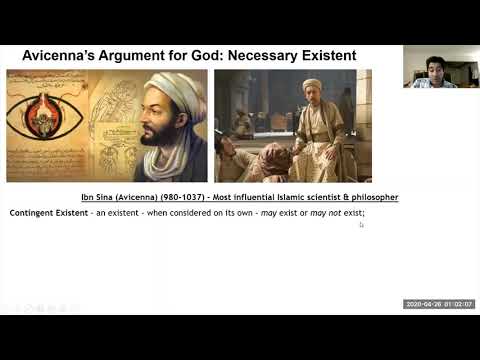 Ibn Sina (Avicenna)'s Proof of God's Existence by Dr. Khalil Andani · Dr. Khalil Andani: Thinking IslamPlays on “Did the universe have a beginning, and does it need a cause?” →
A Muslim scholar explains Ibn Sina’s argument from contingency step by step.
Philosophers of several views discuss what it means to call God the Creator.
A short university revision lecture on Maimonides and saying what God is not.
Do it together
Set up a line of dominoes and knock it over. Ask: could the line be infinitely long and still fall? Does something have to start it? Let children argue both ways.
In pairs, each write the answer you would give a seven-year-old who asks “who made God?”. Swap with someone from another faith or none and talk about the differences.
Print the Nicene Creed’s first lines, Surah al-Ikhlas and Adon Olam on one sheet. Read them aloud together and mark where they agree and where they don’t.
Adon Olam, ‘Lord of the world’, ends many synagogue services, sung to dozens of tunes, from solemn to jaunty. Listen to two settings online, then read its line about God “without beginning, without end”. Which tune fits the words better?
Go deeper
- Ibn Sina’s Metaphysics (Stanford Encyclopedia of Philosophy) · article
- Cosmological Argument (Stanford Encyclopedia of Philosophy) · article
- Surah al-Ikhlas (Quran.com) · scripture
- Exodus 3 (Sefaria) · scripture
- The first cause argument, GCSE RS (BBC Bitesize) · article
- Maimonides, Guide for the Perplexed I:57 (Sefaria) · book
- Revelation 1 (Bible Gateway, WEB) · scripture
- Understanding Humanism: resources for schools (Humanists UK) · article
Check yourself
Three quick questions. No score, nothing saved.
1. According to the argument, what needs a beginner?
2. What did Ibn Sina call God?
3. Qur'an 112 says God…
Sources (7)
- Ibn Sina’s Necessary Existent: Lizzini, Ibn Sina’s Metaphysics, SEP
- Classical cosmological arguments restrict the causal premise to contingent or beginning things; objections from Hume, Russell, Oppy: Reichenbach, Cosmological Argument, SEP
- Augustine: the world was made with time, not in time: Augustine, Confessions XI; SEP, Saint Augustine
- Dawkins’ complexity argument (‘Ultimate Boeing 747’): SEP, Teleological Arguments for God’s Existence
- Al-Ikhlas equals a third of the Qur’an: Sahih al-Bukhari 5013, Sunnah.com
- Hadith on ‘who created your Lord?’: Sahih al-Bukhari 3276, Sunnah.com
- Russell–Copleston debate, BBC Third Programme, 1948: Wikipedia, Bertrand Russell