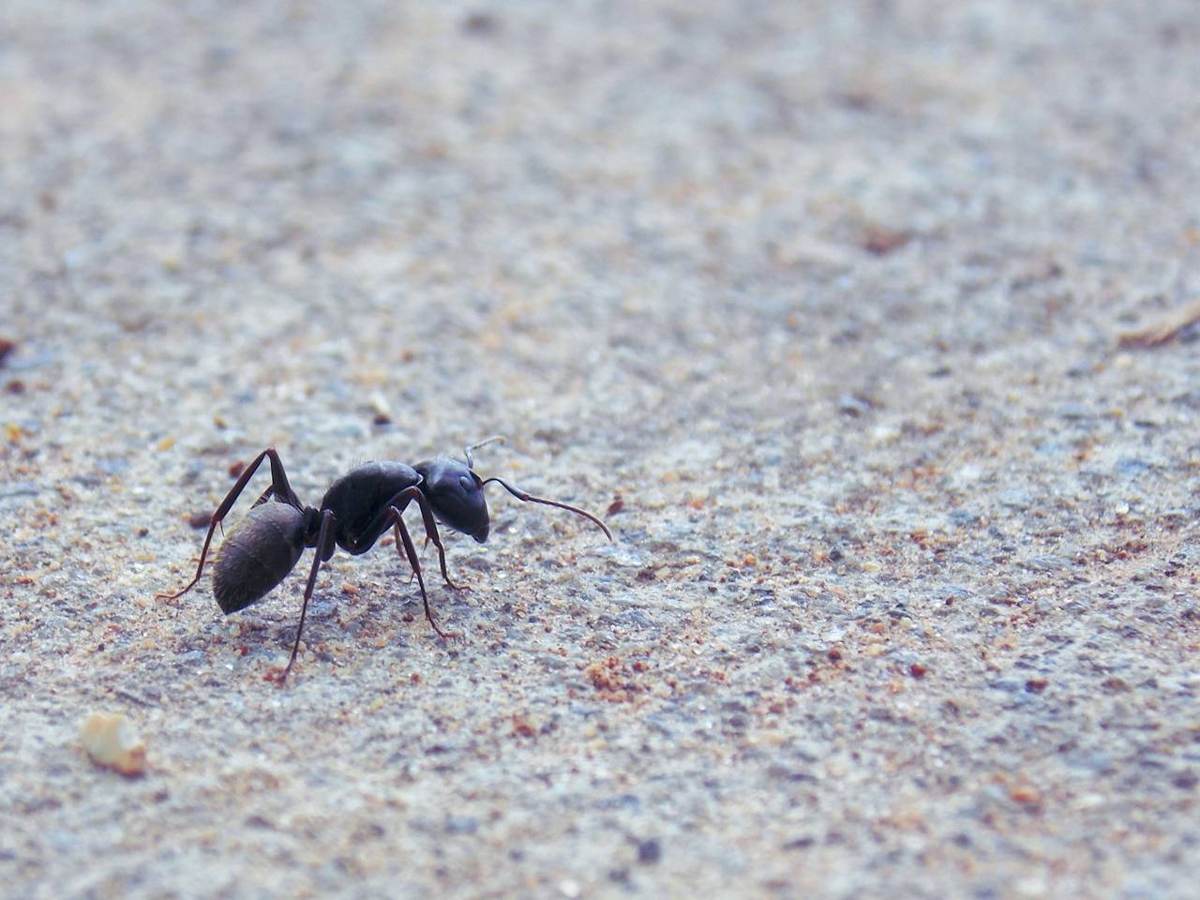
Scientists estimated in 2022 that there are about 20 quadrillion ants on Earth: 20,000,000,000,000,000. That is roughly two and a half million ants for every person alive. Put together, they weigh more than all the wild birds and wild mammals combined.
Two of the world’s scriptures stop to notice one of them. In the Hebrew Bible, the book of Proverbs, traditionally linked with King Solomon (peace be upon him), tells the lazy to go and watch the ant. In the Qur’an, Solomon marches an army across a valley and hears a single ant call out a warning to her colony. He smiles, stops, and prays.
“When they came to the valley of the ants, an ant said: “Ants, go into your homes, so that Solomon and his soldiers do not crush you without knowing it.” He smiled, laughing at her words, and said: “And (Solomon) smiled, laughing at her speech, and said: My Lord, arouse me to be thankful for Thy favour wherewith Thou hast favoured me and my parents, and to do good that shall be pleasing unto Thee, and include me in (the number of) Thy righteous slaves.”
Qur'an 27:18–19 · Pickthall (1930)
Surah an-Naml (The Ants) is named after this moment. The ant is careful to add “without knowing it”: she does not accuse the king of cruelty. Solomon’s response is not pride at hearing her, but gratitude. Proverbs puts the ant to work as a teacher: “Go to the ant, thou sluggard; Consider her ways, and be wise” (Proverbs 6:6, JPS 1917).
What science shows about ants, and the world behind the story
Ants really do warn each other. Most ant communication is chemical: they lay trails of scent and release alarm pheromones when danger comes, and nest-mates nearby react within seconds. Many ants also use sound and vibration. They can make squeaks by rubbing parts of their bodies together, a behaviour called stridulation, and they sense vibrations through their legs. In the 1960s the German biologist Hubert Markl showed that leaf-cutter ants buried by a cave-in stridulate, and that their nest-mates feel the vibrations and dig them out.
Proverbs says the ant gathers food “having no chief, overseer, or ruler”. Biologists agree. An ant queen lays eggs; she does not give orders. A colony of millions organises itself through countless small interactions, each ant responding to scents, touches and what its neighbours are doing. Scientists call this self-organisation, and engineers now copy it to route data and design robots.
What about Solomon? The Hebrew Bible describes him as the son of David (peace be upon him) and king of Israel in the tenth century BCE. He built the first Temple in Jerusalem and was famous for wisdom: he “spoke also of beasts, and of fowl, and of creeping things, and of fishes” (1 Kings 5:13). Archaeologists debate how large and rich his kingdom was. Some point to monumental gates at Gezer, Hazor and Megiddo and to sites such as Khirbet Qeiyafa as signs of a tenth-century state. Others date those buildings later and see a smaller kingdom. No inscription naming Solomon has yet been found.
Where was the valley of the ants? The Qur’an does not say. Some early commentators placed it in Syria or near Ashkelon; others in the region of Ta’if in Arabia. As with many stories in scripture, the place is less important than the moment: power stopping to listen.
What each faith says
Judaism
“Go to the ant, thou sluggard; Consider her ways, and be wise; Which having no chief, Overseer, or ruler, Provideth her bread in the summer, And gatherest her food in the harvest.”
Proverbs 6:6–8 · JPS 1917
The Hebrew Bible remembers Solomon as the wisest of kings. When God offers him anything, he asks for “an understanding heart” to judge his people, and God gives him wisdom and much more besides (1 Kings 3:9–12). His wisdom reaches into nature: he spoke of trees from the cedar to the hyssop, and of every kind of creature. Jewish tradition credits him with Proverbs, Ecclesiastes and the Song of Songs, and synagogues still read his books through the year: the Song of Songs at Passover, Ecclesiastes at Sukkot. The Queen of Sheba comes from far away “to prove him with hard questions”, and leaves praising his God (1 Kings 10:1–9). She is a woman who tests a king, and is not fooled.
Proverbs mentions the ant twice. Once it wakes the lazy (6:6–8). Once it appears in a list of small things that are “exceeding wise”: “The ants are a people not strong, Yet they provide their food in the summer” (30:25). The Talmud says that if the Torah had not been given, we could have learned honesty from the ant, which does not take another ant’s grain (Eruvin 100b).
Christianity
“Consider the lilies of the field, how they grow. They don’t toil, neither do they spin, yet I tell you that even Solomon in all his glory was not dressed like one of these.”
Matthew 6:28–29 · WEB
Christians read Proverbs as part of their Old Testament, and the ant has long been a favourite of Christian preachers. The New Testament has no ant, but Jesus also pointed his listeners to small creatures and plants as teachers. He spoke of the birds that God feeds and the lilies of the field. He said that “even Solomon in all his glory was not dressed like one of these” (Matthew 6:29).
Francis of Assisi, the thirteenth-century friar, was remembered for treating every creature as a sister or brother. He is said to have moved worms off the road so they would not be crushed. On or near his feast day, 4 October, many Catholic and Anglican churches hold a blessing of the animals. Christian writers on creation today, such as Pope Francis in Laudato Si’ (2015), take up the same theme: every creature has its own value before God.
Islam
“And (Solomon) smiled, laughing at her speech, and said: My Lord, arouse me to be thankful for Thy favour wherewith Thou hast favoured me and my parents, and to do good that shall be pleasing unto Thee, and include me in (the number of) Thy righteous slaves.”
Qur'an 27:19 · Pickthall (1930)
In the Qur’an, Solomon (Sulayman) inherits kingship and prophethood from his father David (peace be upon him), and is taught “And Solomon was David's heir. And he said: O mankind! Lo! we have been taught the language of birds, and have been given (abundance) of all things. This surely is evident favour.” (27:16, Pickthall). His armies of people, jinn and birds march in ranks. When the ant warns her colony, Solomon smiles and prays to be grateful. In the same surah, the hoopoe bird brings him news of the Queen of Sheba, and Solomon listens to a bird too. The queen, whom Muslim tradition calls Bilqis, is one of the Qur’an’s wisest rulers. She consults her council before acting (27:32–33), and in the end says, “It was said unto her: Enter the hall. And when she saw it she deemed it a pool and bared her legs. (Solomon) said: Lo! it is a hall, made smooth, of glass. She said: My Lord! Lo! I have wronged myself, and I surrender with Solomon unto Allah, the Lord of the Worlds.” (27:44, Pickthall).
The Prophet Muhammad ﷺ (peace be upon him) taught care for ants. He told of an earlier prophet who was bitten by an ant and had the whole colony burned. God rebuked him: because one ant bit you, you burned a whole nation that glorifies God (Bukhari 3019; Muslim 2241). He also forbade killing four creatures, the ant, the bee, the hoopoe and the sparrow-hawk (Abu Dawud 5267). Two of the Names of God fit this story: as-Sami’, the All-Hearing, who hears the smallest voice, and ash-Shakur, the Appreciative.
Same and different
All three faiths honour Solomon as a king of great wisdom whose understanding reached into the natural world, and all three treat small creatures as teachers. They use the ant differently. In the Qur’an, the ant is a small voice that power stops to hear, and her warning becomes a prayer of gratitude. In Proverbs, the ant is a model of hard work, foresight and self-organisation. Christians read Proverbs and add Jesus’ lilies and birds. All three remember the Queen of Sheba as a clever ruler who came to test him. In Judaism and Christianity Solomon is a king and wise man, honoured but not usually called a prophet; in Islam he is a prophet.
A moment to reflect
- Who are the small voices in your school, workplace or street that powerful people might not hear?
- The ant says the army might crush them “without knowing it”. What harm do we do without knowing?
- Solomon’s first response to hearing the ant was gratitude. What do you feel first when you notice something small and wonderful?
- What could you learn from watching an ant for ten minutes?
Watch
BBC Earth’s best ant moments: colonies working together without a leader.
Planet Earth III on insects that communicate by vibration.
 The Billion Ant Mega Colony and the Biggest War on Earth · Kurzgesagt – In a NutshellPlays on “The ant who warned her people” →
Kurzgesagt on ant supercolonies and how a colony works as one.
A simple explanation, for younger viewers, of how ants find food and tell each other.
Do it together
Find an ant trail in a garden or park. Put down a crumb of biscuit a little way off and time how long it takes for the first ant to find it and for others to follow. Don’t harm them.
Hold a listening meeting where the people least often heard in your area, such as young people, carers or newcomers, speak first and longest. Leaders only listen.
Read Proverbs 6:6–8 and Qur’an 27:15–19 together. Draw the scene from the ant’s point of view, showing the setting and the ants but no people.
Around 4 October, the feast of St Francis, many Catholic and Anglican churches invite people to bring pets for a blessing. Go along with a neighbour, or hold your own thank-you for the creatures that share your street.
Go deeper
- Surah an-Naml (Quran.com) · scripture
- Proverbs 6 (Sefaria) · scripture
- Matthew 6 (Bible Gateway, WEB) · scripture
- How many ants are there on Earth? (PNAS, 2022) · paper
Check yourself
Three quick questions. No score, nothing saved.
1. About how many ants are there on Earth?
2. What does Solomon do when he hears the ant?
3. What does Proverbs tell the lazy to do?
Sources (7)
- About 20 quadrillion ants, 12 megatonnes of carbon: Schultheiss et al., PNAS 119(40), 2022
- Buried leaf-cutter ants stridulate and are rescued: Markl, Science 149, 1965
- Ant colonies self-organise without central control: Gordon, Ant Encounters (Princeton, 2010); Stanford news
- Debate over Solomon’s kingdom and tenth-century archaeology: Encyclopaedia Britannica, Solomon
- Prophet rebuked for burning an ant colony: Sahih al-Bukhari 3019, Sunnah.com
- Prohibition on killing the ant, bee, hoopoe and sparrow-hawk: Sunan Abi Dawud 5267, Sunnah.com
- Learning honesty from the ant: Eruvin 100b (Sefaria)