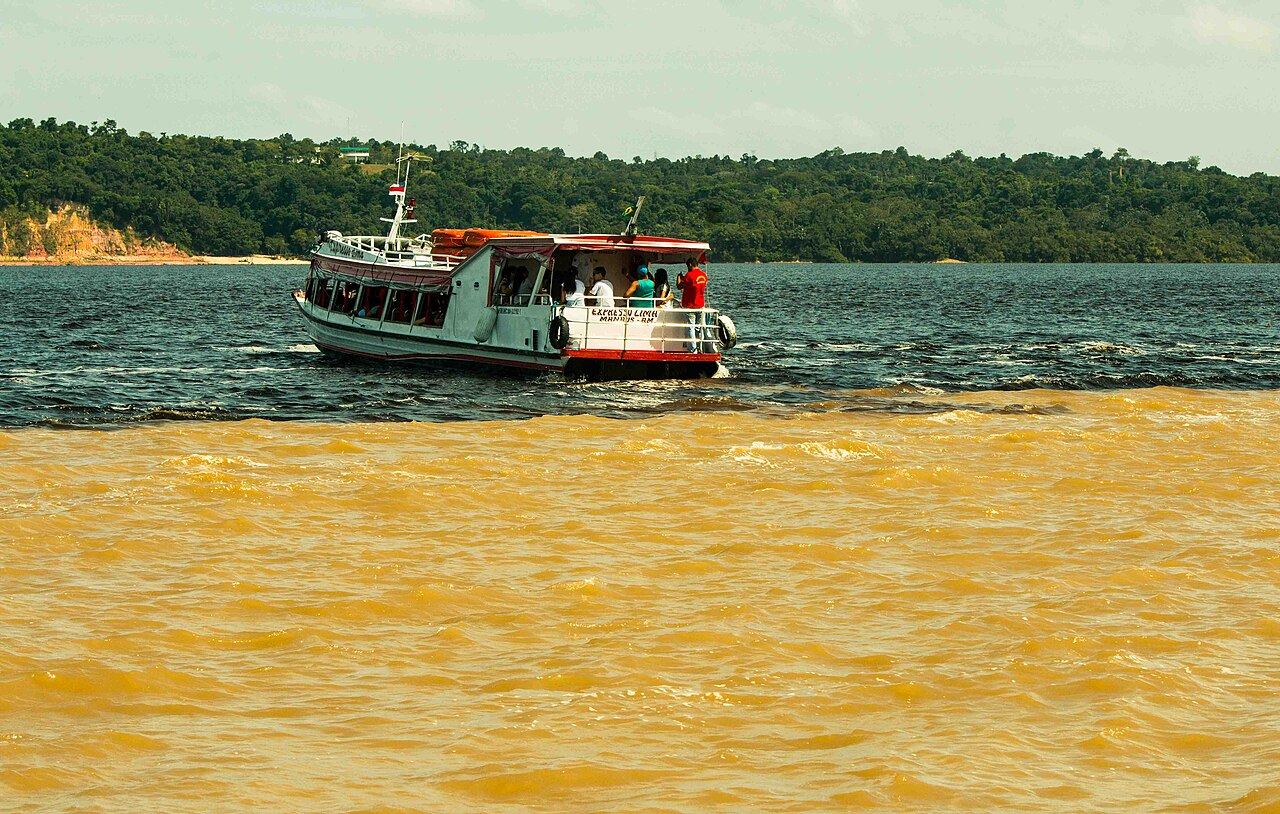
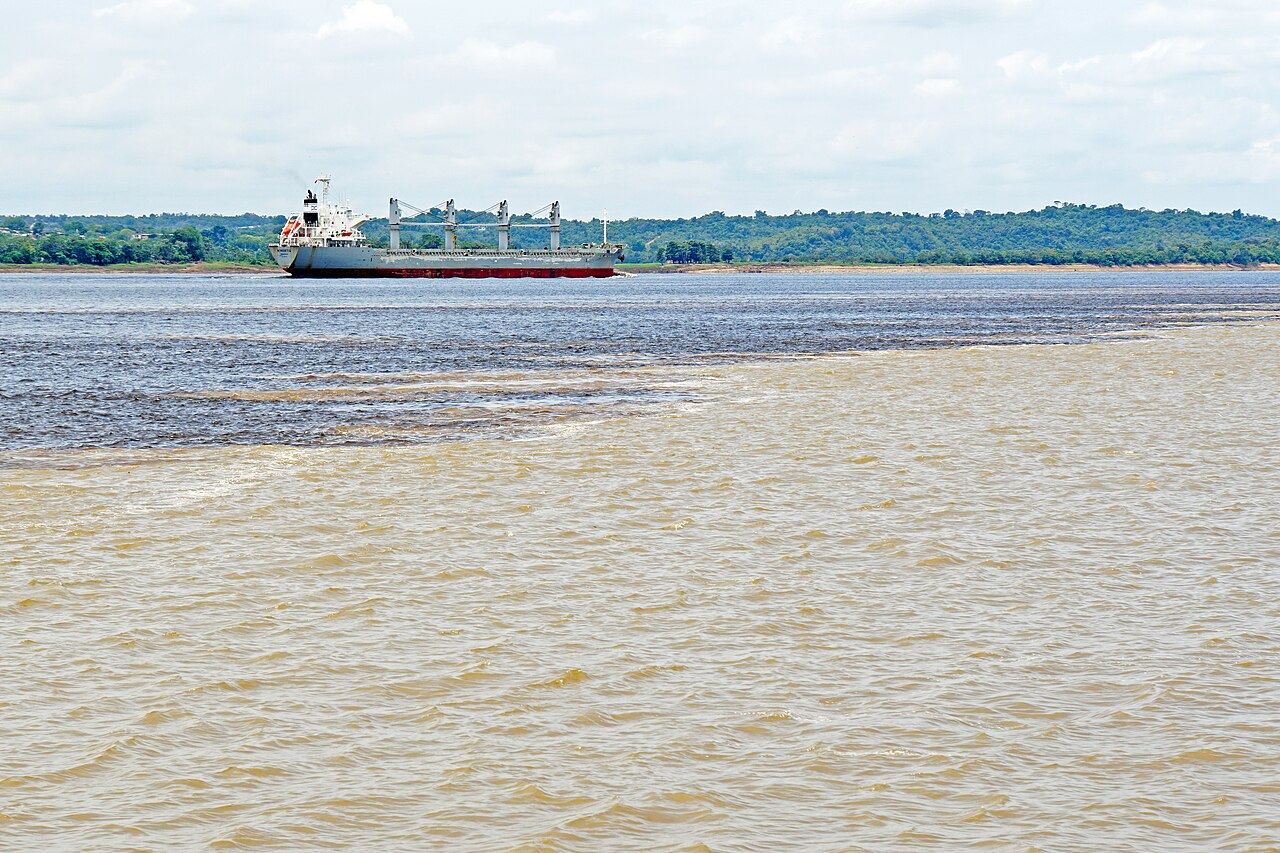
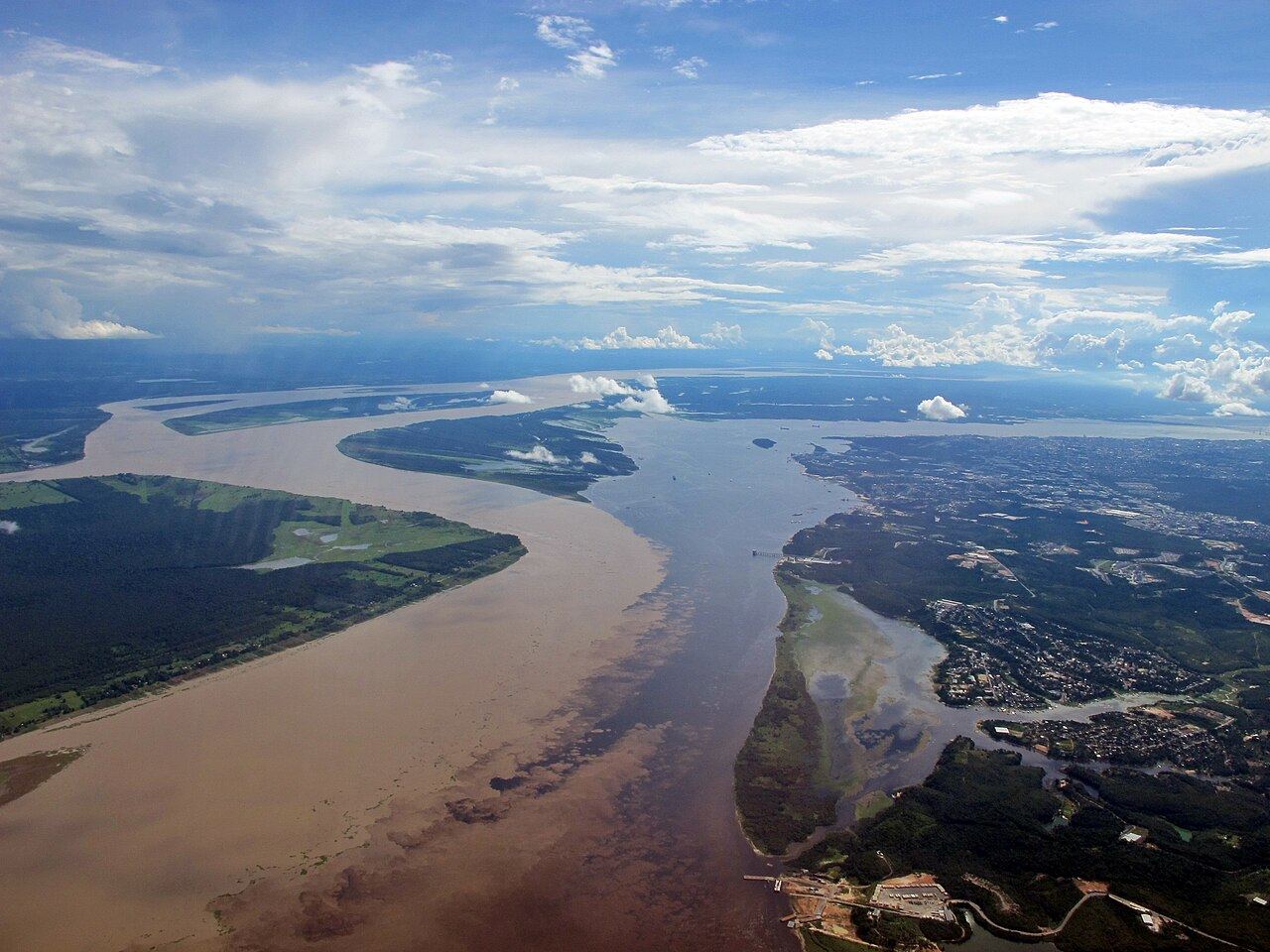
Stand beside a big estuary and the water can look like two different rivers. Try the Severn, the Humber or the Thames below London. Brown and silty on one side, grey-green on the other, sometimes with a visible seam of foam between them, shifting with the tide.
It is the place where a river finally meets the sea. Fresh water and salt water run into each other, and for a while they do not quite mix. The Qur'an noticed this meeting, and used it as a picture of something much bigger.
“He hath loosed the two seas. They meet. There is a barrier between them. They encroach not (one upon the other). Which is it, of the favours of your Lord, that ye deny? There cometh forth from both of them the pearl and coral-stone.”
Qur'an 55:19-22 · Pickthall (1930)
This passage comes in the chapter ar-Raḥmān, The Most Merciful, famous for its refrain, “So which of your Lord's favours will you both deny?”, repeated 31 times. Another verse is more specific: “And He it is Who hath given independence to the two seas (though they meet); one palatable, sweet, and the other saltish, bitter; and hath set a bar and a forbidding ban between them.” (25:53, Pickthall). The word for barrier is barzakh. The Qur'an uses the same word for the state between death and resurrection (23:100): one word for a boundary in this world and the boundary beyond it.
What science shows
Seawater is salty: NOAA gives the average salinity of the ocean as about 35 parts per thousand, meaning about 3.5% of the weight of seawater is dissolved salt. River water is fresh. Salt water is denser, so when the two meet, fresh water tends to slide over the top of the salt water like oil over vinegar.
An estuary is the zone where this happens. NOAA describes it as a partly enclosed body of water where fresh water from rivers mixes with salt water from the sea, producing brackish water. In some estuaries the salt water pushes upstream along the bottom as a “salt wedge” under the fresh water above. The sharp change in saltiness between the layers is called a halocline. Where tides and waves are gentle, these boundaries can last for hours or extend for kilometres.
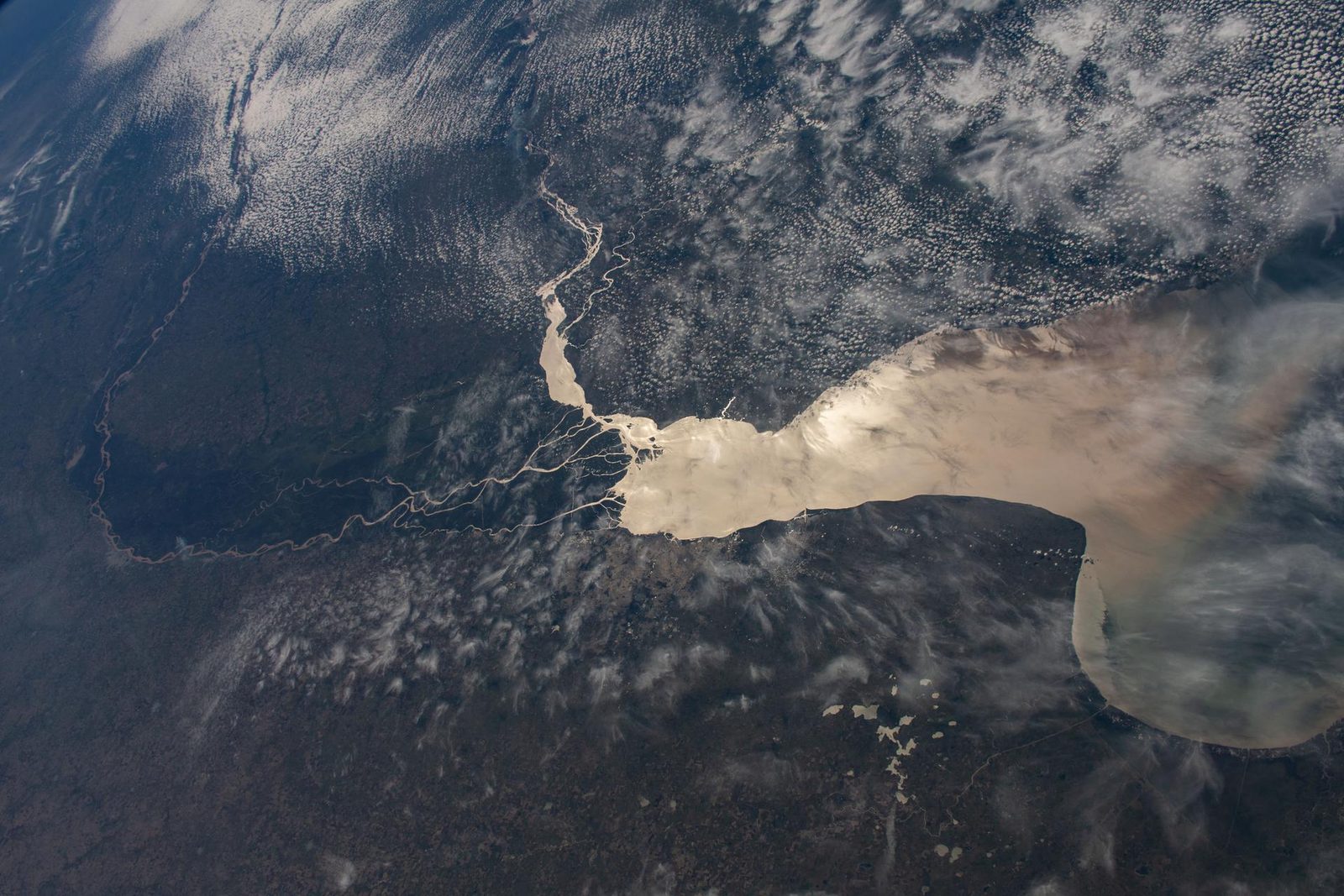
The same thing happens between seas. At the Strait of Gibraltar, the Mediterranean, which loses lots of water to evaporation, is saltier than the Atlantic. Lighter Atlantic water flows in at the surface, while denser, saltier Mediterranean water flows out underneath, sinking to depth. Oceanographers can trace that Mediterranean water spreading across the Atlantic long after it leaves the strait.
These boundaries are real, but they are never perfectly sealed. Waves, tides and currents always mix the waters in the end. A popular online video claims to show two oceans in the Gulf of Alaska that “never mix”. Oceanographers explain it shows silty glacier meltwater meeting clearer seawater, and that they do mix, slowly. Honesty about this matters to us.
And these meeting zones are some of the richest places on Earth. Estuaries are nurseries for fish, shellfish and birds. Places where water masses meet in the open ocean gather plankton, and the fish and whales that feed on it. The boundary is not just a line. It is where life gathers.
What each faith says
Judaism
“Who have placed the sand for the bound of the sea, An everlasting ordinance, which it cannot pass; And though the waves thereof toss themselves, yet can they not prevail.”
Jeremiah 5:22 · JPS 1917
In Genesis, God gathers the waters into one place and calls them Seas. The Hebrew Bible then speaks again and again of boundaries God sets for the sea. In the speeches from the whirlwind, God asks Job who shut up the sea with doors and said, “Thus far shalt thou come, but no further.” Jeremiah says God placed the sand as the boundary of the sea, an everlasting decree it cannot pass.
The prophet Ezekiel gives a vision that turns the meeting of waters into healing. A river flows out from the Temple down into the Dead Sea. Where it meets the salt water, the sea is made fresh and fish swarm in it (Ezekiel 47:8-9). Fresh water meeting salt becomes a picture of life returning.
Water is part of Jewish practice as well as scripture. On seeing the sea, a Jew says a blessing to the One “who made the great sea” (Mishnah Berakhot 9:2). At Rosh Hashanah many go to a river, pond or the sea for Tashlikh, “casting”, and throw crumbs into the water. They remember Micah's promise: “Thou wilt cast all their sins into the depths of the sea” (Micah 7:19). The rabbis also told of Miriam's well, a spring that followed Israel through the desert for her sake and dried up when she died (Taanit 9a).
Christianity
“He showed me a river of water of life, clear as crystal... On this side of the river and on that was the tree of life... The leaves of the tree were for the healing of the nations.”
Revelation 22:1-2 · WEB
The Gospels show Jesus on the Sea of Galilee in a storm, rebuking the wind and telling the sea to be still. His disciples ask, “Who then is this, that even the wind and the sea obey him?” For Christians, this moment reveals Jesus sharing in God's authority over the waters, which they understand through their belief in him as the Son of God.
The Bible's last book ends with water too. John's vision of a new creation includes a river of the water of life, clear as crystal. The tree of life grows on both banks, its leaves “for the healing of the nations”. Like Ezekiel's river, it is water that heals rather than divides. Water is at the heart of Christian practice too, in baptism. And at Epiphany in January, Orthodox churches hold the Great Blessing of the Waters. In some places a priest throws a cross into the sea or a river for swimmers to bring back.
Islam
“There is a barrier between them. They encroach not (one upon the other). Which is it, of the favours of your Lord, that ye deny?”
Qur'an 55:20-21 · Pickthall (1930)
Muslims read this sign as a mercy: two kinds of water, each kept in its place, both giving gifts, “pearls and coral”. Classical commentators such as Ibn Kathīr, writing in fourteenth-century Damascus, explain the two seas as the fresh water of rivers and the salt water of the sea. They meet without one swallowing the other. We present it as observation and image, as they did, not as a scientific discovery.
The phrase majmaʿ al-baḥrayn, “the meeting place of the two seas”, appears in the story of Moses (peace be upon him). He travels to find a servant of God with special knowledge, al-Khiḍr (peace be upon him) (18:60-82). The place where two waters meet becomes the place where two kinds of knowledge meet. And the barzakh of 23:100 reminds Muslims that every life reaches a boundary, which only God can carry us across.
Same and different
All three traditions see God setting boundaries for the waters. Each turns the meeting of waters into hope: Ezekiel's healing river, John's river of life, the Qur'an's pearls from both seas. The Qur'an alone uses one word, barzakh, for the line between waters and the line between this life and the next. Judaism is the one that takes people down to the water every new year, to cast away their sins at Tashlikh. Christianity adds the image of Jesus himself commanding the sea, which belongs to its own belief about who he is. It also meets water at the start of every Christian life, in baptism.
A moment to reflect
- Where in your life do two very different “waters” meet: home and school, two cultures, two languages?
- Is a boundary always a barrier, or can it be a place where life gathers?
- Have you ever stood at an edge, a shoreline, a border, a last day somewhere, and felt something change?
- How do we keep what is distinct in each of us while still meeting?
Watch
NOAA's short film on what happens where a river meets the sea.
Our Planet's free episode on coastal seas and their life.
 Travel to the Depths of Our Mysterious Oceans | 4K UHD | Blue Planet II | BBC Earth · BBC EarthPlays on “If the sea were ink” →
Blue Planet II's journey into ocean depths and water layers.
Do it together
Fill a clear jar half with very salty water coloured blue. Then slowly pour fresh water coloured yellow over the back of a spoon so it floats on top. Watch the line between them and how long it lasts.
Visit an estuary nature reserve, from Rainham Marshes to the Severn at Slimbridge, at a changing tide. Look for the line between waters and count the birds feeding along it.
Read Ezekiel 47:8-9, Revelation 22:1-2 and Qur'an 55:19-22 together. Each person names one “meeting place” in your area where different communities come together, and one that is missing.
At Rosh Hashanah, in September or October, many Jewish communities walk to a river, pond or the sea for Tashlikh. Join one if you are invited, or at any time of year take a quiet walk to moving water and name one thing you would like to let go of.
Around Epiphany in January, Orthodox churches bless the waters, sometimes at a river or the shore. Look for a Greek, Russian or Romanian Orthodox parish near you and ask whether visitors may watch.
Go deeper
- Qur'an 55:19-25 with translations · scripture
- NOAA: What is an estuary? · article
- NOAA: Why is the ocean salty? · article
- Ezekiel 47 (JPS 1917) on Sefaria · scripture
- Revelation 22 (WEB) on Bible Gateway · scripture
- Mishnah Berakhot 9:2 on Sefaria: blessings for sea, mountains and storms · scripture
In pictures
Try this · KS2 · 15 min · Science
Where two waters meet
You need: a tall clear glass, salt, two food colourings, a spoon, a jug
- Stir 4 big spoonfuls of salt into a cup of warm water with blue colouring. Pour it into the glass.
- Colour a second cup of plain water yellow.
- Hold the spoon upside down just above the salty layer and pour the yellow water very slowly over its back.
- Look from the side: a line forms between the two. Leave it an hour. What happens?
Fresh and salt side by side with a line between them: the Qur'an calls it a barzakh.
Sources (5)
- Average ocean salinity about 35 parts per thousand (3.5% by weight): NOAA Ocean Service, Why is the ocean salty?
- Estuaries: where fresh river water mixes with seawater: NOAA Ocean Service, What is an estuary?
- At Gibraltar, deeper, saltier, denser Mediterranean water flows out under inflowing Atlantic water: Wikipedia, Strait of Gibraltar: inflow and outflow (with sources)
- Salt wedges and haloclines in estuaries: NOAA Ocean Service, Estuaries tutorial: classifying estuaries by water circulation
- Gulf of Alaska video shows glacial sediment-laden water mixing slowly with seawater: Anchorage Daily News, Mythbusting the place where two oceans meet, 5 Feb 2013