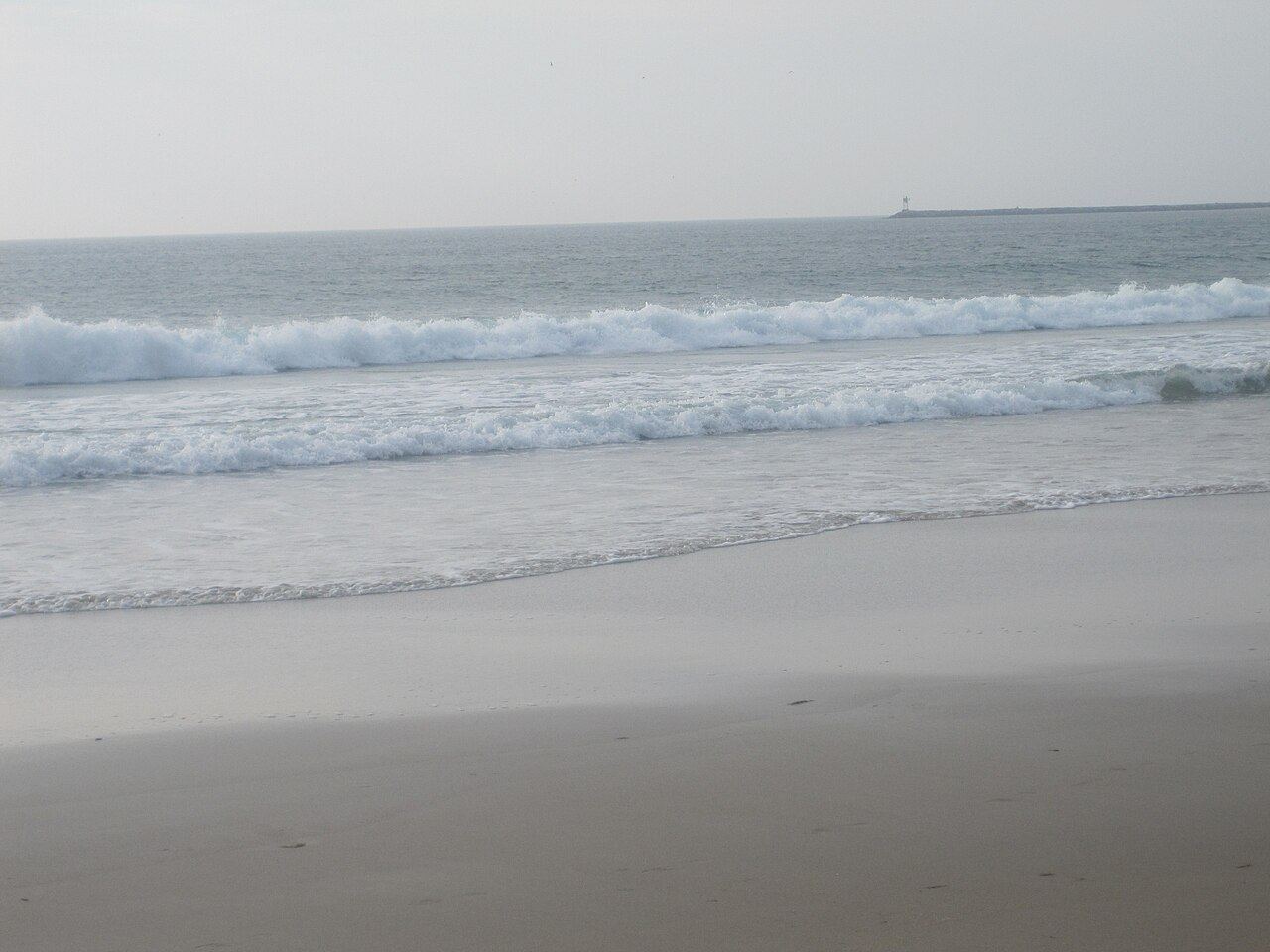
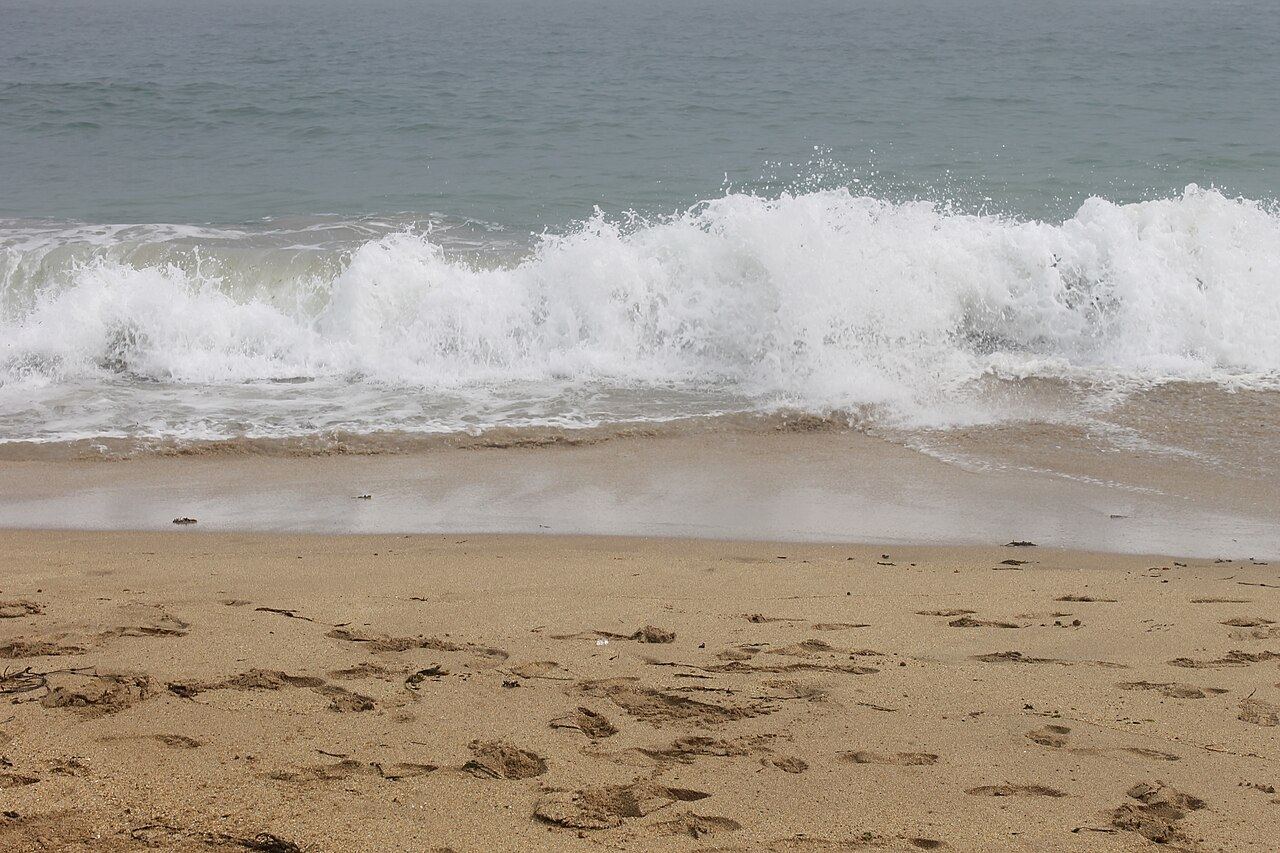
Stand on a beach and look out. The water you can see is a sliver of a sliver. Below the horizon, the ocean goes down on average more than three and a half kilometres, and in one place nearly eleven. Most of its floor has never been seen in detail by anyone.
Now imagine all of it as ink, every drop, and a pen that never tires. What could you write? The Qur'an, the Talmud's poets and the Gospel of John each pick up this exact picture, centuries apart, to say something about God.
“Say: Though the sea became ink for the Words of my Lord, verily the sea would be used up before the words of my Lord were exhausted, even though We brought the like thereof to help.”
Qur'an 18:109 · Pickthall (1930)
This verse closes the chapter called al-Kahf, The Cave, which is full of stories about the limits of human knowledge. A second verse makes the picture bigger: “And if all the trees in the earth were pens, and the sea, with seven more seas to help it, (were ink), the words of Allah could not be exhausted. Lo! Allah is Mighty, Wise.” (31:27, Pickthall). Commentators read “the words of my Lord” as His knowledge, His wisdom and His creative command.
What science shows
The US Geological Survey estimates that Earth holds about 1.386 billion cubic kilometres of water, and about 96.5% of it is in the oceans. That is roughly 1.33 billion cubic kilometres of sea. A single cubic kilometre is a million million litres.
According to the US National Oceanic and Atmospheric Administration (NOAA), the ocean covers about 70% of Earth's surface, some 360 million square kilometres, with an average depth of 3,682 metres. Its deepest known point, Challenger Deep in the Mariana Trench, is about 10,935 metres down. If you dropped Mount Everest into it, the summit would still be more than two kilometres under water.
For all that, we know remarkably little about it. NOAA reports that as of April 2026, only 28.7% of the global seafloor had been mapped with modern high-resolution sonar. We have better maps of the surface of Mars than of much of our own ocean floor.
Here is a rough sum, just for wonder. Suppose one millilitre of ink writes about a thousand words (an assumption: it depends on the pen). A cubic kilometre holds a thousand million million millilitres, so the oceans could write roughly a thousand million million million million words: a 1 followed by about 27 zeros. That is far more than every word every human has ever said. And yet it is a number. It can be counted. It would run out.
That is the force of the verse. Even the largest thing most of us will ever see is finite. The scripture's point is not the size of the sea. It is that God's knowledge and creative word have no end at all.
What each faith says
Judaism
“If the heavens were parchment, the trees quills, and all the seas ink, it would not suffice to set down the glory of the Creator.”
Akdamut (Rabbi Meir of Worms, 11th century), paraphrase · our rendering
Jewish tradition loves this image. The Talmud (Shabbat 11a) uses it about the hidden thoughts of rulers. Even if all the seas were ink, the reeds quills, the heavens parchment and all people scribes, they could not write it all down. A midrash on the Song of Songs (Song of Songs Rabbah 1:3) puts it in the mouth of Rabbi Eliezer, a great teacher of the late first century. He is speaking of the Torah he had learned from his teachers.
Most famously, the medieval hymn Akdamut, sung in many synagogues on the festival of Shavuot, opens with it. If all the heavens were parchment, all the trees quills and all the seas ink, it would not be enough to tell the glory of the Creator. Shavuot celebrates the giving of the Torah at Sinai, so the image belongs at the heart of the Jewish year.
Christianity
“There are also many other things which Jesus did, which if they would all be written, I suppose that even the world itself wouldn't have room for the books that would be written.”
John 21:25 · WEB
John's Gospel ends with a picture of overflowing: if everything Jesus did were written down, the world itself would not have room for the books. For Christians it is a way of saying that the life of Christ overflows any record of it.
The image also reached Christian worship through the Jewish hymn. Frederick Lehman's 1917 gospel song The Love of God has a final verse that is widely traced to the Akdamut. “Could we with ink the ocean fill, and were the skies of parchment made... to write the love of God above would drain the ocean dry.” A Jewish poem from medieval Germany ended up sung in churches across the world.
Islam
“And if all the trees in the earth were pens, and the sea, with seven more seas to help it, (were ink), the words of Allah could not be exhausted. Lo! Allah is Mighty, Wise.”
Qur'an 31:27 · Pickthall (1930)
For Muslims, these verses are about al-ʿAlīm, the All-Knowing, and about God's word kun, “Be”, by which He creates (36:82). God's words are not used up by being spoken. Every created thing is, in a sense, one of them, and there is always more.
A hadith in Sahih al-Bukhari makes the same point in miniature. When Moses (peace be upon him) travelled with the wise servant al-Khiḍr, “the Green One” (peace be upon him), a small bird landed on the edge of their boat. It dipped its beak into the sea. Al-Khiḍr said that their knowledge, compared with God's, was like what that bird had taken from the sea (Bukhari 122). The whole ocean on one side, one beakful on the other.
Same and different
The three traditions share one picture of the inexhaustible, and it has travelled between them. It went from Talmud and midrash to a synagogue hymn, and then to a Christian gospel song. The Qur'an uses it independently, and most directly about God's words. They differ in what overflows: for the rabbis, God's glory and the Torah; for John, the life of Jesus; for the Qur'an, God's own knowledge and creative command.
A moment to reflect
- What is the biggest thing you have ever seen? Did it make you feel small, or something else?
- Is there anything you love that you feel could never be fully written down?
- If you tried to write down everything you are grateful for, where would you start? Would you ever finish?
- Does it change anything to know that most of the ocean has never been seen?
Watch
A long, quiet journey into the deep ocean from Blue Planet II.
The full Our Planet episode on the open ocean, free from Netflix.
A 90-second NASA explainer on how much water Earth really has.
Do it together
Give pupils a fountain pen cartridge and ask them to write until it runs dry, counting the words. Scale it up to a litre, a swimming pool, then the ocean. Discuss what “runs out” means.
Invite a Jewish, Christian and Muslim reader to read Akdamut's opening, John 21:25 and Qur'an 18:109. Then write a sentence each on a long paper scroll: one thing you could never finish saying about someone you love.
On a trip to the coast or an estuary, sit for ten minutes and just watch the water. Afterwards, each person says one thing they noticed that they had never noticed before.
Find Frederick Lehman's gospel song The Love of God in a hymn book or online and sing or read its last verse together. Then read the opening of the Akdamut beside it and spot the lines that travelled from a medieval synagogue into churches around the world.
Go deeper
- Qur'an 18:109 with translations · scripture
- Qur'an 31:27 with translations · scripture
- NOAA: How much of the ocean have we explored? · article
- Talmud Shabbat 11a on Sefaria · scripture
- Akdamut on Sefaria · scripture
- John 21 (WEB) on Bible Gateway · scripture
In pictures
Try this · KS2 · 15 min · Maths
How far does one drop go?
You need: food colouring, a small glass, a jug, a washing-up bowl, water, a dropper or teaspoon
- Put one drop of food colouring in a small glass of water. How dark is it?
- Pour that glass into a jug of water. Can you still see the colour?
- Pour the jug into a bowl of water. Can you still see it?
- Now imagine all the oceans as ink. What would you write?
Safety: Food colouring stains clothes; wear an apron.
Three faiths reach for the same image: all the oceans as ink, and still not enough to write down the words of God.
Sources (5)
- Earth holds about 1.386 billion km³ of water, 96.5% in oceans: USGS Water Science School, How much water is there on Earth?
- Ocean covers ~70% of surface, ~360 million km²; 28.7% of seafloor mapped as of April 2026: NOAA Ocean Service, accessed Nov 2026
- Average ocean depth 3,682 m; Challenger Deep about 10,935 m: NOAA Ocean Exploration, How deep is the ocean?
- Bird dipping its beak in the sea, Moses and al-Khidr: Sahih al-Bukhari 122
- Lehman's 1917 hymn The Love of God and its final verse's link to Akdamut: Hymnary.org, The Love of God