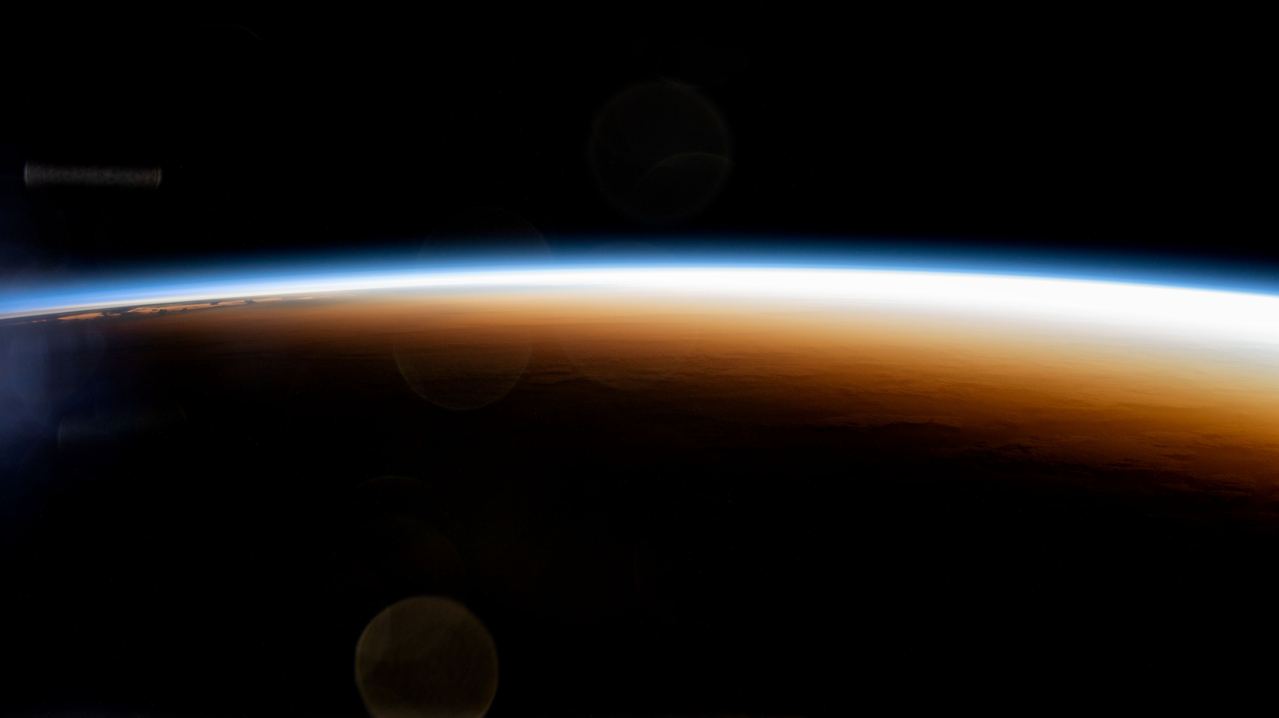
Astronauts on the International Space Station see about sixteen sunrises and sixteen sunsets every day. From up there, the line between night and day is a soft edge sweeping endlessly round the planet. Down here we just call it evening.
It is so regular we stop seeing it. But inside you, right now, there is a clock that knows roughly what time it is, even in a windowless room. It is built from genes, proteins and a cluster of cells behind your eyes. The Qur'an says the alternation of night and day is a sign “for people of understanding”. It may be the most overlooked sign of all.
“In the creation of the heavens and the earth, and the alternation of the night and the day, there are signs for people of understanding: those who remember God standing, sitting and lying on their sides, and reflect on the creation of the heavens and the earth: “Lo! In the creation of the heavens and the earth and (in) the difference of night and day are tokens (of His Sovereignty) for men of understanding, Such as remember Allah, standing, sitting, and reclining, and consider the creation of the heavens and the earth, (and say): Our Lord! Thou createdst not this in vain. Glory be to Thee! Preserve us from the doom of Fire.”
Qur'an 3:190-191 · Pickthall (1930)
These verses are near the end of the chapter Āl ʿImrān, The Family of ʿImrān. A report in Sahih al-Bukhari (4569) tells how the young Ibn ʿAbbās, the Prophet's cousin, stayed overnight in the Prophet's house. He saw him wake in the night, look up at the sky and recite these verses. Elsewhere the Qur'an asks its listeners to imagine the alternative: what if God made the night last for ever, or the day? Who could bring you light, or night to rest in (28:71-72)?
What science shows
Night and day come from the Earth spinning on its axis, once every 24 hours relative to the Sun. The line between them, which astronomers call the terminator, moves across the equator at about 1,670 kilometres an hour. From the International Space Station, which circles the Earth about every 90 minutes, astronauts cross it about 32 times a day.
The day has not always been 24 hours long. Records of ancient eclipses, studied by Richard Stephenson and colleagues in 2016, show the length of the day increasing by about 1.8 thousandths of a second per century. The Moon's tides act like a gentle brake. Go back far enough and the effect is large. In 1963 the geologist John Wells counted daily growth lines on fossil corals about 380 million years old. He found around 400 days in a year, meaning each day lasted only about 22 hours.
Living things keep time with the planet. In 2017 the Nobel Prize in Physiology or Medicine went to Jeffrey Hall, Michael Rosbash and Michael Young. They discovered how genes and proteins inside cells make a circadian clock, from the Latin for “about a day”, that runs on a roughly 24-hour cycle. In humans, a master clock in a tiny region of the brain called the suprachiasmatic nucleus, made of about 20,000 neurons, keeps the body's many clocks in step.
Light resets that clock every day. Special light-sensing cells in the eye, separate from the ones we use to see, report brightness to the master clock. That is why morning daylight helps you wake and why screens late at night can push your body clock later.
So the alternation of night and day is written into rocks, corals and every cell of your body. You are, in a quite literal sense, built to the rhythm the Qur'an calls a sign.
What each faith says
Judaism
“Surely the LORD'S mercies are not consumed, Surely His compassions fail not. They are new every morning; Great is Thy faithfulness.”
Lamentations 3:22-23 · JPS 1917
Genesis tells creation in days that run from evening to morning: “And there was evening and there was morning, one day.” So the Jewish day begins at sunset, and Shabbat begins on Friday as the light fades, with candles lit just before. The Psalms describe the same rhythm. The beasts of the forest come out at night, and in the morning “Man goeth forth unto his work And to his labour until the evening” (Psalm 104:23).
Jewish evening prayer, Maariv, opens with a blessing for God “who brings on evenings”, who rolls light away before darkness and darkness before light (our rendering). Morning prayer blesses the One who forms light and creates darkness (in words taken from the prophet Isaiah, 45:7). And Lamentations, written after catastrophe, still finds hope in the dawn: God's mercies “are new every morning”.
Christianity
“Because of the tender mercy of our God, by which the dawn from on high will visit us, to shine on those who sit in darkness and the shadow of death; to guide our feet into the way of peace.”
Luke 1:78-79 · WEB
Christians inherited the Jewish rhythm of morning and evening prayer. For centuries monks and nuns have prayed at fixed hours from before dawn to nightfall. Catholic communities still pray this Liturgy of the Hours, and many Anglican churches and cathedrals hold Morning Prayer and Choral Evensong. The Gospels say Jesus rose “early in the morning, while it was still dark” to pray alone (Mark 1:35).
Each morning, many Christians say the Benedictus, the song of Zechariah from Luke's Gospel. It celebrates “the dawn from on high” that will shine on those who sit in darkness. For Christians that dawn is Christ, and every sunrise can be a reminder of it.
Islam
“Such as remember Allah, standing, sitting, and reclining, and consider the creation of the heavens and the earth, (and say): Our Lord! Thou createdst not this in vain. Glory be to Thee! Preserve us from the doom of Fire.”
Qur'an 3:191 · Pickthall (1930)
For Muslims the five daily prayers are fixed by the movement of night and day. Fajr, “dawn”, comes before sunrise; Ẓuhr, “midday”, just after noon; ʿAṣr, “afternoon”, later in the day; Maghrib, “sunset”, as the Sun goes down; and ʿIshāʾ, “night”, once darkness has fallen. A Muslim's whole day is framed by the turning of the Earth. The Qur'an often swears by the times of day: by the dawn (89:1), by the morning brightness and the night when it is still (93:1-2), by time itself (103:1).
The verse ends with the words of the people who reflect: “You did not create all this without purpose.” That is why this sign links to the Name al-Ḥakīm, the All-Wise. The rhythm of night and day is not just mechanics; for the believer it is a daily reminder that creation is ordered with wisdom and meant for something.
Same and different
Each faith builds its prayer around the turning of night and day: Jewish morning and evening prayer, Christian Morning Prayer and Evensong, Muslim prayer times set by the Sun. All three see the dawn as a sign of mercy and hope. They mark the day's start differently. Jews begin the day at sunset, and so does the Islamic calendar. Most Christian calendars start it at midnight. Yet the church keeps the older pattern in its worship: a great feast begins with evening prayer the night before, and many Catholics keep Sunday at a Saturday evening Mass. Islam is the one that ties its prayer times to the Sun's exact position, so they move a little every day. Each fills the hours with its own words and its own scripture.
A moment to reflect
- Are you a morning person or a night person? What do you notice at your favourite time of day?
- What would you miss most if there were only day, or only night?
- When did you last watch a sunrise or a sunset from beginning to end?
- Lamentations finds hope in the morning even after disaster. What helps you start again?
Watch
NASA footage from orbit, crossing from night to day and back again.
ESA's short animation of night and day sweeping the Earth.
TED-Ed explains the body clock and the 2017 Nobel discovery.
Do it together
Pick a weekend in winter, when sunrise is late and sunset early. Meet once to watch the sunrise and again for the sunset, at the same spot. Read Psalm 104:19-23 in the morning and Qur'an 3:190-191 in the evening.
Draw a 24-hour clock face and mark sunrise and sunset for today, then the times of Jewish, Christian and Muslim daily prayers. Talk about why each tradition chose those moments.
For a week, everyone gets outside in daylight within an hour of waking and puts screens away an hour before bed. Keep a simple diary of how sleepy and alert you feel.
Many Jewish children learn Modeh Ani, a one-line prayer said on waking, which thanks God for giving back the soul each morning. Learn it from a Jewish friend or a children's prayer book, and talk about what your own first words of the day usually are.
Go to Choral Evensong at a cathedral or college chapel as the light fades. It is free, lasts about 45 minutes, and anyone may simply sit and listen to the choir sing the end of the day.
Go deeper
- Qur'an 3:190-194 with translations · scripture
- Nobel Prize 2017: circadian rhythm press release · article
- Stephenson et al. 2016, Earth's rotation 720 BC to AD 2015 · paper
- Psalm 104 (JPS 1917) on Sefaria · scripture
- Luke 1 (WEB) on Bible Gateway · scripture
In pictures
Try this · KS1 · 10 min · Science
Globe and torch
You need: a ball or globe, a sticker or a dot of play dough, a torch, a dark room
- Put the sticker on the ball where Britain would be.
- Shine the torch at the ball. The torch is the Sun.
- Turn the ball slowly. When is the sticker in daylight? When is it in the night?
- Turn it once all the way round: that is one day.
The most ordinary sign of all: the dark comes every evening and goes every morning, and we can see why.
Sources (5)
- ISS orbits about every 90 minutes; about 16 sunrises and sunsets a day: NASA, Space Station facts and figures
- Length of day increasing about 1.8 ms per century: Stephenson, Morrison & Hohenkerk, Proceedings of the Royal Society A, 2016
- Devonian corals record about 400 days a year: Wells, Nature, 1963
- 2017 Nobel Prize for molecular mechanisms of the circadian clock: Nobel Prize press release, 2017
- Suprachiasmatic nucleus has about 20,000 neurons; light-sensing retinal cells set the clock: National Institute of General Medical Sciences, Circadian rhythms fact sheet