Get up an hour before sunrise near the end of a lunar month and look east. Low over the rooftops, if the sky is clear, you may see the last sliver of the moon. It is thin, pale and curved, a fingernail of light that will be gone in a day or two. In the Arabia of the seventh century, people knew exactly what it looked like. It looked like the stalk of a bunch of dates that has been left to dry, thin, yellow and bent.
A few evenings later, people across the world go out at sunset and look west, searching the glow for the first new crescent. If they see it, a new month begins. Fasts start and end on it. Festivals wait for it. The moon is the oldest calendar there is.
“And for the moon We have appointed mansions till she return like an old shrivelled palm-leaf.”
Qur'an 36:39 · Pickthall (1930); 2:189 · in brief
Surah Yā Sīn, named after its two opening letters, is a chapter many Muslims read for the dying and on Thursday nights. It lists signs in the sky: night peeled from day, the sun running to its resting place, and the moon passing through its stations (36:37-40). The image of the ʿurjūn, the dried date-stalk, comes from the first listeners' own palm groves. Surah al-Baqara (2:189) answers a question people put to the Prophet about why the moon waxes and wanes: the answer is not astronomy but purpose. The new moons are for counting time.
What science shows
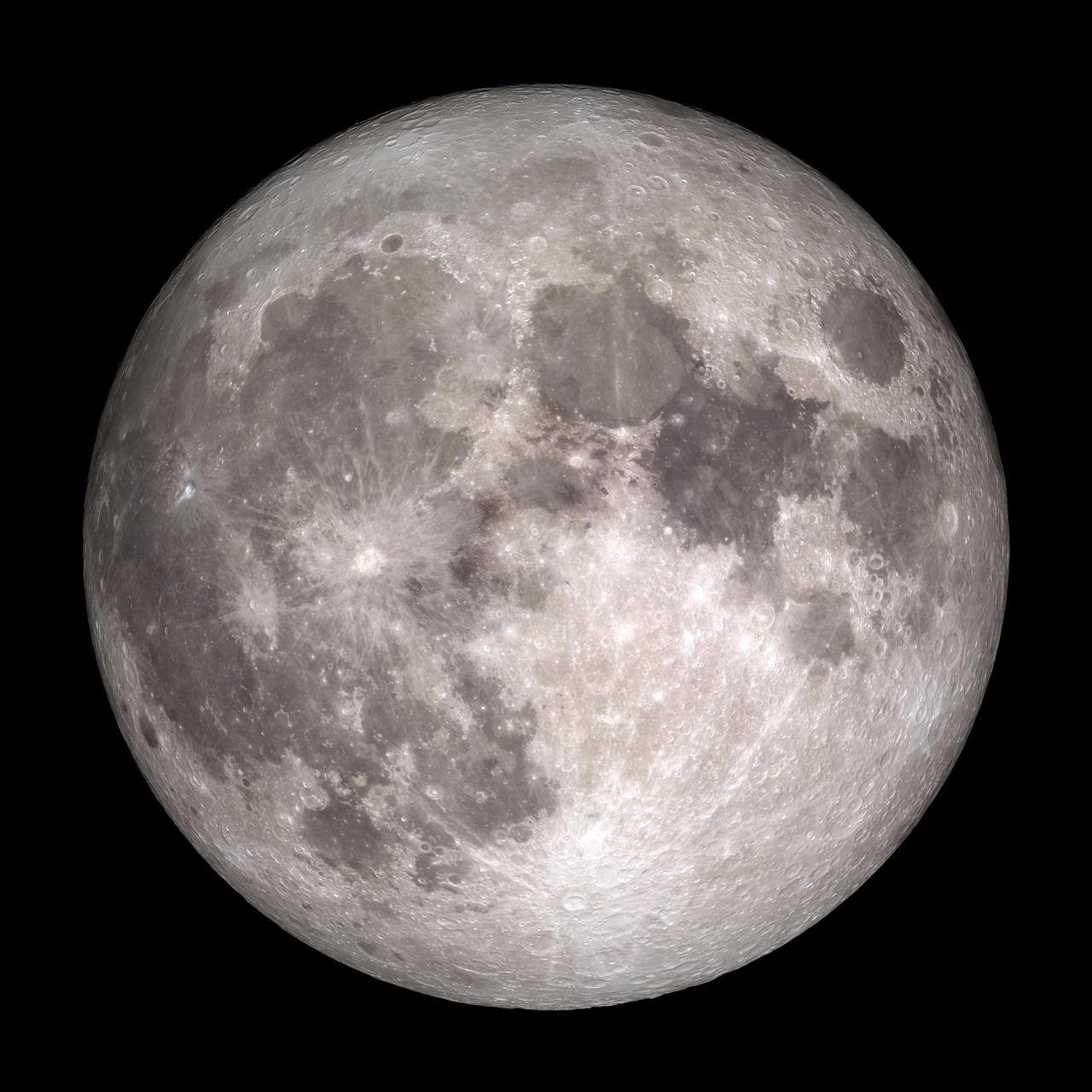
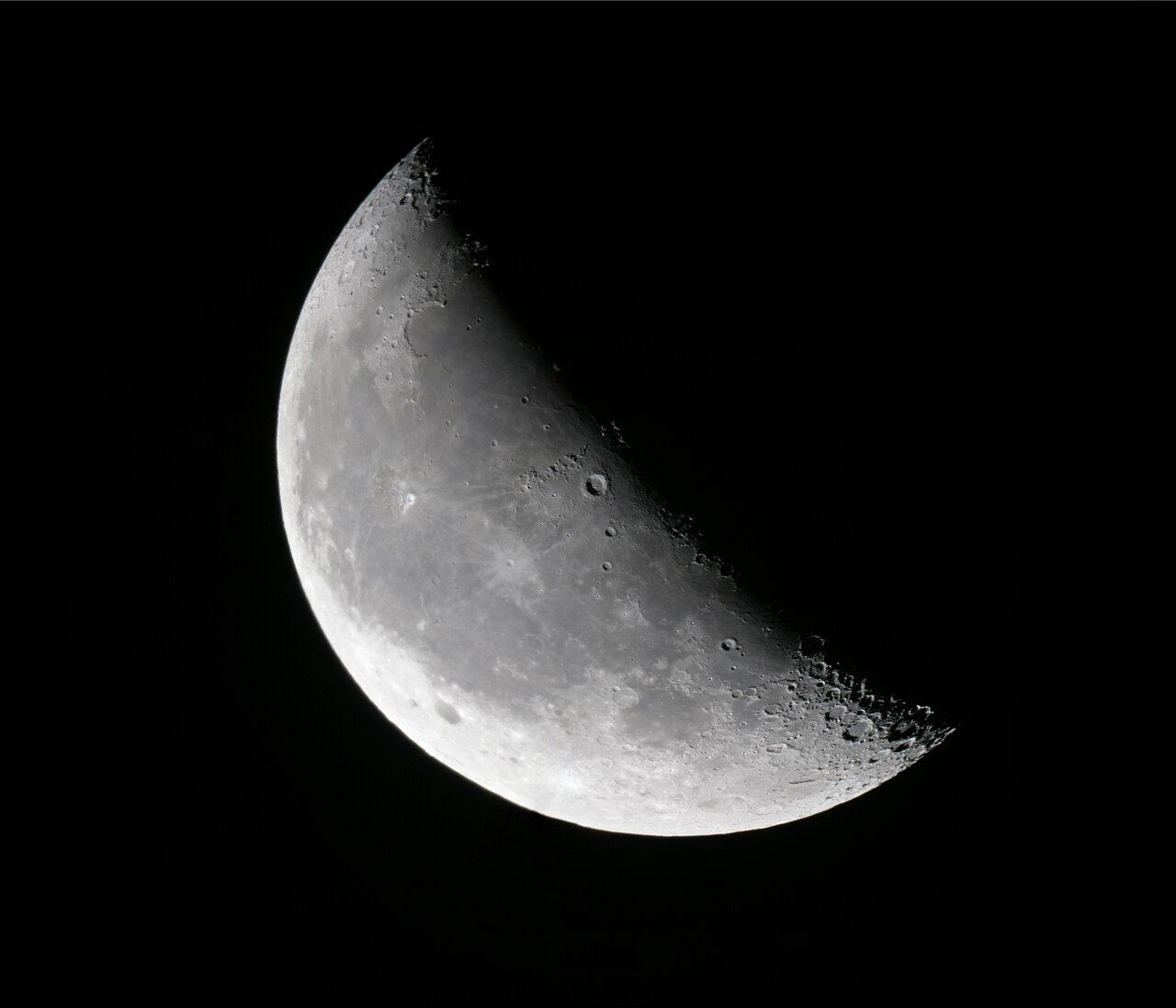
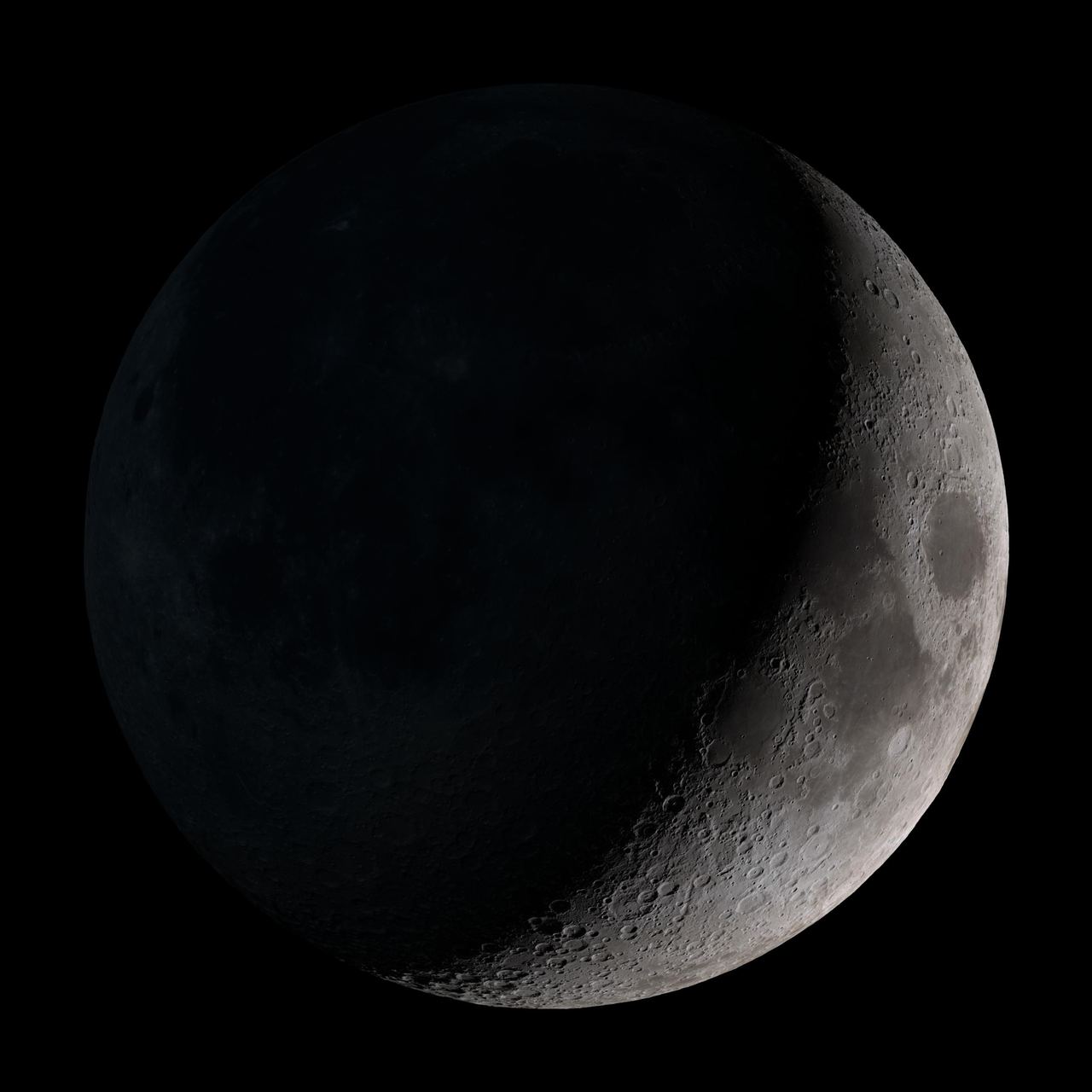
The Moon does not make its own light. Half of it is always lit by the Sun, and as it travels round the Earth we see different amounts of that sunlit half. When it lies between us and the Sun we see its dark side, the new moon. A few days later a thin crescent appears in the evening sky. Then come the half moon, the full moon opposite the Sun, and back down to the last thin crescent before dawn.
One trip round the Earth takes about 27 days. But because the Earth is also moving round the Sun, the cycle of phases from one new moon to the next takes about 29 and a half days, as NASA explains. Twelve of those make about 354 days, roughly 11 days shorter than the solar year of 365. That is why Ramadan arrives about 11 days earlier each year and moves through all the seasons in about 33 years.
The Moon is tidally locked to the Earth: it turns once on its axis for every orbit, so we always see the same face. Nobody saw the far side until a Soviet spacecraft photographed it in 1959. Lasers fired at reflectors left by Apollo astronauts show that the Moon is also slowly drifting away, at about 3.8 centimetres a year, roughly the speed your fingernails grow.
Look closely at a thin crescent and you may see the rest of the Moon glowing faintly, 'the old moon in the new moon's arms'. That is earthshine: sunlight reflected off the Earth onto the Moon and back again. Leonardo da Vinci was one of the first to explain it correctly, around 1510.
The Moon has organised human time for as long as there have been humans. The Islamic calendar is purely lunar. The Jewish calendar is lunar too, but adds an extra month in seven years out of every nineteen to keep Passover in spring. And the Christian date for Easter is set by the first full moon on or after 21 March. Three calendars, one moon, measured out in stations.
What each faith says
Judaism
“Who appointedst the moon for seasons; the sun knoweth his going down.”
Psalm 104:19 · JPS 1917
The Torah says the lights in the sky are 'for signs, and for seasons, and for days and years' (Genesis 1:14). The Psalm says God 'appointedst the moon for seasons'. The very first commandment given to Israel as a people, in Exodus 12, is about the calendar: 'This month shall be unto you the beginning of months.' The new month, Rosh Chodesh, “head of the month”, is a minor festival to this day. Tradition gives it a special place for women. They are said to have refused to hand over their jewellery for the golden calf (Pirkei de-Rabbi Eliezer 45). Many communities hold Rosh Chodesh women's groups for study and song.
In the time of the Mishnah, the new month was declared in Jerusalem when witnesses came to the court to say they had seen the new crescent. The judges questioned them carefully about its shape and position (Mishnah Rosh Hashanah 2). Today the calendar is calculated in advance. But once a month many Jews still go outside after nightfall to say a blessing over the moon, Kiddush Levanah, “sanctifying the moon”, praising the One who renews the months.
Christianity
“Every good gift and every perfect gift is from above, coming down from the Father of lights, with whom can be no variation, nor turning shadow.”
James 1:17 · WEB
Christianity inherited its holiest date from the Jewish moon. Jesus died and, Christians believe, rose again at the time of Passover, which falls at the full moon of the spring month. So the early Church tied Easter to the moon as well. After long debate, the rule settled on the first Sunday after the first full moon on or after 21 March. Working out that date in advance, called the computus, drove centuries of astronomy and even the reform of the calendar in 1582. Eastern and Western churches still often celebrate on different days because they use different calendars.
Christian writers also used the moon's changes as a picture of human life, waxing and waning, and set against it the God who does not change. The Letter of James calls God 'the Father of lights, with whom can be no variation, nor turning shadow'. The moon borrows its light and keeps changing; its Maker does neither.
Islam
“He it is Who appointed the sun a splendour and the moon a light, and measured for her stages, that ye might know the number of the years, and the reckoning. Allah created not (all) that save in truth. He detaileth the revelations for people who have knowledge.”
Qur'an 10:5 · Pickthall (1930)
The Islamic calendar is the moon's calendar. Each month begins with the sighting of the new crescent, the hilāl, and the most important months are watched for with real care. Muhammad ﷺ (peace be upon him) said: 'Fast when you see it, and end the fast when you see it; and if it is hidden from you by cloud, complete thirty days of Shaʿbān' (Bukhari 1909). Shaʿbān is the month before Ramadan. On the eve of Ramadan and of Eid, British Muslims still go out to hills and rooftops to look. They still debate whether to follow local sighting, sighting elsewhere, or calculation.
The Qur'an treats this as a gift of order. Because the lunar year moves through the solar seasons, the fast falls in long summer days and short winter ones across a lifetime, for Muslims everywhere on Earth in turn. And Surah Yūnus, “Jonah”, makes the counting itself a sign: the moon's stations are there 'so that you may know the number of years and the reckoning'.
Same and different
Jews, Christians and Muslims all count holy time by the moon, and all three see the moon as appointed by God for marking seasons. Judaism keeps a lunar calendar with leap months so that festivals stay in their seasons. Christianity ties Easter to the spring full moon but keeps a solar calendar for most of its year. Islam keeps a purely lunar year, so its holy months travel round all the seasons. Two communities once declared the new month from eyewitnesses of the crescent; one still does.
A moment to reflect
- When did you last notice what phase the moon was in?
- What changes when a community waits to see something together rather than looking it up?
- Which time of year would be hardest for you to give something up? Which would be easiest?
- The moon has no light of its own. What light do you reflect, and where does it come from?
Watch
Animations and time-lapse showing exactly why the Moon has phases.
NASA demonstrates the Moon's phases with a lamp and a ball.
Two minutes on tidal locking: why we only ever see one side.
A short guide to how the Jewish calendar balances moon and sun.
How churches work out the date of Easter from the full moon.
Do it together
For one lunar month, draw the moon's shape each evening (or morning) and the time you saw it. At the end you will have your own picture of the moon's 'stations'.
On the evening after a new moon, gather on a hill or open space with a clear western view at sunset. Try to be the first to spot the crescent, and share what the new month means in each tradition.
Put a Hijri, a Hebrew and a church calendar side by side for this year. Find Ramadan, Passover and Easter, and trace each back to the moon.
Many Jewish women meet at Rosh Chodesh, the new moon, to study, sing and share food. Borrow the idea. Meet friends or neighbours at each new moon for three months, share one thing that is new in your life, and look for the crescent on the way home.
Go deeper
- Qur'an 36:37-40 with translations · scripture
- Psalm 104 (JPS 1917) on Sefaria · scripture
- Mishnah Rosh Hashanah 2 on Sefaria · scripture
- NASA: Moon facts · article
- NASA: Measuring the Moon's distance with lasers · article
In pictures
Try this · KS2 · 15 min · Science
Moon phases in your hand
You need: a ball (a satsuma or tennis ball) stuck on a pencil, a lamp with the shade off, a dark room
- Put the lamp at one side of the room. It is the Sun.
- Hold the ball at arm's length, a little above your head. Your head is the Earth.
- Turn slowly on the spot, watching the ball.
- See it go from a thin crescent to half, to full, and back.
Safety: Don't touch the hot bulb.
The Moon makes no light of its own, yet three faiths keep their holy days by its changing face.
Check yourself
Three quick questions. No score, nothing saved.
1. How long does one cycle of the Moon's phases take?
2. Twelve lunar months make about 354 days. What does that mean for Ramadan?
3. Where does the Moon's light come from?
Sources (5)
- The Earth and Moon are tidally locked; we see one side; far side first seen in 1959; phase cycle about 29 days: NASA Science, Moon facts
- The Moon is receding from Earth at about 3.8 cm per year: NASA Goddard, Measuring the Moon's distance (Apollo laser ranging)
- Twelve lunar months ≈ 354 days, about 11 days shorter than the solar year: Our calculation from mean lengths, 2026
- Hebrew calendar adds leap months in 7 of every 19 years (Metonic cycle): Hebrew calendar, Wikipedia
- Easter is the first Sunday after the Paschal full moon on or after 21 March: Computus, Wikipedia