Read the first five verses of Surah al-ʿĀdiyāt, “The Chargers”, aloud in Arabic and you can hear horses. The lines are short and hard, the sounds pant and clatter. In English you get the pictures. Horses run so hard you can hear their breath, and hooves strike sparks off the stones in the dark. Then comes a dawn raid, a cloud of dust, a plunge into the middle of the enemy.
Then the charge stops dead, and the chapter turns round and looks at you. 'Truly the human being is ungrateful to his Lord.' Why open with horses? Because a horse that gives everything for its rider is the sharpest possible contrast with a person who gives so little back.
“By the snorting courses, Striking sparks of fire And scouring to the raid at dawn, Then, therewith, with their trail of dust, Cleaving, as one, the centre (of the foe)”
Qur'an 100:1-5 · Pickthall (1930)
Surah al-ʿĀdiyāt (The Chargers) is one of the short Meccan chapters, eleven verses in all. The first five are an oath by the war-horses, a common Arabic way of saying 'look at this and take it seriously'. Verse 6 gives the point: the human being is ungrateful to his Lord, and verse 8 adds that he is fierce in his love of wealth. The words are vivid: ḍabḥ is the hard panting of running horses, and qadḥ is the striking of fire, which classical commentators read as hooves throwing sparks off flint.
What science shows
Where did our horses come from? For a long time no one knew. In 2021 a team led by Pablo Librado and Ludovic Orlando published 273 ancient horse genomes in the journal Nature. They traced modern domestic horses to the western Eurasian steppes, especially the lower Volga-Don region of what is now southern Russia. They showed that this one lineage spread rapidly across Asia and Europe from about 4,000 years ago, replacing almost all other horse populations.
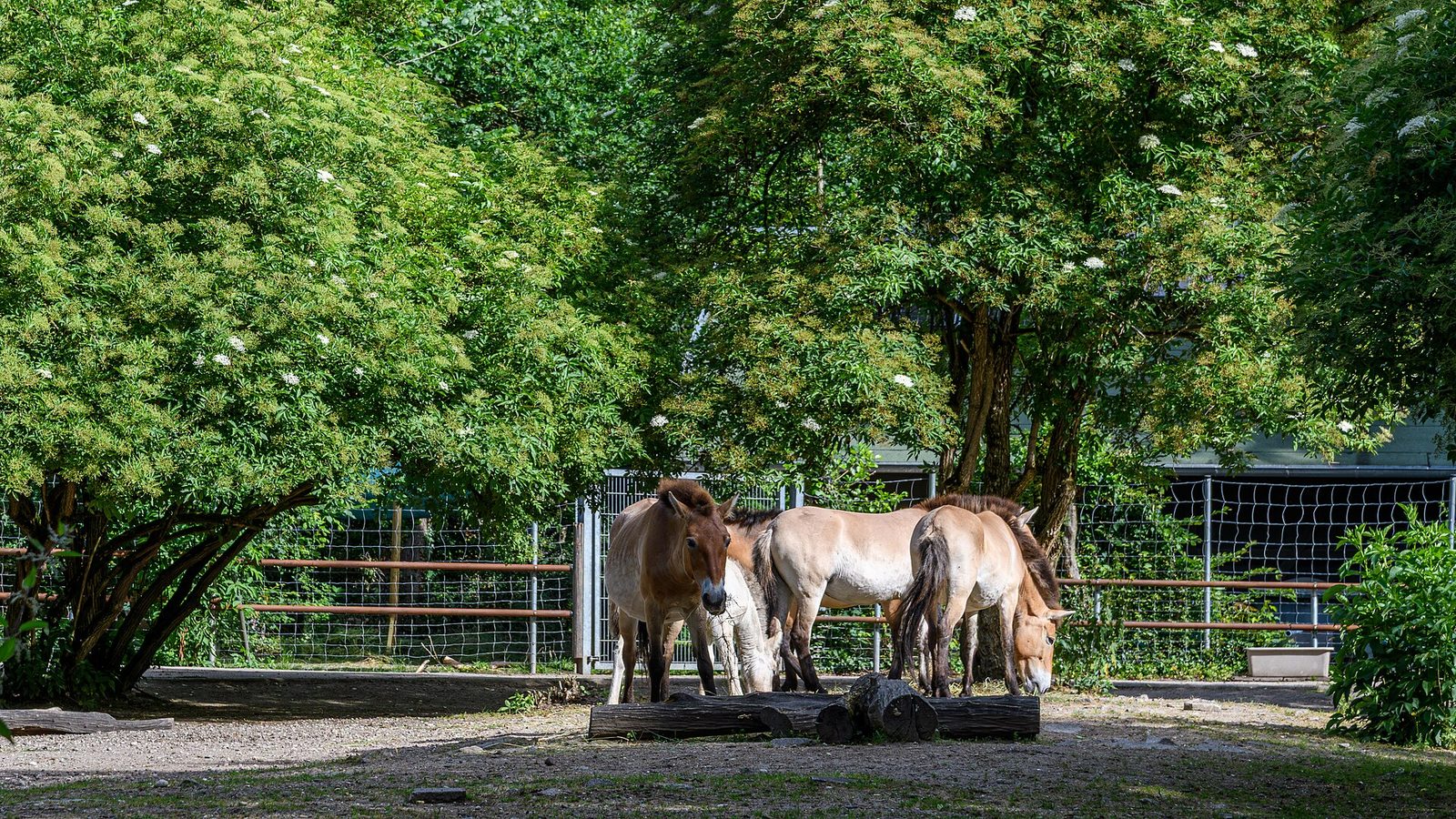
An earlier study in Science (Gaunitz and colleagues, 2018) had a surprise. The horses kept at Botai in Kazakhstan around 5,500 years ago, the earliest known with signs of bridling and milking, are not the ancestors of today's riding horses. Instead they are the ancestors of Przewalski's horses, the stocky Mongolian horses long thought to be the last truly wild ones. So even the 'wild' horse turns out to have a tame past.
The panting in the verse is real physiology. In 1983 Dennis Bramble and David Carrier reported in Science that running mammals lock their breathing to their stride. A galloping horse takes one breath for each stride. As the front legs hit the ground, the gut swings forward like a piston and pushes air out of the lungs; as the body rises, it breathes in. Every hoofbeat is a breath. You can hear it.
Horses are built for this. They are prey animals that survive by running. They have long legs, a huge heart and lungs, and eyes set on the sides of the head that see almost all the way round. That is why they have been prized for thousands of years for carrying riders over distance at speed. Their courage is not fearlessness; a horse is an anxious animal that trusts its rider enough to run where it would never go alone.
As for the sparks: an unshod hoof is mostly keratin and does not spark on its own. But hooves that kick flint and other hard stones together at night can, and iron horseshoes on stone throw sparks that riders and farriers know well. Commentators of the first centuries read the verse that way. The science adds weight to the picture without needing to prove anything: an animal giving every breath it has, at full stretch, for someone else.
What each faith says
Judaism
“Hast thou given the horse his strength? Hast thou clothed his neck with fierceness? … He paweth in the valley, and rejoiceth in his strength; he goeth out to meet the clash of arms. He mocketh at fear, and is not affrighted.”
Job 39:19-22 · JPS 1917
The Hebrew Bible's great horse poem comes near the end of the book named after Job. God answers him out of the whirlwind with a series of questions about the wild world that Job did not make and cannot control. One of them is the war-horse: its strength, its snorting, its pawing in the valley, the way it 'mocketh at fear' and 'swalloweth the ground'. The point is wonder and humility: who gave the horse this?
Elsewhere the Hebrew Bible is wary of trusting in horses. 'A horse is a vain thing for safety,' says Psalm 33. Proverbs adds that 'the horse is prepared against the day of battle; but victory is of the LORD.' Psalm 147 says God 'delighteth not in the strength of the horse' but in those who wait for His mercy. Jewish teaching holds both together: admire the horse, but do not put your trust in it. Jewish law also protects the animal: the Talmud teaches that you must feed your animals before you sit down to eat yourself (Berakhot 40a).
Christianity
“Indeed, we put bits into the horses' mouths so that they may obey us, and we guide their whole body.”
James 3:3 · WEB
Christians read Job and the Psalms as their own scripture too, as a call to wonder at creation and to trust God rather than strength. The New Testament itself has fewer horses. The Letter of James uses the bit in a horse's mouth as a picture of how a small thing, the tongue, steers a whole life. Learn to guide your words and you can guide everything else.
The Book of Revelation uses horses as symbols in its visions, most famously the four horses of the Apocalypse and the white horse whose rider is called 'Faithful and True'. Christian readers have usually taken these as images of judgement and of Christ's final victory, not as pictures to be drawn literally. One of the best-loved saints of Catholic Europe was a horseman, Martin of Tours. He was a Roman cavalry officer who, the story goes, cut his cloak in half at a city gate to share it with a freezing beggar. His feast, Martinmas, falls on 11 November.
Islam
“Lo! man is an ingrate unto his Lord And lo! he is a witness unto that; And lo! in the love of wealth he is violent.”
Qur'an 100:6-8 · Pickthall (1930)
The Qur'an speaks of horses several times. Surah al-Naḥl, “The Bee”, lists horses, mules and donkeys as gifts 'for you to ride, and as adornment'. Then it adds a striking line: 'And horses and mules and asses (hath He created) that ye may ride them, and for ornament. And He createth that which ye know not.' (16:8, Pickthall). Many modern readers hear this as an open door to every vehicle humans have since invented. Surah Āl ʿImrān, “The Family of ʿImrān”, names 'branded horses' among the things people love and desire in this life (3:14).
Muhammad ﷺ (peace be upon him) loved horses and urged people to care for them well. 'Goodness is tied to the forelocks of horses until the Day of Resurrection,' he said (Bukhari 2850). But in Surah al-ʿĀdiyāt the horse is a mirror. It gives its breath and its strength for its rider. The human being, who has been given far more, is 'ungrateful to his Lord', and 'he himself is witness to that'. The chapter ends by reminding the reader that one day what is hidden in hearts will be brought out.
Same and different
Job 39 and Surah al-ʿĀdiyāt are two of the great war-horse poems of world literature, and both use the horse's strength to humble the human listener. Jewish and Christian scripture add a warning not to trust in horses for safety. Islam is the one that swears an oath by the horses, and uses their loyalty to expose human ingratitude. Judaism is the one that writes care for the animal into daily law: feed it before yourself. Christianity reads the horses of Revelation as symbols of Christ's victory, a meaning the other two traditions do not share.
A moment to reflect
- What do you give everything for, the way a horse gives everything for its rider?
- What is one thing you were given this week that you have not yet said thank you for?
- Is it possible to admire strength and still refuse to trust in it?
- Who in your life has carried you further than you could have gone alone?
Watch
Galloping horses in super slow motion: watch the breath and stride lock together.
How the Przewalski's horse came back from the brink, and what 'wild' really means.
Planet Earth II follows mustangs across the Nevada desert.
For older students: Ludovic Orlando on the genomic history of the domestic horse.
Do it together
Visit a riding school, city farm or Riding for the Disabled group. Ask the staff how a horse shows trust, and listen to a horse breathing after a canter.
Read Job 39:19-25 and Qur'an 100:1-11 aloud, one after the other, ideally with someone reading the Arabic for its sound. Talk about what each poem wants its listener to feel.
Ask pupils to jog on the spot and count their steps per breath, then sprint and count again. Compare with the horse's one breath per stride and discuss why four legs make a difference.
Around Martinmas, 11 November, remember the soldier on horseback who shared his cloak. Collect warm coats together for a local shelter or refugee project, and tell Martin's story as you sort them.
Go deeper
- Qur'an 100 with translations · scripture
- Job 39 (JPS 1917) on Sefaria · scripture
- James 3 (WEB) on Bible Gateway · scripture
- Librado et al. 2021, the origins and spread of domestic horses · paper
- Sahih al-Bukhari 2850 on Sunnah.com · scripture
In pictures
Try this · KS2 · 15 min · Science
Breath and pace
You need: a stopwatch or phone, a notebook
- Sit still for a minute, then count your breaths in 30 seconds. Double it.
- Run on the spot or do star jumps for one minute.
- Count your breaths for 30 seconds again. Double it.
- How much faster were you breathing? Your heart sped up too.
- Read the page: the chargers come 'panting'. What is your body doing to keep going?
Safety: Stop if you feel dizzy. Only exercise as hard as is comfortable.
Breath, hooves, sparks and dust: the chapter opens with a charge, then turns to ask whether we are grateful.
Sources (4)
- Modern domestic horses originated in the western Eurasian steppes (lower Volga-Don); 273 ancient genomes; the lineage replaced almost all others: Librado et al., Nature, 2021
- Botai horses (c. 3500 BC) are ancestors of Przewalski's horses, not modern domestic horses: Gaunitz et al., Science, 2018
- Running quadrupeds lock breathing to stride at 1:1 in trot and gallop, including horses: Bramble & Carrier, Science, 1983
- Meanings of ḍabḥ (panting) and qadḥ (striking fire); khayl occurrences: Lane, Arabic-English Lexicon; al-Rāghib, Mufradāt