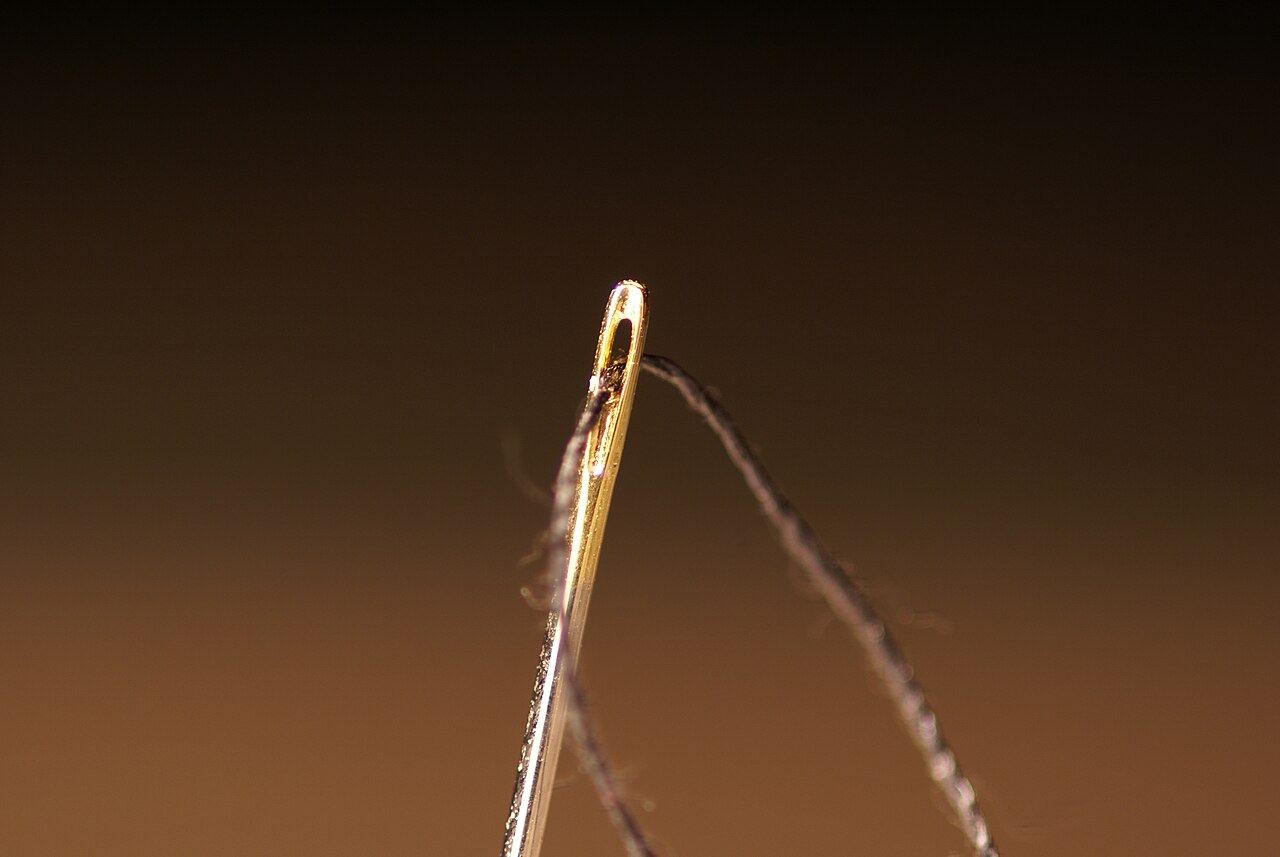
Thread a needle. Now imagine trying to get a camel through the hole instead. That is half a tonne of animal, two metres tall at the shoulder, nudged towards a slot narrower than a grain of rice.
It is meant to be absurd. That is why it sticks. Jesus (peace be upon him) used this picture about riches, and the Qur'an uses it about arrogance. Two scriptures, six centuries apart, reach for the same joke-that-isn't-a-joke. And in both, scholars have argued for centuries about whether the word might really mean a rope.
“Lo! they who deny Our revelations and scorn them, for them the gates of heaven will nor be opened not will they enter the Garden until the camel goeth through the needle's eye. Thus do We requite the guilty.”
Qur'an 7:40 · Pickthall (1930)
The verse comes in the chapter al-Aʿrāf, The Heights, in a passage about the end of life and judgement. Its subject is arrogance: people who see signs and turn away because they think they know better. The Arabic for camel is jamal; a reading attributed to the early scholar Ibn ʿAbbās vocalises the same letters as jummal, a thick ship's rope. Either way, the meaning is the same: as things stand, it cannot happen.
What science shows
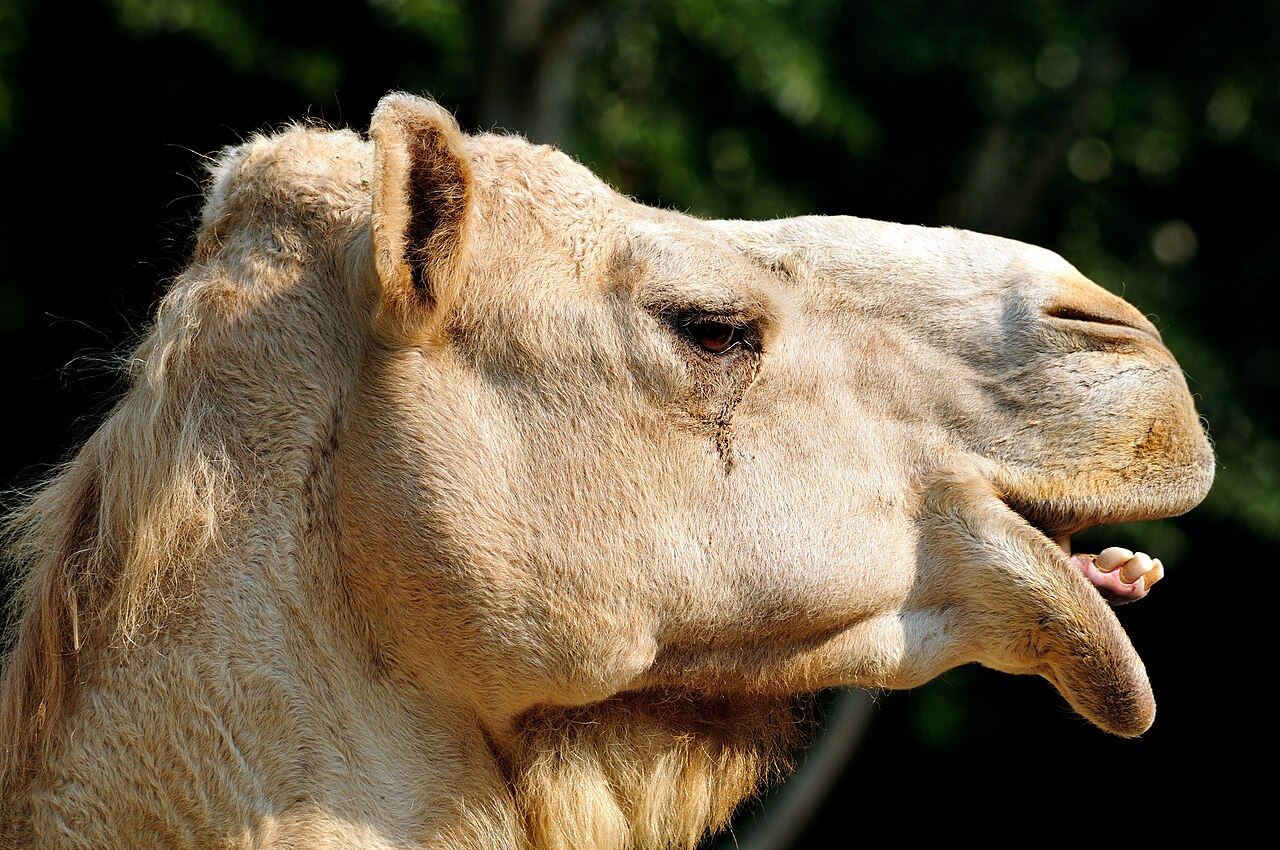
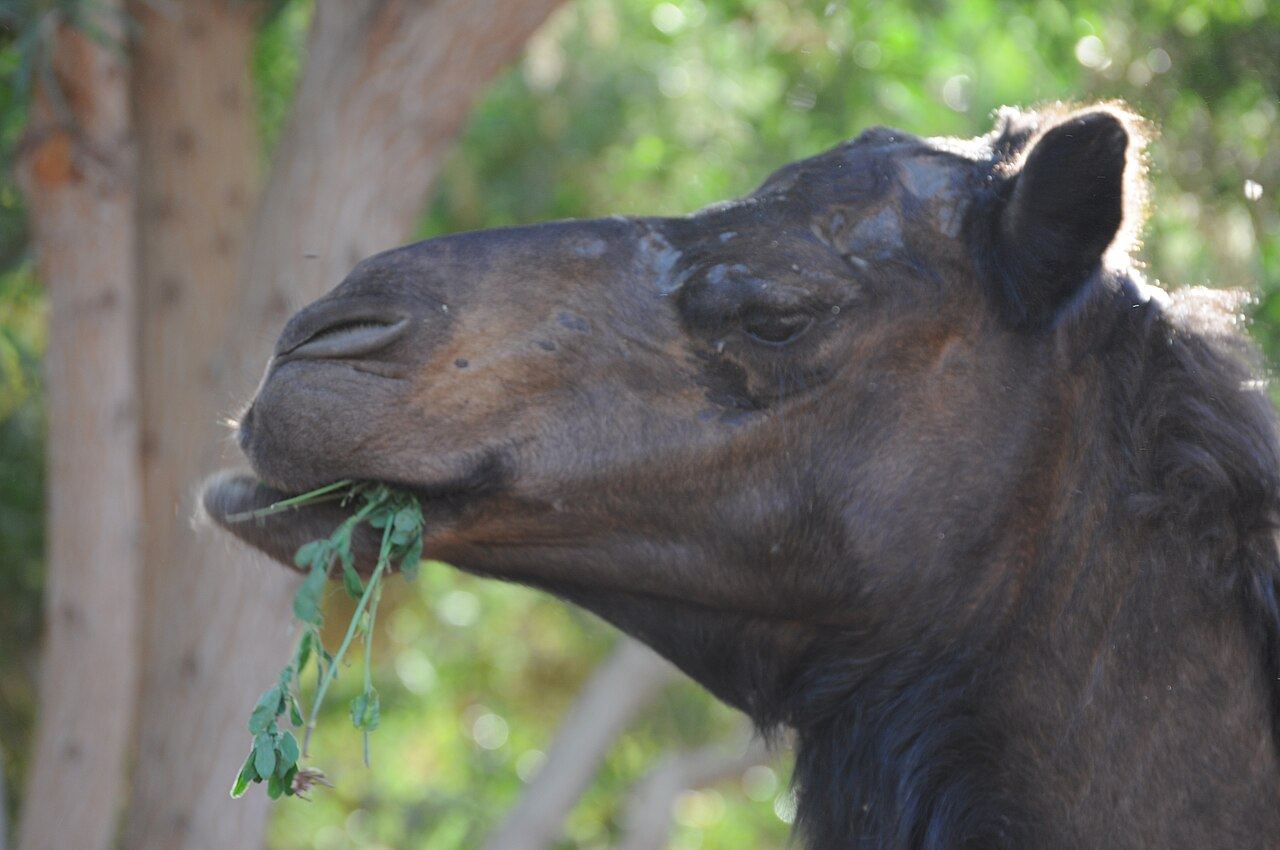
Start with the sizes. A dromedary, the one-humped camel of Arabia, stands around 1.8 to 2 metres at the shoulder and usually weighs 400 to 600 kilograms. The eye of an ordinary sewing needle is about a millimetre wide. The camel is roughly five hundred times wider than the hole, and in cross-section hundreds of thousands of times larger.
Proverbs like this are called adynata, from a Greek word for “impossibilities”. Many languages have them: “when pigs fly”, “a cold day in hell”. The Babylonian Talmud has its own version with an elephant. Linguists note that such sayings work precisely because they are physically impossible, so the listener has to stop and ask what the speaker really means.
Then there is the manuscript puzzle. In Greek, the word for camel is kamēlos, and a word for a ship's cable is kamilos. By the time of the New Testament, the two sounded almost alike. In the fifth century, Cyril of Alexandria suggested that Jesus meant a rope, and a handful of later Greek manuscripts actually read kamilos. Most textual scholars today think “camel” is original and the rope is a later attempt to soften the saying.
Another popular explanation says there was a small gate in Jerusalem called the Eye of the Needle, which a camel could squeeze through only after being unloaded. It is a good sermon illustration, but historians have found no evidence that such a gate existed. The idea seems to appear first in medieval writers, around a thousand years after the Gospels were written.
The Qur'an has the same kind of debate in Arabic: jamal, camel, or jummal, rope. In both scriptures, the scholarly argument has never changed the meaning. Whether camel or cable, it does not fit through the eye of a needle.
What each faith says
Judaism
“For when he dieth he shall carry nothing away; His wealth shall not descend after him.”
Psalm 49:18 · JPS 1917
The Hebrew Bible has no camel and needle, but the Babylonian Talmud has a near cousin. It says that people are never shown in dreams things they have never thought about, such as “an elephant passing through the eye of a needle” (Berakhot 55b). Elsewhere, a rabbi teases a clever arguer: perhaps you come from Pumbedita, a famous Babylonian centre of learning (Bava Metzia 38b). There, the joke goes, they pass an elephant through the eye of a needle. In other words, your logic is too clever by half.
On wealth itself, the Psalms are blunt: when the rich die they carry nothing away, and their glory does not go down after them. Jewish teaching does not condemn wealth, and tzedakah, giving justly to those in need, is one of its great duties. What it warns against is trusting in wealth rather than in God. Maimonides, the great twelfth-century teacher, set out eight levels of tzedakah. The highest is helping someone stand on their own feet, with a gift, a loan or work (Mishneh Torah, Gifts to the Poor 10:7).
Christianity
“It is easier for a camel to go through a needle's eye, than for a rich man to enter into God's Kingdom.”
Matthew 19:24 · WEB
In Matthew, Mark and Luke, a rich young man asks Jesus what he must do to have eternal life. He goes away sad when told to give his wealth to the poor. Jesus then says the famous line. The disciples are astonished: “Who then can be saved?” His answer is the key: “With men this is impossible, but with God all things are possible.”
Christian teachers have long read the saying as a warning about trusting in riches, as Mark's Gospel puts it, rather than a ban on having them. The point is not that a camel might squeeze through if it tried harder. It is that salvation is God's gift, not something any of us can manage on our own. Some heard the story as a call all the same. Around the year 270, a young Egyptian called Antony heard Jesus' words to the rich man read in church, gave away his land and went into the desert. Catholic and Orthodox monks and nuns who take a vow of poverty still follow his path.
Islam
“Lo! they who deny Our revelations and scorn them, for them the gates of heaven will nor be opened not will they enter the Garden until the camel goeth through the needle's eye. Thus do We requite the guilty.”
Qur'an 7:40 · Pickthall (1930)
In the Qur'an the same picture is aimed not at wealth but at arrogance, kibr: turning away from God's signs because you think you are above them. The Prophet Muhammad ﷺ (peace be upon him) said that no one will enter Paradise who has even a mustard seed's weight of arrogance in their heart. Asked whether it was arrogance to like fine clothes and shoes, he said God is beautiful and loves beauty. Arrogance, he said, is rejecting the truth and looking down on people (Muslim 91).
Muslims link this verse to the Name al-Kabīr, the Great. Only God is truly great; a human who claims greatness for themselves is trying to be what they are not, as absurd as a camel at a needle. Humility, in this reading, is not low self-esteem; it is simply seeing things the right size.
Same and different
Christianity and Islam share the very same proverb, and both traditions have the same scholarly debate about a rope. Judaism has its own elephant version, used for clever impossibility rather than salvation. They aim the picture differently: the Gospels at trust in riches, the Qur'an at the arrogance that turns away from signs. And Christianity's answer, that what is impossible for people is possible for God, finds an echo in the Qur'an's insistence that guidance and mercy belong to God alone.
A moment to reflect
- Why might an absurd picture be more memorable than a plain warning?
- Is it easier to trust in money, or in being clever? Which is harder to notice in yourself?
- What is the difference between confidence and arrogance?
- Have you ever been told something was impossible that turned out not to be?
Watch
The Natural History Museum on how camels survive in deserts.
A light-hearted BBC look at travelling with camels in the Arabian desert.
Our Planet's free episode on deserts and grasslands.
Do it together
Collect “impossible” proverbs from every language in the room, from “when pigs fly” onwards. Put the camel and the elephant sayings among them and talk about why people use impossibility to make a point.
Mark out a camel's shoulder height (2 metres) on a wall and draw a needle's eye (1 mm) beside it. Work out how many needle eyes would fit across the camel.
Read Matthew 19:23-26, Qur'an 7:40 with the hadith on arrogance, and Psalm 49:17-18. Ask each person: what is one practical way our community could share what it has?
Many Jewish homes keep a tzedakah box and drop coins in before lighting the Sabbath candles on a Friday. Make one together from a tin or a jar, agree where the money will go, and open it at the end of a month.
Each May, churches across Britain and Ireland hold Christian Aid Week, with door-to-door envelopes, quizzes and sponsored walks. Find a local event and join in, or ask a church what it is raising money for this year.
Go deeper
- Qur'an 7:40 with translations · scripture
- Matthew 19 (WEB) on Bible Gateway · scripture
- Talmud Berakhot 55b on Sefaria · scripture
- Sahih Muslim 91 on arrogance · scripture
- Eye of a needle (overview with sources) · article
In pictures
Try this · KS2 · 15 min · Maths
How many needle eyes make a camel?
You need: a large blunt tapestry needle, a ruler with millimetres, a calculator
- Measure the eye of the needle in millimetres (about 1 to 3 mm).
- A camel stands about 2 metres tall. How many millimetres is that?
- Divide the camel's height by the width of the eye.
- Now try threading a thick rope or string through the eye. What happens?
Safety: Use a blunt tapestry needle; younger children work with an adult.
Jesus and the Qur'an both chose an impossible picture so that we would remember the point.
Sources (4)
- Dromedary height and weight: Encyclopaedia Britannica, Dromedary
- Cyril of Alexandria's kamilos (rope) reading; the 'gate' reading dates from the 9th-11th century with no evidence for such a gate: Wikipedia, Eye of a needle (citing Simonetti, Ancient Christian Commentary on Scripture, and others)
- Talmud's elephant through the eye of a needle: Babylonian Talmud, Berakhot 55b; Bava Metzia 38b
- Jummal reading attributed to Ibn Abbas: al-Tabari, Tafsir on 7:40 (via quran.com tafsir and R21 index)