One word, many voices
Allah around
the world
The word travels: in Arabic prayer everywhere, and into languages and faiths you might not expect.
The Word · Allah around the world
Next: Who else says “Allah” besides Muslims? →On the map
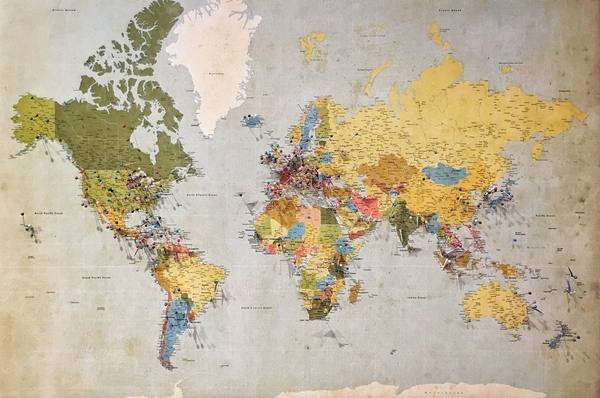
Tap a light to read who says it, and how.
Map: Natural Earth via world-atlas (public domain data). Each light opens its story below.
- Cairo, Egypt “Allah (Arabic); Noute (Coptic)” · Coptic Orthodox Christians
Egypt's Copts, one of the oldest churches in the world, pray in Coptic and Arabic. In Arabic hymns and Bibles, God is Allah. Source ↗
- Old Cairo (Fustat), Egypt “Allah, in Hebrew letters” · Jewish scholars writing Judeo-Arabic
The Cairo Geniza, a storeroom of the Ben Ezra Synagogue, kept Jewish letters and books for centuries, many in Judeo-Arabic: Arabic written in Hebrew letters. Maimonides wrote in Judeo-Arabic in Egypt. Source ↗
- St Catherine's Monastery, Sinai, Egypt “Allah” · Orthodox monks and Arabic-speaking Christians
The monastery library holds Sinai Arabic Codex 151, Paul's letters in Arabic, dated 867. Inside its walls stands a small mosque from 1106, still preserved. Source ↗
- Beirut, Lebanon “Allah” · Arabic-speaking Christians
The Smith–Van Dyck Arabic Bible was completed and printed here in 1865. It is still the Bible most Arabic-speaking Protestants read. Its first verse: 'In the beginning Allah created the heavens and the earth.' Source ↗
- Balamand Monastery, Lebanon “Allah” · Antiochian Orthodox Christians
At the Monastery of Our Lady of Balamand, the ancient hymn 'Holy God, Holy Mighty, Holy Immortal' is sung in Greek and in Arabic. Source ↗
- Madaba, Jordan “Allah” · Arab Christian families
Christian families resettled Madaba in the 1880s and found Byzantine church mosaics, including the famous sixth-century map of the Holy Land. Its churches pray in Arabic. Source ↗
- Bethlehem, Palestine “Allah” · Arab Christians
Arab Christian families have worshipped at the Church of the Nativity for centuries. In their Arabic Bibles, prayers and Christmas carols, God is Allah. Source ↗
- Zabad, Syria “al-ilāh” · Arab Christians of the sixth century
In 512, a century before Islam, Christians carved a dedication over a shrine door in Greek, Syriac and Arabic. The Arabic line asks God, al-ilāh, to remember them. Source ↗
- Maaloula, Syria “Allah in Arabic; Aramaic at home” · Aramaic-speaking Christians
One of three villages where Western Neo-Aramaic, a sister language of Arabic and Hebrew, is still spoken. Its people pray in Arabic and Aramaic. Source ↗
- Mor Gabriel Monastery, Tur Abdin, Turkey “Alaha” · Syriac Orthodox Christians
Founded in 397, one of the oldest working monasteries in the world. Its monks pray in Syriac, where God is Alaha, a close cousin of the Arabic word Allah. Source ↗
- Alqosh, Iraq “Alaha (Syriac); Allah (Arabic)” · Chaldean and Assyrian Christians
Christians in northern Iraq pray in Syriac, where God is Alaha, and speak Arabic, where God is Allah. Both words grow from the same old Semitic root. Source ↗
- Baghdad, Iraq “Allah” · Arabic-speaking Jews
Rabbi Saadia Gaon (882–942) led the Jewish academy here and translated the Torah into Arabic. His translation calls God Allah. Source ↗
- Sana'a, Yemen “Allah, in Hebrew letters” · Yemenite Jews
Yemenite Jewish Bibles set Saadia Gaon's Judeo-Arabic translation beside the Hebrew and Aramaic, verse by verse. A trilingual Bible from Yemen dated 1838 survives in Manchester. Source ↗
- Makkah, Saudi Arabia “Allah” · Muslims
Muslims everywhere face the Ka'ba here to pray. The Qur'an, revealed in Arabic, calls God Allah and links the house to Abraham. Source ↗
- Valletta, Malta “Alla” · Maltese Catholics
Maltese grew from Arabic. Catholic Malta prays to Alla, which comes from the Arabic Allah. Maltese is the only Semitic language that is an official language of the European Union. Source ↗
- Palermo, Italy “Allah” · Arabic-speaking Christians of Norman Sicily
In twelfth-century Sicily, Christians copied the Psalms in Greek, Latin and Arabic side by side. The Harley Trilingual Psalter is now in the British Library. Source ↗
- Córdoba, Spain “Allah” · Mozarabs: Arabic-speaking Christians of al-Andalus
Christians of Muslim Spain read scripture in Arabic. Tradition credits Isaac Velázquez of Córdoba with an Arabic translation of the Gospels, probably in the tenth century. Source ↗
- Timbuktu, Mali “Allah” · West African Muslim scholars
Timbuktu's family libraries keep manuscripts in Arabic, and in African languages written in Arabic script, on faith, law, astronomy and medicine. Source ↗
- Kano, Nigeria “Allah” · Hausa-speaking Christians and Muslims
In Hausa, Christians and Muslims alike say Allah. The Hausa Bible renders Immanuel as 'Allah tare da mu': God with us (Matthew 1:23). Source ↗
- Zanzibar, Tanzania “Mungu; Allah” · Swahili-speaking Christians and Muslims
Swahili Bibles begin 'Hapo mwanzo Mungu aliumba mbingu na nchi'. Swahili-speaking Muslims also say Mungu, often Mwenyezi Mungu, God Almighty, alongside Allah. Source ↗
- Tehran, Iran “Khoda; Allah” · Persian-speaking Muslims and Christians
Persian has its own everyday word for God, Khoda. The Old Persian Version of the Bible opens with it, and Muslims use both Khoda and Allah. Source ↗
- Istanbul, Turkey “Allah; Tanrı” · Turkish Muslims
Turkish Muslims say Allah. Turkish also keeps the old Turkic word Tanrı, God, from before the Turks became Muslim. Source ↗
- Comrat, Moldova “Allah” · Gagauz Orthodox Christians
The Gagauz are Turkic-speaking Orthodox Christians in southern Moldova. Their language uses Allah for God. Source ↗
- Amritsar, India “Allah, beside Ram, Hari and Waheguru” · Sikhs
The Guru Granth Sahib names God in many words. A hymn of Bhagat Kabir begins 'Awal Allah nur upaya': first, Allah made the Light (Guru Granth Sahib p. 1349). Source ↗
- Sultanpur Lodhi, India “Karim, Rahim, Allah” · Sikhs
Tradition says Guru Nanak began his mission here. In a hymn in Persian he addresses God as karim, the Generous, and parvardigar, the Sustainer (Guru Granth Sahib p. 721). Source ↗
- Jakarta, Indonesia “Allah” · Indonesian Christians and Muslims
Indonesian Bibles say Allah for God: 'Pada permulaan segala sesuatu, Allah menciptakan...' Malay Gospels have used the word since Ruyl's Matthew, printed in 1629. Source ↗
- Kota Kinabalu, Sabah, Malaysia “Allah” · Malay-speaking Christians of Sabah and Sarawak
Many Christians in Malaysian Borneo pray in Malay. Their Bibles, like Indonesian ones, translate the Hebrew Elohim as Allah, as Malay Bibles have for about four centuries. Source ↗
- London (Kensington), United Kingdom “Allah (Arabic); Noute (Coptic)” · Coptic Orthodox Christians
St Mark's Coptic Orthodox Church opened here in 1975, the first Coptic Orthodox church in Europe. Services are held in English and Arabic. Source ↗
- London (British Library), United Kingdom “Allah” · Readers of every faith
The British Library holds Arabic Christian Bibles and the twelfth-century Harley Trilingual Psalter, where Arabic-speaking Christians sang the Psalms in Arabic. Source ↗
- Manchester, United Kingdom “Allah” · Arabic-speaking Christians
The Arabic Church in Manchester, a registered charity, gathers Arabic-speaking Christians in the city. In Arabic prayer and song, God is Allah. Source ↗
- Detroit, United States “Alaha; Allah” · Chaldean Catholics
Detroit has its own Chaldean Catholic diocese, the Eparchy of St Thomas the Apostle. Families from northern Iraq pray in Syriac and Arabic. Source ↗
Malta
Omm Alla
In Malta, a Catholic country, the Hail Mary says Omm Alla: Mother of God. Alla jbierek means God bless you.
West Africa
Yàlla
In Wolof, spoken in Senegal and the Gambia, God is Yàlla, from Allah. In Hausa, Muslims and Christians alike say Allah; the Hausa Bible begins “A farko-farko, Allah ya halicci sama da ƙasa”.
The Sikh scripture
38 times
The Guru Granth Sahib names God “Allah” 38 times, in hymns by Guru Nanak, Guru Arjan, Kabir and Sheikh Farid. Guru Arjan wrote: ekō alahu pārbraham, Allah and Parbrahm are One.
The Bahá'í Faith
Alláh-u-Abhá
Every day, Bahá'ís repeat Alláh-u-Abhá, “God the All-Glorious”, ninety-five times, and use it as a greeting.
Persian, Urdu and beyond
Khudā
In Persian, God is Khudā: a different word with the same meaning. It travelled into Urdu, Kurdish and the Sikh scripture. Many British Muslims with roots in Pakistan say both Allah and Khuda.
Indonesia and Malaysia
Since 1629
Indonesian Christians have read “Allah” in their Bibles since 1629. In Malaysia the word went to the highest court; in 2021 a judge struck down a 1986 ban in a case brought by a Christian from Sarawak.
The Sikh and Bahá'í lines will be read by Sikh and Bahá'í readers before going public.
Keep going
Watch and listen
Documentaries and short films on the word and its story.


Watch more: Allah around the world
7 films and talks, chosen for this page. They play here.
Jewish, Muslim and Christian Arabic: Dr Esther-Miriam Wagner
WoolfInstitute · 8 min
Woolf Institute: Dr Esther-Miriam Wagner on the Arabic of Jews, Muslims and Christians.
The Lord's Prayer | Arabic
St Luke's Kentish Town · 1 min
St Luke's Kentish Town: the Lord's Prayer said in Arabic, where God is Allah.
Can Arabic Speakers Understand Maltese?
Langfocus · 29 min
Langfocus: can Arabic speakers understand Maltese, a language that also says Alla for God?
Coptic Christianity Explained
ReligionForBreakfast · 40 min
ReligionForBreakfast: Coptic Christianity, Egypt's ancient church that prays in Arabic today.
The Origins of Arabic
Let's Talk Religion · 22 min
Let's Talk Religion: the origins of the Arabic language.
Who Is Allah? | Surah Al-Ikhlas
Cambridge Central Mosque · 1 min
Cambridge Central Mosque: Surah al-Ikhlas, "Say: He is God, the One", heard in mosques everywhere.
Podcast: Arabic Music in Middle Eastern Jewish Worship
WoolfInstitute · 15 min
- More films and talks on F-ILMWatch free