Drive along the M40 through the Chilterns and look up. You will almost certainly see a red kite: forked tail, wings held wide, hanging on the air without a single flap, tilting its tail to steer. Thirty-five years ago there were none breeding in England. Now they are part of the sky.
A bird in the air is so common we forget how strange it is. A few hundred grams of feather and bone, heavier than the air around it, simply staying up. The Qur'an asks a plain question about it: who is holding them?
“Have they not seen the birds above them spreading out their wings and closing them? Naught upholdeth them save the Beneficent. Lo! He is Seer of all things.”
Qur'an 67:19 · Pickthall (1930)
This verse is in the chapter al-Mulk, The Dominion, which many Muslims recite every night before sleep. A similar verse says: “Have they not seen the birds obedient in mid-air? None holdeth them save Allah. Lo! herein, verily, are portents for a people who believe.” (16:79, Pickthall). And another says every bird, wings outspread, “Hast thou not seen that Allah, He it is Whom all who are in the heavens and the earth praise, and the birds in their flight? Of each He knoweth verily the worship and the praise; and Allah is Aware of what they do.” (24:41, Pickthall). The Qur'an does not deny that wings work; it asks us to see the mercy in a world where wings work at all.
What science shows
A 2021 study by Corey Callaghan and colleagues estimated that there are around 50 billion wild birds on Earth, about six for every person, across some 10,000 species. Every one of them that flies is solving the same problem: how to stay up in a fluid that is far lighter than it is.
The answer is lift. A bird's wing is curved and angled so that, as air flows past, it is pushed downwards. Push air down and, as Newton's third law says, the air pushes the wing up. Flapping adds thrust to keep moving forward. Researchers at the University of Oxford have filmed birds in wind tunnels and in Wytham Woods to measure exactly how wing shape and feather movement do this.
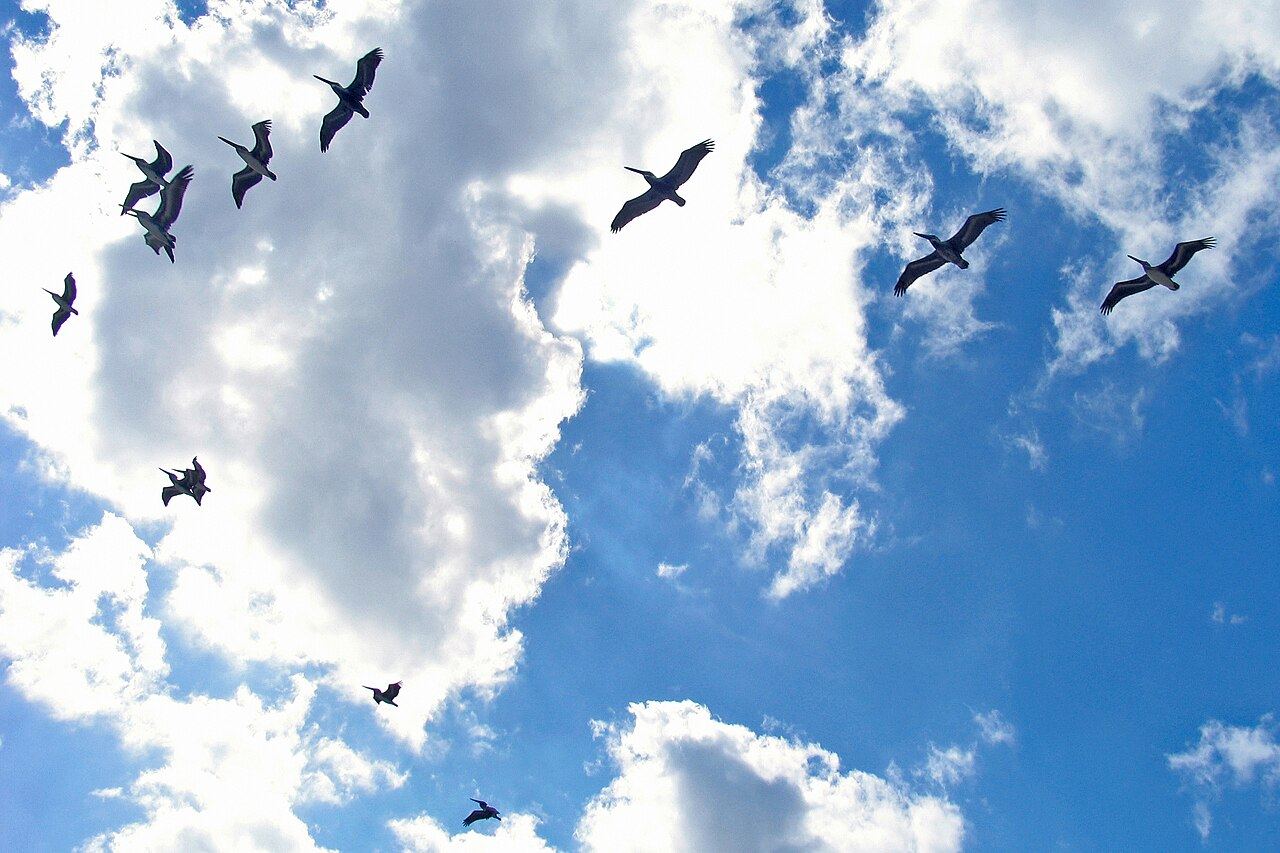
Some birds barely flap at all. Kites, buzzards, gulls and eagles use thermals, columns of air warmed by the ground, circling inside them to climb, then gliding to the next. Their wings are a balance of control and stillness: the “spreading and folding” of the verse is exactly what a soaring bird does to steer and to rest.
The distances are hard to believe. A 2010 tracking study found that some Arctic terns, weighing under 125 grams, fly more than 80,000 kilometres a year between the Arctic and Antarctic. In 2022 a young bar-tailed godwit flew 13,560 kilometres non-stop from Alaska to Tasmania, a Guinness world record. Common swifts that nest in British roofs can stay airborne for ten months.
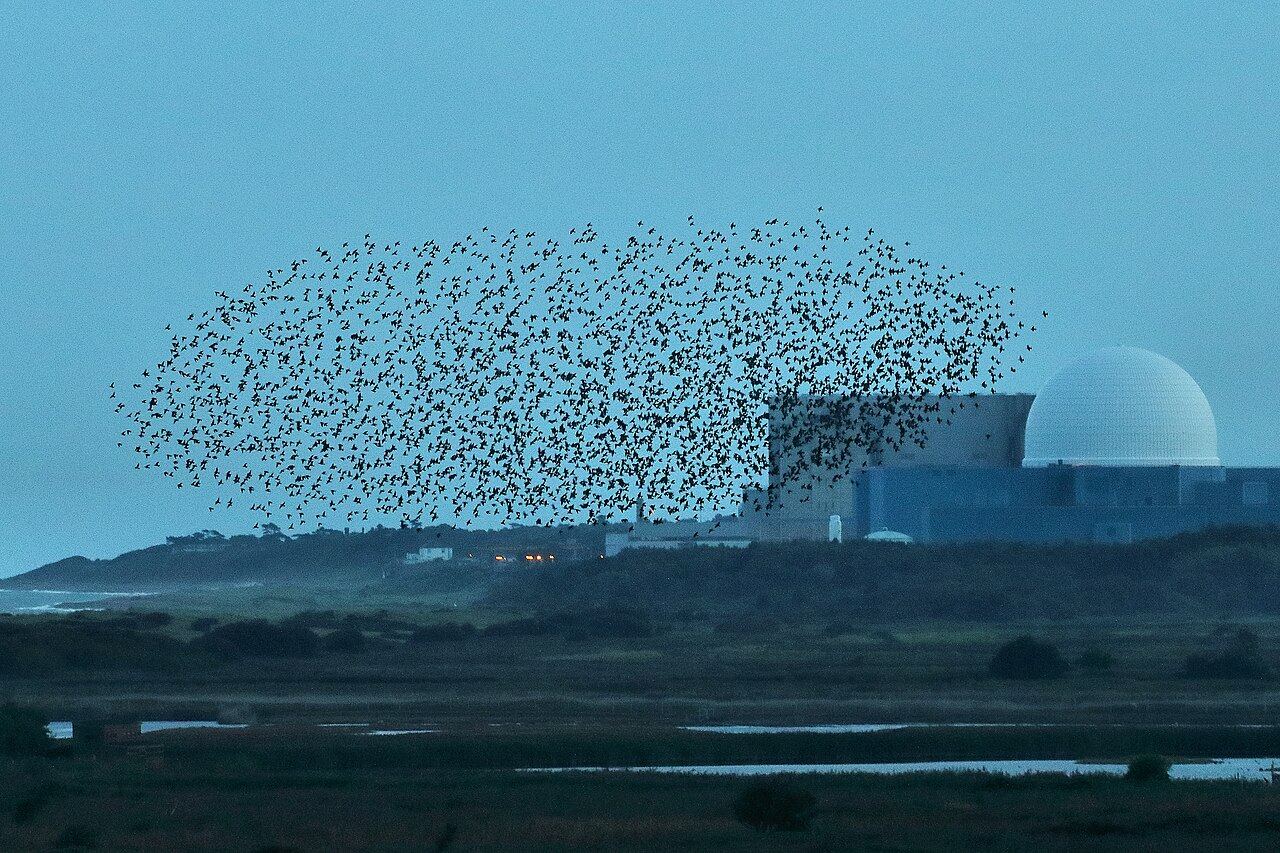
And flocks hold themselves together in the air. A 2008 study of starling murmurations in Rome found that each bird tracks about six or seven nearest neighbours, not a fixed distance. That is what lets thousands of birds move like one shape across a winter sunset.
What each faith says
Judaism
“Doth the hawk soar by thy wisdom, And stretch her wings toward the south?”
Job 39:26 · JPS 1917
In the speeches from the whirlwind, God asks Job: “Doth the hawk soar by thy wisdom, And stretch her wings toward the south?” It is a humbling question: Job did not teach the bird to fly, or where to go. Jeremiah adds that even the stork knows its appointed times, and the swallow and crane keep the time of their coming.
The Torah also commands kindness to birds. If you find a nest, you must send the mother bird away before taking the young or eggs (Deuteronomy 22:6-7). This is shiluaḥ ha-ken, “sending away the nest”, a law Jewish teachers have long linked to compassion. On Shabbat Shirah, the “Sabbath of Song” in midwinter, when synagogues read the song Moses and Miriam sang at the sea, many Jewish families put out food for the birds. And the prophet Isaiah uses the soaring eagle in a famous promise: those who wait for the LORD “shall mount up with wings as eagles”.
Christianity
“See the birds of the sky, that they don't sow, neither do they reap, nor gather into barns. Your heavenly Father feeds them. Aren't you of much more value than they?”
Matthew 6:26 · WEB
Jesus pointed to birds to teach trust: “See the birds of the sky, that they don't sow, neither do they reap, nor gather into barns. Your heavenly Father feeds them.” He also said that not one sparrow falls to the ground without the Father knowing, and that people are of more value than many sparrows.
Birds carry deep meaning in Christian worship. At the baptism of Jesus, the Gospels say the Spirit came down “like a dove”. The dove has been a Christian symbol of the Holy Spirit and of peace ever since. Saint Francis of Assisi is remembered for preaching to the birds as fellow creatures praising God. And generations of British children have sung Cecil Frances Alexander's hymn All Things Bright and Beautiful (1848), with its “each little bird that sings”.
Islam
“Have they not seen the birds above them spreading out their wings and closing them? Naught upholdeth them save the Beneficent. Lo! He is Seer of all things.”
Qur'an 67:19 · Pickthall (1930)
The Prophet Muhammad ﷺ (peace be upon him) used birds to teach trust too. If you relied on God as you should, he said, God would provide for you as He provides for the birds. They go out hungry in the morning and come back full in the evening (Tirmidhi 2344). Trust, in this picture, still means going out and looking for food.
He also taught kindness to them. Once, on a journey, his companions took two chicks from a nest and the mother bird circled overhead in distress. He asked who had upset her by taking her young, and told them to give them back (Abu Dawud 2675). The bird that is held up by the Most Merciful, ar-Raḥmān, is to be treated with mercy.
Same and different
Each faith uses birds to teach trust in God's care and kindness towards the small. Judaism has the oldest written law on it: send the mother bird away before you touch the nest. Islam is the one that asks, in so many words, who holds the bird up in the air, and answers with a Name of God, ar-Raḥmān, the Most Merciful. It also has the Prophet's order to give the chicks back to their mother. Christianity gives the dove a special place as a sign of the Holy Spirit, which reflects its belief in God as Father, Son and Holy Spirit. Judaism and Islam see the bird as a creature praising the one God in its own way.
A moment to reflect
- If you watched one bird for five minutes today, what would you notice?
- What is the difference between trusting like a bird and doing nothing?
- The verse says the birds are “held”. What holds you up when you feel like falling?
- How should knowing about the tern's journey or the swift's ten months in the air change how we treat birds?
Watch
Oxford researchers show the science of how birds fly.
Smarter Every Day compares bird wings with aeroplane wings.
National Geographic's short film of a starling murmuration.
BBC Earth on the planet's greatest animal migrations.
Do it together
Join the RSPB's Big Garden Birdwatch at the end of January: one hour, one window or park bench, counting every bird. Share your counts with a neighbour or partner school.
Between November and February, go together to a known starling roost at dusk, such as a nature reserve, pier or reed bed near you. Read Qur'an 24:41 and Psalm 104:12 as the birds settle.
Make simple seed feeders from pine cones, lard and seed, and hang them outside a school, mosque, church or synagogue. Keep a tally of visitors over a month.
In January or February, on the Friday before Shabbat Shirah, put out seed for the birds as many Jewish families do. Read the Song at the Sea (Exodus 15) aloud and listen for the birds singing back.
Read the story of St Francis preaching to the birds from The Little Flowers of St Francis, a collection of stories about him. Then sit outside in silence for five minutes and write down every bird call you hear.
Go deeper
- Qur'an 67:19 with translations · scripture
- Job 39 (JPS 1917) on Sefaria · scripture
- Egevang et al. 2010, the Arctic tern's migration · paper
- RSPB: Big Garden Birdwatch · article
- Matthew 6 (WEB) on Bible Gateway · scripture
In pictures
Try this · KS2 · 10 min · Science
Make paper lift
You need: a strip of paper about 20 cm by 4 cm
- Hold one end of the paper strip just under your bottom lip, so it droops down.
- Blow hard and steadily over the top of the strip.
- Watch the strip rise. Try blowing softer, then harder.
- Talk about it: fast air over a curved wing helps hold a bird up.
Wings spread, wings folded, and still they stay up: who holds them in the sky is the page's question.
Sources (6)
- Around 50 billion wild birds across ~10,000 species: Callaghan, Nakagawa & Cornwell, PNAS, 2021
- Arctic terns fly more than 80,000 km a year: Egevang et al., PNAS, 2010
- Bar-tailed godwit flew 13,560 km non-stop, Alaska to Tasmania, 2022: Guinness World Records, January 2023
- Common swifts airborne for 10 months: Hedenström et al., Current Biology, 2016
- Each starling interacts with 6-7 neighbours: Ballerini et al., PNAS, 2008
- Red kites reintroduced to the Chilterns from 1989: RSPB, Red kite