Closer look · 7 min · Film: Kingdom of Heaven
The King Behind the Mask
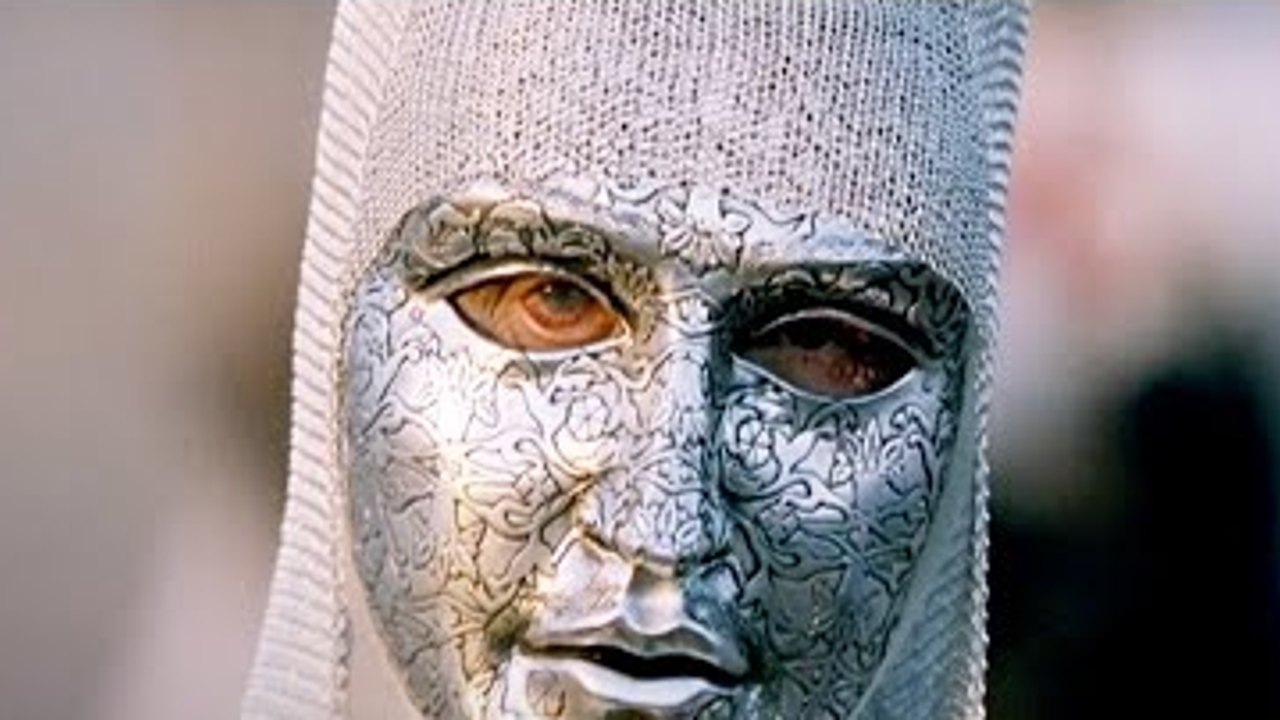
A leper king rules Jerusalem behind a silver mask. What does real kingship look like?
The idea in one minute
A leper king who beat Saladin at sixteen, a surrender that was merciful and cruel at once, and a film both faiths argued with.
Our page on The Message and Kingdom of Heaven looks at how two films told the story of faith and Jerusalem. This one goes deeper into Ridley Scott's film, and the history behind it, for anyone planning to watch it with friends.
Watch the long one
The studio had Scott cut about 45 minutes before the film's release in 2005. The director's cut, released later that year and restored in full in 2014, runs about three hours and fourteen minutes, with an overture and an interval, and critics agreed the missing scenes explain why the characters do what they do. Scott has since said he regrets the shorter version. If you are showing it, show the long one, and check which cut your streaming service has. One restored storyline is heavy: a young king's death, which is invented. Know it is coming. Both versions are rated 15.
The real leper king
The film's most memorable figure is Baldwin IV, the young King of Jerusalem behind a silver mask. He was real. His tutor, the chronicler William of Tyre, noticed as a child that he felt no pain when pinched: the first sign of leprosy. At about sixteen he defeated Saladin at the Battle of Montgisard in 1177. Three years later he agreed a truce with him. He died in 1185, in his early twenties, and was buried in the Church of the Holy Sepulchre. The mask is the film's invention. People who knew him describe a king who kept leading, not one who hid.
2 October 1187: mercy, ransom and slavery
The film ends with the surrender of Jerusalem. What happened is more complicated, and worth knowing. Balian of Ibelin, defending the city, threatened to kill thousands of Muslim prisoners and destroy the Dome of the Rock and al-Aqsa unless the people inside were spared. Saladin consulted his advisers and agreed terms: a ransom for each person, with forty days to pay. Many of the poor who could not pay were let go, against his treasurers' wishes. His brother asked for a thousand captives and freed them on the spot. Saladin later invited Jews back into the city. And about fifteen thousand people who could not be ransomed were taken into slavery. The mercy was real, and so was the enslavement. Remembering a hero honestly means holding both.
Saladin in Christian memory
Medieval Christians admired him. Dante placed him among the virtuous non-Christians in the gentlest part of the afterlife. Boccaccio wrote of him warmly. A German poet urged his own king to be as generous as Saladin. Walter Scott's novel The Talisman (1825) fixed the chivalrous Saladin in English minds. His own Muslim biographer, Ibn Shaddad, who knew him, remembered him as devout, and devoted to defending the land.
How each side received the film
The film did well in Arabic-speaking countries. The Lebanese-French novelist Amin Maalouf said it clearly stands against religious fanaticism, and an Egyptian critic saw it as an attempt to heal old wounds. Some Christian reviewers felt it treated church leaders unfairly; the real Patriarch of Jerusalem, shown in the film as a coward, in fact helped raise ransom money. Both faiths' viewers felt their side was misjudged. That may be a sign the film got something right.
Judaism
The Crusaders killed Jerusalem's Jews in 1099. After 1187, Saladin invited Jews to return, and the community of Ascalon came.
Christianity
Baldwin, a leper who led armies and made peace, fits the Christian idea of strength made perfect in weakness. And Dante's Saladin is a medieval Christian's tribute to a Muslim's virtue.
Islam
Saladin's restraint is remembered against the massacre of 1099. “The (faithful) slaves of the Beneficent are they who walk upon the earth modestly, and when the foolish ones address them answer: Peace” (Qur'an 25:63, Pickthall). Jerusalem matters to Muslims as the first direction of prayer and the place of the Night Journey.
Where the film and history part
The film's hero is a modern conscience in medieval armour, a blacksmith rather than the leading baron Balian really was. Its Saladin is closer to Walter Scott's romantic knight than to the historical sultan. And its gentle ending leaves out the people who were enslaved.
The Names in this closer look


Talk about it
- Baldwin was a teenager when he beat Saladin and a dying man when he made peace. What makes a leader strong?
- The film gives Baldwin a mask history never mentions. Why do you think it did?
- Mercy and enslavement happened on the same day. How should we remember a hero honestly?
- Dante honoured Saladin. Who outside your faith does your tradition honour?
- Viewers of both faiths said the film was unfair to their side. Can a film be fair to everyone?
- “What is Jerusalem worth? Nothing. Everything.” What place is like that for you?
Widely available to stream or buy. For history alongside it, see Saladin and the Crusades on F-ILM ▶.
Sources: Wikipedia articles on Kingdom of Heaven, Baldwin IV of Jerusalem and Saladin (with their primary references, including William of Tyre and Ibn Shaddad); SlashFilm (Devin Meenan, 2023) on Scott's regret; the Guardian's “Reel history” column, reprinted by HNN (2008); Religion News Service via Baptist News Global (2005); BBFC. Qur'an: Pickthall (1930).
Where to watch · Trailer
Kingdom of Heaven (2005) · Widely available to stream or buy · F-ILM
© 20th Century Studios (Disney)
Content note. Kingdom of Heaven: The 1187 siege of Jerusalem; Saladin shown with honour, some Crusader priests as villains. Strong battle violence (15). See Before you watch.
Trailers are the studios' own, played from YouTube. We show them and any stills for criticism and review; all rights stay with their owners.
Next closer look
A different film, a different question.

Watch more: The King Behind the Mask
6 films and talks, chosen for this page. They play here.
Medieval Historian Breaks Down 'Kingdom of Heaven' Movie | Deep Dives
History Hit · 64 min
History Buffs: Kingdom of Heaven
History Buffs · 22 min
King Baldwin IV: The Tragic Leper King Of Jerusalem
Timeline - World History Documentaries · 66 min
The Victory That Reopened Jerusalem | The Salahuddin Generation | Ep. 8 | Dr. Hassan Elwan
Yaqeen Institute · 39 min
Yaqeen: the victory that reopened Jerusalem, and Salahuddin's mercy.
How One Man Freed Jerusalem after it Was Lost for a Century | The Real Story of Saladin
Yasir Qadhi · 26 min
Dr Yasir Qadhi: the real story of Saladin.
Saladin & the 3rd Crusade | Middle Eastern History | Extra History Complete
Extra History · 48 min
- More films and talks on F-ILMWatch free