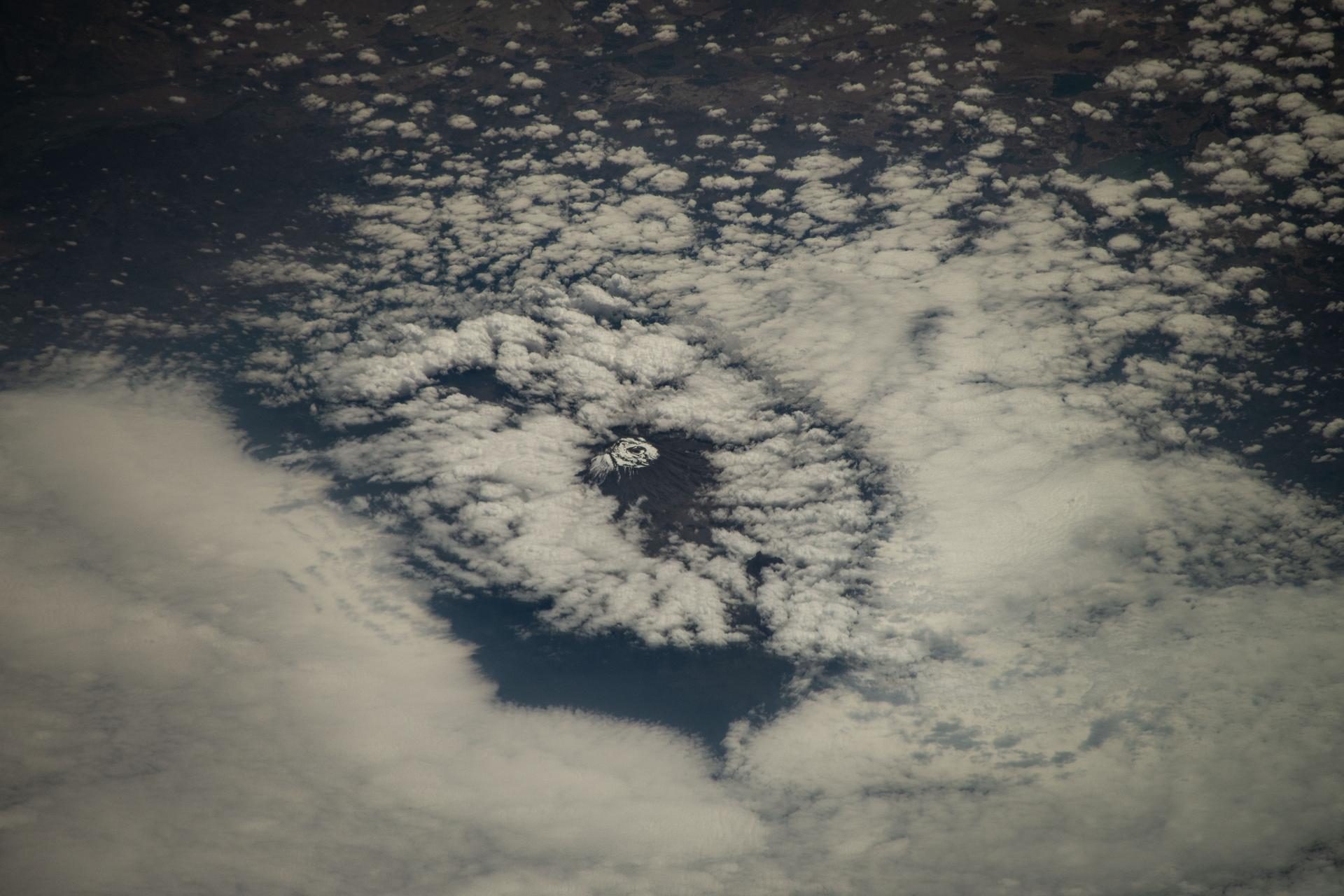
Stone fish traps curve across the Barwon River at Brewarrina, in New South Wales. The Ngemba people say the creator Baiame designed them by throwing his net over the river, and told every family to share. In Kenya, Kikuyu elders turned towards Mount Kenya to pray to Ngai, the one Creator. In Nigeria, Yoruba people speak of Olodumare, owner of all power. In the Andaman Islands, the Great Andamanese spoke of Puluga, who rules the monsoon.
In the 1890s a Scottish writer best known for fairy-tale books, Andrew Lang, noticed stories like these in reports from missionaries and travellers. The experts of his day said religion began with many spirits and only slowly climbed towards one God. Lang's evidence did not fit. The argument he started is still going on. It is easy to say too much here, so we listen first and theorise second.
“If thou shouldst ask them: Who created the heavens and the earth? they would answer: Allah. Say: Praise be to Allah! But most of them know not.”
Qur'an 31:25 · Pickthall (1930)
The Qur'an says this several times (also 29:61, 39:38, 43:87) about the people of Mecca in the Prophet Muhammad's (peace be upon him) day. They worshipped many idols, yet when asked who made the heavens and the earth they named one supreme God, Allah. The Qur'an's challenge was not to introduce a Creator but to ask why anyone else was worshipped alongside Him.
In their own words, then what researchers found
Start with the peoples themselves. At Brewarrina, in north-west New South Wales, the Ngemba people and their neighbours call the stone fish traps Baiame's Ngunnhu. Their Dreaming stories say the creator ancestor Baiame designed the traps by throwing his net over the river, and built them with his two sons. He gave each family group its own traps to use and look after. And he told them to share the fishery with neighbouring peoples, who came to fish and to join ceremonies. Many Aboriginal stories belong to their own communities, and some are not for outsiders. What is told openly speaks of a Maker who also gave a law for living together.
In Kenya, the Kikuyu writer Jomo Kenyatta described his own people's faith in Facing Mount Kenya (1938). Ngai, he wrote, is the Creator and giver of all things, and cannot be seen by human eyes. When people prayed, they faced Kĩrĩnyaga, Mount Kenya, one of Ngai's dwelling places. Ngai was not to be troubled over small things. Families and elders called on Ngai at the great moments of life, and in times of drought, often beneath a sacred fig tree, the mugumo.
In Yorubaland, in south-west Nigeria, people speak of Olodumare, also called Olorun, 'owner of the heavens'. Olodumare is the source of àṣẹ, the power that makes things happen. In Yoruba tradition, Olodumare sent the orishas, divine beings such as Obatala, to shape the world and guide people, and most daily worship goes to them. The Yoruba scholar Wande Abimbola, who served as Awise Awo Agbaye, spokesperson for Ifá worldwide, recorded Ifá's own verses in Yoruba and English. Bolaji Idowu, a Yoruba theologian and Methodist minister, wrote Olódùmarè: God in Yoruba Belief (1962), and later called the pattern a 'diffused monotheism'.
The Andaman Islands, in the Bay of Bengal, are home to some of the oldest communities in Asia: the Great Andamanese, Onge, Jarawa and Sentinelese peoples. Very little of their own telling was ever written down, and most of it was recorded by colonial officers. The Great Andamanese spoke of Puluga, also called Biliku, a powerful being of the sky and the monsoon storms, who could be angered. In some accounts Biliku is female. In the 2000s the linguist Anvita Abbi worked with the last fluent speakers of Great Andamanese, recording their songs and stories in their own language.
Then come the European scholars. Edward Tylor's Primitive Culture (1871) said religion began with 'animism', the belief that everything has a spirit. Over time, he argued, it grew through many gods towards one. Andrew Lang's The Making of Religion (1898) challenged that timeline. He collected reports of 'high gods' among hunter-gatherer peoples, Baiame and Puluga among them. These were supreme beings who made the world and cared about right and wrong. Often they were not worshipped with images or sacrifices at all.
The Austrian priest and scholar Wilhelm Schmidt (1868–1954) took Lang's idea much further. In twelve volumes, Der Ursprung der Gottesidee ('The Origin of the Idea of God', 1912–1955), he argued for Urmonotheismus, 'primordial monotheism'. On this theory, humanity's earliest religion was belief in one God, later covered over by spirits and many gods. Schmidt gathered a vast amount of evidence. But his critics, then and now, point to real problems. His method assumed a fixed series of 'culture circles' that most anthropologists no longer accept. He leaned on missionary reports, which might have read Christian ideas into what they heard. And hunter-gatherer peoples living today have long histories of their own; they are not snapshots of the first humans. The Italian historian Raffaele Pettazzoni argued that many high gods are sky gods, not one God in the biblical sense. Most scholars today do not accept Urmonotheismus as proven history. Many do accept Lang's basic point: high gods are widespread, and they are not simply a late invention.
Later writers filled in the picture. The religious historian Mircea Eliade described the deus otiosus, the 'idle' or withdrawn high god. This god made the world and then stepped back, leaving everyday religion to nearer spirits. The Kenyan theologian John Mbiti wrote in 1969 that 'all African peoples' have a notion of God as Supreme Being: Olodumare among the Yoruba, Nyame among the Akan, Ngai among the Kikuyu. The Ugandan poet and scholar Okot p'Bitek replied that Mbiti had dressed African gods in Greek and Christian clothing. He said this made them sound more like the God of the Bible than they were. Both views are still read and argued over in African universities.
Recently, scientists have tried counting. A 2014 study led by Carlos Botero, in the Proceedings of the National Academy of Sciences, used data on 583 societies. It found that belief in moralising high gods, gods who care how people behave, was more common in harsher, less predictable places, and in more politically complex societies. The psychologist Ara Norenzayan's book Big Gods (2013) argues that belief in watchful, moral gods helped large groups of strangers trust one another. A 2019 paper in Nature, using the Seshat historical database, claimed that big moralising gods appeared only after societies became complex. It was retracted in 2021, after other researchers showed problems with how missing data had been treated. Which came first is still an open question.
What can be said with care? Belief in a supreme Maker is found among many peoples, in many places. It is not simply borrowed from Judaism, Christianity or Islam. How it began, and whether it was there at the start, is a question the evidence cannot yet settle. Each faith tradition has its own answer to that. Anthropology does not need to agree or disagree with them to find the pattern remarkable.
What each faith says
Judaism
“Lift up your eyes on high, And see: who hath created these? He that bringeth out their host by number, He calleth them all by name.”
Isaiah 40:26 · JPS 1917
The Hebrew Bible uses an old title for God that scholars recognise from the wider ancient Near East: El Elyon, 'God Most High'. The non-Israelite priest Melchizedek uses it to bless Abraham as 'Maker of heaven and earth', and Abraham replies by swearing by 'the LORD, God Most High' (Genesis 14:22), joining the shared title to the personal name revealed to his family.
Jewish tradition teaches that humanity once knew one God and drifted. The Talmud and later Maimonides (Laws of Idolatry 1:1-3) describe how people in the generation of Enosh began to honour the stars as God's servants, and ended by worshipping them; Abraham, they say, rediscovered the Creator by thinking about the heavens. This is a teaching about the human heart, not an anthropological claim.
Jewish prayer keeps the whole world in view. The Aleinu, said at the end of every daily service, looks forward to the day when all the peoples of the earth will recognise the one God. It ends with the prophet's words: “In that day shall the LORD be One, and His name one” (Zechariah 14:9).
Christianity
“Yet he didn't leave himself without witness, in that he did good and gave you rains from the sky and fruitful seasons, filling our hearts with food and gladness.”
Acts 14:17 · WEB
Paul told a crowd in Lystra that God 'didn't leave himself without witness' among any people: He sent rain, harvests and gladness (Acts 14:17). Missionaries in Africa, Asia and the Pacific often found they could use local names for the high god when translating the Bible: Nyame, Ngai, Olodumare and many more appear in African Bibles today.
That practice has its own debate. Some Christians welcome it as evidence that God had prepared every people. Others worry it blurs the difference between a distant creator and the God Christians believe came close in Jesus. Wilhelm Schmidt himself was a Catholic missionary priest, and his critics asked whether faith shaped his findings. His defenders replied that the evidence he gathered remains, whatever one makes of his theory.
Islam
“And verily We have raised in every nation a messenger, (proclaiming): Serve Allah and shun false gods. Then some of them (there were) whom Allah guided, and some of them (there were) upon whom error had just hold. Do but travel in the land and see the nature of the consequence for the deniers!”
Qur'an 16:36 · Pickthall (1930)
The Qur'an teaches that every people received a messenger (16:36) and that the first human beings, Adam and his children, worshipped one God. On this view, belief in a supreme Creator is a remnant of an original fiṭra and an original revelation, overlaid in many places by other worship. Muslim readers often find Lang's and Schmidt's material striking for that reason.
Muslim scholars would add two cautions. First, the Qur'an's account is a matter of revelation, not of anthropology, and does not depend on any theory being right. Second, the Meccans' own case shows that knowing of a supreme Maker is not the same as tawḥīd, worshipping Him alone. A distant high god with nearer spirits doing the daily work is exactly the pattern the Qur'an addresses.
Without religion
Non-religious anthropologists and readers often see the same pattern as a story about people rather than about God. Big, watchful gods may help strangers trust one another, as Norenzayan argues. Or they may grow from minds quick to sense an agent behind events, as the anthropologist Pascal Boyer suggests. On that reading, a supreme Maker is one of humanity's most widespread and interesting ideas, and no less worth studying for being human.
Many humanists add a point about respect. These are other peoples' sacred stories, and for a long time outsiders told them badly, calling their tellers 'primitive'. The respectful course, they say, is the one this page tries to follow: listen first to how a people tells its own story, and keep the theories for afterwards.
Same and different
All three faiths have a story in which humanity began with knowledge of the one Creator and in which that knowledge was later obscured, and all three see the worldwide spread of high gods as consistent with that story. They differ on the remedy: the covenant with Abraham's descendants, the coming of Christ, or the final message of the Qur'an. Anthropology neither confirms nor refutes these accounts. Each tradition reads the pattern in its own light. The Ngemba, Kikuyu, Yoruba and Andamanese peoples tell it in their own way, and non-religious people read it differently again.
A moment to reflect
- When you picture whatever made the world, or picture nothing there at all, does it feel near to you or far away?
- Is it fair to translate another people's word for God as 'God'? What might be gained or lost?
- Should a researcher's own faith, or lack of it, matter when we judge their work?
- When did someone last show you that you were wrong? What did you do next?
Watch
An anthropologist's lively introduction to how the discipline studies religion.
Was animism the first religion? A religious-studies scholar looks at Tylor's theory.
Tylor's idea that dreams gave rise to religion, and what later scholars made of it.
Ara Norenzayan presents the 'Big Gods' theory in his own words (a long lecture).
Do it together
Ask people in your group whose families come from different places what word their grandparents used for God. Make a map of the names and talk about what each one means.
Visit the British Museum's Africa, Oceania and Americas galleries or the Pitt Rivers Museum in Oxford. Look for objects connected with creation stories and read the labels together, noticing who wrote them and how.
Read a short news report on the 2019 Nature paper and the Retraction Watch story on its retraction. Discuss what went wrong, who spotted it and why retraction is a strength, not a failure.
Many churches hold a harvest festival each autumn, giving thanks, in Paul's words, for “rains from the sky and fruitful seasons”. Go together, bring tins for a local food bank, and ask the people around you what they call the giver of the harvest.
Read the Aleinu, the prayer that ends every synagogue service, with its hope that all peoples will one day know one God. Then read Kenyatta on Ngai, or the Ngemba story of Baiame's fish traps. Talk about what ‘all peoples’ might mean when each tells its own story.
Go deeper
- Baiame's Ngunnhu and the First Nations of Brewarrina (Brewarrina Shire Council) · article
- The ecology of religious beliefs (ScienceDaily summary of Botero et al., PNAS 2014) · article
- Critique topples Nature paper on belief in gods (Retraction Watch, 2021) · article
- Andrew Lang, The Making of Religion (1898), full text · article
- High god (Encyclopaedia Britannica) · article
- Pitt Rivers Museum, Oxford · museum
- Is it the same God? (on this site) · article
- Genesis 14, Melchizedek and God Most High (Sefaria) · scripture
- Acts 14 (Bible Gateway, WEB) · scripture
Sources (10)
- Botero et al. 2014: 583 societies; moralising high gods more common in harsher environments and more politically complex societies: ScienceDaily / NESCent, 2014; PNAS doi:10.1073/pnas.1408701111
- 2019 Nature paper on moralising gods retracted in 2021 after critique led by Bret Beheim: Retraction Watch, 7 July 2021
- Lang's high gods, Schmidt's Urmonotheismus and their critics; Pettazzoni; deus otiosus: Encyclopaedia Britannica, 'high god'
- Norenzayan, Big Gods (Princeton University Press, 2013): Princeton University Press
- Mbiti 1969 and p'Bitek 1970 debate: Mbiti, African Religions and Philosophy (1969); p'Bitek, African Religions in Western Scholarship (1970)
- Tylor, Primitive Culture (1871) and animism: Encyclopaedia Britannica, 'animism'
- Baiame's Ngunnhu: Baiame designed the traps by throwing his net over the river, built them with his two sons, allocated traps to family groups and commanded they be shared: Brewarrina Shire Council, First Nations
- Ngai, Kĩrĩnyaga (Mount Kenya) and Kikuyu prayer: Jomo Kenyatta, Facing Mount Kenya (1938), chapter on religion
- Olodumare, the orishas, Ifá; 'diffused monotheism': E. Bolaji Idowu, Olódùmarè: God in Yoruba Belief (1962) and African Traditional Religion: A Definition (1973); Wande Abimbola, Ifá: An Exposition of Ifá Literary Corpus (1976)
- Biliku/Puluga and the monsoon among the Great Andamanese; Great Andamanese language documentation: A. R. Radcliffe-Brown, The Andaman Islanders (1922); Anvita Abbi, Dictionary of the Great Andamanese Language (2012)