1st c. BCE – 1st c. CERead time 1 min GospelQur'an
Mary was a young Jewish woman of Nazareth, according to the Gospels. Christians and Muslims both honour her as chosen by God, pure, and the virgin mother of Jesus (peace be upon him), announced by the angel Gabriel. The Qur'an names her more often than the whole New Testament does, and gives a surah her name. Catholic and Orthodox Christians call her Mother of God; other Christians, the mother of the Lord. Muslims honour her among the best of women. They agree on her purity and differ on who her son is.
Mary (peace be upon her) is not counted among the prophets in mainstream Christian or Sunni teaching; a minority of Muslim scholars, such as Ibn Hazm and al-Qurtubi, held that she received revelation. We say “honoured in both faiths” and claim no title. This page shows no people.
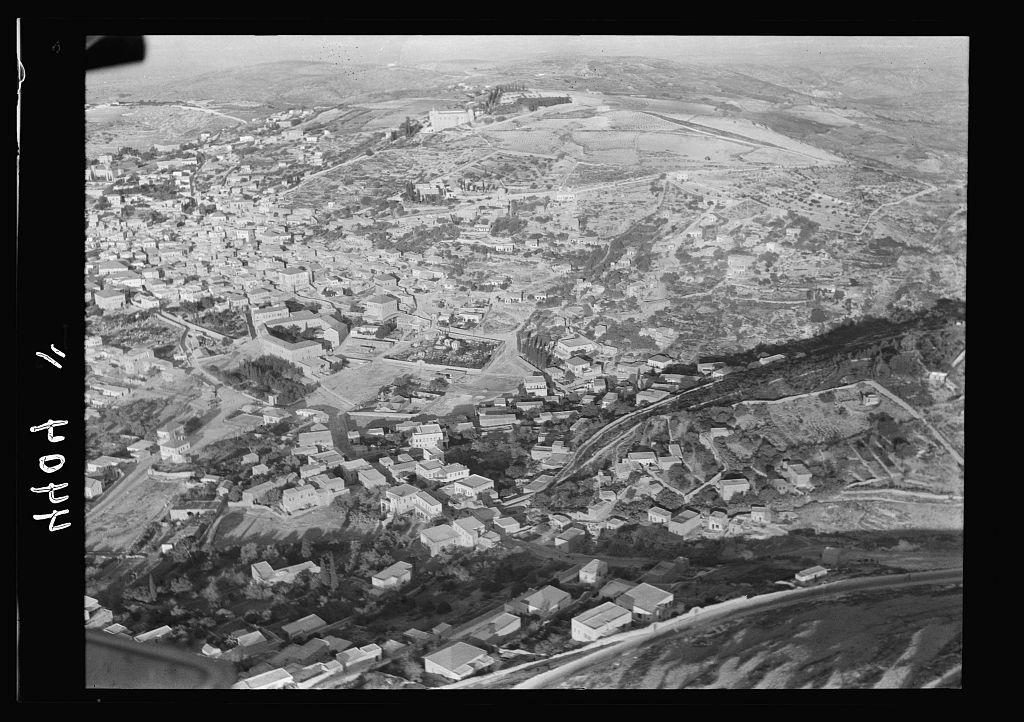
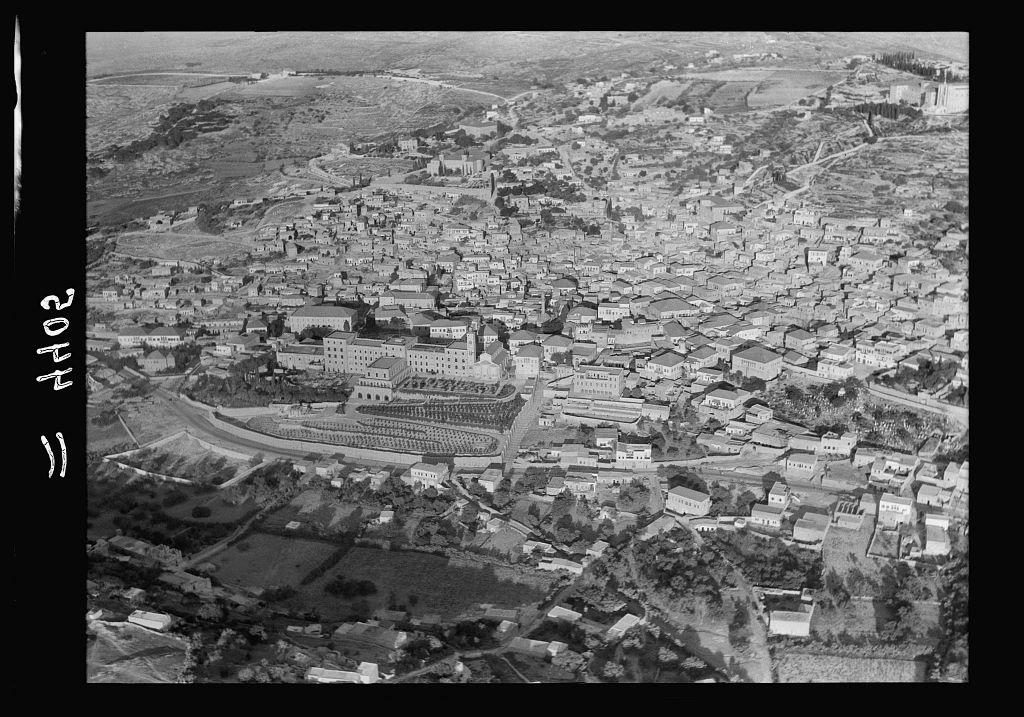
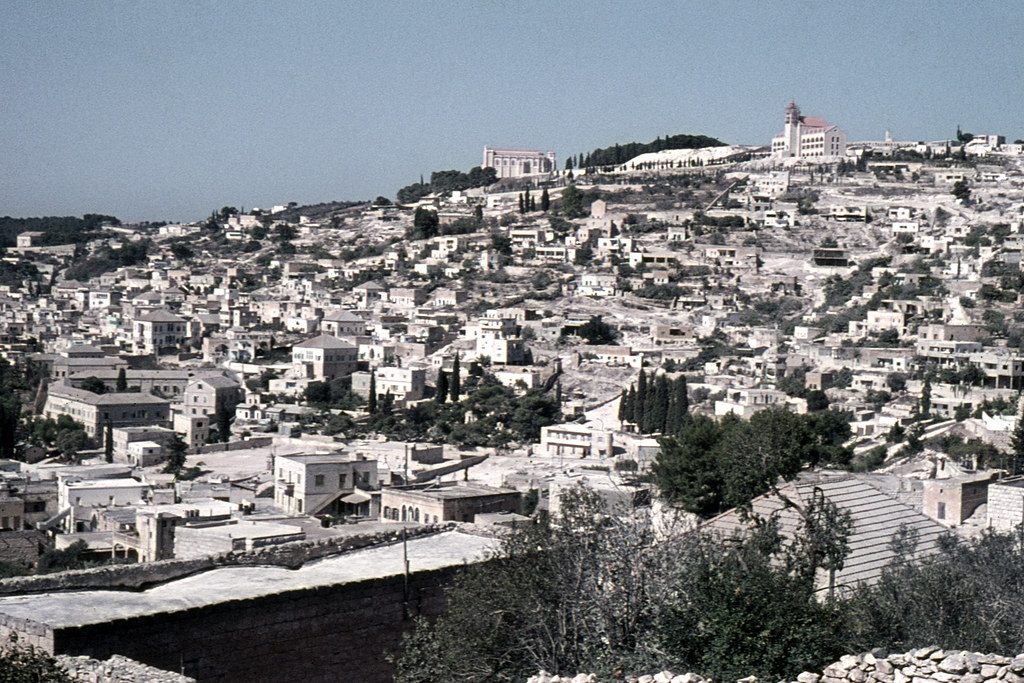
Approaching Nazareth from the air, 1930s. American Colony (Jerusalem) Photo Dept. / Matson Photo Service, Library of Congress (public domain)
Watch
Films from each tradition
Each told by its own community, in its own words, side by side. More on F-ILM.
A Christian telling
The Birth of Jesus: Luke 1-2BibleProject · 5 min Shows prophets (a film-maker's portrayal)BibleProject: the birth of Jesus in Luke 1-2, Mary's song included.
A Muslim telling
Ep. 3: The Power of Du'a: Maryam bint Imran (as) | Upheld by Allah: Women in the Qur'anYaqeen Institute · 17 minYaqeen, Upheld by Allah ep 3: Maryam and the power of du'a; the only woman named in the Qur'an.
The story
A young woman chosen above all women. Honoured by Christians and Muslims as the virgin mother of Jesus (peace be upon him), and the only woman named in the Qur’an.
Mary (peace be upon her) is mentioned more often in the Qur’an than in the whole of the New Testament. That surprises many people in Britain. She is named 34 times in the Qur’an, and a whole chapter, Surah Maryam, carries her name. She is the only woman the Qur’an names at all.
In Lebanon, since 2010, 25 March, the feast of the Annunciation, when the angel Gabriel greeted Mary, has been a national holiday for Christians and Muslims together. Across the Middle East, Muslims visit shrines of Mary alongside Christians. Her story is told in Luke’s Gospel and in the Qur’an. It is one of the clearest places where two great faiths look at the same woman with love, even as they understand her son differently.
“And when the angels said: O Mary! Lo! Allah hath chosen thee and made thee pure, and hath preferred thee above (all) the women of creation.”
This verse is from Surah Al ‘Imran, named after Mary’s family. In Luke’s Gospel the angel Gabriel greets her with words Christians have repeated for centuries: “Rejoice, you highly favoured one! The Lord is with you. Blessed are you amongst women!” (Luke 1:28, WEB).
The world behind the story
Mary lived in Galilee, in the north of what is now Israel, at the time of the Roman Empire, around the turn of the first century BCE and CE. Her home town in the Gospels, Nazareth, was a small Jewish village. Archaeologists working there since the 1990s have found houses, rock-cut tombs and a first-century courtyard house under the Sisters of Nazareth convent. The British archaeologist Ken Dark has studied it in detail. The village was probably home to a few hundred people, mostly farmers and craftsmen.
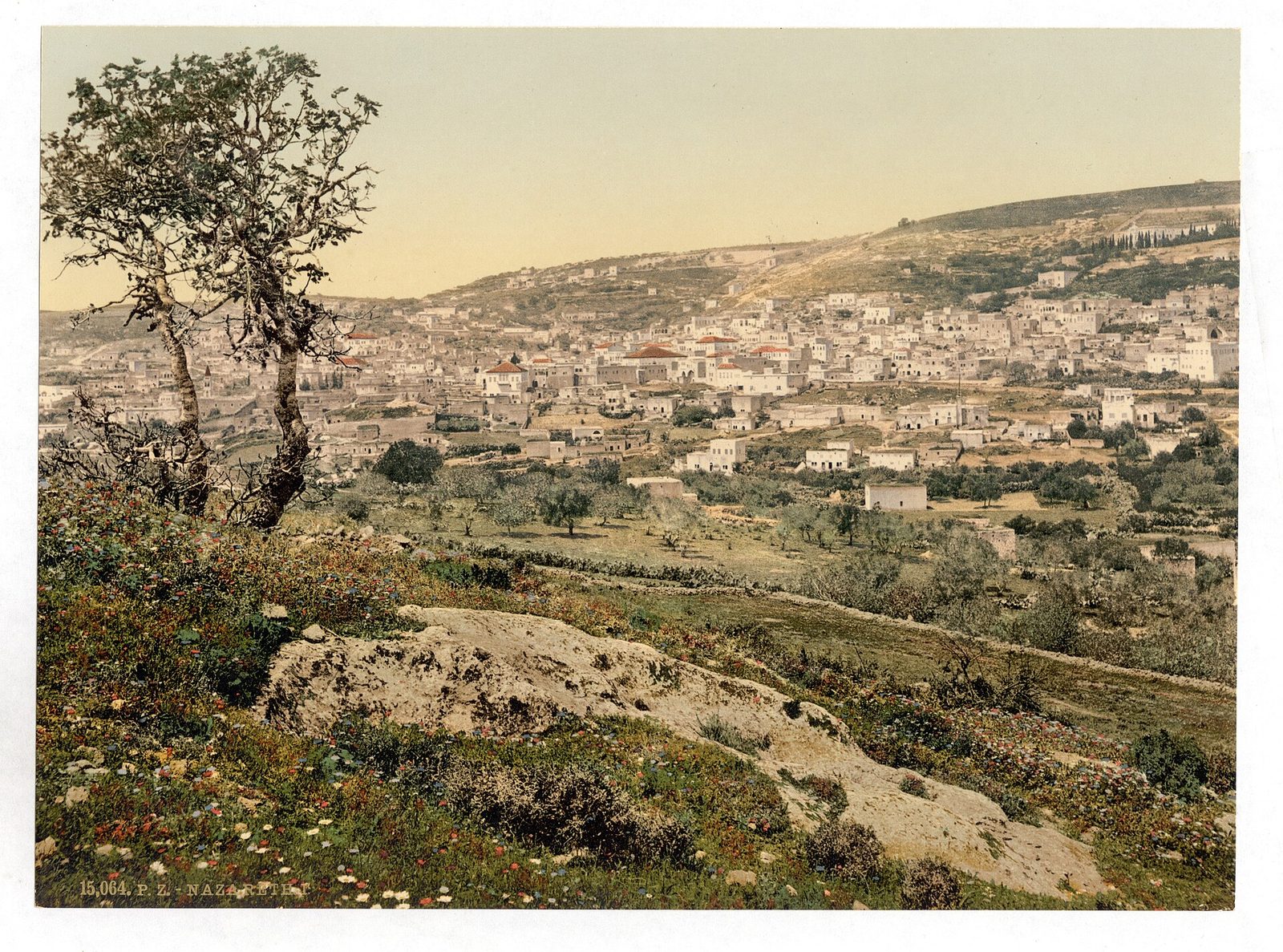
Nazareth from the east, Holy Land, photochrom c. 1890–1900. Photoglob Co. / Library of Congress, public domain (via Wikimedia Commons)
Her name, in Hebrew and Aramaic, was Miryam, the same as Miriam, the sister of Moses and Aaron (peace be upon them). It was one of the most common names for Jewish women of her time. One study of names in ancient inscriptions and texts found that about one in five Jewish women in the region was called Mary or Salome. The Qur’an calls Mary “O sister of Aaron! Thy father was not a wicked man nor was thy mother a harlot.” (19:28, Pickthall); Muslim scholars explain this as meaning a descendant of Aaron’s priestly family, or a woman as devout as Aaron.
Early Christian writings outside the New Testament also told of Mary’s childhood. The Protoevangelium of James, written in the second century, tells of her birth to Joachim and Anne, her upbringing in the Temple, and her care by a guardian. The Qur’an tells of her mother’s vow, her upbringing in the sanctuary and the care of Zechariah (peace be upon him) for her (3:35–37). Historians compare these; Muslims hold the Qur’an’s account as revelation.
Places linked with Mary are visited by people of both faiths today. There is the Church of the Annunciation in Nazareth, and the tomb of Mary in the Kidron Valley in Jerusalem, where a Muslim prayer niche sits beside the Orthodox altar. Near Ephesus in Turkey, at the House of the Virgin Mary, Muslim and Christian pilgrims tie prayers to the same wall.
34times Mary is named in the Qur’an
19the surah named after her, Surah Maryam
2010Lebanon makes the Annunciation a shared Christian–Muslim holiday
What each faith says
Read:
Judaism
“And Miriam the prophetess, the sister of Aaron, took a timbrel in her hand; and all the women went out after her with timbrels and with dances. And Miriam sang unto them: Sing ye to the LORD, for He is highly exalted: The horse and his rider hath He thrown into the sea.”
Jewish scripture has no story of Mary, and Jewish tradition does not teach about her. We don’t invent a parallel. Historically, Mary was a Jewish woman of Galilee, one of many Miriams.
The nearest connection is her name. Miriam, the sister of Moses, is the Torah’s great prophetess. She watched over her baby brother in the river, and after the crossing of the sea she took up a timbrel and led the women in song. Rabbinic tradition says that a well followed Israel through the desert in her merit, and dried up when she died (Ta’anit 9a). Many Jewish families now place a cup of water for Miriam on the Seder table.
Jewish tradition has its own great praying mother: Hannah. Childless and mocked, she prays at the sanctuary at Shiloh, her lips moving but her voice unheard, and the priest thinks she is drunk. “I poured out my soul before the LORD,” she tells him (1 Samuel 1:15). The Talmud learns from Hannah how to pray: from the heart, quietly, with the lips moving (Berakhot 31a). That is why the Amidah, the central Jewish prayer, is said in a whisper to this day. Her story and her song of thanks (1 Samuel 2:1–10) are read in synagogues on the first day of Rosh Hashanah.
Christianity
“Mary said, “My soul magnifies the Lord. My spirit has rejoiced in God my Saviour, for he has looked at the humble state of his servant. For behold, from now on, all generations will call me blessed.”
In Luke’s Gospel, the angel Gabriel is sent to a young woman in Nazareth, engaged to a man called Joseph. He tells her she will bear a son, Jesus. “How can this be, seeing I am a virgin?” she asks. The angel answers that the Holy Spirit will come upon her. She replies, “Behold, the servant of the Lord; let it be done to me according to your word” (Luke 1:34–38). She visits her cousin Elizabeth and sings the Magnificat, a song about God lifting up the humble and filling the hungry. In Bethlehem she lays her newborn son in a manger, “because there was no room for them in the inn” (Luke 2:7).
Christians honour Mary in different ways. Catholic and Orthodox Christians call her Theotokos, “God-bearer” or Mother of God, a title agreed at the Council of Ephesus in 431, and ask her prayers. Many Protestants honour her as a model of faith and obedience without praying to her. At the foot of the Cross, John’s Gospel says, she stood by her son to the end (John 19:25–27).
Her song lives on in daily worship. Every evening in Church of England cathedrals and parish churches, Choral Evensong sings the Magnificat, as it has since the first English Prayer Book of 1549. Catholics pray the Angelus at morning, noon and evening, remembering the angel’s greeting. Every year thousands of Anglican and Catholic pilgrims walk to the shrines of Our Lady of Walsingham in Norfolk.
Islam
“(And remember) when the angels said: O Mary! Lo! Allah giveth thee glad tidings of a word from him, whose name is the Messiah, Jesus, son of Mary, illustrious in the world and the Hereafter, and one of those brought near (unto Allah).”
In the Qur’an, Mary’s mother dedicates her unborn child to God, and when a girl is born she says, “And when she was delivered she said: My Lord! Lo! I am delivered of a female - Allah knew best of what she was delivered - the male is not as the female; and lo! I have named her Mary, and lo! I crave Thy protection for her and for her offspring from Satan the outcast.” (3:36, Pickthall). Mary grows up in the sanctuary in the care of Zechariah (peace be upon him). He finds food with her that God has provided: “And her Lord accepted her with full acceptance and vouchsafed to her a goodly growth; and made Zachariah her guardian. Whenever Zachariah went into the sanctuary where she was, he found that she had food. He said: O Mary! Whence cometh unto thee this (food)? She answered: It is from Allah. Allah giveth without stint to whom He will.” (3:37, Pickthall). The angels tell her she is chosen above the women of the worlds. Then the spirit of God appears to her “in the form of a well-proportioned man” to announce a pure son. “How can I have a son when no man has touched me?” she asks (19:20).
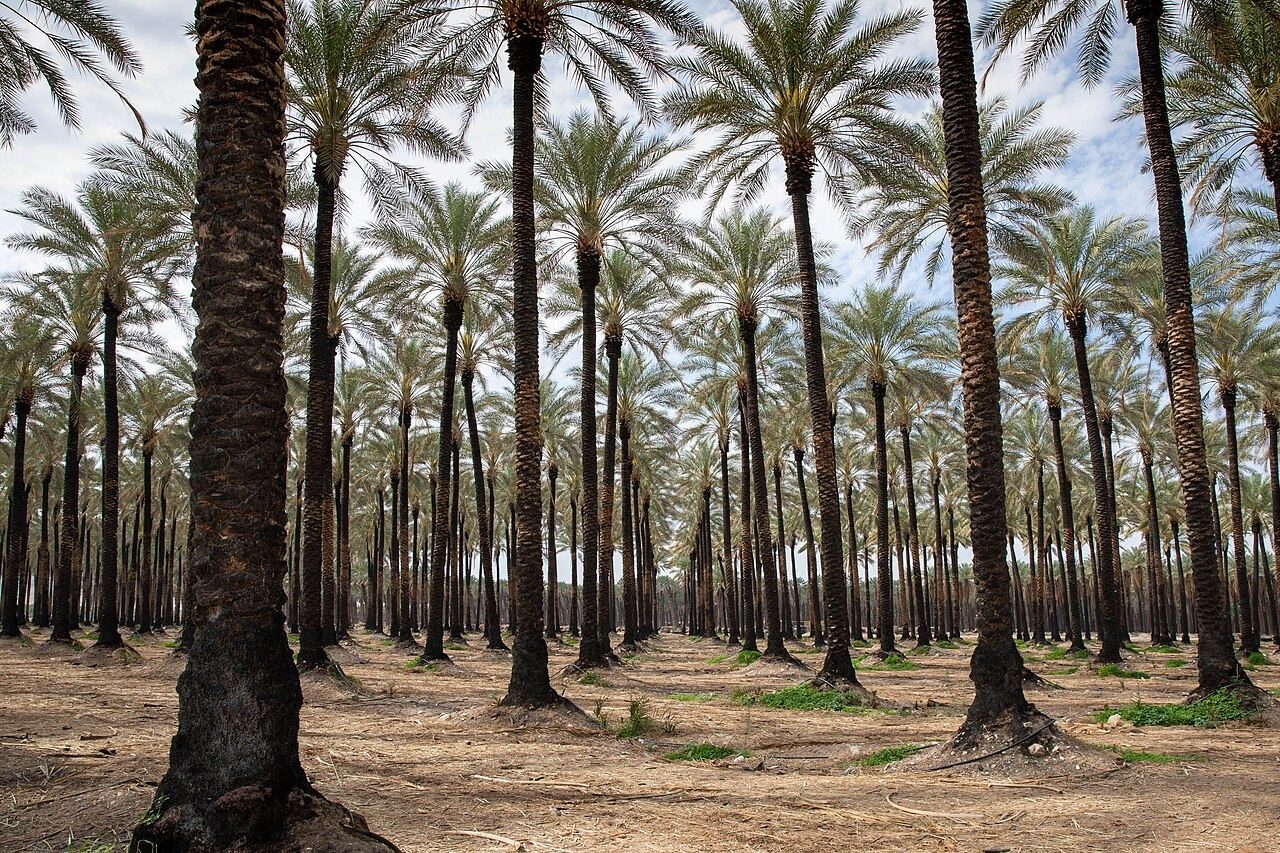
Alone in labour, she holds the trunk of a date palm and cries, “I wish I had died before this.” A voice calls to her: do not grieve; a stream flows beneath you; shake the palm and fresh dates will fall (19:23–26). When her people accuse her, she points to the baby, who speaks from the cradle: “He spake: Lo! I am the slave of Allah. He hath given me the Scripture and hath appointed me a Prophet.” (19:30, Pickthall). The Prophet Muhammad ﷺ (peace be upon him) named Mary among the best of women (Bukhari 3432). Muslims honour Jesus as a prophet, the Messiah and “a word from God”, born of a virgin, but not as God or the son of God.
Same and different
Christians and Muslims agree on a great deal. Mary was chosen and pure; an angel announced her son; she conceived as a virgin by God’s power; and she is honoured above all women. Her son is called the Messiah in both. They differ on who that son is. For Muslims he is a prophet and servant of God, created by God’s word like Adam (peace be upon him). For Christians he is the Son of God, God made flesh. Jews regard him as a Jewish teacher of his time, not the Messiah and not divine. The Qur’an places the birth under a palm tree, with a stream and fresh dates; the Gospels place it in a stable in Bethlehem. Muslims do not pray to Mary but honour her deeply; Catholic and Orthodox Christians ask her prayers. Judaism has no Mary narrative, but it gives the world her name, Miriam, and a mother whose prayer came first. Mary’s Magnificat echoes Hannah’s song of a thousand years before, and Christians have long read the two side by side.
A moment to reflect
Mary said yes to something she did not fully understand. When have you had to do that?
Mary cried out, “I wish I had died before this,” and was still honoured above all women. Is it all right to say how hard something is and still keep faith?
What could Christians and Muslims learn from honouring the same woman?
The Magnificat says God lifts up the humble. Who are the humble in our society?
Watch
A Muslim sermon celebrating Mary, the mother of Jesus, in the Qur’an.
Surah Maryam recited by Mishary Rashid Alafasy, to hear her story in Arabic.
The Magnificat, Mary’s song from Luke’s Gospel, sung by the Choir of Trinity College Cambridge.
Do it together
interfaith groups / neighboursAnnunciation together
On or near 25 March, hold a shared evening like Lebanon’s: a reading of Luke 1:26–38 and Qur’an 19:16–26, music from both traditions, and food. Many UK churches and mosques have done this.
families / schoolsDates and water
Share fresh dates and a glass of water, as in Surah Maryam, while reading the story. Talk about what Mary needed most at that moment, and what people in hard times need today.
youth groups / community groupsWomen of faith
Each person researches one woman honoured in the three faiths, such as Miriam, Hannah, Mary, Asiya (Pharaoh’s wife) or Khadija, and tells her story in two minutes.
neighbours / interfaith groupsChoral Evensong
Go to Choral Evensong at a cathedral or college chapel. It is free, takes under an hour, and visitors are welcome to sit and listen. Listen for the Magnificat, then read Hannah’s song (1 Samuel 2:1–10) together afterwards.
families / interfaith groupsMiriam’s cup
At Passover many Jewish families place a cup of water for Miriam on the Seder table, remembering the well that followed her through the desert. At any shared meal, set a cup of water for the women whose stories are often left out, and tell one of their stories.
Check yourself
Three quick questions. No score, nothing saved.
1. How many times is Mary named in the Qur'an?
2. What does Lebanon keep on 25 March?
3. Where do Christians and Muslims differ about Mary's son?
Quotations: Torah and Hebrew Bible, JPS 1917 · New Testament, World English Bible (British Edition) · Qur'an, Pickthall (1930). Translations and sources
THebrew Bible · Jewish view
In Jewish tradition's own words.
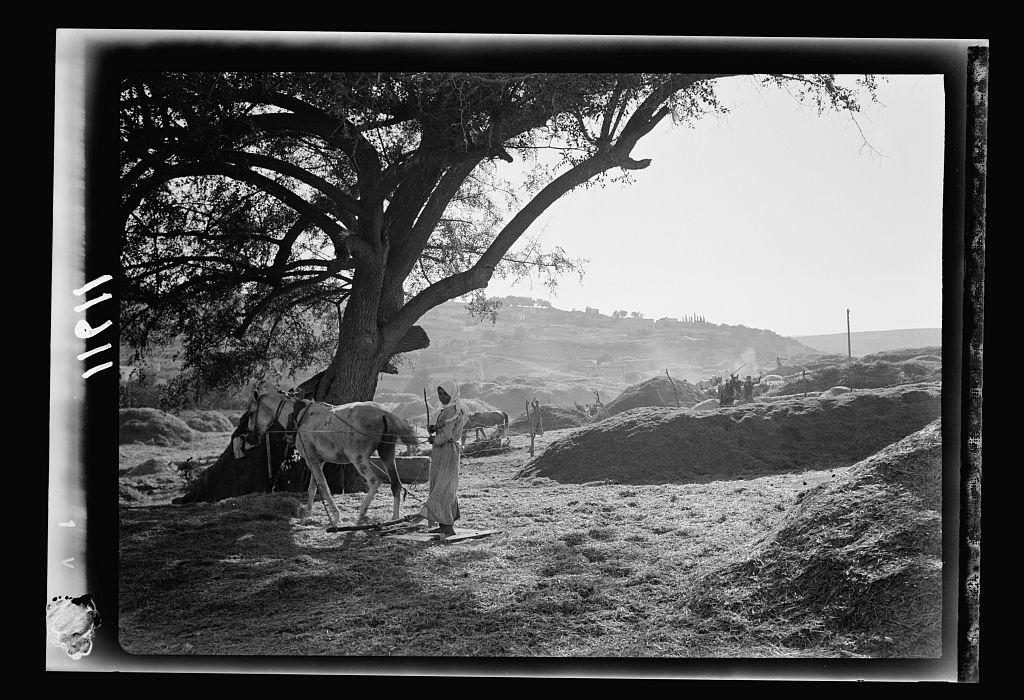
The threshing floor at Sepphoris, near Nazareth. American Colony (Jerusalem) Photo Dept. / Matson Photo Service, Library of Congress (public domain)
Mary does not appear in the Hebrew Bible; she lived after it was complete.
She carries the name of Miriam, the prophetess, sister of Moses and Aaron.
Jewish tradition has no religious teaching about Mary.
“And Miriam the prophetess, the sister of Aaron, took a timbrel in her hand; and all the women went out after her with timbrels and with dances.”Exodus 15:20 · JPS 1917 · Miriam, whose name Mary carries
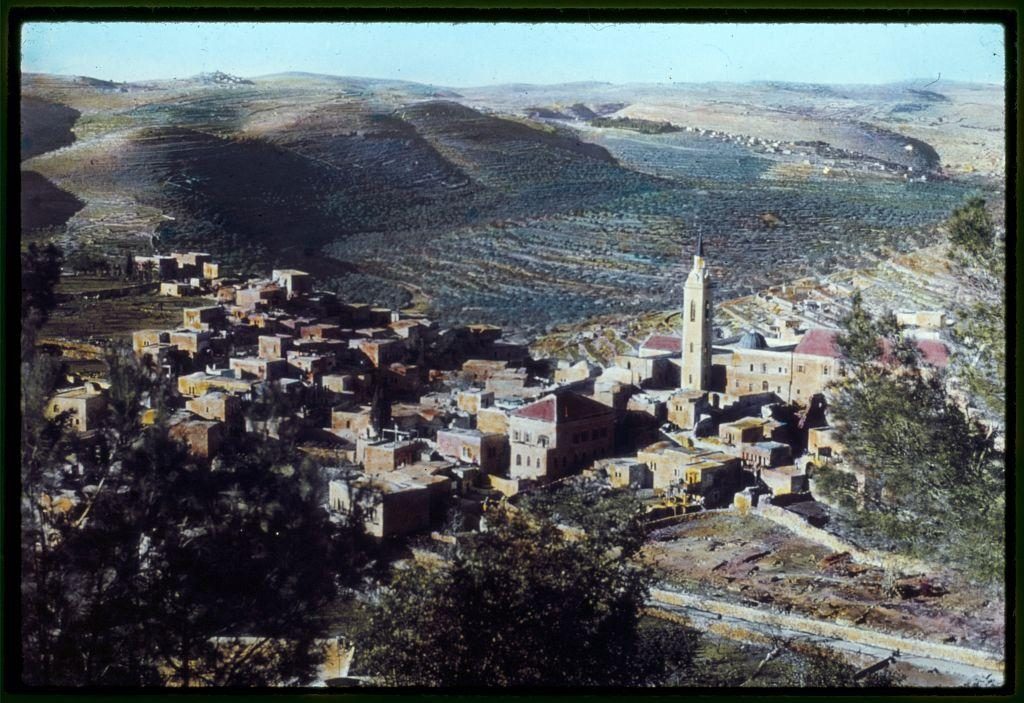
Ain Karim, remembered in Christian tradition as the village of the Visitation. American Colony (Jerusalem) Photo Dept. / Matson Photo Service, Library of Congress (public domain)
The angel Gabriel's greeting and her answer.
Her song of praise, the Magnificat.
The birth in Bethlehem; the wedding at Cana; at the foot of the cross.
“Mary said, “My soul magnifies the Lord. My spirit has rejoiced in God my Saviour, for he has looked at the humble state of his servant. For behold, from now on, all generations will call me blessed.”Luke 1:46–48 · WEB (British Edition)
The title Theotokos, “God-bearer”, was affirmed at the Council of Ephesus (431). Catholic teaching adds the Immaculate Conception (1854) and the Assumption (1950); the Orthodox keep the Dormition. Protestant churches honour her as a model of faith without those teachings.
Her parents' names, Joachim and Anne, come from the 2nd-century Protoevangelium of James.
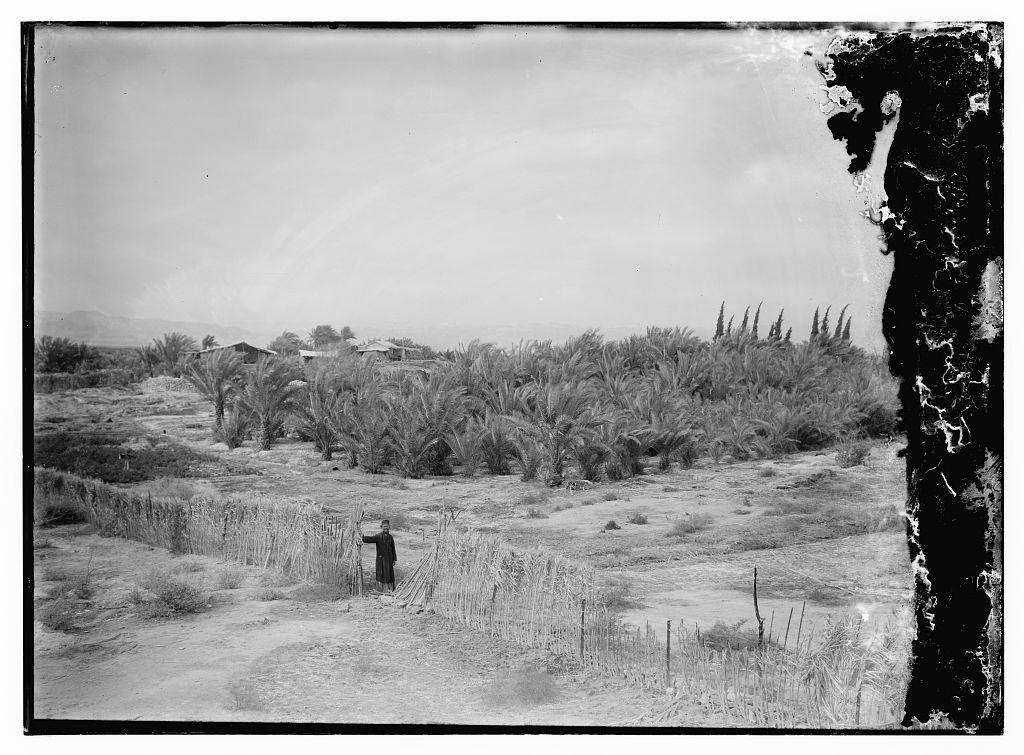
A palm plantation in the Jordan valley: “shake the trunk of the palm-tree toward thee” (Qur'an 19:25). American Colony (Jerusalem) Photo Dept. / Matson Photo Service, Library of Congress (public domain)
Her mother, the wife of Imran, dedicates her before birth.
She grows up in the sanctuary in Zechariah's care, and he finds provision with her from God.
The angels tell her she is chosen; the Spirit brings her the news of a son.
In labour she shelters under a palm, and fresh dates fall.
“And when the angels said: O Mary! Lo! Allah hath chosen thee and made thee pure, and hath preferred thee above (all) the women of creation.”Qur'an 3:42 · Pickthall (1930)
A hadith names Mary (peace be upon her) and Khadijah as the best of the world's women (Bukhari 3432).
The Qur'an calls her “sister of Aaron” (19:28). Muslim scholars read this as an honorific or a line of descent (Muslim 2135).
And Miriam the prophetess, the sister of Aaron, took a timbrel in her hand; and all the women went out after her with timbrels and with dances.
Read the passages The Christian telling · 6
Matthew 1:18–25 · New Testament · WEB British Edition
18
Now the birth of Jesus Christ was like this: After his mother, Mary, was engaged to Joseph, before they came together, she was found pregnant by the Holy Spirit.
19
Joseph, her husband, being a righteous man, and not willing to make her a public example, intended to put her away secretly.
20
But when he thought about these things, behold, an angel of the Lord appeared to him in a dream, saying, “Joseph, son of David, don’t be afraid to take to yourself Mary as your wife, for that which is conceived in her is of the Holy Spirit.
21
She shall give birth to a son. You shall name him Jesus, for it is he who shall save his people from their sins.”
22
Now all this has happened that it might be fulfilled which was spoken by the Lord through the prophet, saying,
23
“Behold, the virgin shall be with child, and shall give birth to a son. They shall call his name Immanuel,” which is, being interpreted, “God with us.”
24
Joseph arose from his sleep, and did as the angel of the Lord commanded him, and took his wife to himself;
25
and didn’t know her sexually until she had given birth to her firstborn son. He named him Jesus.
Luke 1:26–56 · New Testament · WEB British Edition
26
Now in the sixth month, the angel Gabriel was sent from God to a city of Galilee named Nazareth,
27
to a virgin pledged to be married to a man whose name was Joseph, of David’s house. The virgin’s name was Mary.
28
Having come in, the angel said to her, “Rejoice, you highly favoured one! The Lord is with you. Blessed are you amongst women!”
29
But when she saw him, she was greatly troubled at the saying, and considered what kind of salutation this might be.
30
The angel said to her, “Don’t be afraid, Mary, for you have found favour with God.
31
Behold, you will conceive in your womb and give birth to a son, and shall name him ‘Jesus.’
32
He will be great and will be called the Son of the Most High. The Lord God will give him the throne of his father David,
33
and he will reign over the house of Jacob forever. There will be no end to his Kingdom.”
34
Mary said to the angel, “How can this be, seeing I am a virgin?”
35
The angel answered her, “The Holy Spirit will come on you, and the power of the Most High will overshadow you. Therefore also the holy one who is born from you will be called the Son of God.
The passage continues; open it in the player or your own Bible or Qur'an.
Luke 2:1–52 · New Testament · WEB British Edition
1
Now in those days, a decree went out from Caesar Augustus that all the world should be enrolled.
2
This was the first enrolment made when Quirinius was governor of Syria.
3
All went to enrol themselves, everyone to his own city.
4
Joseph also went up from Galilee, out of the city of Nazareth, into Judea, to David’s city, which is called Bethlehem, because he was of the house and family of David,
5
to enrol himself with Mary, who was pledged to be married to him as wife, being pregnant.
6
While they were there, the day had come for her to give birth.
7
She gave birth to her firstborn son. She wrapped him in bands of cloth and laid him in a feeding trough, because there was no room for them in the inn.
8
There were shepherds in the same country staying in the field, and keeping watch by night over their flock.
9
Behold, an angel of the Lord stood by them, and the glory of the Lord shone around them, and they were terrified.
10
The angel said to them, “Don’t be afraid, for behold, I bring you good news of great joy which will be to all the people.
The passage continues; open it in the player or your own Bible or Qur'an.
John 2:1–11 · New Testament · WEB British Edition
1
The third day, there was a wedding in Cana of Galilee. Jesus’ mother was there.
2
Jesus also was invited, with his disciples, to the wedding.
3
When the wine ran out, Jesus’ mother said to him, “They have no wine.”
4
Jesus said to her, “Woman, what does that have to do with you and me? My hour has not yet come.”
5
His mother said to the servants, “Whatever he says to you, do it.”
6
Now there were six water pots of stone set there after the Jews’ way of purifying, containing two or three metretes apiece.
7
Jesus said to them, “Fill the water pots with water.” So they filled them up to the brim.
8
He said to them, “Now draw some out, and take it to the ruler of the feast.” So they took it.
9
When the ruler of the feast tasted the water now become wine, and didn’t know where it came from (but the servants who had drawn the water knew), the ruler of the feast called the bridegroom
10
and said to him, “Everyone serves the good wine first, and when the guests have drunk freely, then that which is worse. You have kept the good wine until now!”
The passage continues; open it in the player or your own Bible or Qur'an.
John 19:25–27 · New Testament · WEB British Edition
25
But standing by Jesus’ cross were his mother, his mother’s sister, Mary the wife of Clopas, and Mary Magdalene.
26
Therefore when Jesus saw his mother, and the disciple whom he loved standing there, he said to his mother, “Woman, behold, your son!”
27
Then he said to the disciple, “Behold, your mother!” From that hour, the disciple took her to his own home.
Acts 1:14 · New Testament · WEB British Edition
14
All these with one accord continued steadfastly in prayer and supplication, along with the women and Mary the mother of Jesus, and with his brothers.
(Remember) when the wife of 'Imran said: My Lord! I have vowed unto Thee that which is in my belly as a consecrated (offering). Accept it from me. Lo! Thou, only Thou, art the Hearer, the Knower!
And when she was delivered she said: My Lord! Lo! I am delivered of a female - Allah knew best of what she was delivered - the male is not as the female; and lo! I have named her Mary, and lo! I crave Thy protection for her and for her offspring from Satan the outcast.
And her Lord accepted her with full acceptance and vouchsafed to her a goodly growth; and made Zachariah her guardian. Whenever Zachariah went into the sanctuary where she was, he found that she had food. He said: O Mary! Whence cometh unto thee this (food)? She answered: It is from Allah. Allah giveth without stint to whom He will.
And the angels called to him as he stood praying in the sanctuary: Allah giveth thee glad tidings of (a son whose name is) John, (who cometh) to confirm a word from Allah lordly, chaste, a prophet of the righteous.
He said: My Lord! How can I have a son when age hath overtaken me already and my wife is barren? (The angel) answered: So (it will be). Allah doeth what He will.
He said: My Lord! Appoint a token for me. (The angel) said: The token unto thee (shall be) that thou shalt not speak unto mankind three days except by signs. Remember thy Lord much, and praise (Him) in the early hours of night and morning.
This is of the tidings of things hidden. We reveal it unto thee (Muhammad). Thou wast not present with them when they threw their pens (to know) which of them should be the guardian of Mary, nor wast thou present with them when they quarrelled (thereupon).
The passage continues; open it in the player or your own Bible or Qur'an.
O People of the Scripture! Do not exaggerate in your religion nor utter aught concerning Allah save the truth. The Messiah, Jesus son of Mary, was only a messenger of Allah, and His word which He conveyed unto Mary, and a spirit from Him. So believe in Allah and His messengers, and say not "Three" - Cease! (it is) better for you! - Allah is only One God. Far is it removed from His Transcendent Majesty that He should have a son. His is all that is in the heavens and all that is in the earth. And Allah is sufficient as Defender.
The Messiah, son of Mary, was no other than a messenger, messengers (the like of whom) had passed away before him. And his mother was a saintly woman. And they both used to eat (earthly) food. See how We make the revelations clear for them, and see how they are turned away!
He said: So (it will be). Thy Lord saith: It is easy for Me. And (it will be) that We may make of him a revelation for mankind and a mercy from Us, and it is a thing ordained.
And the pangs of childbirth drove her unto the trunk of the palm-tree. She said: Oh, would that I had died ere this and had become a thing of naught, forgotten!
And Mary, daughter of 'Imran, whose body was chaste, therefor We breathed therein something of Our Spirit. And she put faith in the words of her Lord and His scriptures, and was of the obedient.
Common ground
Where they agree
Chosen and pure.
The angel's announcement and the virgin birth by God's power.
Mother of Jesus (peace be upon him) the Messiah.
A model of faith and devotion.
Said plainly, ranked never
Where they differ
Who her son is: the Son of God in Christianity; a prophet and servant of God in Islam.
Her titles, Mother of God, and the later doctrines, in Catholic and Orthodox teaching.
Where she gives birth: the stable in Bethlehem (Luke), or beneath a palm tree (Qur'an).
In Judaism she has no religious role.
Era and place
The world of Mary
Where
Nazareth in Galilee, the Judean hills, Bethlehem and Jerusalem. Ephesus has the “House of the Virgin Mary”, a later tradition.
When
Late 1st century BCE to the 1st century CE.
What archaeology can and cannot say
Nazareth was a small Jewish village. A 1st-century house has been excavated under the Sisters of Nazareth convent (Ken Dark).
Nazareth from the air, 1930s. American Colony (Jerusalem) Photo Dept. / Matson Photo Service, Library of Congress (public domain)
Gallery
The world of Mary
Like everything on this page, they show places, plants and objects, never people.
Jewish tradition has no religious teaching about Mary (peace be upon her). The name Miriam belongs to the prophetess of the Exodus, who led the women in song (Exodus 15:20).
And Miriam the prophetess, the sister of Aaron, took a timbrel in her hand; and all the women went out after her with timbrels and with dances.
Christian tradition
Devotion to Mary grew from the Gospels and early writings such as the Protoevangelium of James. Catholics, Orthodox and Protestants differ on the doctrines about her, while all honour her faith.
Tafsir and hadith
Ibn Kathir, on 19:16 and 3:42, describes her upbringing in the sanctuary and the annunciation. Surah 19, Maryam (peace be upon her), is one of the best-loved chapters of the Qur'an.
Reference works: Encyclopaedia Judaica (2nd ed.); The Oxford Dictionary of the Christian Church; Encyclopaedia of Islam (3rd ed.); Ibn Kathir, Qisas al-Anbiya.