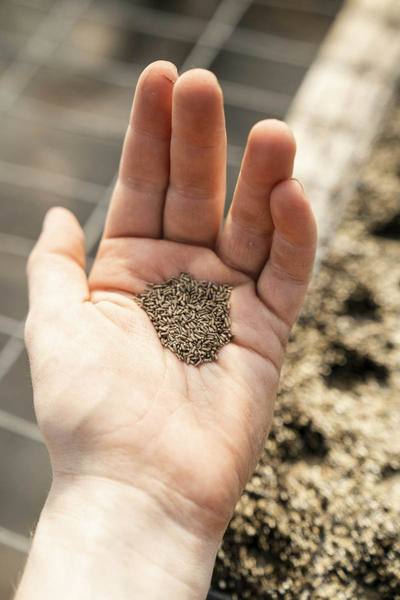
Deep inside a mountain on the Arctic island of Svalbard, a vault holds more than 1.4 million packets of seeds. They come from almost every country on Earth: a back-up of the world's crops, in case anything is lost.
We spend our lives deciding what to pass on. Al-Wārith, the Inheritor, names the One to whom everything returns when every heir has passed.
Start with what we know
Start with something we know. Then take away everything it needs. What is left is not a bigger version of us: it is the Name.
Episode 1
In us
When William Shakespeare died in 1616, his will left most of his estate to his elder daughter Susanna, and famously left his wife Anne “my second best bed”. He had planned carefully for his line to continue. But his granddaughter Elizabeth, Susanna's only child, married twice and died without children in 1670, and Shakespeare's direct line ended. His plays are his real inheritance, and even they are passed on by others. Every heir we choose will one day pass something on, and pass away.
Episode 2
In nature
After the Chernobyl nuclear disaster in 1986, around 350,000 people were moved out of the surrounding area. In 2015 a study in Current Biology led by Tatiana Deryabina used decades of helicopter surveys. It reported that elk, deer, wild boar and wolves had become abundant in the exclusion zone. Forests now grow through the streets of the abandoned town of Pripyat. Nature inherits what people leave. But it inherits blindly, and the radiation that remains is a reminder of what the inheritance cost.
Episode 3
At our best
The Svalbard Global Seed Vault opened in 2008, built into a mountainside where the rock stays frozen. According to the vault's own figures, it now holds 1,417,799 seed samples from more than 6,500 species, deposited by gene banks around the world, free of charge. In 2015 it made its first withdrawal, when a gene bank in Syria needed to rebuild its collections. It is humanity's will for the future of farming. But the vault needs people, power and seeds that are still alive.
Episode 4
The Break
Death and succession make a long chain of heirs, each of whom must pass on what they received. Everything we own is passing to someone, and every someone is passing too. Al-Wārith is the One who remains when the chain ends, to whom all things return. The Qur'an says it plainly: “Lo! and it is We, even We, Who quicken and give death, and We are the Inheritor.” (Qur'an 15:23, Pickthall).
Zechariah (peace be upon him) was an old priest who served at the Temple in Jerusalem. He and his wife had no children, and they were both well on in years.
The Qur'an tells how he prayed quietly, in secret. My Lord, my bones have grown weak and my hair is white with age, and I have never been disappointed in calling on You. I am afraid of what my relatives will do after me, and my wife is barren. Give me, from Yourself, an heir. Another passage gives the words of his prayer that name this Name. “And Zachariah, when he cried unto his Lord: My Lord! Leave me not childless, though Thou art the Best of inheritors.” (Qur'an 21:89 · Pickthall).
God answered him. He was given the good news of a son, John (peace be upon him), and his wife was made able to bear a child. (Qur'an 19:2-7; 21:89-90)
Luke's Gospel tells the same story. Zechariah and Elizabeth are righteous and old, and the angel Gabriel bringing the news in the Temple that Elizabeth would bear a son called John (Luke 1:5-25).
Zechariah's prayer is beautiful because it hopes for an heir and trusts God whether or not one comes. Even if he were left alone, God would still be the best of inheritors.
What each faith says
Read:
Judaism
“Arise, O God, judge the earth; for Thou shalt possess all the nations.”
Psalm 82 ends with a prayer that God will judge the earth, “for Thou shalt possess all the nations”: the Hebrew verb, tinḥal, means to inherit. Psalm 24 begins: “The earth is the LORD'S, and the fulness thereof.”
Jewish tradition places great weight on passing on. The Torah tells parents to teach their children “diligently” (Deuteronomy 6:7), and an ethical will, a letter of values to one's children, is an old Jewish custom.
Christianity
“But the angel said to him, “Don’t be afraid, Zacharias, because your request has been heard. Your wife, Elizabeth, will bear you a son, and you shall call his name John.”
Luke's Gospel opens with Zechariah and Elizabeth. The angel says: “Don't be afraid, Zacharias, because your request has been heard. Your wife, Elizabeth, will bear you a son, and you shall call his name John.”
Jesus told his followers not to store up treasure on earth, “where moth and rust consume”, but in heaven (Matthew 6:19-20). Christians also speak of an inheritance kept for them by God.
Zechariah's own song of thanks when John was born, the Benedictus (Luke 1:68-79), is sung every morning at Anglican Morning Prayer and in Catholic Lauds.
Islam
“And Zachariah, when he cried unto his Lord: My Lord! Leave me not childless, though Thou art the Best of inheritors.”
Al-Wārith appears in the plural, 'the Inheritors', of God several times: “Lo! and it is We, even We, Who quicken and give death, and We are the Inheritor.” (15:23, Pickthall (1930); 28:58). Another verse says: “Lo! We, only We, inherit the earth and all who are thereon, and unto Us they are returned.” (19:40, Pickthall).
The Qur'an uses this to encourage generosity now: “And what aileth you that ye spend not in the way of Allah when unto Allah belongeth the inheritance of the heavens and the earth? Those who spent and fought before the victory are not upon a level (with the rest of you). Such are greater in rank than those who spent and fought afterwards. Unto each hath Allah promised good. And Allah is Informed of what ye do.” (57:10, Pickthall).
Same and different
Zechariah's prayer is shared by the Qur'an and Luke's Gospel, and all three faiths teach that the earth and everything in it belong to God. All three encourage passing on goodness to the next generation. They differ on John himself: for Christians he prepared the way for Christ; for Muslims, Yaḥyā is a prophet in his own right; Jewish scripture does not tell his story.
A moment to reflect
What would you most like to pass on to people after you?
What have you inherited that is not money or things?
What would you give away now if you remembered that none of it stays with you?
Watch
Veritasium goes inside the Svalbard Global Seed Vault.
BBC News on wildlife in the Chernobyl exclusion zone.
Do it together
families / faith groupsEthical wills
Learn about the Jewish custom of an ethical will. Each person writes a short letter of the values they hope to pass on. Share them if you wish. Read Qur'an 21:89 and Luke 1:13.
neighbours / schoolsSeed swap
Start a seed library or swap box at your library, school or place of worship, so that people pass on seeds from their gardens each year.

 Episode 1