Young Explorers · ages 7–11
Who holds the birds up?
Young Explorers · Who holds the birds up?
Next: Why does the moon change shape? (children) →Look up. There is a bird in the sky.
It might be a pigeon flapping over the rooftops, or a seagull floating on the wind. It might be a little sparrow zipping into a hedge. Birds are everywhere, and most of the time we do not even notice them.
There are about ten thousand kinds of birds in the world. The smallest, the bee hummingbird, is about as long as your little finger. The biggest, the ostrich, is taller than a grown-up, and cannot fly at all. It runs instead.
But stop and watch for a moment. How does a bird stay up there? You cannot fly, however hard you flap your arms. A bird can.
Birds are built for flying. Their bones are hollow inside, full of tiny air spaces, so they are light. Their feathers overlap like roof tiles, making each wing smooth and strong. When a bird flaps, its wings push air downwards and backwards, and the bird goes up and forwards.
Some birds can stay in the sky for a very, very long time. The common swift, which visits Britain every summer, can fly for ten months without landing. It eats in the air, drinks raindrops in the air, and even sleeps in the air.
Some birds can stand still in the sky. Next time you are near a motorway or a field, look out for a kestrel. It faces into the wind, flutters its wings and fans its tail. Its head stays perfectly still while it looks for mice on the ground far below.
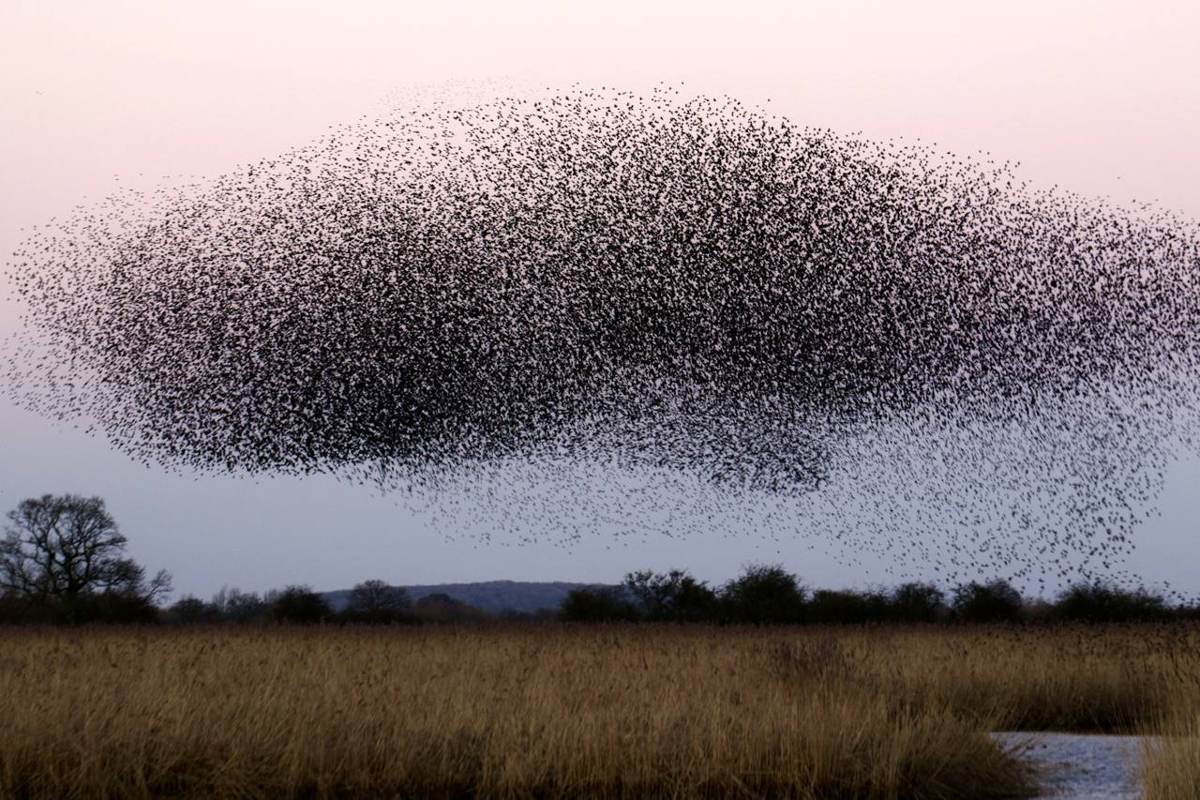
And in winter, as the sun goes down, some lucky people see something wonderful. Thousands and thousands of starlings fly together, swooping and swirling like a great cloud of smoke. It is called a murmuration. The birds twist and turn all at once, but they never crash. Scientists have found that each starling watches about seven of its nearest neighbours, and copies what they do. Those little copies spread through the whole flock like a wave.
Every autumn, some birds set off on enormous journeys. Swallows that nest in British barns fly all the way to South Africa for the winter. In the spring they come back, often to the very same barn. Nobody gives them a map.
Muslims read in the Qur’an an invitation to look up too. “Do they not see the birds above them, spreading their wings and folding them? Nothing holds them up except the Most Merciful.”
Christians read in the Gospels that Jesus also pointed at the birds. “See the birds of the sky,” he said. “They don’t plant seeds or gather crops into barns, and your Father in heaven feeds them.”
Jewish people read in the book of Job that if you ask the birds, they will teach you.
Jewish families also have a winter Sabbath called Shabbat Shirah, the Sabbath of Song. That week they read an ancient song of thanks from the Torah. Before it begins, many children put out crumbs or seeds for the birds, to thank them for their singing.
So tomorrow, look up. Count the birds you see. Watch how they fly. Wonder.
Wonder with us
Look up. What keeps them there?
Stand or sit outside for five minutes, very still and quiet. Count every bird you see or hear. Draw the one you liked best. If you can, put out a shallow dish of water for birds to drink from, and check it every day.
Watch together
Big animal journeys, including birds that fly thousands of miles, for young viewers.
Millions of starlings swirling together, from BBC Earth.
For grown-ups
The verses are Qur’an 67:19, Matthew 6:26 (World English Bible) and Job 12:7 (“the fowls of the air, and they shall tell thee”, JPS 1917, paraphrased for children). Shabbat Shirah is the Sabbath when Exodus 15, the Song at the Sea, is read; putting out food for birds beforehand is a widespread Ashkenazi custom. The swift fact comes from a 2016 study led by Anders Hedenström at Lund University, which found common swifts can stay airborne for ten months. The seven-neighbours finding comes from a 2008 study of Rome’s starlings by Michele Ballerini and colleagues. The RSPB’s Big Garden Birdwatch each January is a lovely family activity to try together. A question to talk about: if you could fly for one day, where would you go?
Watch more: Who holds the birds up?
8 films and talks, chosen for this page. They play here.
Why can't some birds fly? - Gillian Gibb
TED-Ed · 4 min
Why most birds can fly and a few cannot.
The surprising secrets of hummingbird flight - Kristiina J. Hurme and Alejandro Rico-Guevara
TED-Ed · 5 min
Penguins, Birds That Fly in Water! | SciShow Kids
SciShow Kids · 8 min
Why Do Birds Migrate Like This?
MinuteEarth · 2 min
Why migrating birds fly in a V shape.
A Baby Falcon's First Flight | Animal Babies | BBC Earth
BBC Earth · 3 min
A baby falcon takes its very first flight.
Birds-of-Paradise Project Introduction
Cornell Lab of Ornithology · 6 min
Cornell Lab introduces the dazzling birds-of-paradise and their dances.
Bird Sounds For Babies To Sleep To | BBC Earth Kids
BBC Earth Kids · 7 min
BBC Earth Kids: a calm stretch of birdsong for quiet time.
There’s no such thing as a fake feather
MinuteEarth · 3 min
How feathers are built so cleverly that nothing else can copy them.