In one minute
Judaism is the faith and way of life of the Jewish people. Jews believe there is one God, the Creator of heaven and earth, who made a covenant (brit) with Abraham and his descendants and, at Mount Sinai, gave the Torah, God's teaching, to Moses and the people of Israel. Judaism is about how a whole life can answer that covenant: in prayer and study, at the family table, in the way people treat their neighbours, their workers, strangers and the poor.
Two things make Judaism distinctive:
- It is both a faith and a people. Someone can be born Jewish or can join the Jewish people by conversion. Jews speak of themselves as a family, the "children of Israel", going back to Jacob, whose other name was Israel.
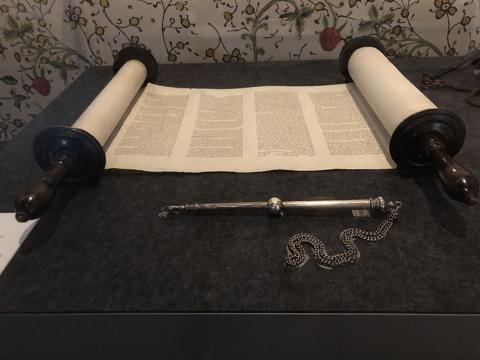
- It puts great weight on doing. Jews often say that the deed matters more than the creed. The Torah contains, by rabbinic count, 613 commandments (mitzvot), and Jewish life is shaped by them from waking to sleeping.
Everything essential on these pages fits through two doors:
- What Jews believe — one God; the Torah, written and oral; the covenant and the people of Israel; prophets and revelation; ethics and the commandments; and hope for the world to come.
- How Jewish life is lived — Shabbat; prayer and the synagogue; tzedakah and chesed (justice-giving and loving-kindness); the festivals; and life in the home, from birth to mourning.
There are about 15 to 16 million Jews in the world. In England and Wales the 2021 Census counted about 271,000 Jews (0.5% of the population), one of the oldest faith communities in Britain.
The frame: "Hear, O Israel"
If Islam's essentials are framed by the Hadith of Jibril, Judaism's are framed by a sentence Jews say every morning and every night, the Shema:
"Hear, O Israel: the LORD our God, the LORD is one." (Deuteronomy 6:4, JPS 1917)
Hebrew:
שְׁמַע יִשְׂרָאֵל יְהוָה אֱלֹהֵינוּ יְהוָה אֶחָד
The passage continues, and almost every essential of Jewish life is already inside it:
"And thou shalt love the LORD thy God with all thy heart, and with all thy soul, and with all thy might. And these words, which I command thee this day, shall be upon thy heart; and thou shalt teach them diligently unto thy children, and shalt talk of them when thou sittest in thy house, and when thou walkest by the way, and when thou liest down, and when thou risest up. And thou shalt bind them for a sign upon thy hand, and they shall be for frontlets between thine eyes. And thou shalt write them upon the door-posts of thy house, and upon thy gates." (Deuteronomy 6:5–9, JPS 1917)
| In the Shema | What Jews do with it | Page |
|---|---|---|
| "the LORD is one" | belief in one God | One God |
| "love the LORD thy God" | prayer, study and the commandments done out of love | Ethics and mitzvot |
| "these words … upon thy heart" | the Torah, written and oral | Torah |
| "teach them diligently unto thy children" | the home as a place of learning; festivals that tell the story to children | Festivals |
| "when thou liest down, and when thou risest up" | evening and morning prayer | Prayer and the synagogue |
| "a sign upon thy hand … frontlets between thine eyes" | tefillin, worn at weekday morning prayer | Prayer and the synagogue |
| "the door-posts of thy house" | the mezuzah on the doorpost | Life and home |
"The rest is commentary"
The Talmud tells a story about two great teachers who lived about two thousand years ago, Shammai and Hillel. A man who wanted to become Jewish asked to be taught the whole Torah while standing on one foot. Shammai sent him away. Hillel welcomed him and said, in effect: what is hateful to you, do not do to your neighbour. That is the whole Torah; the rest is commentary. Now go and learn it. (Paraphrased; Babylonian Talmud, Shabbat 31a.)
The last three words matter as much as the first. Judaism holds that the heart of the Torah can be said in a sentence, and that a lifetime of study is the way to live it.
The covenant: why it all hangs together
Jews speak of their relationship with God as a covenant, a binding bond of love and loyalty on both sides, more like a marriage than a contract. It began with Abraham and Sarah, was renewed with Isaac and Jacob, and was sealed at Sinai with the whole people, who answered:
"All that the LORD hath spoken will we do, and obey." (Exodus 24:7, JPS 1917)
The ancient rabbis noticed that the people promised to do before they promised to understand (the Hebrew is literally "we will do and we will hear"). Judaism has kept that order: live the commandments, and understanding grows from the living. → Covenant and the people of Israel
Two doors
Door one: what Jews believe
- One God — the Creator, one and indivisible, beyond any image. → One God
- Torah — God's teaching, written (the Five Books of Moses and the Hebrew Bible) and oral (the Mishnah, Talmud and the living tradition). → Torah
- Covenant and the people of Israel — chosen for responsibility, not privilege. → Covenant
- Prophets and revelation — God speaks; Moses is the greatest of the prophets. → Prophets
- Ethics and mitzvot — 613 commandments; love your neighbour; justice, justice. → Ethics and mitzvot
- Hope — the world to come, the Messiah and the resurrection of the dead. → Hope
Door two: how Jewish life is lived
- Shabbat — the seventh day of rest, from Friday sunset to Saturday nightfall. → Shabbat
- Prayer and the synagogue — three services a day, the minyan, the prayer book. → Prayer
- Tzedakah and chesed — giving as justice; kindness as a way of life. → Tzedakah and chesed
- The festivals — the Jewish year, from Rosh Hashanah to Purim. → The festivals
- Life and home — kosher food, the mezuzah, and the life cycle from birth to mourning. → Life and home
Thirteen principles: a medieval summary
Judaism has never had one compulsory creed, but the most famous summary of belief was written by Moses Maimonides (the Rambam, 1138–1204), the great philosopher and legal scholar of Cordoba and Cairo. He listed thirteen principles: that God exists; is one; has no body; is eternal; alone is to be worshipped; that God speaks through prophets; that Moses was the greatest prophet; that the Torah is from heaven; that it will not be replaced; that God knows human deeds; rewards and punishes; that the Messiah will come; and that the dead will be raised. (Paraphrased; Maimonides, Commentary on the Mishnah, introduction to Sanhedrin chapter 10, "Perek Helek".)
The principles are sung in many synagogues as the hymn Yigdal, and printed in many prayer books as Ani Ma'amin ("I believe"). Not every Jew accepts each one in Maimonides' wording, and Jewish thinkers have debated them for eight centuries; but they show the shape of classical Jewish belief, and the pages under door one follow it.
One people, many ways
Jews hold the essentials in common and live them in different ways. In Britain the main movements are:
- Orthodox Judaism, the largest in the UK, holds that both the Written and Oral Torah are God-given and that halakhah (Jewish law) is binding and unchanging in its principles. It ranges from modern Orthodox communities to strictly observant Haredi (sometimes called "ultra-Orthodox") communities, including Hasidic groups.
- Masorti Judaism (called Conservative in the United States) holds that Jewish law is binding but has always developed, and studies it with historical scholarship.
- Reform and Liberal Judaism (often called Progressive Judaism) hold that the tradition is to be lived thoughtfully and adapted to each age, with personal choice informed by study; men and women take equal roles in worship.
Many Jews also describe themselves as secular or cultural Jews: Jewish by people, history, food, language and family, whatever their practice of faith. Each page notes briefly where the movements differ. None of these differences is the subject of polemic here; Jews themselves are the best guides to them.
How Christians and Muslims might recognise this
Each tradition speaks for itself, and none of this claims that the faiths are the same. But neighbours will find much that is familiar:
- Christianity grew from Judaism: Jesus was a Jew who prayed in the synagogue and kept the festivals. When asked for the greatest commandment, he quoted the Shema and "love thy neighbour as thyself" (Leviticus 19:18, JPS 1917), as Mark 12:29–31 records. Christians read the Hebrew Bible as the first part of their Scriptures.
- Islam honours Abraham, Moses, David and the prophets of Israel, and the Qur'an speaks of the Torah as revealed by God: "Lo! We did reveal the Torah, wherein is guidance and a light" (Qur'an 5:44, Pickthall). Muslims also begin with God's oneness, pray at set times, give to the poor and fast.
Reflection
If someone asked you, as the visitor asked Hillel, to say what matters most while standing on one foot, what would you say? And what would "the rest" be?
Next
- Start with the first belief: One God.
- Print the one-page summary for schools.
Watch
A Jewish telling
A Jewish telling
 What is the Shema? Intro to the Most Important Jewish Prayer · BimBamPlays on “One God — the Shema” →