In a minute
Five times a day, wherever they are, Muslims stop, wash, turn towards the Ka'bah in Makkah and pray. They stand, bow, kneel with their forehead on the ground, and sit, reciting the Qur'an in Arabic. The prayer takes about five to ten minutes. It is the first deed Muslims believe they will be asked about on the Day of Judgement (Jami' al-Tirmidhi 413 ), and the pillar most woven into ordinary days.
What it is and how it's lived
The five prayers
| Prayer | Time | Obligatory units (rak'ahs) |
|---|---|---|
| Fajr | dawn, before sunrise | 2 |
| Dhuhr | just after midday | 4 |
| 'Asr | afternoon | 4 |
| Maghrib | just after sunset | 3 |
| 'Isha | night | 4 |
The times move with the sun. In a British summer Fajr can come before 3am and 'Isha after 11pm; in winter all five fit between about 6am and 6pm. Mosques publish a timetable each month. Many Muslims also pray extra voluntary prayers (sunnah and nafl), and some get up for the night prayer (tahajjud).
Before the prayer: wudu (ablution)
Muslims pray in a state of purity. The washing called wudu is described in the Qur'an (5:6). In order, it usually goes:
- intention (niyyah) and "Bismillah" (in the name of God)
- hands
- mouth and nose
- face
- arms up to the elbows
- a wet hand passed over the head, and the ears
- feet up to the ankles
If water can't be found or would cause harm, there is a dry purification called tayammum. Prayer also needs a clean body, clean clothes and a clean place, which is why prayer mats are used.
Facing the qiblah
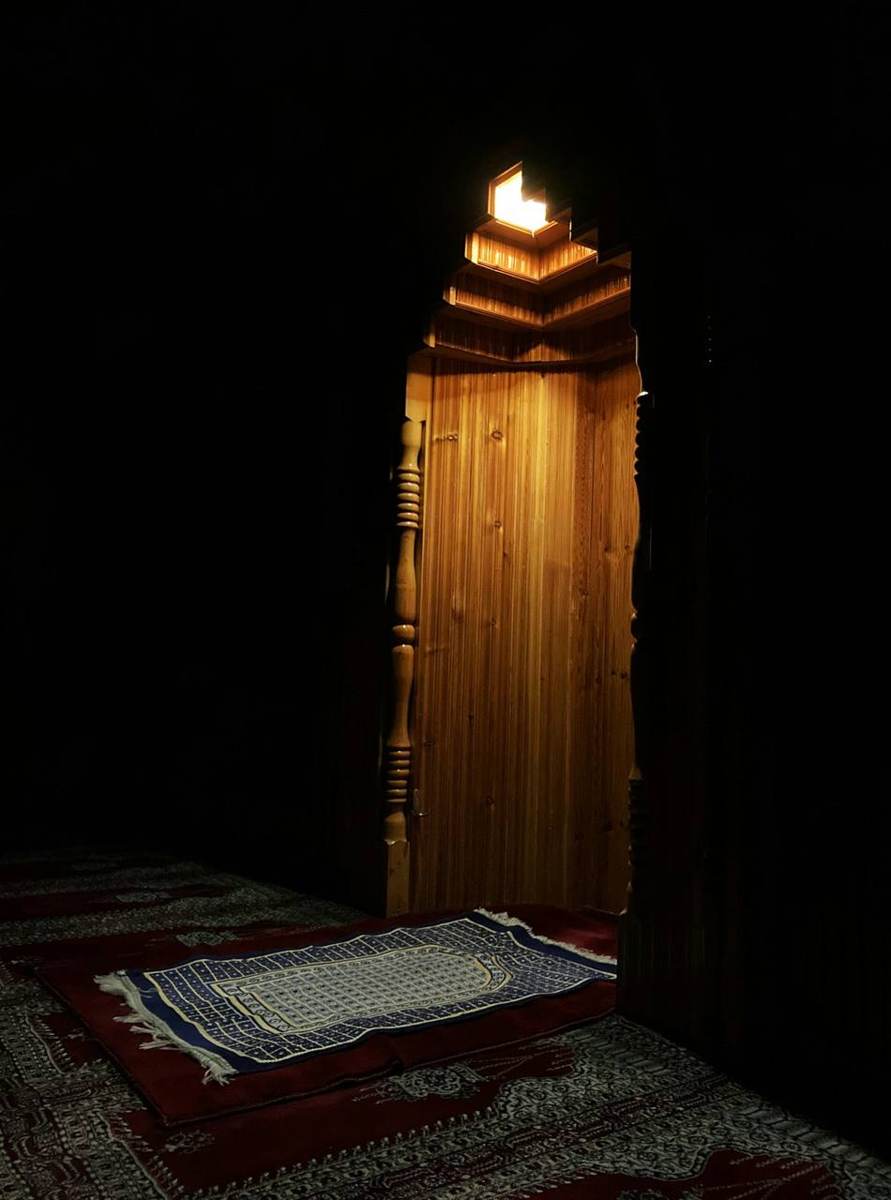
Muslims everywhere face the Ka'bah in Makkah, a cube-shaped house of worship that Muslims believe Abraham and Ishmael raised. This direction is the qiblah. From Britain it is roughly south-east. A niche in the mosque wall, the mihrab, shows the way. The Qur'an records the change of qiblah from Jerusalem to Makkah (2:144).
The movements
Each unit (rak'ah) follows the same shape:
- Standing (qiyam): "Allahu akbar" (God is greater), then the opening chapter of the Qur'an, al-Fatihah, and another passage
- Bowing (ruku'): "Glory be to my Lord, the Magnificent"
- Standing again, then prostration (sujud), forehead, nose, hands, knees and toes on the ground: "Glory be to my Lord, the Most High". This is done twice.
- Sitting (julus), with the testimony of faith (tashahhud) and blessings on the Prophet in the final sitting
- Ending by turning the head right and left: "As-salamu 'alaykum wa rahmatu'llah" (peace be upon you, and the mercy of God)
The words of the prayer are in Arabic, so a Muslim can pray in any mosque in the world. Personal prayer in any language, du'a, can be added at any time.
Together and alone
Prayer can be done anywhere clean: at home, at work, in a park. Praying together in a congregation is especially valued. On Fridays, men gather for the midday Jumu'ah prayer with a sermon (khutbah). Women are welcome and many attend. Rows stand shoulder to shoulder, rich beside poor, with no reserved seats.
Who prays and who is excused
Prayer is required of every adult Muslim of sound mind. Children are taught gently from about seven. Someone who is ill prays as they can, sitting or even lying down. Travellers may shorten four-unit prayers to two and combine some prayers. Women are excused during menstruation and after childbirth, and do not make these prayers up.
Its inner meaning
Salah is an appointment with God, five times a day. It breaks the day into rhythms of remembrance, so that no part of life goes too long without turning back to Him. In prostration, the highest part of the body, the head, is placed on the ground. Muslims see this as the posture of greatest closeness: the Prophet said a servant is never nearer to his Lord than when prostrating (paraphrased; Sahih Muslim 482).
The aim is khushu': humble presence of heart, not just correct movements.
Key verses
"Lo! I, even I, am Allah, There is no God save Me. So serve Me and establish worship for My remembrance." (Qur'an 20:14, Pickthall)
Arabic: إِنَّنِىٓ أَنَا ٱللَّهُ لَآ إِلَٰهَ إِلَّآ أَنَا۠ فَٱعْبُدْنِى وَأَقِمِ ٱلصَّلَوٰةَ لِذِكْرِىٓ
"Be guardians of your prayers, and of the midmost prayer, and stand up with devotion to Allah." (Qur'an 2:238, Pickthall)
"Recite that which hath been inspired in thee of the Scripture, and establish worship. Lo! worship preserveth from lewdness and iniquity, but verily remembrance of Allah is more important." (Qur'an 29:45, Pickthall)
"Seek help in patience and prayer; and truly it is hard save for the humble-minded," (Qur'an 2:45, Pickthall)
Pickthall often translates "salah" as "worship", so "establish worship" means "establish the prayer".
From the Prophet (peace be upon him)
- If a river ran past your door and you bathed in it five times a day, would any dirt be left on you? So it is with the five prayers: through them God wipes away wrongdoing (paraphrased; Sahih al-Bukhari 528, Sahih Muslim 667).
- The nearest a servant comes to his Lord is in prostration, so make many prayers then (paraphrased; Sahih Muslim 482).
- Muslims believe the five daily prayers were given to the Prophet on the Night Journey and Ascension (al-Isra' wa'l-Mi'raj) (paraphrased; Sahih al-Bukhari 349).
Common misunderstandings, answered gently
- "Muslims pray to Makkah or to the Ka'bah." No. The Ka'bah is a direction, not an object of worship. It gives a worldwide congregation one shared focus. Prayer is to God alone.
- "Prayer means rushing out of work five times a day." Most prayers have a window of a few hours. At work, a prayer usually takes a quiet room and ten minutes. Friday prayer is the one that needs a longer midday break.
- "Women aren't allowed in mosques." The Prophet told people not to stop women going to mosques (paraphrased; Sahih al-Bukhari 900, Sahih Muslim 442). Practice varies between communities; many British mosques have dedicated women's spaces and welcome visitors.
Sunni and Shia
Shia Muslims pray the same five prayers, but often combine Dhuhr with 'Asr and Maghrib with 'Isha, praying at three points in the day. Many prostrate on a small tablet of natural clay (a turbah), as they hold that prostration should be on earth or natural material. Some details of posture also differ, such as praying with arms at the sides.
Reflection
If you paused five times today, just to stand still and give thanks, what might change about the day?
In the other traditions
- Judaism: Jews pray three set services each day, Shacharit (morning), Mincha (afternoon) and Ma'ariv (evening), facing towards Jerusalem, with the Amidah, said standing, at the centre.
- Christianity: Christians pray personally and together, often with the Lord's Prayer: "Our Father in heaven, may your name be kept holy" (Matthew 6:9, World English Bible). Some keep set hours of prayer, as in the monastic Daily Office or Anglican Morning and Evening Prayer.
Watch
A Muslim telling
A Muslim telling