In a minute
The creed says "I believe… the holy Catholick Church; the Communion of Saints". For Christians, the Church is not first a building but a people: everyone who belongs to Christ, across every nation and every century, living and departed. St Paul calls it the body of Christ, with Christ as its head and every believer a part.
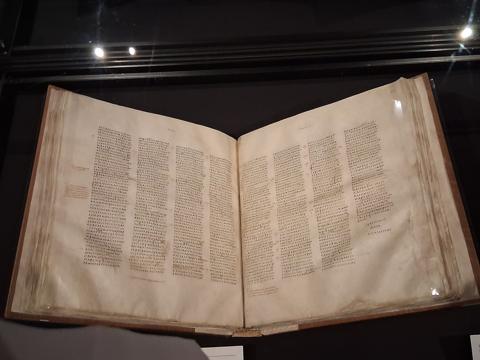
The Church gathers around the Bible, the collection of writings that Christians believe God inspired. It has two parts: the Old Testament, the Scriptures of Israel which Jesus himself read and prayed, and the New Testament, written by his first followers within a lifetime of his death and resurrection.
What it is and how it's lived
The Church: one, holy, catholic, apostolic
The Nicene Creed describes the Church in four words:
- One — one body, however divided in practice; Jesus prayed "that they may all be one" (John 17:21, WEBBE).
- Holy — set apart for God, not because its members are perfect but because God is at work in it.
- Catholic — from Greek katholikos, "according to the whole": universal, for all people everywhere.
- Apostolic — built on the faith of the apostles, the first witnesses sent out by Jesus.
The first believers in Jerusalem "continued steadfastly in the apostles' teaching and fellowship, in the breaking of bread, and prayer" (Acts 2:42, WEBBE). Christians still recognise these four marks of a living church: learning, belonging, Communion and prayer.
"The communion of saints" means that all Christians, on earth and in heaven, belong together in one family. The word saint in the New Testament means every believer; churches also honour particular saints whose lives showed God's love, such as Mary, the apostles, Patrick, Francis or Teresa.
Ministers and members
Most churches have ordained ministers. Catholic, Orthodox and Anglican churches have bishops, priests and deacons; many Protestant churches have ministers, pastors and elders. Catholic and Orthodox churches ordain only men as priests; the Church of England and many Protestant churches also ordain women. But every member is called to serve: the "priesthood of all believers", as Protestants especially stress.
The Bible: a library of books
The word Bible comes from the Greek ta biblia, "the books". It is a library written over more than a thousand years, in Hebrew, some Aramaic and Greek:
| Part | What it contains | Number of books |
|---|---|---|
| Old Testament | the law, history, poetry (Psalms, Proverbs) and prophets of Israel | 39 in Protestant Bibles; 46 in Catholic Bibles; more in Orthodox Bibles |
| New Testament | four Gospels (Matthew, Mark, Luke, John), Acts of the Apostles, 21 letters, and Revelation | 27 in all churches |
The difference in the Old Testament comes from the Deuterocanonical books (such as Tobit, Wisdom and 1 and 2 Maccabees), found in the ancient Greek translation of the Hebrew Bible. Catholic and Orthodox churches include them as Scripture; Protestant churches call them the Apocrypha and value them for reading but not for doctrine. Anglicans read them in worship.
How Christians use the Bible
The Bible is read aloud at every Christian service. Many Christians read a passage daily, often with notes or in a small group. Some memorise verses. Catholic and Anglican churches follow a lectionary, a cycle of readings over three years, so that much of the Bible is heard in turn.
The Bible has been translated, in whole or part, into more than 3,700 languages. In England, William Tyndale's New Testament (1526) and the King James Version (1611) shaped the English language itself.
Its inner meaning
Christians believe the Bible is "God-breathed" (2 Timothy 3:16, WEBBE): written by human authors in their own languages and styles, yet carrying God's word. They read it as a living voice, not only as an ancient text: "For the word of God is living and active" (Hebrews 4:12, WEBBE). Above all, Christians read the whole Bible in the light of Jesus, whom John's Gospel calls the Word.
Being part of the Church means faith is never a solo journey. "Now you are the body of Christ, and members individually" (1 Corinthians 12:27, WEBBE). Every part matters, St Paul says: "The eye can't tell the hand, 'I have no need for you,'" (1 Corinthians 12:21, WEBBE).
Key texts
"For as the body is one and has many members, and all the members of the body, being many, are one body; so also is Christ." (1 Corinthians 12:12, WEBBE)
Greek (1 Corinthians 12:27): Ὑμεῖς δέ ἐστε σῶμα Χριστοῦ — Hymeis de este sōma Christou, "You are the body of Christ".
"Every Scripture is God-breathed and profitable for teaching, for reproof, for correction, and for instruction in righteousness," (2 Timothy 3:16, WEBBE)
"Your word is a lamp to my feet, and a light for my path." (Psalm 119:105, WEBBE)
"For where two or three are gathered together in my name, there I am in the middle of them." (Matthew 18:20, WEBBE)
From the Christian tradition
- St Jerome, who translated the Bible into Latin (the Vulgate, about 382–405), wrote that ignorance of the Scriptures is ignorance of Christ (paraphrased; Commentary on Isaiah, Prologue).
- St Cyprian of Carthage (3rd century) wrote that no one can have God as Father who does not have the Church as mother (paraphrased; On the Unity of the Church 6).
Common misunderstandings, answered gently
- "Christians think every word of the Bible is to be taken literally." Christians agree the Bible is inspired, but most read it with attention to its many kinds of writing: history, poetry, law, parable, letter and vision. Some Protestant Christians hold that the Bible is without error in everything it affirms; others put it differently.
- "The Bible has been changed." Christians point to thousands of ancient manuscripts, some within a few generations of the originals, which scholars compare to establish the text. Translations differ in wording, not in the core message.
- "Churches are only buildings." A building is called a church because the church, the people, meet there. Christians also meet in homes, schools, halls and the open air.
- "Christians are all the same" or "always fighting". There are many traditions, with real differences, but the twentieth century saw a great movement for unity (the ecumenical movement); most churches now pray and work together.
Across the churches
Catholics hold that Scripture and Tradition together, interpreted by the bishops in communion with the Pope, hand on God's word. Orthodox Christians see Scripture as the heart of Holy Tradition, read in the light of the Church Fathers and the councils. Anglicans speak of Scripture, tradition and reason. Many Protestants stress sola scriptura: the Bible as the supreme authority over all church teaching.
Reflection
St Paul says the eye cannot tell the hand, "I have no need for you". Who in your community might be overlooked but is really needed?
In the other traditions
- Judaism: the Hebrew Bible, the Tanakh (Torah, Prophets and Writings), is Jewish Scripture, read in its own order and in Hebrew; the Torah scroll is read in the synagogue through the year, together with the Oral Torah of the rabbis.
- Islam: Muslims believe God revealed the Torah (Tawrat) to Moses, the Psalms (Zabur) to David and the Gospel (Injil) to Jesus, and that the Qur'an, revealed to the Prophet Muhammad, is God's final word.
Watch
A Christian telling
A Christian telling