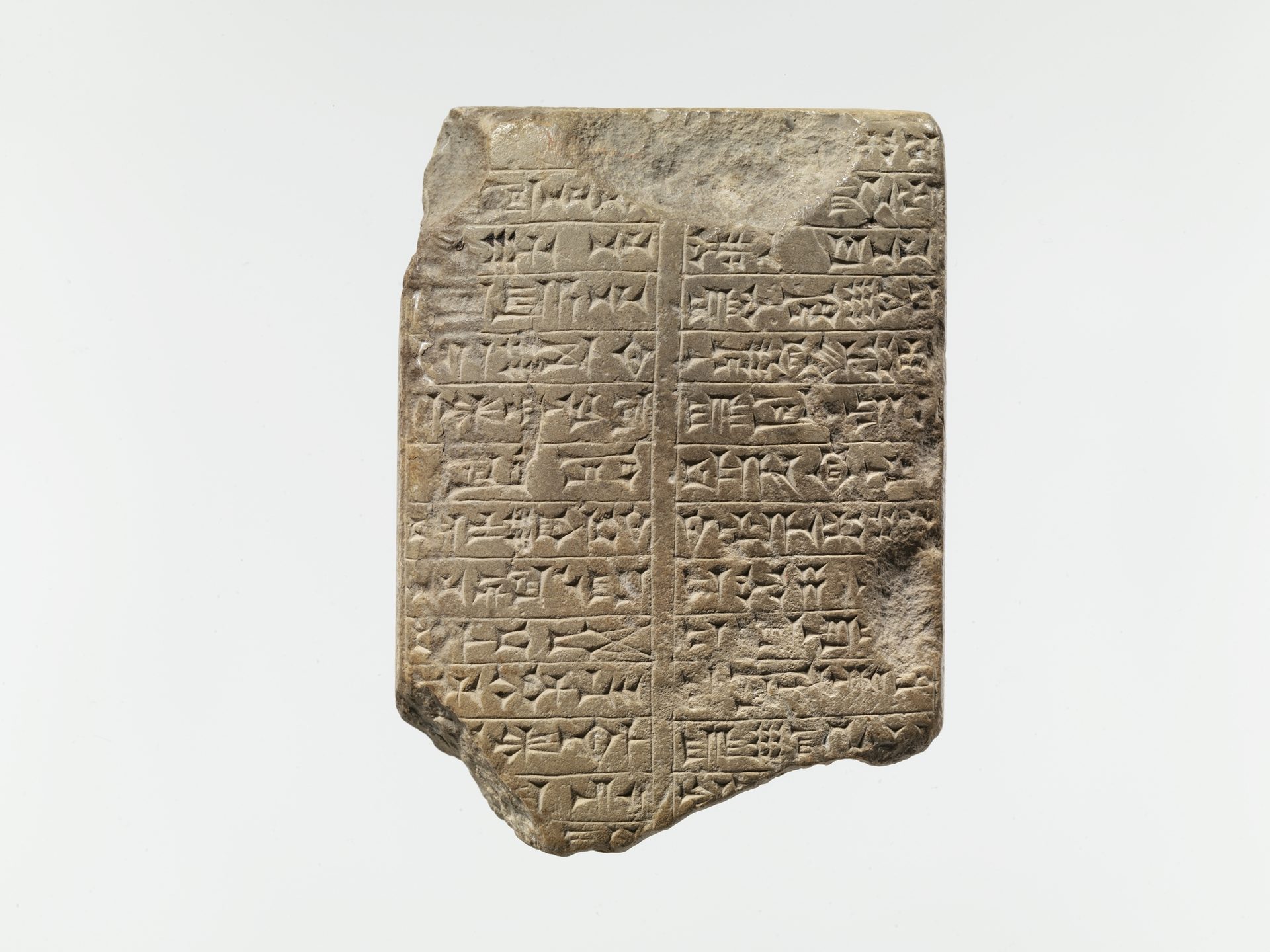
Object
The word on
the church wall
The oldest dated Arabic inscription naming God is on a church.
The Word · The word on the church wall, 512 CE
Next: Who is God to each of us? →In 512 CE, at Zabad, south-east of Aleppo in Syria, Christians dedicated a church to St Sergius. Over the door they carved an inscription in three languages: Greek, Syriac and Arabic. The Arabic line calls on al-ilāh, “the God”: “may God remember…”, followed by the names of the people who built it.
It is the oldest dated Arabic inscription naming God. It is older than Islam by about a century. And it is Christian.
The lintel is now in the Art & History Museum in Brussels. Scholars still discuss exactly how to read its first word; we say no more than the stone does.
Guess first
Is the word Allah older or younger than Islam?
Older. The oldest dated Arabic inscription naming God is on this church, from 512 CE.
Source: Nicolai Sinai, Rain-Giver, Bone-Breaker, Score-Settler (2019), p. 7. We show no photograph of the stone until we have one we may use.
The fuller story
In 512 CE, a century before Islam, a Christian community in northern Syria finished a small shrine to a soldier saint. Over its door they carved a dedication in three languages. One of them was Arabic, and the Arabic line names God: al-ilāh, “the God”. It is the oldest dated Arabic inscription that names God, and it is on a church.
Where and when
Zabad (also spelled Zebed) is a village south-east of Aleppo, on the edge of the Syrian steppe, near ancient Anasartha. In the early sixth century this was Roman country, Christian in faith and mixed in language: Greek for the empire, Syriac for the local churches, and Arabic for the Arab families who farmed, herded and fought along the desert edge. Many of those Arab families were Christians. The great Arab Christian tribe of the region, the Ghassanids, were allies of the empire and keen builders of churches and shrines.
The building was a martyrion, a shrine honouring a martyr. Its saint was Sergius, a Roman soldier remembered for refusing to sacrifice to the old gods, whose great shrine at Rusafa drew Arab Christian pilgrims from across the desert. The Greek text gives the date: the 24th of the month Gorpiaios in the year 823 of the Seleucid calendar, which is 512 CE.
Three languages, three messages
The three inscriptions do not simply translate one another. Each speaks to its own readers.
- The Greek records the official facts: when the shrine was built “from the foundations”, under which clergy, and the names of its two architects, Symeon and Leontius, and its donors.
- The Syriac opens with the church's praise, “Glory be to the Father and to the Son and the Holy Spirit”, and names the man who laid the first stone and the man who wrote the inscription.
- The Arabic is a short prayer for named people. In George Bevan's translation: “May God be mindful of Sirgu son of ʿAbd Manafu and Ha[l/n]i son of Mara al-Qays and Sirgu son of Sadu and Syrw and S[.]ygw.”
“May God be mindful of Sirgu son of ʿAbd Manafu …” The Arabic line at Zabad, 512 CE, translated by George Bevan
These are Arab Christians asking God to remember them, in their own language, on the door of their own church. Several are named Sergius, after the saint.
Where it is now
Johann Gottfried Wetzstein, the Prussian consul in Damascus, noticed the stone in the nineteenth century, and Eduard Sachau published it in 1881. It later passed to a dealer in Aleppo, and by 1904 it had been acquired by the museum in Brussels now called the Art & History Museum, where the lintel is today. We do not show a photograph of it until we have one we are allowed to use.
Why it matters
Some people assume “Allah” is an Islamic invention, or a name for a different god. Zabad shows something simpler. Before the Qur'an was revealed, Arabic-speaking Christians were already calling on the God of Abraham, the God of their Bible, with the Arabic word for “the God”. Arab Christians still do: in Cairo, Beirut and Bethlehem, church prayers are addressed to Allah. When the Qur'an came, it spoke of God to people who already had the word.
What scholars debate
- The first word. The opening of the Arabic is worn. Marc-Antoine Kugener read it in 1907 as “With the help of God”. More recent readings take it as a prayer formula, “May God remember”, which also appears, with a cross, on another Christian Arabic inscription dated 548–549.
- Al-ilāh or Allāh? The stone writes the word with the article, “the God”. Whether readers said al-ilāh or already said the shortened form Allāh cannot be heard from a stone. Nicolai Sinai notes that the full and contracted forms were sometimes used interchangeably.
- The names. Some letters are uncertain, so the names are spelled differently in different editions.
- The script. The Arabic is in Paleo-Arabic, the script between Nabataean and the Arabic of the Qur'an. Scholars such as Ahmad Al-Jallad and Laïla Nehmé use inscriptions like this one to trace how Arabic writing developed.
We say no more than the stone does. It does not tell us what each person believed about God in detail. It tells us that Christians in 512 wrote the Arabic word for God over the door where they prayed.
Reflect
If you had to carve one line over the door of the place you pray, or the place you live, what would it ask God, or the world, to remember?
- Nicolai Sinai, Rain-Giver, Bone-Breaker, Score-Settler: Allāh in Pre-Quranic Poetry (American Oriental Society, 2019), pp. 7–8.
- “Zabad inscription”, Wikipedia, with George Bevan's translations of the Greek, Syriac and Arabic: https://en.wikipedia.org/wiki/Zabad_inscription (read 8 Nov 2026).
- M.-A. Kugener, “Nouvelle note sur l'inscription trilingue de Zébed”, Rivista degli Studi Orientali 1 (1907); summarised at https://www.islamic-awareness.org/history/islam/inscriptions/zebed.html.
- Cult of Saints in Late Antiquity database, E01817: Greek, Syriac and Arabic inscriptions from the door-lintel of a martyr shrine of Sergios in Zabad, University of Oxford: https://portal.sds.ox.ac.uk (search “E01817”).
- E. Sachau, first publication of the inscription (1881), as cited in the sources above.
Watch more: The word on the church wall
6 films and talks, chosen for this page. They play here.
Jewish, Muslim and Christian Arabic: Dr Esther-Miriam Wagner
WoolfInstitute · 8 min
The Origins of Arabic
Let's Talk Religion · 22 min
Let's Talk Religion: the origins of the Arabic language.
Religion in Pre-Islamic Arabia
Let's Talk Religion · 23 min
Let's Talk Religion: religion in pre-Islamic Arabia.
The Gods of Pre-Islamic Arabia
ReligionForBreakfast · 31 min
Hegra Archaeological Site (al-Hijr / Madā ͐ in Ṣāliḥ) (Saudi Arabia) / TBS
UNESCO · 1 min
Coptic Christianity Explained
ReligionForBreakfast · 40 min
ReligionForBreakfast: Coptic Christianity, the ancient Arabic-speaking church.
- More films and talks on F-ILMWatch free