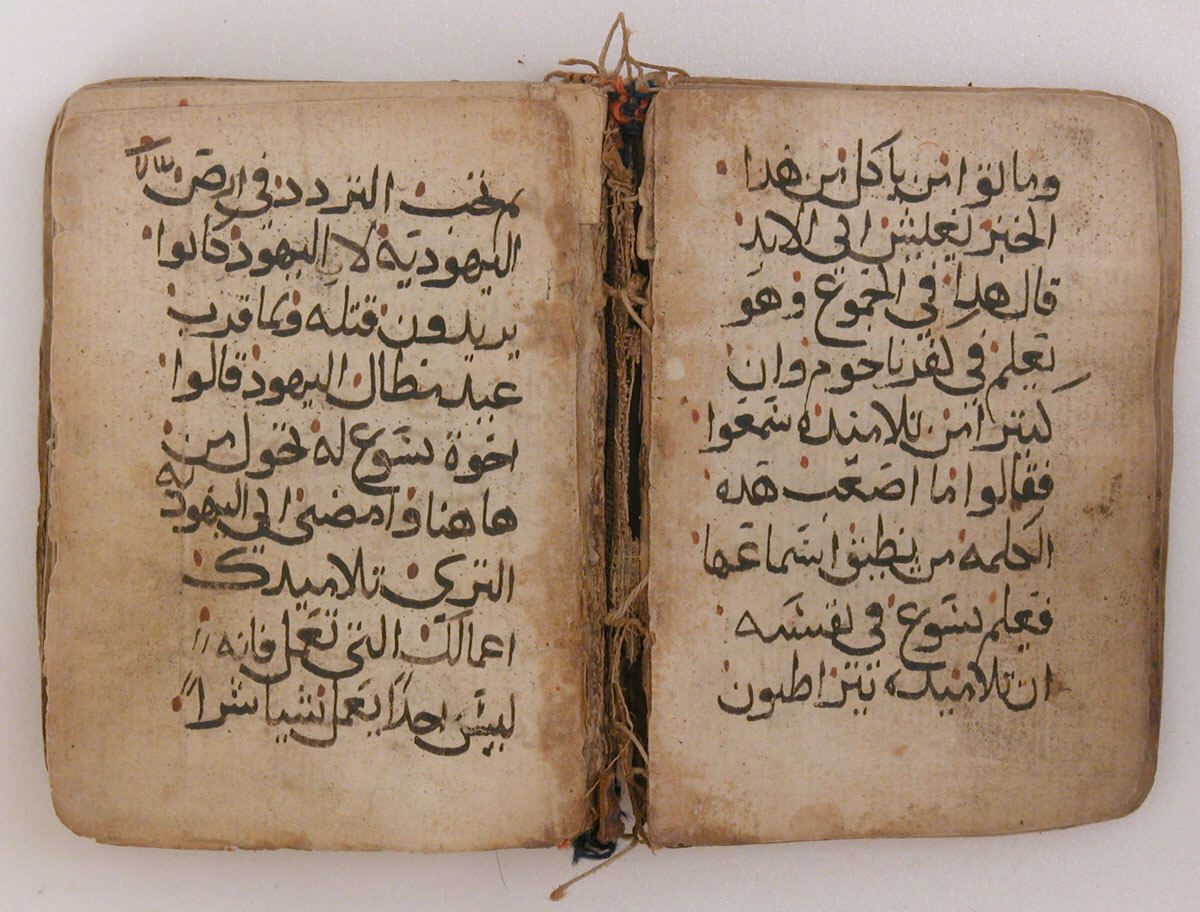
A Christian scholar in Damascus laid down his pen in Ramadan, in the year 253 of the hijri calendar. It was September or October 867 CE. Bishr ibn al-Sirrī had finished putting the letters of the apostle Paul into Arabic, from the Syriac of his own church. When he wrote down the date, he used the month of the Muslim fast and the Muslim calendar, because that was simply how people in Damascus counted time.
His book has survived more than eleven hundred years. It lies in the library of St Catherine's Monastery, at the foot of Mount Sinai in Egypt, under the shelf-mark Sinai Arabic 151. It is the earliest dated manuscript of the Bible in Arabic that scholars know of. Open it at Paul's letter to the Romans and you find, line after line, one word for God: Allāh.
“For the invisible things of him since the creation of the world are clearly seen, being perceived through the things that are made, even his everlasting power and divinity; that they may be without excuse.”
Romans 1:20 · WEB
Paul wrote this to the Christians of Rome in the 50s CE. On the page of Sinai Arabic 151 that carries this verse, Bishr's Arabic, as we read it on the Library of Congress microfilm, speaks of khafiyyāt Allāh, 'the hidden things of God', which His creation has come to know bi-l-iʿtibār, 'by reflection', through 'His might, His power and His divinity'. The word iʿtibār, taking a lesson from what you see, is the same root the Qur'an uses for the lessons in creation. Our reading of individual words is for a specialist in Christian Arabic to check.
The object
What it is. Sinai Arabic 151 is a parchment book, 269 leaves on the Library of Congress microfilm. It holds Paul's letters, divided into 55 chapters, and the Acts of the Apostles with the shorter New Testament letters known as the Catholic Epistles, divided into 32 chapters. Vevian Zaki of the Biblia Arabica project explains that these were once two manuscripts, later bound together, with some lost leaves replaced.
It is more than a translation. Beneath the Bible text Bishr wrote short explanations of difficult words and verses, in smaller, denser lines, often framed in red, and sometimes running up the margins. To show which note belongs to which word he invented a system of red reference marks: dots, dashes, little arrows and a few Greek letters, about five to seven to a page. Later readers copied his marks in black ink. In effect, it is a ninth-century study Bible.
Where and when. Bishr's colophon, the note a scribe writes at the end of a book, says he finished in Damascus in Ramadan 253 AH. The Biblia Arabica blog calls the result 'the earliest dated manuscript of the Arabic Bible'. Bishr worked from Syriac, the Aramaic language of the churches of Syria and Iraq, and he describes himself as translator, interpreter and scribe at once. By then Arabic had become the everyday language of many Christians under Muslim rule, and the churches needed their scripture in it.
How it names God. On the opening pages of Romans, God is Allāh again and again: the wrath of God, rijz Allāh, 'from heaven' (Romans 1:18), and the hidden things of God, khafiyyāt Allāh (1:20). When Paul says 'I thank my God' (1:8), Bishr writes ilāhī, 'my God', from the same root. Jesus (peace be upon him) is Aysūʿ al-Masīḥ, 'Jesus the Messiah', and 'our Lord' is rabbunā. These are our readings of the microfilm image, given so that you can see the word in use; the full scholarly text is Harvey Staal's edition (1983 and 1984).
Who reads it. The monks of St Catherine's, a working Greek Orthodox monastery founded in the sixth century and part of a UNESCO World Heritage Site, have kept it for centuries. The library was microfilmed by a Library of Congress expedition in the mid-twentieth century, and the films are now online, so anyone can turn its pages on a screen. Harvey Staal published the Arabic text with an English translation in the series Corpus Scriptorum Christianorum Orientalium. Today the Biblia Arabica project studies it beside Jewish and Muslim Arabic Bible texts.
What scholars say. One word has started a lively debate. Wherever the Greek says 'Pharisees', Bishr writes al-muʿtazila, 'those who keep themselves apart'. In his day Muʿtazila was also the name of a famous school of Muslim theology. Some scholars took this as a sign that Bishr happily borrowed Islamic vocabulary. Christian Blumenthal (Arabica, 2018) argues for a more careful answer: Bishr chose the word for the Pharisees' ascetic piety and their belief in the resurrection, the qualities Paul himself claims as a Pharisee.
What is uncertain. First, the date belongs to the letters of Paul; because the book joins two manuscripts, the Acts part may have a different history. Second, 'earliest dated' is not the same as 'earliest': undated Arabic Bible fragments may be older, and scholars still argue about when Christians first put the Gospels into Arabic. Third, we know Bishr only from his own book. Fourth, the microfilm is black and white and some words are faint, so every reading, including ours above, should be checked against the edition and, ideally, the parchment.
What each faith says
Judaism
“HEAR, O ISRAEL: THE LORD OUR GOD, THE LORD IS ONE.”
Deuteronomy 6:4 · JPS 1917
Arabic-speaking Jews had their own great translator. Rabbi Saadia Gaon (882–942) was born in Egypt and later led the academy of Sura in Babylonia. Some fifty years after Bishr, he translated the Torah into Arabic, the Tafsīr, ‘explanation’, so that Jews who now thought and prayed in Arabic could read it. He wrote it in Hebrew letters, and called God Allāh, about 1,650 times by our count of his text. His translation is still read in Yemenite Jewish communities beside the Hebrew.
Judeo-Arabic, Arabic written in Hebrew letters, became the everyday language of Jewish learning from Baghdad to Córdoba. Maimonides wrote his Guide for the Perplexed in it. Thousands of its pages survive from the genizah of the Ben Ezra Synagogue in old Cairo, a store-room for worn-out texts that bore God's name, now kept mostly in Cambridge.
Christianity
“First, I thank my God through Jesus Christ for all of you, that your faith is proclaimed throughout the whole world. For God is my witness, whom I serve in my spirit in the Good News of his Son, how unceasingly I make mention of you always in my prayers”
Romans 1:8-9 · WEB
For Arabic-speaking Christians, Allāh is not a borrowed or Muslim word. It is the word for God in their Bibles and prayers, as Theos is in Greek and Deus in Latin. Churches across the Middle East, Orthodox, Catholic, Coptic, Maronite and Protestant, still pray to Allāh in Arabic, and the Van Dyck Arabic Bible of 1865 opens fī al-badʾ khalaqa Allāh, 'In the beginning God created'.
Christians read Romans as one of the great letters of their faith: it is where Paul sets out how God puts people right with Himself. Bishr's Arabic carries Christian belief exactly. Jesus is the Messiah and Lord, and God is Father. What changed was the language, not the faith. Bishr's notes show a teacher who wanted ordinary readers to understand every hard word.
The monastery that kept Bishr's book is itself a living Christian tradition. Greek Orthodox monks have prayed at St Catherine's, at the foot of Mount Sinai, since the sixth century, and its library is one of the oldest in continuous use anywhere.
Islam
“And argue not with the People of the Scripture unless it be in (a way) that is better, save with such of them as do wrong; and say: We believe in that which hath been revealed unto us and revealed unto you; our God and your God is One, and unto Him we surrender.”
Qur'an 29:46 · Pickthall (1930)
Muslims honour the Tawrāh and the Injīl as scriptures that God sent before the Qur'an. Paul's letters are not the Injīl of Islam, and Muslims and Christians understand Jesus differently: Muslims hold him to be a mighty messenger of God and the Messiah, not divine. Even so, the Qur'an asks Muslims to speak with Christians and Jews 'in the best way', and to say 'our God and your God is one'.
Muslim readers may notice how at home Bishr's vocabulary feels. His word iʿtibār, learning a lesson from what you see, shares its root with the Qur'an's ʿibra, as in 'And lo! in the cattle there is a lesson for you. We give you to drink of that which is in their bellies, from betwixt the refuse and the blood, pure milk palatable to the drinkers.' (16:66, Pickthall). Both Paul's verse and the Qur'an point to creation as a place where God's work can be read: 'Lo! In the creation of the heavens and the earth and (in) the difference of night and day are tokens (of His Sovereignty) for men of understanding.' (3:190, Pickthall).
Same and different
All three traditions agree that the One God can be named in any human language, and in the ninth and tenth centuries Jews, Christians and Muslims in the Arabic-speaking world all said Allāh. They genuinely differ on who Jesus is, on whether Paul's letters are scripture, and on the Trinity, which Christians confess and Jews and Muslims do not. Sinai Arabic 151 does not settle those differences. It shows that they were argued about, and prayed through, in one shared word. In the ninth and tenth centuries, a Christian in Damascus and a rabbi in Iraq were each doing the same thing for their own communities. They were giving their scriptures to people who now thought, prayed and argued in Arabic. Neither borrowed the other's faith. They shared a language, and the language had one everyday word for the One God.
A moment to reflect
- What everyday habits do you share with neighbours of a different faith, or none, without even thinking about it?
- If you translated your most treasured text into another language, which words would be hardest to carry across?
- When someone uses a word you don't know, would you rather they explained it or swapped it for an easier one?
- Is a word for God the same as a belief about God? Where would you draw the line?
Watch
A short look inside the library where Sinai Arabic 151 has been kept, from the National Library of Israel.
A two-minute news film on the monastery's ancient manuscripts and how they are being preserved.
Historian Claudia Rapp's lecture on St Catherine's and its manuscripts, for those who want the full story.
A Bible translation podcast on the world that produced the Arabic Bible, in plain language.
Do it together
Open the Library of Congress images of Sinai Arabic 151 and find image 5, the start of Romans. Look for the word الله, which has a distinctive shape: a tall upright stroke, two more uprights, then a loop. Count how many times you can spot it on one page.
Give pupils a short passage with three hard words. They write a one-line explanation of each at the foot of the page and invent their own marks to link note and word, as Bishr did. Then swap and see whether someone else can follow the system.
Invite an Arabic speaker, a Christian and a Muslim to read Romans 1:20 in English and Arabic, and Qur'an 3:190 in English and Arabic. Talk about what is shared and what is different in the two ideas of reading God's signs in creation.
Browse the Cairo Genizah collection on the Cambridge Digital Library and find a page of Judeo-Arabic: Arabic words in Hebrew letters. Compare it with an image of Sinai Arabic 151. Two scripts, one language, two faiths.
Go deeper
- Sinai Arabic 151 on the Library of Congress site · manuscript
- Lost in the Margins: Reference Marks in MS Sinai Arabic 151 (Biblia Arabica) · article
- Saint Catherine Area (UNESCO World Heritage) · heritage
- Romans 1 (World English Bible) · scripture
- Qur'an 29:46 · scripture
- Taylor-Schechter Genizah Research Unit (Cambridge University Library) · article
- Saadya [Saadiah] Gaon (Stanford Encyclopedia of Philosophy) · article
Sources (7)
- Finished in Damascus, Ramadan 253 AH (September/October 867 CE), by Bishr ibn al-Sirrī from Syriac; 'the earliest dated manuscript of the Arabic Bible'; two manuscripts bound together; 55 and 32 chapters; red reference marks and notes: Vevian Zaki, Biblia Arabica blog, 3 November 2022
- Library of Congress record: Arabic Manuscripts 151, Epistles and Acts, 867, vellum, 269 folios on microfilm: Library of Congress, Manuscripts in St Catherine's Monastery, Mount Sinai
- Our readings of Romans 1:8, 1:17–20 (Allāh, ilāhī, rabbunā, Aysūʿ al-Masīḥ, khafiyyāt Allāh, bi-l-iʿtibār): Library of Congress microfilm, image 5
- Edition and translation: Harvey Staal, Mt Sinai Arabic Codex 151, CSCO 452–453 (1983) and 462–463 (1984): Biblia Arabica bibliography
- Bishr translates 'Pharisees' as muʿtazila; Blumenthal's explanation (ascetic piety, resurrection): Christian Blumenthal, Arabica 65.3 (2018), pp. 314–330
- St Catherine's Monastery and its setting are a UNESCO World Heritage Site (Saint Catherine Area): UNESCO World Heritage List
- Saadia Gaon's Arabic Torah uses Allah about 1,650 times: Tafsir Rasag (Derenbourg edition) on Sefaria; our count