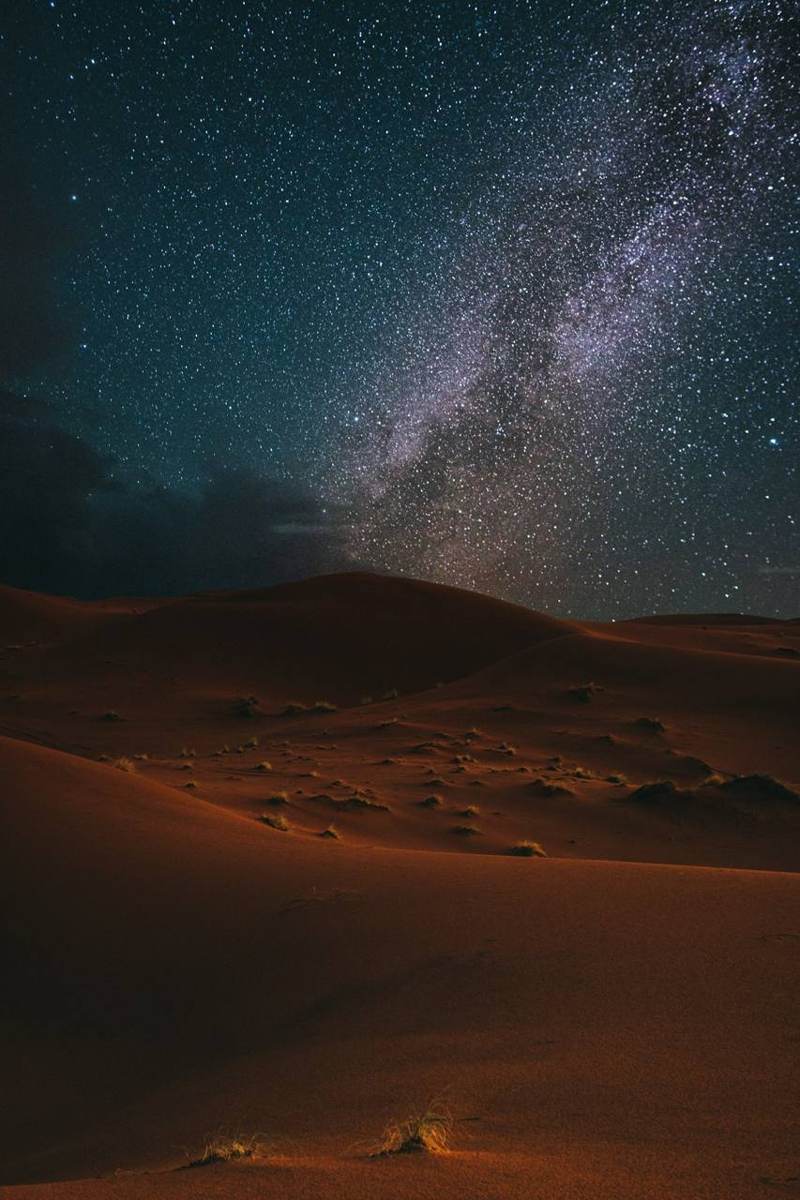
Shepherds scratched words onto black basalt rocks where Syria, Jordan and Saudi Arabia now meet, two thousand years ago. It was how they passed the long hours. They wrote their names, their family trees, their grief for a dead friend, and their prayers for rain. Archaeologists call their writing Safaitic, and tens of thousands of these graffiti survive.
Most of their prayers go to a goddess, Allāt: 1,437 times in one scholar's count. But 41 times, the nomads call on Allāh, 'the god'. One of them carved an oath that still reads clearly: 'by Allāh, who is living'. The word was in the desert before Islam. What it meant there, and how that meaning grew, is one of the most interesting stories in the history of religion.
“And if thou wert to ask them: Who created the heavens and the earth, and constrained the sun and the moon (to their appointed work)? they would say: Allah. How then are they turned away?”
Qur'an 29:61 · Pickthall (1930)
The Qur'an itself says that its first hearers in Mecca already knew the name Allāh and called Him Creator. Its quarrel with them was not about the name but about worshipping other powers beside Him. It names some of those powers too: 'Have ye thought upon Al-Lat and Al-'Uzza And Manat, the third, the other?' (53:19–20, Pickthall).
What the stones and poems show
The desert inscriptions. Safaitic inscriptions date from about the first century BCE to the fourth century CE. In his open-access book The Religion and Rituals of the Nomads of Pre-Islamic Arabia (2022), Ahmad Al-Jallad, a specialist in ancient Arabian languages, counts Allāh 41 times, spelled ʾlh 15 times and lh 26 times. Allāt is invoked 1,437 times. He describes Allāh as 'a deity likely introduced from the west, literally meaning "the god"'. A Greek spelling of a nomad's name, Ouaballas for Wahb-Allāh, 'gift of God', confirms how the word was said.
Among other gods. In these inscriptions Allāh is one name among several. One text calls on him beside Dusares, the great god of the Nabataeans, which Al-Jallad says 'seems to exclude the identification of these two gods'. Another calls on Allāh beside Allāt. One man asks, 'O Allāh, deliver.' Another swears 'by Allāh, who is living'. A single inscription prays to 'the One' alongside Allāt, and scholars still debate whom the writer meant: Al-Jallad first linked it to the Jewish God of the Shema, then later to a Greek title, 'one god'.
Christians in stone. Further north, Arabic-speaking Christians were writing too. Over the door of a church of St Sergius at Zabad, near Aleppo, in 512 CE, they carved a prayer in Arabic: dkr ʾl-ʾlh, 'may God remember'. Christian inscriptions of the sixth century consistently write al-ilāh, 'the God', in full. Most scholars think the short form Allāh grew out of this al-ilāh, much as Allāt grew from al-ilāt, 'the goddess'.
The poets. Arabia's pride was its poetry, recited from memory and written down later. Zuhayr ibn Abī Sulmā, who died around 609, warns in his famous ode: 'Do not hide from Allāh what is in your souls, hoping it stays hidden: whatever is hidden, Allāh knows.' The poet Labīd, who lived on into the time of Islam, wrote: 'Is not everything, apart from Allāh, vanishing?' Nicolai Sinai of Oxford, who studied this poetry closely, finds that Allāh as Creator and as the highest power was common ground between the Qur'an and its opponents.
How sure can we be? The stones are first-hand: they are as their writers left them. The poetry is different. It was carried by memory for generations before being written down in the eighth and ninth centuries, and since the 1920s scholars, including the Egyptian writer Ṭāhā Ḥusayn, have debated how much of it was reshaped later. Most specialists today treat much of it as genuinely old, but read individual lines with care.
A myth to set aside. You may meet the claim that Allāh was once a moon god. Specialists reject it. In the poets' oaths the moon is something Allāh made, and in the inscriptions Allāh appears beside other gods, not as the moon. The honest picture is richer than the myth: a word meaning 'the god', used by nomads among many gods, by Christians for the one God, and then, in the Qur'an, for the One alone.
What each faith says
Judaism
“HEAR, O ISRAEL: THE LORD OUR GOD, THE LORD IS ONE.”
Deuteronomy 6:4 · JPS 1917
Jews lived in Arabia long before Islam. There were Jewish tribes in Yathrib, the later Medina, and in the oases of the north, and in Yemen the kings of Ḥimyar turned to a strict monotheism in the fourth century, calling in their inscriptions on Raḥmānān, 'the Merciful', a name for God shared with Jewish Aramaic. The 'One' in that single Safaitic prayer reminded Al-Jallad of the Shema.
Judaism's own memory of the wider world's gods is told in the Hebrew Bible: Abraham leaving his father's house, and the prophets calling Israel back from the gods of the nations. That memory is kept in daily practice. Jews say the Shema morning and evening and again at bedtime. Many cover their eyes for its first line, to shut out everything else, and at bedtime it is the last thing they say before sleep.
Christianity
“that they should seek the Lord, if perhaps they might reach out for him and find him, though he is not far from each one of us. ‘For in him we live, move, and have our being.’ As some of your own poets have said, ‘For we are also his offspring.’”
Acts 17:27-28 · WEB
Christianity reached the Arabs early. Arab Christian kingdoms such as the Ghassanids in Syria and the Lakhmids at al-Ḥīra, on the Euphrates, prayed in Syriac and Arabic. Najrān in south Arabia had a famous Christian community. The Zabad inscription is their voice: Christians naming the one God as al-ilāh, a century before Islam.
Christians have long been comfortable finding true words about God in poets outside their own faith. When Paul spoke in Athens, he quoted a Greek poet to describe the God he preached. Arab Christians had poets of their own: ʿAdī ibn Zayd, a Christian of al-Ḥīra, the Lakhmid capital on the Euphrates, wrote Arabic verse in the sixth century. The churches of the region sang their liturgy in Syriac, the Aramaic of the Eastern churches.
Islam
“And cry not unto any other god along with Allah. There is no God save Him. Everything will perish save His countenance. His is the command, and unto Him ye will be brought back.”
Qur'an 28:88 · Pickthall (1930)
In Islam's own account, the Kaaba in Mecca was raised by Abraham and his son Ishmael (peace be upon them) for the worship of the One God. Over the centuries idols were set up around it, though people still knew Allāh as the highest. The Qur'an's message, in this telling, was a call back: worship Allāh alone, with no partner.
Muslim tradition honours true words wherever they were said. The Prophet Muhammad called Labīd's line the truest thing a poet ever said (Bukhārī 3841). The Qur'an carries the same thought in its own words: 'And cry not unto any other god along with Allah. There is no God save Him. Everything will perish save His countenance. His is the command, and unto Him ye will be brought back.' (28:88, Pickthall).
Same and different
All three traditions agree that God was known, or half-known, before their own scriptures arrived, and each honours people who reached towards Him. Jews trace the word's family through El and Elohim; Christians remember Arab Christians writing al-ilāh; Muslims read the Qur'an as restoring Abraham's worship of the One. They differ in how they read the same evidence: the historian sees a word whose meaning changed among nomads, Christians and Muslims, while Muslims believe the One God was always the true meaning of the name, sometimes forgotten, then restored. Words travel between the families too. The Hebrew El and Elohim and the Arabic Allāh come from the same ancient Semitic root. And each tradition honours true words from outside. Paul quoting a Greek poet at Athens is a fair pair with the way the Prophet Muhammad ﷺ (peace be upon him) praised a line of Labīd.
A moment to reflect
- A shepherd two thousand years ago carved a prayer for rain. What would you carve, if you had one line?
- Can a word mean different things to different people and still point to the same reality?
- Labīd's line was praised by someone of a different generation and outlook. Where have you found true words in an unexpected place?
- How do we treat evidence that was passed down by memory, compared with evidence carved in stone?
Watch
A careful, well-sourced explainer by a scholar of religion on what the inscriptions and poetry show.
Ahmad Al-Jallad, whose counts we use, in conversation about Allāh and Allāt before Islam.
The wider world of pre-Islamic Arabian gods and goddesses, explained calmly.
An introduction to the Muʿallaqāt, the 'hanging odes' of Zuhayr, Labīd and the other great poets.
Do it together
Give everyone a smooth stone or a piece of grey card. Each person scratches or writes one short line: their name, who they come from, and one hope. Lay them out together and read them aloud, as an archaeologist would read the desert.
Read Labīd's line and Zuhayr's lines in Arabic and English, then ask each guest to bring a short poem from their own tradition about time passing or what lasts. Psalm 90, a hymn or a ghazal all work.
Al-Jallad's book on the nomads' religion is free to download. Take one chapter each, with a glossary to hand, and report back on one prayer that surprised you.
Many Jewish families say the Shema at bedtime, covering their eyes for the first line. Ask a Jewish friend to show you how, then talk together about what you would want to be your last words of the day.
Several UK cities have Arabic-speaking churches: Coptic, Antiochian Orthodox, Maronite and Arabic Anglican. Ask permission, attend a service together, and listen for al-ilāh and Allāh in the prayers, words Arab Christians were using before Islam.
Go deeper
- Ahmad Al-Jallad, The Religion and Rituals of the Nomads of Pre-Islamic Arabia (Brill, open access, 2022) · book
- Nicolai Sinai, Rain-Giver, Bone-Breaker, Score-Settler: Allāh in Pre-Quranic Poetry (2019) · book
- Who was Allah before Islam? (Medievalists podcast with Ahmad Al-Jallad) · article
- Ṣaḥīḥ al-Bukhārī 3841 (Labīd's line) · scripture
- Qur'an 29:61 · scripture
- Deuteronomy 6, the Shema (Sefaria) · scripture
- Acts 17 (Bible Gateway, WEB) · scripture
Sources (7)
- Safaitic: Allāh 41 times (ʾlh 15, lh 26), Allāt 1,437; 'a deity likely introduced from the west, literally meaning "the god"'; Wahb-Allāh = Ουαβαλλας; beside Dusares (KRS 2298); 'by Allāh, who is living' (SIJ 293): Al-Jallad 2022, p. 93
- 'The One' in KRS 1131 and Al-Jallad's two readings: Al-Jallad, 'The "One" God in a Safaitic Inscription', Eretz-Israel 34 (2021); Al-Jallad 2022
- Zabad 512 CE, dkr ʾl-ʾlh; Christians wrote al-ilāh; Allāh from al-ilāh preferable; Allāh's supremacy common ground; the moon as Allāh's creation in oaths: Sinai 2019, pp. 7–8, 18–27
- Zuhayr's lines (Muʿallaqa, lines 75–76): OpenITI, Zuhayr ibn Abī Sulmā, Muʿallaqa
- 'The truest word spoken by a poet is the word of Labīd: Is not everything, apart from Allah, vanishing?': Ṣaḥīḥ al-Bukhārī 3841
- The moon-god claim (Winckler 1901) is rejected by specialists: Wikipedia, Allah as a lunar deity (citing Crone 2004 and Al-Jallad 2025)
- Debate on the authenticity of pre-Islamic poetry since Ṭāhā Ḥusayn (1926): Encyclopaedia Britannica, Arabic literature