Far out in space is a quasar so distant that its light set out about eight billion years ago, long before the Earth formed. On the way to us, that light passed through a cloud of gas. In a study published in 2022, astronomers used the ESPRESSO instrument on the Very Large Telescope in Chile to read the cloud's fingerprints. One of nature's basic numbers, which sets the strength of electricity and magnetism, came out the same as in a laboratory on Earth, to within 1.4 parts in a million.
One universe, one rulebook. The same rules then and now, there and here. For billions of years they have stayed steady enough for stars to burn, planets to form and life to grow. Many believers see in that one steady order the signature of one Maker, and it is that order, and the One behind it, that they thank.
“Say: He is Allah, the One! Allah, the eternally Besought of all! He begetteth not nor was begotten. And there is none comparable unto Him.”
Qur'an 112 · Pickthall (1930)
In Arabic: Qul huwa Allāhu aḥad. Allāhu ṣ-ṣamad. Lam yalid wa lam yūlad. Wa lam yakun lahū kufuwan aḥad. Muslims call this chapter al-Ikhlāṣ, “sincerity”. It describes God without a single picture: one, needed by all, without parents or children, like nothing else. Our page One God takes it line by line.
The same laws everywhere, for billions of years
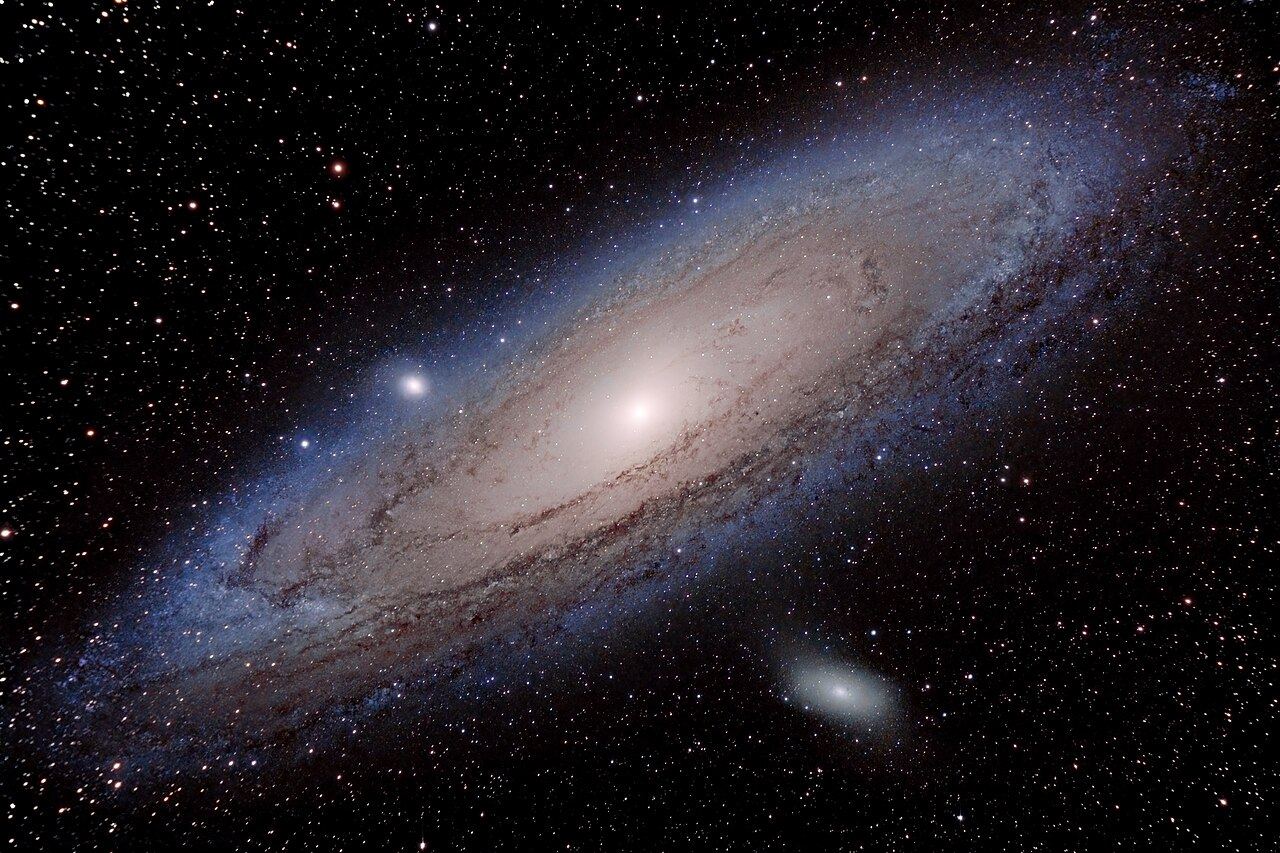
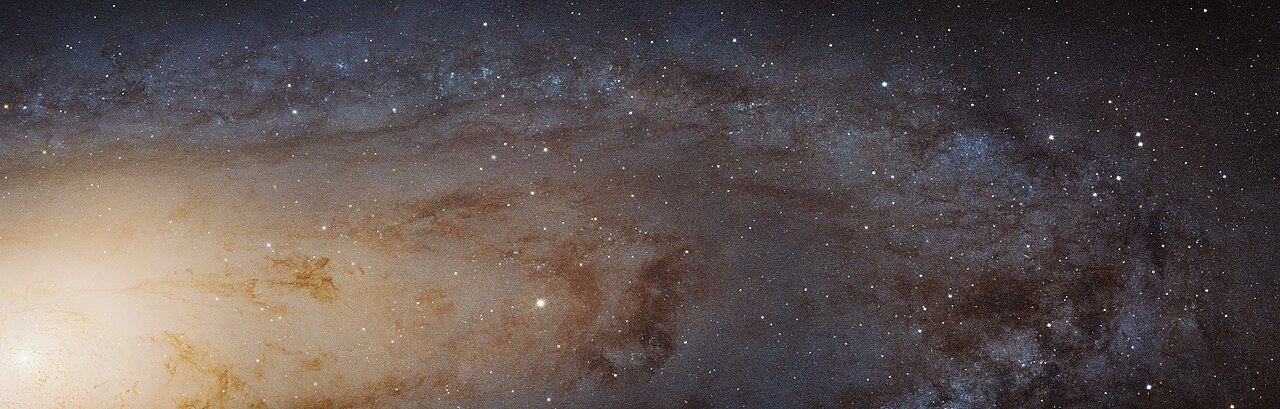
Physicists work on an assumption that keeps passing its tests: the laws of nature are the same everywhere and at all times. Light from distant galaxies carries the same chemical fingerprints as hydrogen, oxygen and iron on Earth. Measurements of quasar light have found no reliable change in nature's constants across billions of years.
That steadiness matters for us. The Sun has been shining for about 4.6 billion years. Life on Earth is at least 3.5 billion years old, and has needed steady conditions the whole time: liquid water, a stable star, a protective atmosphere. Evolution itself depends on the rules staying put. It needs vast stretches of time under the same laws.
The reasoning, plainly. One: we see one set of laws, the same in every place and age we can measure. Two: many separate powers, each in charge of a different part of nature, would not obviously produce one consistent rulebook. Three: one order fits naturally with one Source. The Qur'an makes this point itself (21:22).
A fair reply from a sceptic: the unity of the laws is real, but it may simply be how nature is, a brute fact. Or a deeper physical theory may one day explain why the laws are the same everywhere. A believer can answer that a deeper theory moves the question back a step: why that theory, so steady and so readable? Our page on the order of nature sets out both sides in full.
What each faith says
Judaism
“Let them praise the name of the LORD; For He commanded, and they were created. He hath also established them for ever and ever; He hath made a decree which shall not be transgressed.”
Psalm 148:5–6 · JPS 1917
Jews declare God's oneness every morning and evening in the Shema: “Hear, O Israel: the LORD our God, the LORD is one” (Deuteronomy 6:4). The philosopher Maimonides (1138–1204) taught that God's oneness is unlike any other kind of one: not one of a group, and not made of parts. The Hebrew Bible sees one Maker's command behind the fixed order of the skies. After the flood, God promises that “seedtime and harvest, and cold and heat, and summer and winter, and day and night shall not cease” (Genesis 8:22).
Christianity
“one God and Father of all, who is over all and through all and in us all.”
Ephesians 4:6 · World English Bible (British Edition), public domain
The Nicene Creed, agreed by church councils in 325 and 381 and said in churches every Sunday, begins “We believe in one God”. Christians understand this one God as Father, Son and Holy Spirit, while holding that there are not three gods. Early scientists such as Johannes Kepler studied the heavens expecting to find one rational order, because they believed in one rational Maker.
Islam
“If there were therein gods beside Allah, then verily both (the heavens and the earth) had been disordered. Glorified be Allah, the Lord of the Throne, from all that they ascribe (unto Him).”
Qur'an 21:22 · Pickthall (1930)
Tawḥīd, God's oneness, is the centre of Islam. Al-Ikhlāṣ says it in four lines, and the Prophet Muhammad is reported to have called it equal to a third of the Qur'an (Bukhari 5013). The Qur'an invites readers to look at the sky again and again, and promises they will find no flaw in it (67:3–4). It also argues from the order of the world to the oneness of its Maker.
Without religion
Many non-religious scientists feel deep awe at the unity of nature. For them, the order is the wonder, and needs nothing beyond itself. Some expect physics to explain it one day. Others think it may simply be a fact we have to accept. Either way, they share the believer's trust that the universe makes sense, without which science could not begin.
Sikhi
“There is but one God whose name is true, the Creator, devoid of fear and enmity, immortal, unborn, self-existent; by the favour of the Guru.”
Guru Granth Sahib, ang 1 (Mul Mantar) · Max Arthur Macauliffe, The Sikh Religion (1909), public domain
The Guru Granth Sahib begins with the numeral 1: Ik Onkar, “One Creator”. The opening statement, the Mul Mantar, goes on to describe that One. Later in the Japji, Guru Nanak says the order of nature is upheld not by the mythical bull of old stories but by righteousness, the child of mercy, held steady by patience.
Hindu traditions
Many Hindu traditions speak of one ultimate reality, Brahman, behind everything that exists. The Vedas also speak of ṛta, the cosmic order that keeps the Sun, the seasons and the rivers on course, an idea that later fed into dharma. Hindus differ on whether the One is personal, and on how the many deities relate to the One. Many say they are faces of a single divine reality.
Beyond the Abrahamic faiths
Ancient Greek thinkers looked for one principle behind everything. Heraclitus called it the logos, the reason running through the world. Scientists today seek a “theory of everything”, a single framework for all of nature's forces. It has not been found, but the search itself assumes that nature is one.
Same and different
Jews, Christians, Muslims and Sikhs all begin with One, and describe that oneness in their own ways: the Shema, one God confessed as Father, Son and Holy Spirit, tawḥīd, Ik Onkar. Many Hindus speak of one reality behind many forms. All of them see the steady order of nature as something made and kept. Science cannot settle who or what stands behind the order. But believers and sceptics agree on the order itself, and that shared starting point is a good place to stand together.
A moment to reflect
- Why does it matter that the laws of nature are the same everywhere?
- If the laws changed from day to day, what would happen to life, and to science?
- Does one order point to one Maker? What is the strongest reason for and against?
- Al-Ikhlāṣ describes God without any picture at all. Why might that matter?
Do it together
Look at a spectrum of hydrogen in a lab or online, then at a spectrum from a distant galaxy. Spot the same lines. Discuss what that tells us about the laws of nature.
Read aloud al-Ikhlāṣ, the Shema, the opening of the Nicene Creed and the Mul Mantar. Ask each person what the word “one” means in their own tradition.
Play our What if? game, which asks what would happen if nature's rules were slightly different. Talk about which change surprised you most.
Go deeper
- Precise limit on variations in the fine-structure constant (A&A highlight, 2022) · research
- Qur'an 112 (Quran.com) · scripture
- Mul Mantar, ang 1 (SikhiToTheMax) · scripture
- Psalm 148 (Sefaria, JPS 1917) · scripture
In pictures
Sources (9)
- Fine-structure constant matches Earth value to within 1.4 parts per million at redshift 1.15 (look-back about 8.4 billion years), ESPRESSO on the VLT: Astronomy & Astrophysics 2022 highlights (Murphy et al.)
- Psalm 148:5–6, Genesis 8:22, Deuteronomy 6:4 text: Sefaria, JPS 1917
- Ephesians 4:6 text: World English Bible (British Edition) via bible-api.com
- Qur'an 112, 21:22, 67:3–4 meanings (rendered Pickthall (1930) where quoted); transliteration follows the site's word/one-god page: Quran.com
- Al-Ikhlas equal to a third of the Qur'an: Sahih al-Bukhari 5013 (sunnah.com)
- Mul Mantar and Japji pauri 16 (order of nature upheld by dharma) in Macauliffe's translation: Max Arthur Macauliffe, The Sikh Religion, vol. 1 (1909), Wikisource
- Sun about 4.6 billion years old; life at least 3.5 billion years: NASA, Sun facts; Wikipedia, Earliest known life forms
- Ṛta, Vedic cosmic order: Wikipedia, Ṛta
- Nicene Creed (325, revised 381): Wikipedia, Nicene Creed