
The first question God asks a human being in the Bible is not “What have you done?” It is “Where art thou?” (Genesis 3:9). A man and a woman are hiding among the trees, ashamed, and God comes looking for them.
The story of Adam (peace be upon him) and Eve is one of the most retold in the world. It has shaped how billions of people think about freedom, temptation, shame, men and women, work, death and forgiveness. Jews, Christians and Muslims share it. But read the three versions side by side and you find that they ask different questions of it, and come away with different answers.
“They said: Our Lord! We have wronged ourselves. If thou forgive us not and have not mercy on us, surely we are of the lost!”
Qur'an 7:23 · Pickthall (1930)
In Surah al-A’raf, Adam and his wife are tempted together, eat together and repent together. These words became one of the best-known prayers of repentance in Islam. In Genesis, the first words God speaks after the fruit is eaten are a question: “Where art thou?” (Genesis 3:9, JPS 1917).
The world behind the story
Genesis places the garden of Eden “eastward” and names four rivers flowing out of it, two of which are the Tigris and the Euphrates (Genesis 2:14). That points to Mesopotamia, modern Iraq, the same land where some of the world’s oldest writing was found. Archaeologists have read Mesopotamian stories from that region, such as Atrahasis and the Enuma Elish, in which gods make humans from clay mixed with divine blood. Genesis, too, has the first human formed “of the dust of the ground” and given life by God’s breath. But in Genesis humans are made with dignity, not as servants to lazy gods.
Science tells a different kind of story about human origins. Fossils from Jebel Irhoud in Morocco, published in 2017, push the earliest known Homo sapiens back to about 300,000 years ago. Genetics shows that modern humans share common ancestors with other living apes. It also shows that our species has never, in that time, been a population of only two people: the evidence suggests populations of at least several thousand.
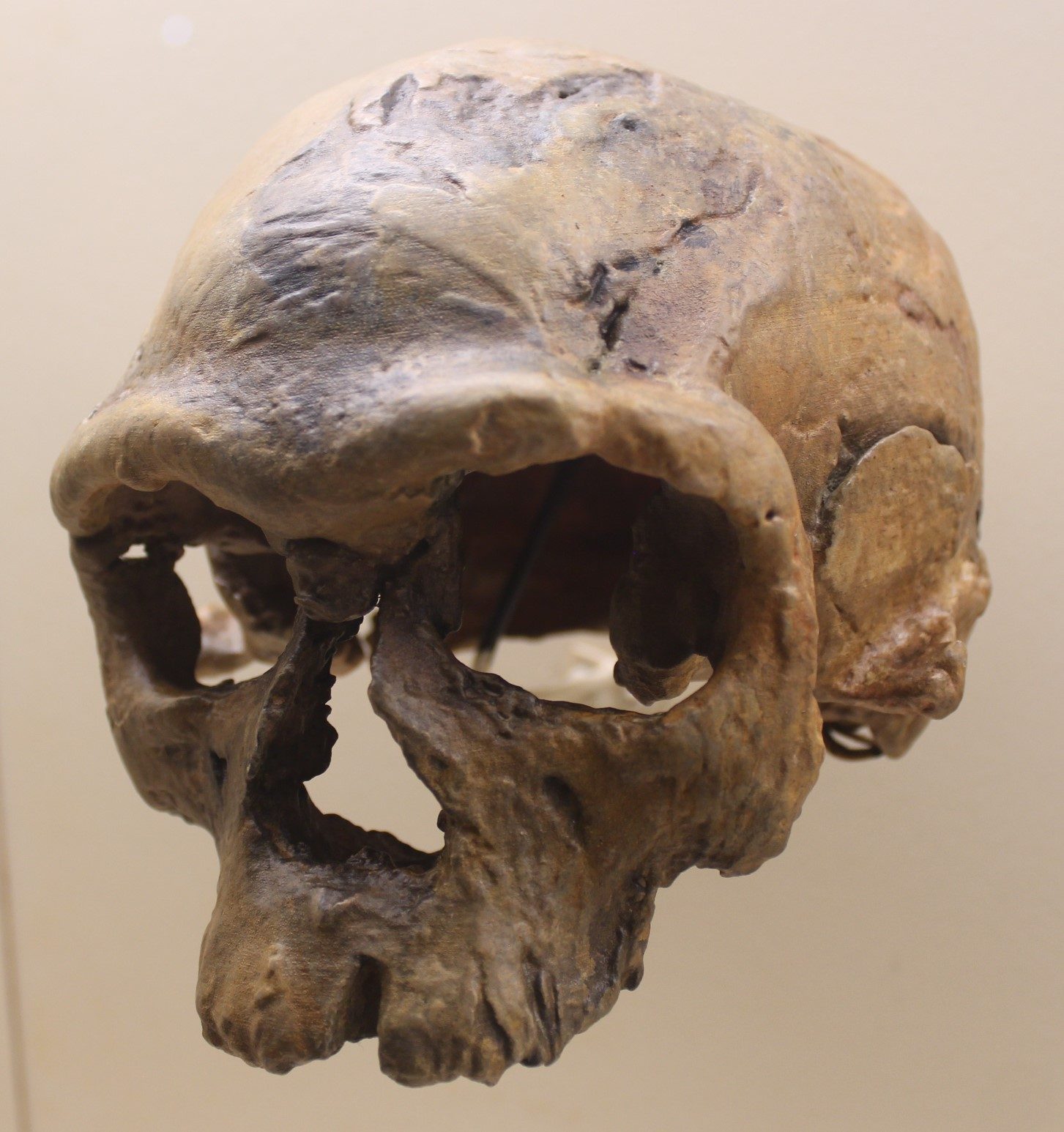
Geneticists talk about “Mitochondrial Eve” and “Y-chromosomal Adam”, the most recent women and men from whom all living people inherit those particular pieces of DNA. Despite the names, they were not a couple; they probably lived tens of thousands of years apart, among many other people.
Believers read all this in different ways. Some hold to a literal first couple created directly by God a few thousand years ago. Many Jews and Christians read Genesis 2–3 as a true story told in symbolic form about all of us. Some Christian scientists, such as Joshua Swamidass, argue for a real Adam and Eve within a larger human population. The Muslim philosopher Shoaib Ahmad Malik describes a position many Muslim thinkers hold: accepting evolution for other living things while making an exception for Adam, created directly. This is a live, respectful debate inside each faith.
What each faith says
Judaism
“And God created man in His own image, in the image of God created He him; male and female created He them.”
Genesis 1:27 · JPS 1917
Genesis has two accounts of human beginnings. In the first, God creates humanity, male and female together, “in His own image” (Genesis 1:27). In the second, God forms the man from the dust and breathes life into him. He places him in a garden “to dress it and to keep it”, and builds the woman from his side. A serpent persuades the woman to eat from the tree of knowledge of good and evil. She gives to the man; they hide; God questions them. Then He sends them out of the garden into a world of hard work, pain and death. The man names the woman Eve, Chavah, “because she was the mother of all living” (Genesis 3:20).
Jewish tradition does not have a doctrine of original sin. It speaks instead of the yetzer ha-ra, an inclination to do wrong that every person has and can master, alongside the yetzer ha-tov, the inclination to good. The Mishnah teaches that God created a single human first so that no one could say “my ancestor is greater than yours”. It adds that whoever saves one life is as if they saved a whole world (Mishnah Sanhedrin 4:5).
The story also lives in a weekly ritual. Every Saturday night, at Havdalah, Jewish families light a braided candle and bless “the lights of the fire”. The Talmud tells that on the first Saturday night outside the garden, God gave Adam the wisdom to strike two stones together and make fire (Pesachim 54a). The first gift after the garden was light in the dark.
Christianity
“For as in Adam all die, so also in Christ all will be made alive.”
1 Corinthians 15:22 · WEB
Christians read the same chapters of Genesis, and give them a central place in their faith. Paul writes that sin and death entered the world through one man, and that life comes through Christ, the “new Adam” (Romans 5:12–21; 1 Corinthians 15:22). Western Christians, following Augustine, speak of original sin: a damage to human nature passed on to all. Orthodox Christians prefer “ancestral sin”, stressing inherited mortality rather than inherited guilt.
For Christians, the story is the first chapter of a longer one that ends in redemption. The early writer Irenaeus saw Adam and Eve as children who were meant to grow up, and whose fall interrupted that growth. Christian art has often blamed Eve; many Christian scholars today point out that Genesis has the man standing beside her, and that both are held responsible.
Catholic churches sing one of the boldest lines in Christian worship at the Easter Vigil. The Exsultet, chanted beside the new Easter candle, calls Adam’s sin a “happy fault” (felix culpa), because it was met by so great a Redeemer. Christians hear in the story not only a fall, but the first chapter of a rescue.
Islam
“Then Adam received from his Lord words (of revelation), and He relented toward him. Lo! He is the relenting, the Merciful.”
Qur'an 2:37 · Pickthall (1930)
In the Qur’an, God tells the angels that He is placing a khalifa, a steward or successor, on the earth (2:30). The angels ask why He would place there one who will cause harm; God answers, “I know what you do not know.” God teaches Adam “And He taught Adam all the names, then showed them to the angels, saying: Inform Me of the names of these, if ye are truthful.” (2:31, Pickthall). The angels bow to him, except Iblis, who refuses: “He said: What hindered thee that thou didst not fall prostrate when I bade thee? (Iblis) said: I am better than him. Thou createdst me of fire while him Thou didst create of mud.” (7:12, Pickthall). Pride, not curiosity, is the first sin.
Adam and his wife (named Hawwa in tradition, not in the Qur’an) are tempted together, eat together and repent together (7:23), and God forgives them (2:37). There is no inherited sin: “Say: Shall I seek another than Allah for Lord, when He is Lord of all things? Each soul earneth only on its own account, nor doth any laden bear another's load. Then unto your Lord is your return and He will tell you that wherein ye differed.” (6:164, Pickthall). Adam becomes the first prophet. The Prophet Muhammad ﷺ (peace be upon him) said that if people did not sin, God would bring people who sin and ask forgiveness, and forgive them (Muslim 2749).
Same and different
All three tell of human dignity, a real choice, a mistake and its consequences, and a God who seeks and speaks to the people who went wrong. All three see in it a story about every human being. They differ on what the mistake left behind. In Islam it is a mistake forgiven at once, with Adam becoming a prophet and humanity God’s steward on earth. In Judaism it is a struggle within each of us that we can master. In Christianity it is a fallen nature that needs redemption in Christ. The Qur’an makes Iblis’s pride the first sin and blames the couple equally; Genesis has the serpent and the woman speak first, and names her Chavah, mother of all living. We describe what each holds, not what it rejects.
A moment to reflect
- God’s first question is “Where are you?” What would your honest answer be today?
- People have often blamed Eve for everything. Where do you still see one person blamed for a mistake that many shared?
- Which do you find more hopeful: a struggle you can win, a fall that is redeemed, or a mistake forgiven at once?
- What does it mean to you to be a steward of the earth?
Watch
A Yale lecture on Genesis 1–4 read alongside other ancient Near Eastern texts.
A short film on how Muslim thinkers relate the Qur’anic Adam to evolutionary biology.
A short documentary on the search for Eden’s location; treat its claims as a hypothesis.
Do it together
Read Genesis 3:8–10 aloud. Give everyone five quiet minutes to write an honest answer to God’s question, for themselves only. Then talk about why it is a question, not an accusation.
The Qur’an calls humans stewards; Genesis says “to dress it and to keep it”. Join or organise a litter pick, a tree planting or a community garden session together.
Lay Genesis 3 and Qur’an 7:11–25 side by side. In mixed pairs, mark what is the same and what is different. Who is blamed? Who repents? What happens next?
Ask a Jewish friend, or a synagogue that welcomes visitors, if you can join Havdalah, the short Saturday-night ceremony with a braided candle, wine and sweet spices. Afterwards, talk about what you would want to carry from one week into the next.
From 1 September to 4 October, Catholic, Orthodox, Anglican and other churches keep the Season of Creation, with prayers and practical action for the earth. Join a local event or start one: a litter pick, a tree planting, a shared walk.
Go deeper
- Genesis 2–3 (Sefaria) · scripture
- Qur'an 7:11–25 (Quran.com) · scripture
- Romans 5 (Bible Gateway, WEB) · scripture
- Islam and Evolution, Shoaib Ahmad Malik (open access) · paper
- Human evolution (Natural History Museum) · museum
Check yourself
Three quick questions. No score, nothing saved.
1. What is the first question God asks a human being in the Bible?
2. In the Qur'an, what do Adam and Eve do after eating from the tree?
3. How far back does science trace Homo sapiens?
Sources (6)
- Jebel Irhoud fossils about 300,000 years old: Hublin et al., Nature 546, 2017
- Human ancestral population never as small as two in recent hundreds of thousands of years: BioLogos, Adam, Eve and population genetics
- Mitochondrial Eve and Y-chromosomal Adam lived at different times: Poznik et al., Science 341, 2013
- Atrahasis: humans made from clay and divine blood: Wikipedia, Atra-Hasis
- The ‘Adam exception’ position in Muslim thought: Malik, Islam and Evolution, Routledge, 2021
- Mishnah Sanhedrin 4:5, one human created first: Sefaria