Picture a ferry in good weather. Phones out, children running about on deck, the sea flat and blue. Two hours later the wind has turned, the boat is climbing walls of grey water and dropping into the troughs, and nobody is filming any more. People grip the rails. Some of them, quietly, are praying, including some who would have told you that morning that they never pray.
The Qur'an describes it in a single long sentence, from a pleasant sail to terror to a promise. The verse after shows what usually happens once the sea goes calm.
“He it is Who maketh you to go on the land and the sea till, when ye are in the ships and they sail with them with a fair breeze and they are glad therein, a storm-wind reacheth them and the wave cometh unto them from every side and they deem that they are overwhelmed therein; (then) they cry unto Allah, making their faith pure for Him only: If Thou deliver us from this, we truly will be of the thankful.”
Qur'an 10:22 · Pickthall (1930)
This passage is in Surah Yūnus, named after the prophet Jonah (peace be upon him). The next verse, 10:23, finishes the story: 'But when He saves them, they at once go back to wrongdoing in the land.' The same scene returns in 17:67 ('when harm touches you at sea, those you call on vanish, except Him') and 31:32 ('waves cover them like canopies'). The Qur'an is less interested in the storm than in the people in the boat.
What science shows
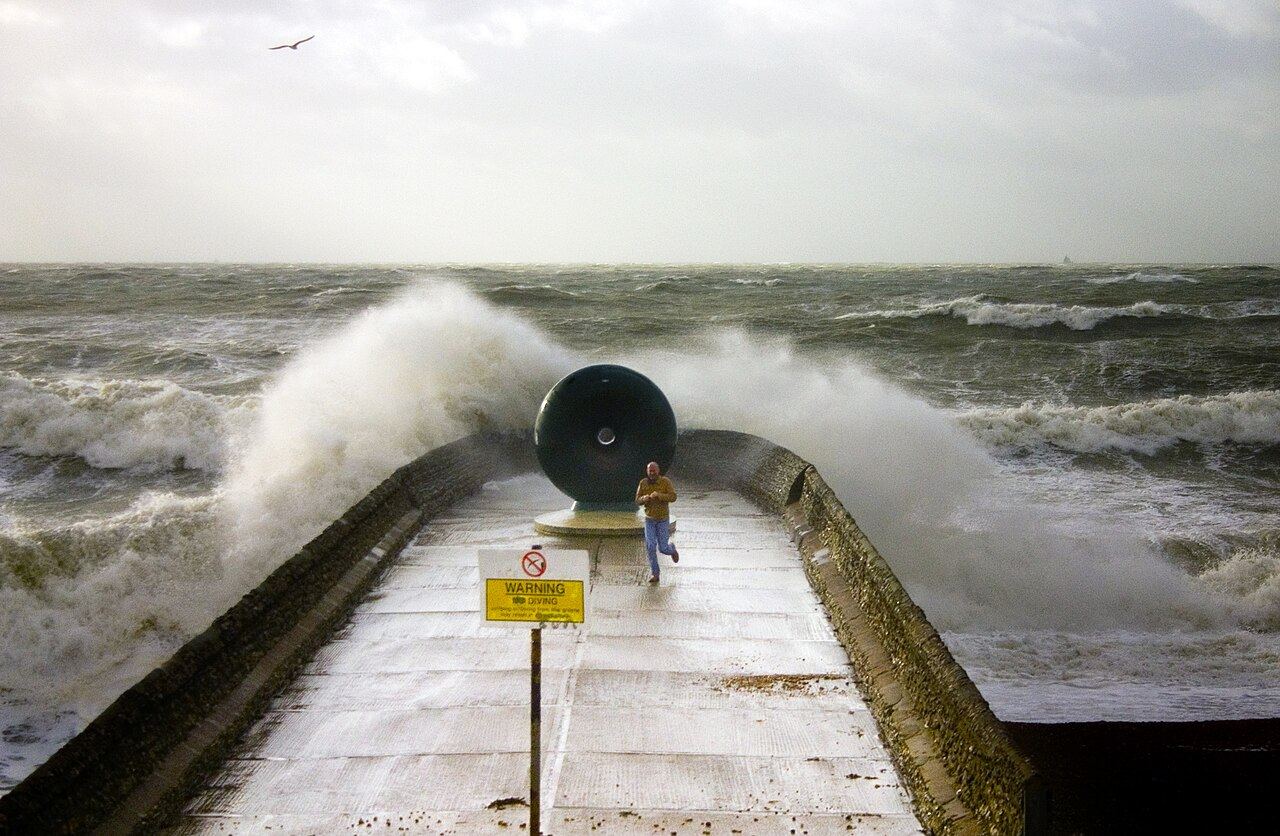
Most ocean waves are made by wind. As NOAA explains, friction between moving air and the water's surface builds crests. The size of the waves depends on how hard the wind blows, for how long, and over how much open water. Waves carry energy, not water, and can travel across a whole ocean basin.
For centuries sailors told stories of single waves far larger than the rest, appearing out of nowhere 'like a wall of water'. Scientists mostly treated these as exaggeration. Then, on 1 January 1995, a laser on the Draupner gas platform in the North Sea measured a wave about 26 metres high. The biggest waves around it were about 12 metres. NOAA now defines such 'rogue' or 'extreme storm' waves as those more than twice the size of the surrounding waves, often arriving from a different direction to the rest.
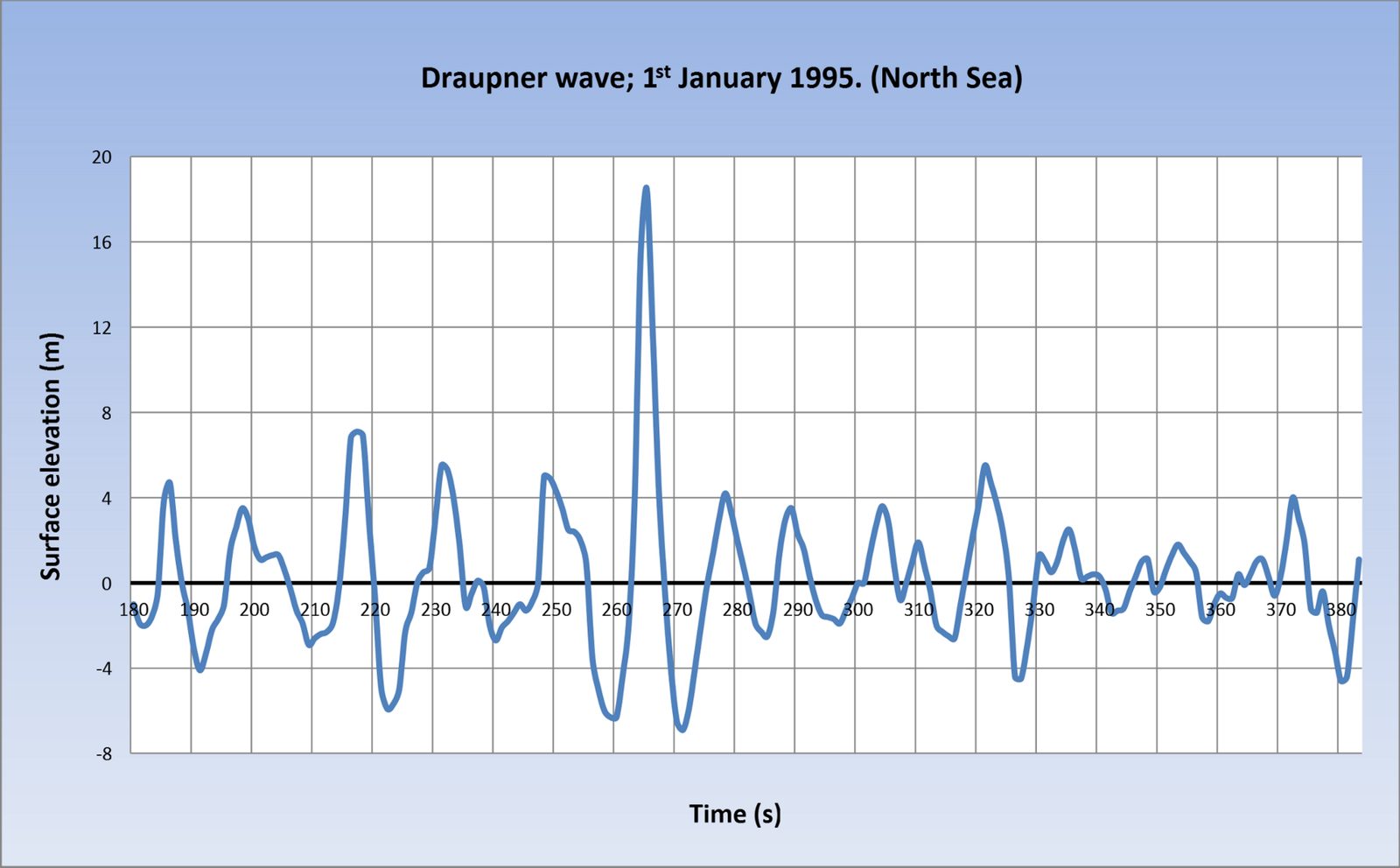
In 2004 the European Space Agency used radar satellites to scan the oceans for three weeks and found more than ten individual waves over 25 metres high. ESA also noted that severe weather had sunk more than 200 supertankers and container ships longer than 200 metres in the previous two decades. Rogue waves were suspected in many cases. In 2020 a buoy off Vancouver Island recorded a 17.6-metre wave in a sea where the others were around six metres. That is nearly three times their height (Gemmrich and Cicon, Scientific Reports, 2022).
Science has also looked at the people in the boat. In 2019 the economist Jeanet Sinding Bentzen combined a world survey of religious belief with maps of earthquakes. She found that people become more religious after an earthquake strikes nearby, a pattern researchers call 'religious coping'. Her data also show that the effect fades over time, although it can linger in later generations.
None of this means the verse knew about rogue waves or surveys. It is something more searching: an accurate description of what people actually do when they are frightened, and what many of them do once the danger has passed.
What each faith says
Judaism
“They cried unto the LORD in their trouble, and He brought them out of their distresses. He made the storm a calm, so that the waves thereof were still. Then were they glad because they were quiet, and He led them unto their desired haven.”
Psalm 107:28-30 · JPS 1917
Psalm 107 tells a sailors' story of its own. It describes merchants who 'go down to the sea in ships', see God's wonders in the deep, and then watch the stormy wind lift the waves to the sky. They reel 'like a drunken man', all their skill is 'swallowed up', and they cry out to God, who makes the storm a calm and brings them to their harbour. The psalm ends with a call to give thanks.
Jews still do this with Birkat HaGomel, the blessing of thanksgiving. It is said in front of a congregation after a sea voyage, a desert crossing, a serious illness or release from prison. The Book of Jonah gives the other side of the picture. Sailors in a tempest each cry to their own god, while Jonah is asleep below deck until the captain wakes him to pray.
Christianity
“He awoke and rebuked the wind, and said to the sea, 'Peace! Be still!' The wind ceased and there was a great calm.”
Mark 4:39 · WEB
The Gospels tell of a storm on the Sea of Galilee in which the disciples' boat is filling with water while Jesus sleeps in the stern. They wake him in panic; he rebukes the wind and calms the sea, then asks them, 'Why are you so afraid? How is it that you have no faith?'
For Christians the scene is about who Jesus is. The disciples ask, 'Who then is this, that even the wind and the sea obey him?' The boat has also become a picture of the Church, or of a single life in trouble. The sailors' hymn 'Eternal Father, strong to save', written by the Anglican William Whiting in 1860, is sung by navies and lifeboat crews. It draws on these passages: 'O hear us when we cry to thee, for those in peril on the sea.'
Islam
“Say: Who delivereth you from the darkness of the land and the sea? Ye call upon Him humbly and in secret, (saying): If we are delivered from this (fear) we truly will be of the thankful. Say: Allah delivereth you from this and from all affliction. Yet ye attribute partners unto Him.”
Qur'an 6:63-64 · Pickthall (1930)
The Qur'an's word for the passengers' prayer is mukhliṣīn, 'sincere', from the same root as ikhlāṣ, purity of devotion, the name of the short chapter that declares God is One. In the storm, every other support falls away, and people call on God alone. Classical commentators such as Ibn Kathīr, in fourteenth-century Damascus, point out that even those who worshipped idols in Muhammad's (peace be upon him) time did this at sea. When the waves came, they forgot their idols.
The sting is in the next verse. Once safe, many go straight back to how they were. The Qur'an is not mocking them; it is asking the reader to notice the same pattern in themselves. Muslims answer it with gratitude in calm weather. A well-known supplication for setting out on any journey was taught by the Prophet. It begins: 'Glory be to Him who has made this subject to us, and we could never have done it ourselves' (Muslim 1342, echoing Qur'an 43:13).
Same and different
Psalm 107 and Qur'an 10:22 each tell the scene: a ship, a storm wind, waves to the sky, a cry to God and rescue. All three traditions turn it into thanksgiving: Birkat HaGomel for Jews, hymns and prayers for those at sea for Christians, the journey supplication and gratitude for Muslims. Judaism is the one that asks the rescued to give thanks out loud, in front of a congregation. Islam is the one that dwells on what happens next, when the sea goes calm and people forget. The Gospel story adds a distinctively Christian claim: that Jesus himself commands the storm, which Christians see as a sign that he is divine. Judaism and Islam honour the prophets but direct the cry to God alone.
A moment to reflect
- Have you ever prayed, or hoped hard, in a moment of fear? What happened afterwards?
- Why do you think gratitude fades so quickly once a danger has passed?
- Is a prayer made only in a crisis worth less than one made in calm weather?
- Who are the people in your area who go out into danger so that others can come home?
Watch
A short, clear explainer on what rogue waves are and how they form.
A physicist shows how waves can add up into a monster.
Oceanographer Helen Czerski at the Royal Institution on how the ocean works.
Inside a giant wave tank where ships are tested against storms.
Do it together
Many coastal and river towns have a lifeboat station that welcomes visitors. Go along, ask the volunteers what a bad night at sea is like, and what keeps them going out.
Read Psalm 107:23-31, Mark 4:35-41 and Qur'an 10:22-23 together. Invite each person to name one danger they came through and one way to say thank you that is not just words.
Fill a long clear tray with water and blow across it with a hairdryer on cool, first gently, then harder, then over a longer stretch of water. Measure the wave heights and see how wind strength and distance change them.
Jews say Birkat HaGomel in front of a congregation after coming safely through danger. Borrow the idea: when someone you know has come home from hospital or a hard journey, gather and let them say thank you out loud, and let everyone answer.
On Sea Sunday, usually the second Sunday in July, many churches pray for seafarers and their families, supported by charities such as the Mission to Seafarers and Stella Maris. Find a service near a port, or send a card to a seafarers' centre.
Go deeper
- Qur'an 10:22-23 with translations · scripture
- Psalm 107 (JPS 1917) on Sefaria · scripture
- Mark 4 (WEB) on Bible Gateway · scripture
- NOAA: What is a rogue wave? · article
- ESA: Ship-sinking monster waves revealed by satellites · article
In pictures
Try this · KS1 · 10 min · Science
A storm in a bottle
You need: a clear plastic bottle with a lid, water, blue food colouring, cooking oil, a little toy boat or piece of cork
- Fill the bottle a third full of water with a drop of blue colouring.
- Add the same amount of oil and the cork.
- An adult screws the lid on tightly.
- Rock the bottle gently, then roughly. Watch the waves and the little boat.
Safety: Lid on tight; wipe up oil spills straight away.
When the waves come from every side, people pray who never prayed before, and then give thanks.
Check yourself
Three quick questions. No score, nothing saved.
1. When were rogue waves, once called sailors' tales, first measured?
2. What did satellites later find in just three weeks?
3. What do all three faiths turn rescue into?
Sources (5)
- Waves are mostly made by wind and carry energy, not water, across ocean basins: NOAA Ocean Service, What causes ocean waves?
- Rogue waves are more than twice the size of surrounding waves and often come from other directions: NOAA Ocean Service, What is a rogue wave?
- Draupner platform wave about 26 m, surrounding waves up to 12 m; ESA satellites found 10+ waves over 25 m in three weeks; 200+ large ships sunk in two decades: ESA, Ship-sinking monster waves revealed by ESA satellites, 2004
- 17.6 m rogue wave off Vancouver Island, nearly three times the surrounding sea: Gemmrich & Cicon, Scientific Reports, 2022
- People become more religious after nearby earthquakes; effect fades over time but persists across generations: Bentzen, The Economic Journal, 2019