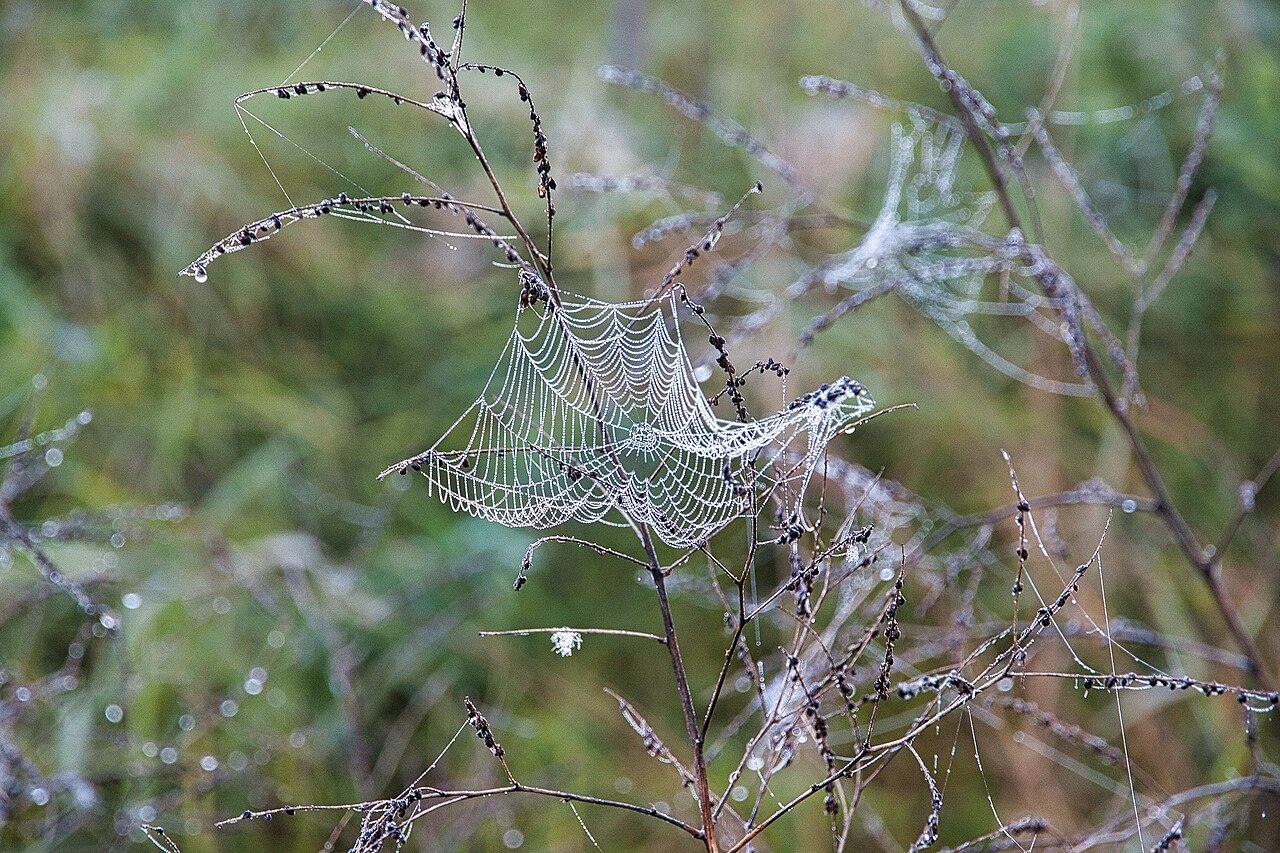
Walk through a park on an autumn morning and you will see webs everywhere. They hang between railings, beaded with dew, perfect as a drawing. Someone built each one overnight, in the dark, without a plan on paper.
A strand of that silk is, weight for weight, one of the toughest things any living creature makes. And yet the Qur'an picks the spider's home as its picture of the weakest house there is. Both things are true. The tension between them is the whole point.
“The likeness of those who choose other patrons than Allah is as the likeness of the spider when she taketh unto herself a house, and lo! the frailest of all houses is the spider's house, if they but knew.”
Qur'an 29:41 · Pickthall (1930)
This verse gives a whole chapter its name: al-ʿAnkabūt, The Spider. It comes after a run of stories about people who trusted in wealth, power or idols, and it is a parable, not a lesson in zoology. Its question is simple: when the storm comes, what are you actually holding on to?
What science shows
Spiders are a vast family. The World Spider Catalog, which scientists use to keep count, lists more than 54,000 described species, and new ones are added almost every week. Between them they kill an estimated 400 to 800 million tonnes of insects every year, which makes them some of the most important pest controllers on the planet.
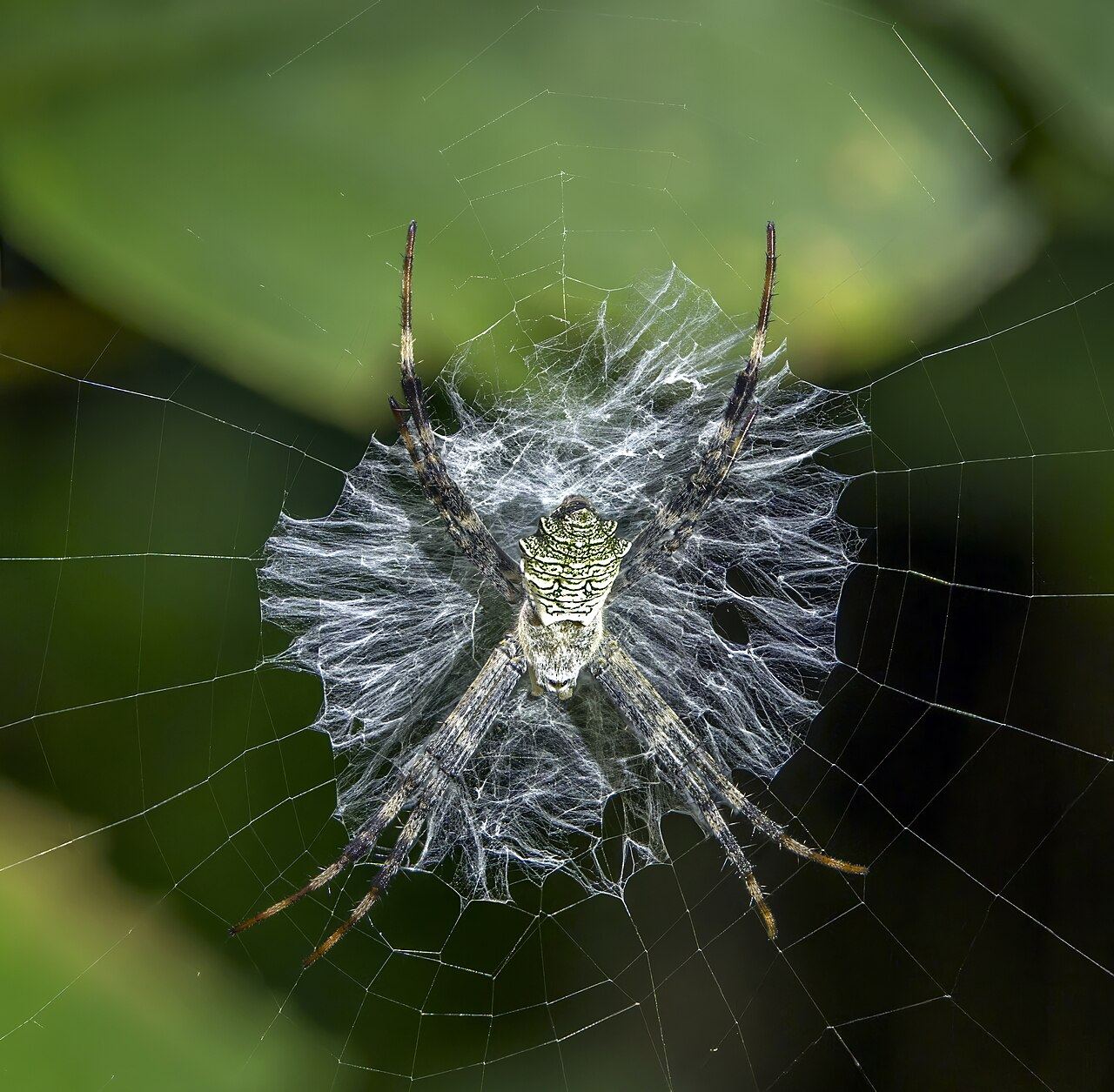
Most spiders make several kinds of silk from different glands, each with a different job: dragline for safety, sticky spiral for catching, soft silk for wrapping eggs. Silk comes out as a liquid protein and turns solid as it is pulled. A garden orb-weaver can build a full web in under an hour. Many orb-weavers eat their old web in the morning and recycle the protein to spin a new one.
The record holder is Darwin's bark spider from Madagascar. In 2010 researchers tested its dragline silk and found it to be the toughest biological material ever measured at that time. It can soak up more energy before snapping than any other silk tested, and more than Kevlar. This small spider strings bridge lines across rivers up to 25 metres wide.
So the thread is extraordinary. But think about the web as a house. It has no roof and no walls. It does not keep out rain, wind or a passing bird. A strong gust or a clumsy hand destroys it in a second. The web is a superb trap and a very poor shelter.
That is why there is no conflict between the science and the verse. The verse is not about the strength of a strand; it is about the safety of a home. The more we learn about silk, the sharper the picture becomes: something can be brilliantly made and still be the wrong thing to trust with your life.
What each faith says
Judaism
“Whose confidence is gossamer, And whose trust is a spider's web.”
Job 8:14 · JPS 1917
The Hebrew Bible knows the spider's web as a picture of false trust. In the book that tells the story of Job, his friend Bildad describes the person who forgets God. Their confidence is as thin as gossamer, and their trust is a spider's web. Lean on it, and it will not hold you up. The prophet Isaiah uses the web too, as a picture of schemes woven by people who do wrong. They are busy, intricate and in the end useless as covering.
Jewish teaching returns again and again to the idea of bitachon, trust in God. The Psalms contrast those who trust in chariots and horses with those who trust in the name of the LORD (Psalm 20:8). The spider's web belongs to the same family of images: impressive, delicate, and not a foundation. Every autumn at Sukkot, Jews leave their solid houses to eat, and some to sleep, in a sukkah, a flimsy hut roofed with branches. It is a yearly lesson that real shelter comes from God, not from walls.
Christianity
“The rain came down, the floods came, and the winds blew, and beat on that house; and it didn't fall, for it was founded on the rock.”
Matthew 7:25 · WEB
Jesus ends the Sermon on the Mount with a parable about two houses. One is built on rock, one on sand. The same storm hits both. Only one stands.
Christians read this as a call to build life on the words of Jesus, rather than on things that look solid in fine weather. It asks a searching question: what will your house be like when the rain comes? Generations of Christians have sung the answer in Edward Mote's hymn of 1834, loved in Baptist and evangelical churches. “On Christ, the solid Rock, I stand; all other ground is sinking sand.” Children learn the parable as an action song, The Wise Man Built His House upon the Rock.
Islam
“And trust thou in the Living One Who dieth not, and hymn His praise. He sufficeth as the Knower of His bondmen's sins.”
Qur'an 25:58 · Pickthall (1930)
In Islam the opposite of the spider's house is tawakkul, trusting God completely while still doing your part. The Qur'an says, “And will provide for him from (a quarter) whence he hath no expectation. And whosoever putteth his trust in Allah, He will suffice him. Lo! Allah bringeth His command to pass. Allah hath set a measure for all things.” (65:3, Pickthall). One of the 99 Names, al-Wakīl, means the Trustee: the one you can safely hand your affairs to.
Muslims also love a story told about the Prophet Muhammad ﷺ (peace be upon him). When he and his companion hid in the cave of Thawr during the journey to Madina, tradition says a spider spun a web across the entrance. This story is found in later biography and some hadith reports whose chains scholars debate, so it is best told as a much-loved tradition. Either way, the pairing is striking: the weakest house in the Qur'an's parable becomes, in the story, a sign that protection comes from God, not from walls.
Same and different
Judaism and Islam share the spider's web as a picture of misplaced trust. Christianity asks the same question through houses on rock and sand, and Judaism has a house lesson of its own in the flimsy sukkah. Islam is the one that names a whole chapter after the spider, and sets the weakest house beside the Name al-Wakīl, the One truly worth relying on. Where they differ is in what the rock is. For Jews, it is the God of Israel and His covenant. For Christians, it is God revealed in Jesus and his words. For Muslims, it is God alone, with no partner, as the Qur'an's chapter insists.
A moment to reflect
- What are the things in your life that look strong but might not hold you in a storm?
- Can something be beautifully made and still be the wrong thing to rely on?
- Is trust something you decide, or something that grows?
- What small thing has taught you something big?
Watch
Watch an orb web go up strand by strand: a beautiful build, and no roof.
Darwin's bark spider shoots a bridge line across a river.
A careful look at the claim that spider silk is stronger than steel.
Do it together
On a misty morning in September or October, walk a local park and count the webs you can see. Photograph three and compare the patterns. Ask: how would this web cope with a storm?
Read Job 8:14, Matthew 7:24-27 and Qur'an 29:41 aloud, one after another. In small mixed groups, list things people trust today, from money to followers, and sort them into “web” or “rock”. Compare lists without arguing for a winner.
Lay a single cotton thread, a hair and a strand of fishing line side by side and hang small paper-clip weights from each until it breaks. Talk about why strength for its weight matters to a tiny animal.
At Sukkot, in September or October, many synagogues build a sukkah and some invite visitors in for a drink. Visit one, or build a mini sukkah from canes and leaves in a garden or classroom, and talk about what makes a home feel safe.
Learn the Sunday-school action song The Wise Man Built His House upon the Rock, with the rain coming down and the house on the sand going splat. Then build two little houses, one on a stone and one on a sand tray, and pour water over both.
Go deeper
- Qur'an 29:41 with translations · scripture
- Job 8 (JPS 1917) on Sefaria · scripture
- Matthew 7 (WEB) on Bible Gateway · scripture
- World Spider Catalog · article
- Agnarsson et al. 2010, the toughest biological material · paper
In pictures
Try this · KS1 · 15 min · Science
Web watch
You need: a dewy or misty morning, a plant sprayer with water (optional), a magnifying glass
- Look for spider webs on hedges, fences or window frames.
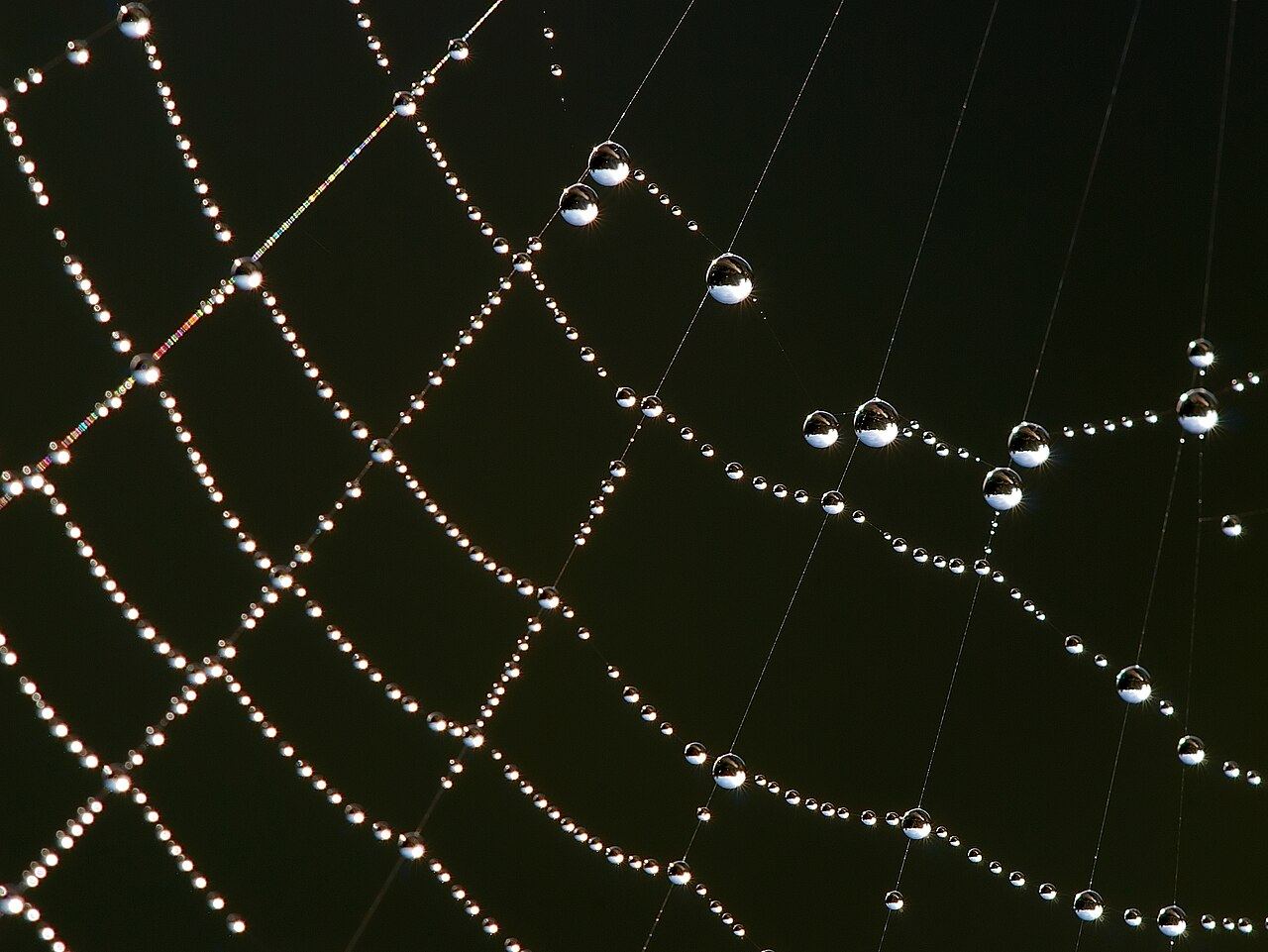
- Gently mist a web with water from a distance. The drops make the threads shine.
- Look at the pattern: spokes and spirals. Count the spokes.
- Look but don't touch: a web is someone's home.
Safety: Don't touch spiders or break webs.
The toughest thread in nature, and still the flimsiest house: a parable about what we lean on.
Sources (5)
- More than 54,000 described spider species: World Spider Catalog, version 27, accessed Nov 2026
- Spiders kill 400–800 million tonnes of prey a year: Nyffeler & Birkhofer, The Science of Nature, 2017
- Darwin's bark spider silk: toughest biological material measured in 2010; tougher than Kevlar; spans rivers: Agnarsson, Kuntner & Blackledge, PLoS ONE, 2010
- Bridge lines up to 25 m across rivers: Gregorič et al., PLoS ONE, 2011
- Spiders make several silk types from different glands; orb-weavers recycle silk: Wikipedia, Spider silk (with sources)