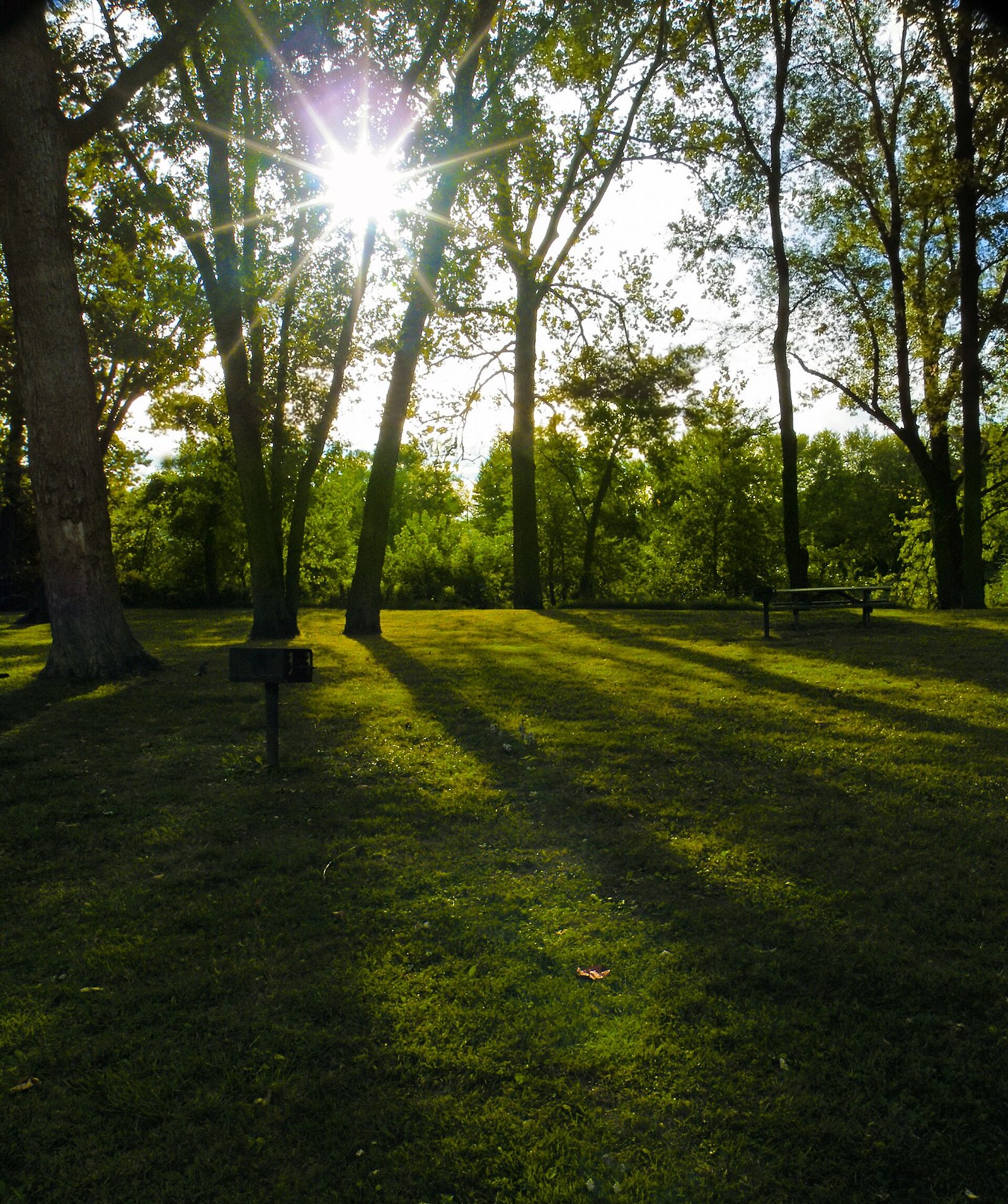
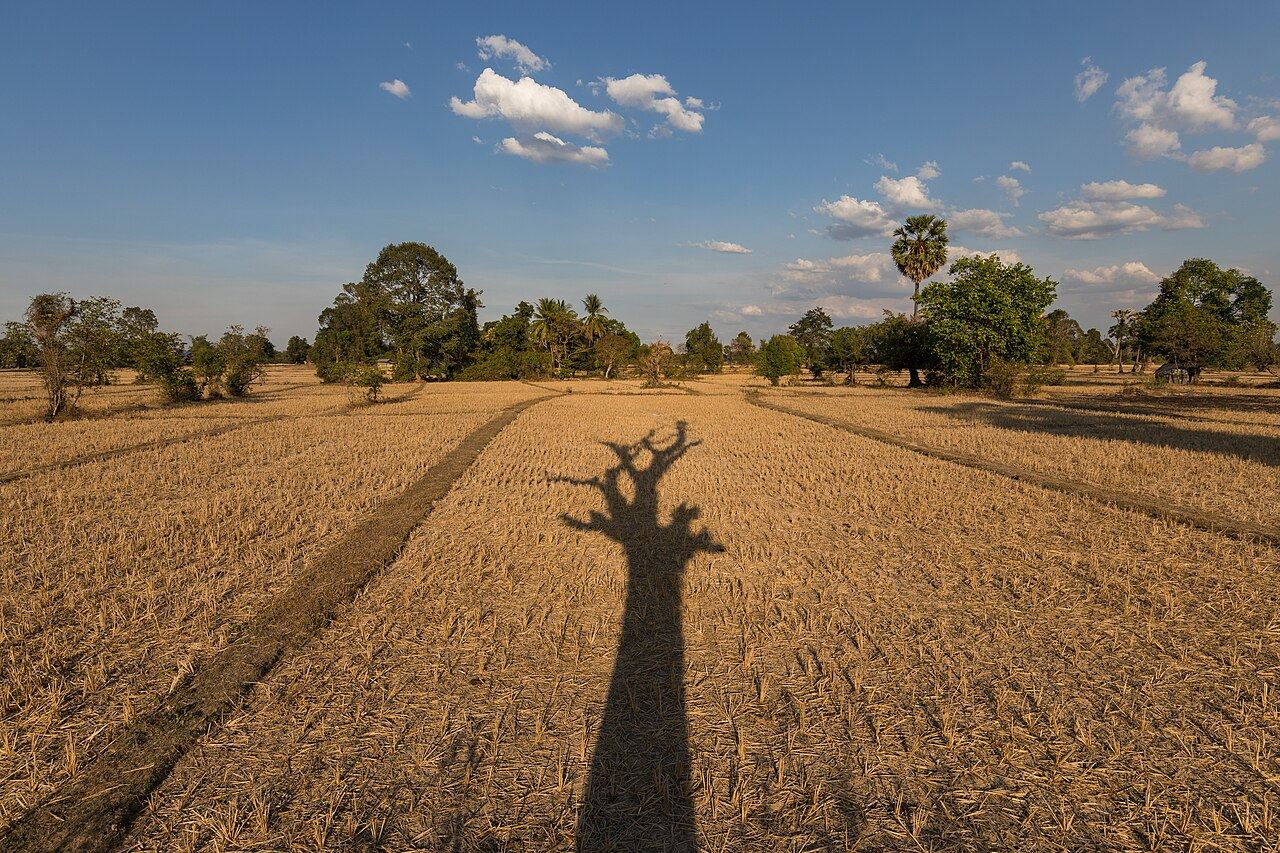
Put a stick in the ground on a sunny morning and mark the tip of its shadow with a stone. Come back every half hour. The shadow shrinks, swings round, then grows long again in the other direction. Nothing has moved, except you, the stick, the ground and the whole planet, turning at the speed of a jet airliner.
Most of us never stop to watch it. The Qur'an asks us to: have you not seen how your Lord stretches out the shadow?
“Hast thou not seen how thy Lord hath spread the shade - And if He willed He could have made it still - then We have made the sun its pilot; Then We withdraw it unto Us, a gradual withdrawal?”
Qur'an 25:45-46 · Pickthall (1930)
These verses are in the chapter al-Furqān, The Criterion, in a list of signs that includes night as a covering, sleep as rest and winds as good news. Classical commentators such as Ibn Kathīr, writing in fourteenth-century Damascus, explain the stretched shadow as the long shade of early morning. The slow “drawing in” is its shortening towards noon. The point is gentleness: the day does not switch on and off; it is drawn in little by little.
What science shows
Shadows move because the Earth spins. It turns once on its axis roughly every 24 hours, so the Sun appears to move across the sky by about 15 degrees an hour. At the equator the ground is travelling at about 1,670 kilometres an hour. In London, further from the equator, it is still about 1,040 kilometres an hour.
Your shadow is shortest at local noon, when the Sun is highest, and in Britain it then points due north. How short depends on the season. At midsummer in London the noon Sun is about 62 degrees above the horizon, so your shadow is about half your height. At midwinter it is only about 15 degrees up, and your shadow stretches to almost four times your height.
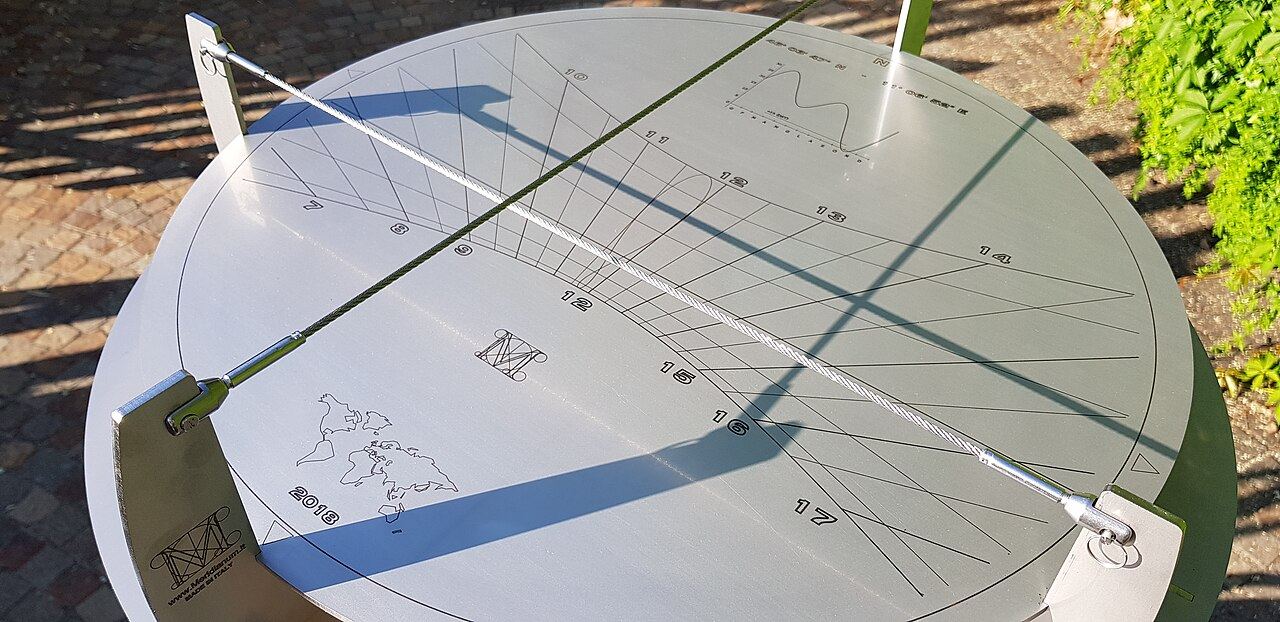
People have told time by shadows for thousands of years. A sundial shows solar time, which can differ from clock time by up to about 16 minutes through the year. That is because the Earth's orbit is an ellipse and its axis is tilted. Astronomers call this difference the equation of time.
Shadows even measured the Earth. Around 240 BCE, the Greek scholar Eratosthenes heard that at noon on midsummer's day the Sun shone straight down a well at Syene, in southern Egypt, casting no shadow. At the same moment in Alexandria, further north, a pole cast a shadow at an angle of about seven degrees, one-fiftieth of a circle. So, he reasoned, the Earth's circumference must be fifty times the distance between the two cities. His answer was remarkably close.
A shadow, then, is information. It tells you the time, the season, your latitude and the shape of the planet you are standing on, if you know how to read it.
What each faith says
Judaism
“O thou that dwellest in the covert of the Most High, And abidest in the shadow of the Almighty.”
Psalm 91:1 · JPS 1917
The Psalms use the shadow as a picture of how short life is. “My days are like a lengthening shadow”, says one (Psalm 102:12); another says “Man is like unto a breath; his days are as a shadow that passeth away” (Psalm 144:4). Yet the same book uses shade for protection. Whoever dwells in the shelter of the Most High abides “in the shadow of the Almighty” (Psalm 91:1), and “The LORD is thy shade upon thy right hand” (Psalm 121:5).
The most famous shadow in the Hebrew Bible is a sign given to King Hezekiah when he was gravely ill. The prophet Isaiah asks whether the shadow on the sundial of Ahaz should go forward or back ten steps. Hezekiah asks for it to go back, and it does (2 Kings 20:9-11). Jewish law also uses the Sun's position to set the times of daily prayer. The latest time for the morning Shema is still counted in shaʿot zmaniyot, “seasonal hours”. Each is a twelfth of that day's daylight, so they stretch in summer and shrink in winter.
Christianity
“Every good gift and every perfect gift is from above, coming down from the Father of lights, with whom can be no variation, nor turning shadow.”
James 1:17 · WEB
The Letter of James has one of the loveliest shadow lines in the Bible. Every good gift comes from “the Father of lights, with whom can be no variation, nor turning shadow”. The writer may be thinking of a sundial: everything under the Sun casts a moving shadow, but God does not change.
Christians also inherited the Psalms' language of shelter. Psalm 91 is prayed at night in Compline, the last service of the day in monasteries and in many Catholic and Anglican churches. Many Christians know its promise of rest “under the shadow of the Almighty” by heart.
Islam
“Have they not observed all things that Allah hath created, how their shadows incline to the right and to the left, making prostration unto Allah, and they are lowly?”
Qur'an 16:48 · Pickthall (1930)
For Muslims, the shadow is not just a sign but a clock. The times of the five daily prayers are set by the Sun. The afternoon prayer, ʿAṣr, traditionally begins when an object's shadow has grown by its own length beyond its noon shadow. In the Hanafi school, one of the four main schools of Sunni law, it waits until the shadow has grown by twice its length. Muslim astronomers developed a whole science of timekeeping, ʿilm al-mīqāt, “the science of appointed times”. In 1371 the astronomer Ibn al-Shāṭir built a great sundial for the Umayyad Mosque in Damascus.
The Qur'an also says that shadows “bow” to God, turning right and left in humility (16:48). And the Prophet Muhammad ﷺ (peace be upon him) spoke of seven kinds of people whom God will shade on a Day when there is no shade but His. Among them is a person who gives charity so quietly that their left hand does not know what their right hand gave (Bukhari 660).
Same and different
All three faiths see the shadow as two things at once: a picture of how brief our lives are, and a picture of God's shelter. Judaism and Islam both use the Sun and shadow to set the times of prayer. The Qur'an adds something distinctive: the shadow itself as a worshipper, bowing to God as it moves, and the slow drawing-in of shade as a sign of God's gentleness.
A moment to reflect
- When did you last watch a shadow move? What would it take to notice it today?
- Is it comforting or unsettling that the ground under you is moving at hundreds of kilometres an hour?
- Shade means rest in a hot country and gloom in a cold one. What does it mean to you?
- What in your life changes slowly enough that you only notice it if you mark it?
Watch
The Royal Observatory Greenwich shows how to make a sundial.
Why the Earth spins in the first place, in under three minutes.
ESA's short film of day and night sweeping across the Earth.
Do it together
Push a garden cane into a lawn or playground and mark the shadow's tip with chalk or stones every 30 minutes from morning to afternoon. Find noon: the shortest shadow. Which way is it pointing?
On a sunny afternoon, measure a friend's height and their shadow every quarter of an hour. Ask a local imam or mosque volunteer to explain when the shadow says it is time to pray, then compare with the printed timetable.
Trace each other's shadows on paper or a wall at morning, noon and late afternoon. Display them side by side with Psalm 102:12 and Qur'an 25:45.
Look up today's zmanim, the Jewish prayer times worked out from the Sun, for your town on a Jewish calendar website. Go outside at the time given for chatzot, midday, and check whether a stick's shadow really is at its shortest.
Many medieval English churches have a scratch dial, or mass dial, cut into a stone on the south wall. It is a small circle of lines with a hole for a stick, once used to time the services. Find one near you and work out which line the shadow would touch now.
Go deeper
- Qur'an 25:45-46 with translations · scripture
- timeanddate: the equation of time · article
- 2 Kings 20 (JPS 1917) on Sefaria · scripture
- James 1 (WEB) on Bible Gateway · scripture
- Britannica: Eratosthenes · article
In pictures

Try this · KS2 · a sunny day · Maths
Shadow clock
You need: a stick or pencil, a sheet of card, stones to hold it down, a pen
- On a sunny morning, stand the stick upright in the middle of the card outside.
- Mark the tip of the shadow and write the time.
- Do it again every hour.
- How has the shadow changed length and direction? Why?
Safety: Never look directly at the Sun.
Watch a shadow cross a courtyard and you are watching the Earth turn.
Sources (5)
- Equatorial rotation speed about 1,670 km/h (40,075 km ÷ 24 h); London about 1,040 km/h (× cos 51.5°): Calculation from NASA Earth fact sheet
- Noon Sun in London about 62° at midsummer and 15° at midwinter: Calculation: 90° − 51.5° ± 23.4°
- Sundial and clock time differ by up to about 16 minutes (equation of time): timeanddate.com, Equation of time
- Eratosthenes measured Earth's circumference from noon shadows: Encyclopaedia Britannica, Eratosthenes
- Ibn al-Shatir's sundial for the Umayyad Mosque, 1371: Encyclopaedia Britannica, Ibn al-Shatir