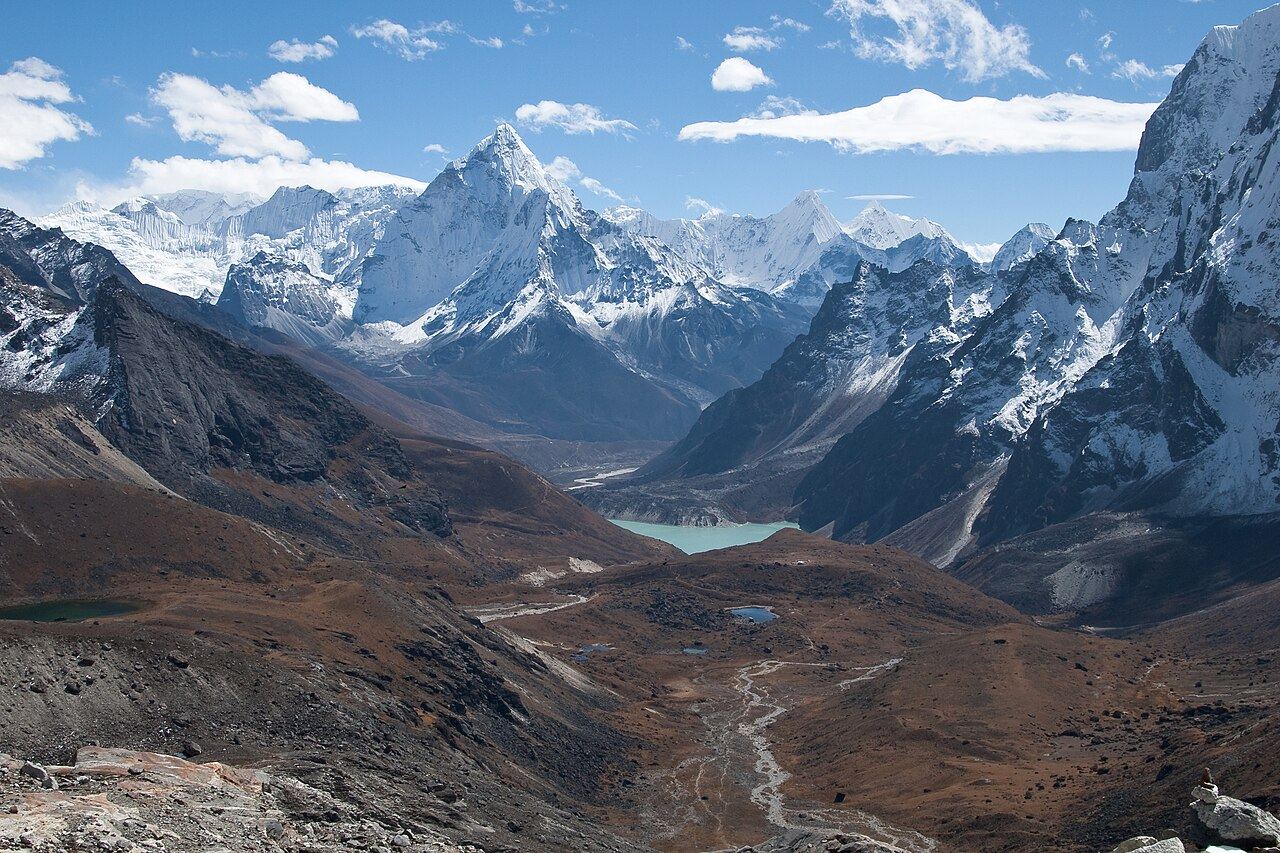
Climbers on the summit of Everest stand on limestone that formed at the bottom of an ancient sea. Geologists have found fossils of sea creatures in the rock near the top of the world, nearly nine kilometres up.
Mountains look like the most permanent things on Earth. People say “as old as the hills” and “steady as a rock”. Scripture uses them that way too: pegs that hold the ground firm, the place where God speaks, the thing that will one day pass away when nothing else would. Every one of those images turns out to be more interesting than it looks.
“Have We not made the earth an expanse, And the high hills bulwarks?”
Qur'an 78:6-7 · Pickthall (1930)
These verses open a list of gifts in the chapter an-Nabaʾ, The News. The earth is spread like a bed, with mountains as tent-pegs, people in pairs, sleep for rest and night as a covering. The picture is of a tent pitched for its occupants: the pegs hold it steady. Another verse says God set firm mountains on the earth “lest it should sway with you” (16:15). The Arabic awtād is the word for tent-pegs. We do not read this as a coded geology lesson; it is an image of shelter and stability.
What science shows
Most great mountain ranges are built where the plates of the Earth's crust collide. The US Geological Survey explains that the Himalayas began rising about 50 million years ago, when the plate carrying India crashed into Asia. They are still rising by more than a centimetre a year. Everest was measured by Nepal and China in 2020 at 8,848.86 metres.
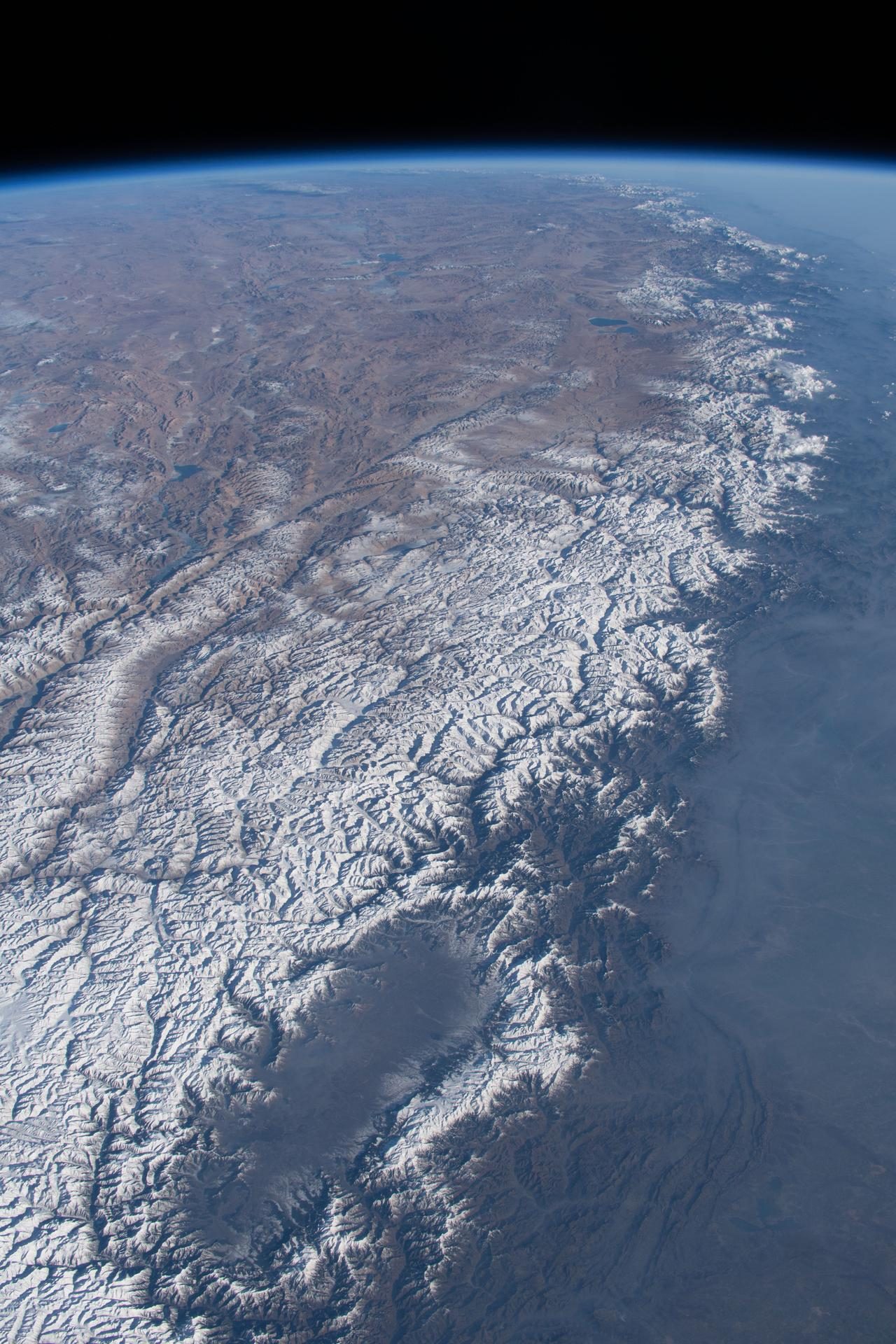
Collisions push up sea-floor rocks, which is why marine fossils are found high in the Himalayas. The summit of Everest is made of limestone from the Ordovician period, around 450 to 470 million years old, laid down on the floor of a tropical sea. A mountain is, in part, the old bottom of an ocean lifted into the sky.
Mountains also have roots. In the 1850s, surveyors in India noticed that the Himalayas did not pull their plumb lines sideways as much as their size suggested. The astronomer George Airy explained why. Beneath a high range, the crust is much thicker, pushing down into the denser rock of the mantle, like the hidden part of an iceberg. This balance is called isostasy. Under the Himalayas and Tibet, the crust is about 70 kilometres thick, roughly twice the usual thickness of continents.
Mountains do not last for ever. Rain, frost and ice wear them down. The British Geological Survey explains that the Scottish Highlands are the worn-down remains of a much older mountain belt, the Caledonides. They were raised more than 400 million years ago when ancient continents collided. Ben Nevis, at 1,345 metres, is what is left.
While they stand, mountains keep the rest of us alive. A 2020 study in Nature mapped the world's mountain “water towers”, the snow, glaciers and lakes that feed rivers. It found that about 1.9 billion people depend on them for water.
What each faith says
Judaism
“For the mountains may depart, and the hills be removed; but My kindness shall not depart from thee, neither shall My covenant of peace be removed.”
Isaiah 54:10 · JPS 1917
In the Hebrew Bible, mountains are places where heaven and earth meet. At Mount Sinai the whole mountain smoked and quaked as God came down and gave the Torah. Psalm 121 begins, “I will lift up mine eyes unto the mountains: From whence shall my help come?” It answers at once that help comes from the One who made heaven and earth, not from the hills themselves. Sinai is remembered every year at Shavuot, the festival of the giving of the Torah. Many Jews stay up all night studying, a custom called Tikkun Leil Shavuot. Some synagogues are decked with greenery, because of a tradition that the bare mountain burst into flower.
The mountains are also a measure of God's faithfulness. Psalm 90 says God was there before the mountains were born. Isaiah promises that even if the mountains move and the hills shake, God's kindness will not move. And Isaiah's great vision of peace is set on a mountain: all nations stream up to the house of God, and they beat their swords into ploughshares.
Christianity
“If you have faith as a grain of mustard seed, you will tell this mountain, ‘Move from here to there,’ and it will move; and nothing will be impossible for you.”
Matthew 17:20 · WEB
Jesus delivered his most famous teaching, the Sermon on the Mount, from a hillside in Galilee. He also used the mountain as a picture of the impossible made possible. If you have faith as small as a mustard seed, he said, you can tell this mountain to move, and it will move. Christians read this as a saying about trust in God, not a challenge to geology.
Mountains mark key moments in the Gospels: Jesus praying alone on hillsides, and the Transfiguration, when his disciples saw him shining with light on a high mountain. Many Christians still go on retreat to hills and high places to pray, as the psalmist did. On Reek Sunday, the last Sunday in July, thousands of Catholic pilgrims climb Croagh Patrick in County Mayo, some of them barefoot.
Islam
“If We had caused this Qur'an to descend upon a mountain, thou (O Muhammad) verily hadst seen it humbled, rent asunder by the fear of Allah. Such similitudes coin We for mankind that haply they may reflect.”
Qur'an 59:21 · Pickthall (1930)
The first revelation of the Qur'an came to the Prophet Muhammad ﷺ (peace be upon him) in the cave of Ḥirāʾ. The cave is high on a mountain outside Makkah now called Jabal al-Nūr, the Mountain of Light. Every year on Hajj, pilgrims stand together on the plain and slopes of Mount ʿArafāt in prayer. In the Qur'an, when Moses (peace be upon him) asked to see God, God revealed Himself to the mountain instead, and it crumbled to dust (7:143).
The Qur'an uses the mountain as a measure of awe. “If We had caused this Qur'an to descend upon a mountain, thou (O Muhammad) verily hadst seen it humbled, rent asunder by the fear of Allah. Such similitudes coin We for mankind that haply they may reflect.” (59:21, Pickthall). Firm as they are, the mountains will one day be like carded wool (101:5). Only God is truly firm: al-Matīn.
Same and different
All three faiths treat mountains as places of revelation and prayer: Sinai, the Mount of the Sermon, Ḥirāʾ and ʿArafāt. Each uses them as pictures of what is strong yet not ultimate, so that God's faithfulness outlasts even the hills. Their sacred mountains are different, and so are the revelations they remember there: the Torah at Sinai, the teaching of Jesus in Galilee, the Qur'an on the Mountain of Light.
A moment to reflect
- What does it feel like to stand somewhere high and look down? Why might people pray in high places?
- A mountain is the lifted-up bottom of an old sea. What else looks permanent but has a long, changing story?
- Psalm 121 looks to the hills and then past them. What do you look to for help?
- Isaiah's vision of peace is set on a mountain everyone climbs together. Where could people of different faiths “go up” together near you?
Watch
The British Geological Survey explains how mountains are made.
TED-Ed on why Everest is so tall, and why it is not taller.
Snow leopards in the high mountains, from Planet Earth II.
A baby ibex on a cliff face: life on the steepest ground.
Do it together
Organise a joint walk up a local hill or high point, from Primrose Hill to Pendle Hill. At the top, read Psalm 121:1-2, Matthew 5:1-2 and Qur'an 59:21, and share food.
Float wooden blocks of different heights in a tray of water and see how the tallest sink deepest. Use it to explain mountain roots and isostasy.
Visit a museum with a fossil gallery, such as the Natural History Museum, or a beach on the Jurassic Coast, and look for sea creatures in rock. Talk about how sea floors end up on mountains.
At Shavuot, in May or June, many synagogues hold an evening or all-night session of study to remember the Torah given at Sinai, and some welcome guests. Ask a local synagogue, or hold your own evening of reading together, with cheesecake: dairy food is a Shavuot favourite.
Churches named after St Michael are often built on high ground, such as St Michael de Rupe on Brent Tor in Devon. Find a hilltop church near you, walk up together, and sit inside for five quiet minutes before you look at the view.
Go deeper
- Qur'an 78:6-16 with translations · scripture
- USGS: The Himalayas, two continents collide · article
- Isaiah 2 (JPS 1917) on Sefaria · scripture
- Matthew 5 (WEB) on Bible Gateway · scripture
- Immerzeel et al. 2020, Importance and vulnerability of the world's water towers · paper
In pictures
Try this · KS2 · 15 min · Geography
Make a mountain range
You need: three or four towels or tea towels, a table
- Lay the towels flat on top of each other. They are layers of rock.
- Put your hands at both ends and push them slowly towards each other.
- Watch the layers fold up into ridges and valleys.
- Read the page: this is how seashells ended up near the top of Everest.
Seashells on the summit of the world: the mountains are older and stranger than they look.
Sources (7)
- Himalayas began forming ~50 million years ago; rising more than 1 cm a year: USGS, This Dynamic Earth: The Himalayas
- Everest 8,848.86 m: Al Jazeera, 8 December 2020
- Everest summit limestone (Qomolangma Formation), Ordovician, with marine fossils: Encyclopaedia Britannica, Mount Everest: geology
- Airy's explanation of mountain roots (isostasy): Encyclopaedia Britannica, Isostasy
- Crust beneath Tibet ~70 km thick: USGS, Tibetan Plateau crustal structure (summary in Britannica, Plateau of Tibet)
- Scottish Highlands are the eroded roots of the Caledonian mountains: British Geological Survey, Caledonian orogeny
- About 1.9 billion people depend on mountain water towers: Immerzeel et al., Nature, 2020