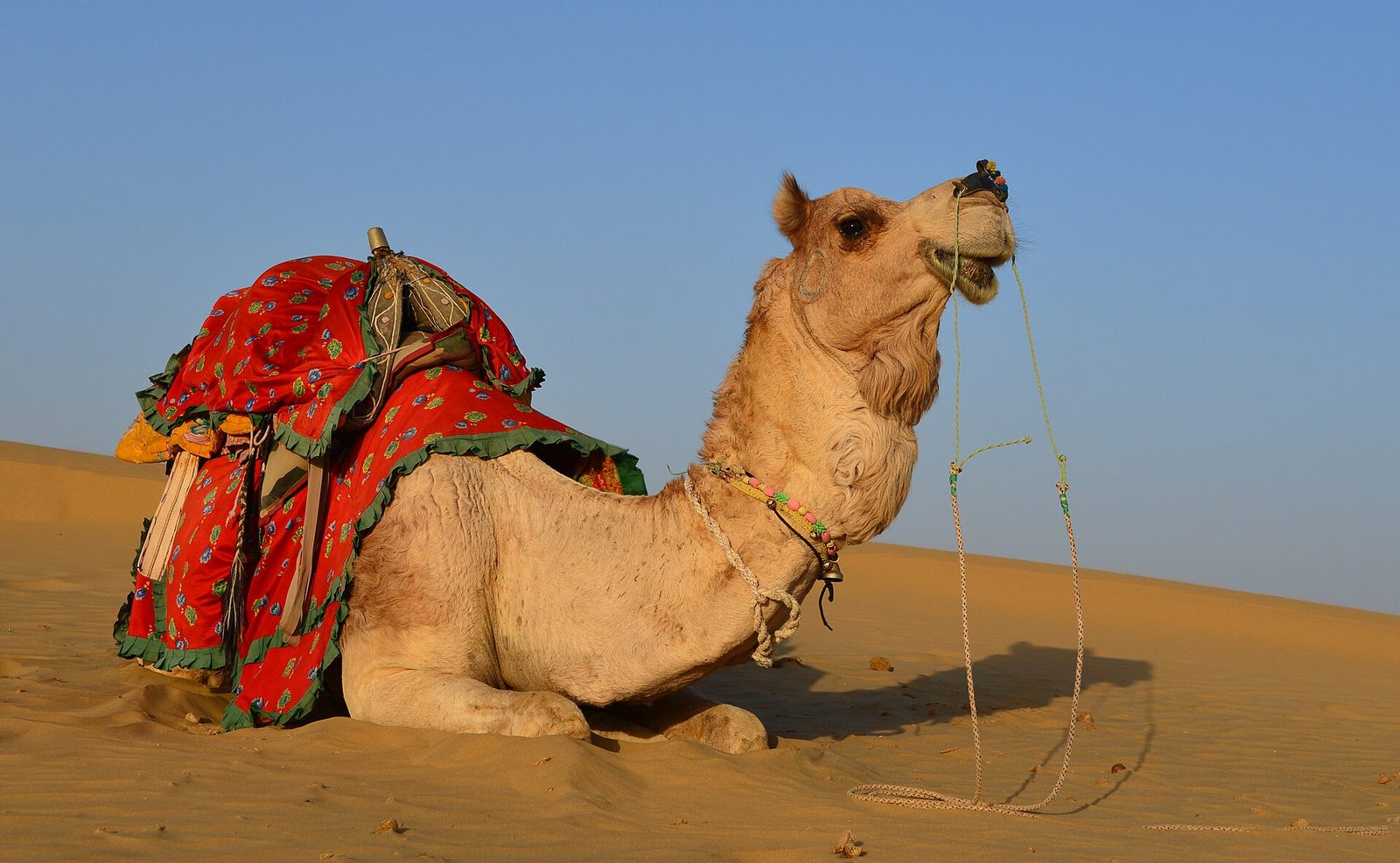
Imagine one unbroken camera shot. It starts close on a camel in the heat haze, chewing slowly. It tilts up to an enormous sky. It pans across to a ridge of mountains. Then it cranes down to a wide plain at dusk, stretching to the horizon.
That shot is a verse of the Qur'an. Four short questions, each beginning with the same word: kayfa, how? Not “what is it?”, but “how was it made?” It is one of the simplest invitations in scripture, and one of the hardest to answer fully.
“Will they not regard the camels, how they are created? And the heaven, how it is raised? And the hills, how they are set up? And the earth, how it is spread?”
Qur'an 88:17-20 · Pickthall (1930)
These verses come near the end of the chapter al-Ghāshiya, The Overwhelming Event, which many Muslims hear recited in Friday prayers. The very next line is: “Remind them, for thou art but a remembrancer.” (88:21, Pickthall). The four looks are what you would see on any journey across Arabia: the animal you ride, the sky above, the hills ahead and the land beneath.
What science shows
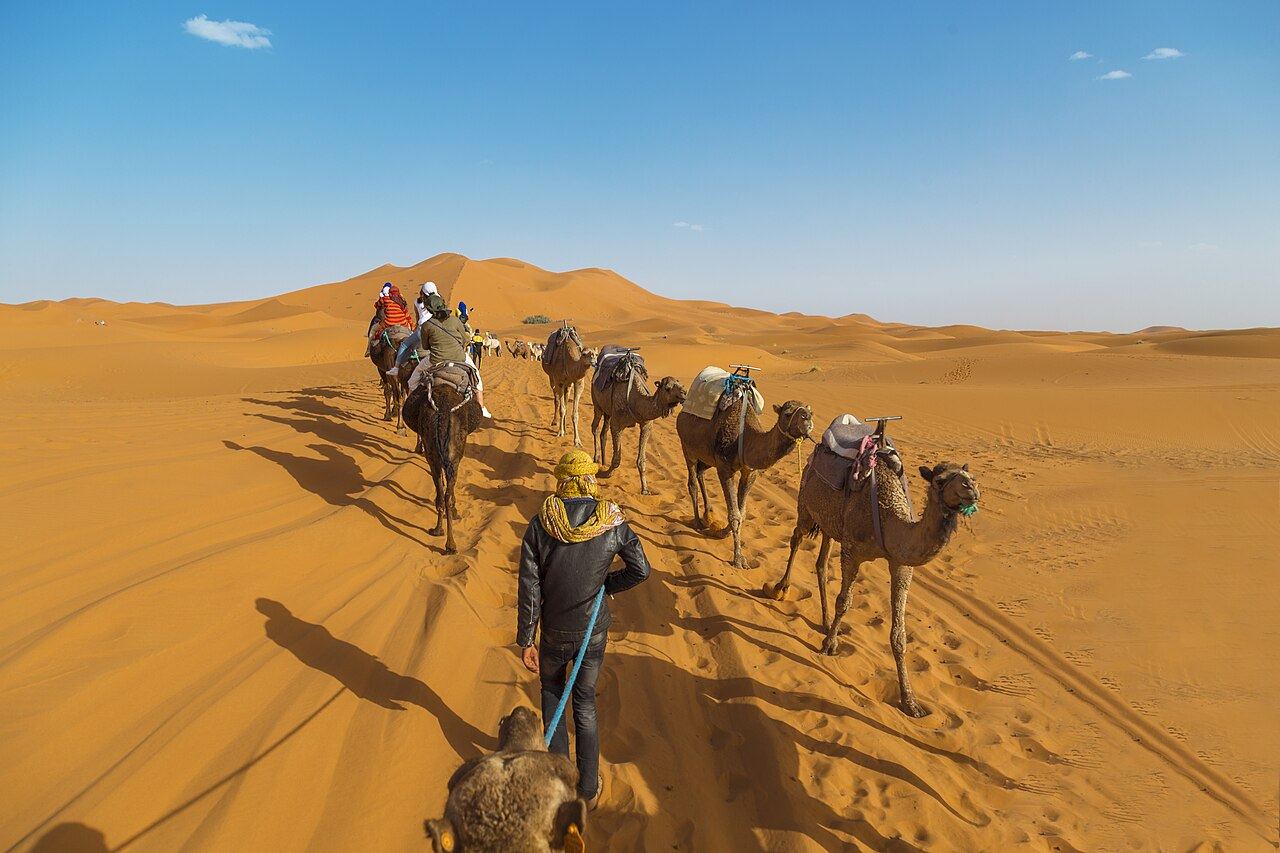
The camel. Dromedaries are built for heat and drought. In classic experiments in the 1950s, Knut Schmidt-Nielsen and colleagues studied thirsty camels. Instead of sweating to stay cool, a camel lets its body temperature drift by about six degrees over a day. It rises from around 34 °C at dawn to about 40 °C in the afternoon. That saves litres of water a day. Camels can lose water equal to around a fifth of their body weight and recover, and their hump stores fat, not water. Their long eyelashes and closable nostrils keep out sand.
The sky. The sky looks blue because molecules of air scatter the short, blue wavelengths of sunlight more than the long red ones, an effect called Rayleigh scattering. At sunset, light passes through more air, so the blue is scattered away and reds and oranges are left. We live at the bottom of an ocean of air. About three-quarters of the atmosphere's mass lies within roughly 11 kilometres of the ground, lower than a long-haul flight's highest cruising height.
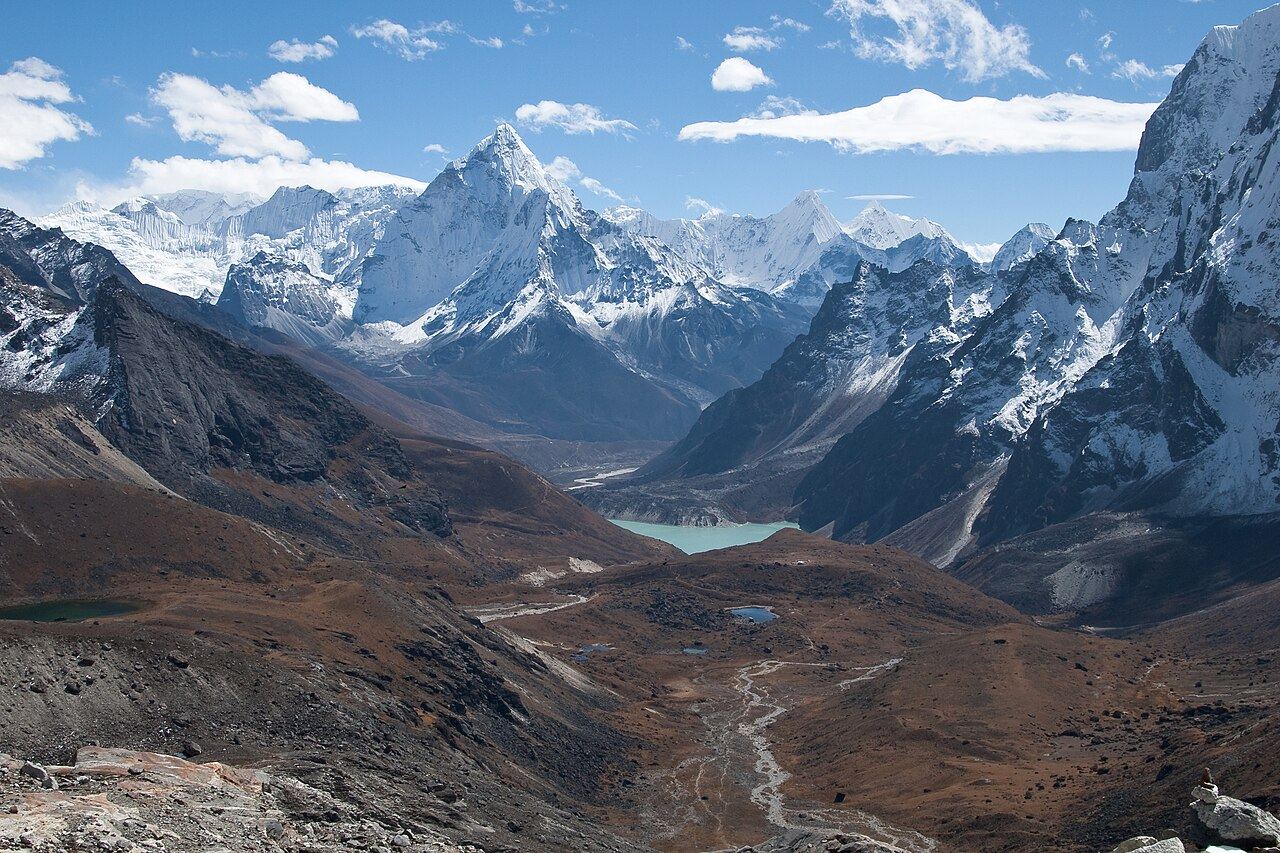
The mountains. The highest, Everest, was measured in 2020 by Nepal and China at 8,848.86 metres. The US Geological Survey explains that the Himalayas formed when India collided with Asia, and that they are still rising by more than a centimetre a year. Mountains are also the world's water towers: a 2020 study in Nature found that mountain snow, glaciers and lakes supply water to about 1.9 billion people.
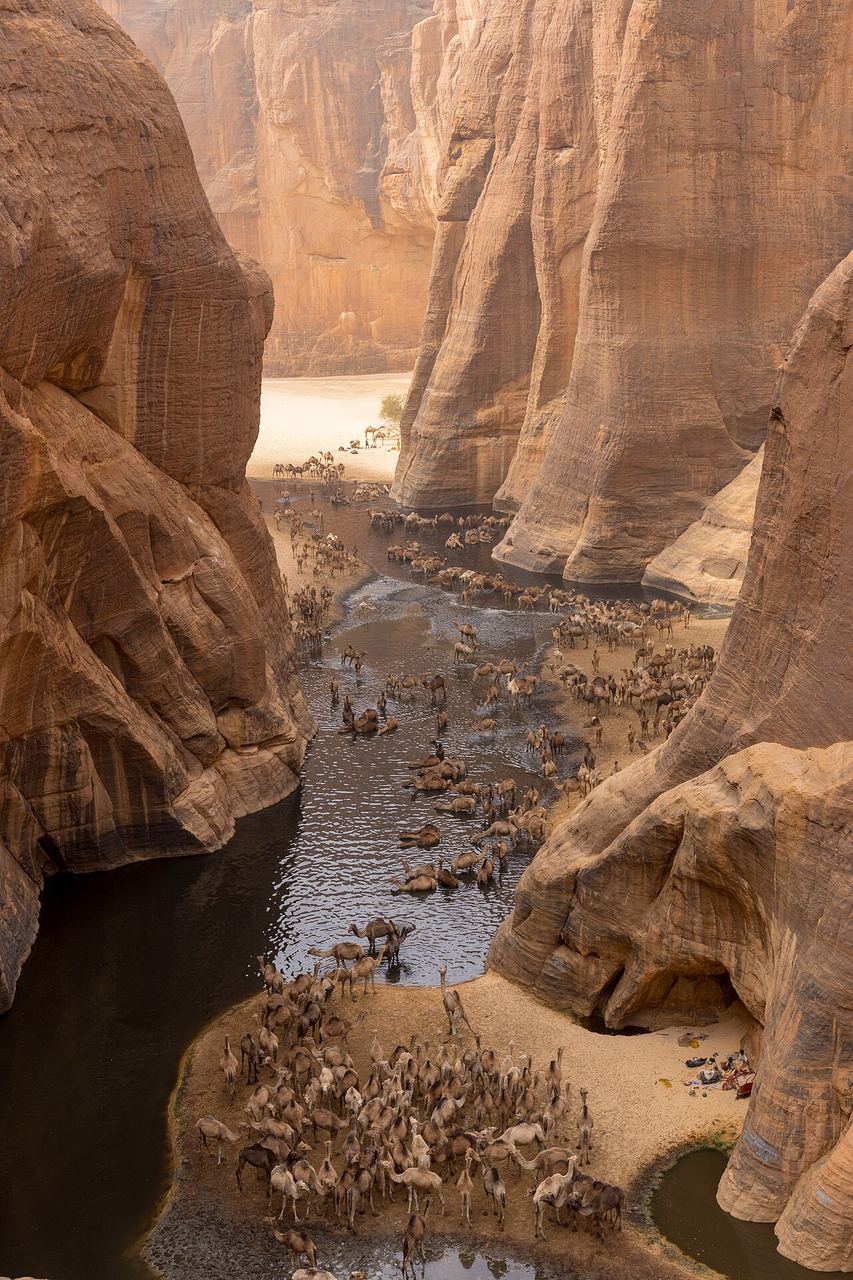
The earth. Earth's surface covers about 510 million square kilometres, with land making up roughly 29% of it. The planet is a sphere, about 12,742 kilometres across, but so large that from where we stand the ground really does look spread out flat to the horizon. That is why Fakhr al-Dīn al-Rāzī, a twelfth-century theologian from Persia, could hold that the Earth was round. He could still read this verse as describing how the land is spread out for us to live on.
Four looks, four sciences: biology, atmospheric physics, geology and geography. Each one opens into more questions than it answers.
What each faith says
Judaism
“But ask now the beasts, and they shall teach thee; And the fowls of the air, and they shall tell thee; Or speak to the earth, and it shall teach thee; And the fishes of the sea shall declare unto thee.”
Job 12:7-8 · JPS 1917
The Hebrew Bible has its own “look and ask” passages. Isaiah tells the people to lift their eyes on high and see “who hath created these?” And Job, in the book that bears his name, answers his friends by sending them to the animals, the birds, the earth and the fish. Ask them, he says, and they will teach you that the hand of the LORD has made this.
Psalm 8 is a single long look at the night sky. “When I behold Thy heavens, the work of Thy fingers, The moon and the stars, which Thou hast established; What is man, that Thou art mindful of him?” Jewish tradition has a blessing for exactly this moment. On seeing high mountains, great deserts or the sky in its glory, a Jew says “Blessed are You... who makes the work of creation” (Mishnah Berakhot 9:2).
Christianity
“For the invisible things of him since the creation of the world are clearly seen, being perceived through the things that are made, even his everlasting power and divinity.”
Romans 1:20 · WEB
In the Sermon on the Mount, Jesus gives his own two looks: “See the birds of the sky... Consider the lilies of the field, how they grow.” He asks his listeners to look at ordinary things closely, and to let what they see change how they live: here, to worry less and trust more.
Paul, writing to the Christians in Rome, says that God's “invisible things” are “clearly seen, being perceived through the things that are made”. For many Christians this is the basis of natural theology, the idea that creation itself points to its Creator, even before anyone opens a Bible. Anglicans have sung the same idea for centuries in the Benedicite, a canticle in the Book of Common Prayer. It calls on sun and moon, mountains and hills, whales and birds to “bless ye the Lord”.
Islam
“Remind them, for thou art but a remembrancer.”
Qur'an 88:21 · Pickthall (1930)
Muslims call this kind of looking tafakkur, reflection. The Qur'an praises people who “Such as remember Allah, standing, sitting, and reclining, and consider the creation of the heavens and the earth, (and say): Our Lord! Thou createdst not this in vain. Glory be to Thee! Preserve us from the doom of Fire.” (3:191, Pickthall). A saying reported in early collections puts the balance well: reflect on God's creation, and do not try to reflect on God's essence, because you cannot grasp it. We are invited to look at what God made, and to let the making speak of the Maker.
The fourteenth-century commentator Ibn Kathīr noticed something about the camel: such a huge, strong animal is led on a rope by a child. Some early Arabic scholars mention that ibil, camels, could also mean rain clouds here, which would make the four looks all about sky and land. One of them is al-Rāghib al-Iṣfahānī, who wrote a famous dictionary of the Qur'an's words around 1100. Either way the question is the same, and so is the Name it points to: al-Khāliq, the Creator.
Same and different
All three traditions teach that looking carefully at creation is a religious act, not a distraction from it. They share almost the same instruction: look, ask, consider. Where they differ is in what they expect looking to lead to. For Jews, it leads to blessing and awe at the Creator of Israel's covenant. For Christians, it leads to trust in a Father who cares and, for many, a first step towards Christ. For Muslims, it leads to dhikr, “remembrance”, of the One God, with the Prophet as “only a reminder”, not a compeller.
A moment to reflect
- If you did the four looks today, from where you are, what would you look at?
- When did a “how?” question last change the way you saw something ordinary?
- Is there something you see every day that you have never really looked at?
- Does knowing the science of the sky make it more wonderful to you, or less?
Watch
Planet Earth II's journey across mountains, deserts and plains: the four looks on film.
A minute with the Natural History Museum on camel survival.
The British Geological Survey on how mountains are made.
Brian Cox on a picture of Earth that changed how we see ourselves.
Do it together
Go for a walk in a park or on a hill and stop four times: look at an animal, the sky, the highest point you can see, and the ground. At each stop, everyone says one “how?” question. Write them down and look up the answers together later.
Photograph the sky from the same spot at the same time each day for a week, plus one sunset. Explain the colours with Rayleigh scattering, using a torch and a glass of water with a few drops of milk.
Share each tradition's words for moments of awe: the Jewish blessing over mountains and sky, a Christian psalm of praise, and the Muslim “subḥān Allāh”, “glory be to God”. Plan a trip somewhere with a big view to say them.
Take the Benedicite, the old church canticle that calls on sun, moon, mountains, seas, whales and birds to praise God, on a walk. Each time you see something it names, someone reads that line aloud.
Go deeper
- Qur'an 88:17-21 with translations · scripture
- Job 12 (JPS 1917) on Sefaria · scripture
- USGS: The Himalayas, two continents collide · article
- Immerzeel et al. 2020, the world's water towers · paper
- Romans 1 (WEB) on Bible Gateway · scripture
In pictures
Try this · All · 20 min · Art
The four looks walk
You need: paper and a pencil, a clipboard or book to lean on
- Go outside. Look at an animal (a bird, a cat, a snail) for two minutes and draw it.
- Look up at the sky for two minutes and draw what you see.
- Look at the tallest thing in view, a hill, a tree or a building, and draw it.
- Look at the ground under your feet and draw it close up.
- Which of the four surprised you most?
Safety: Younger children stay with an adult.
A camel, the sky, the mountains, the ground: the Qur'an asks us to look at how each was made.
Sources (7)
- Camel body temperature swings about 6 °C in dehydration, saving water: Schmidt-Nielsen et al., American Journal of Physiology, 1957
- Camels raise body temperature to cut evaporative cooling; tolerance of long dehydration: Ali et al., Frontiers in Veterinary Science, 2023
- Sky blue from Rayleigh scattering: NASA Space Place, Why is the sky blue?
- Everest 8,848.86 m (2020 survey): Al Jazeera, 8 December 2020
- Himalayas still rising more than 1 cm a year: USGS, This Dynamic Earth: The Himalayas
- Mountain water towers supply about 1.9 billion people: Immerzeel et al., Nature, 2020
- Earth surface ~510 million km², diameter ~12,742 km: NASA Earth fact sheet