Anyone awake at the very end of a night knows the moment. It might come after a long journey, a new baby, a night shift or a night of worry. The dark is still dark, and then it is not quite. The black at one edge of the sky turns grey, then blue. A single bird starts up. You did not see it happen, but the night is over.
The Qur'an describes that moment with one of its most beautiful images. It does not say the sun rose. It says the morning breathed.
“And the close of night, And the breath of morning.”
Qur'an 81:17-18 · Pickthall (1930)
These verses come in Surah al-Takwīr (The Folding Up), a chapter that opens with the end of the world, the sun folded up and the stars falling. Then, as an oath, it turns to something every listener knew: night leaving and morning breathing in. The verb tanaffasa means to breathe, to sigh out; the Arabic word for dawn elsewhere, fajr, comes from a root meaning to split open, the light cleaving the dark. The Qur'an swears by the dawn several times (89:1, 74:34, 93:1).
What science shows
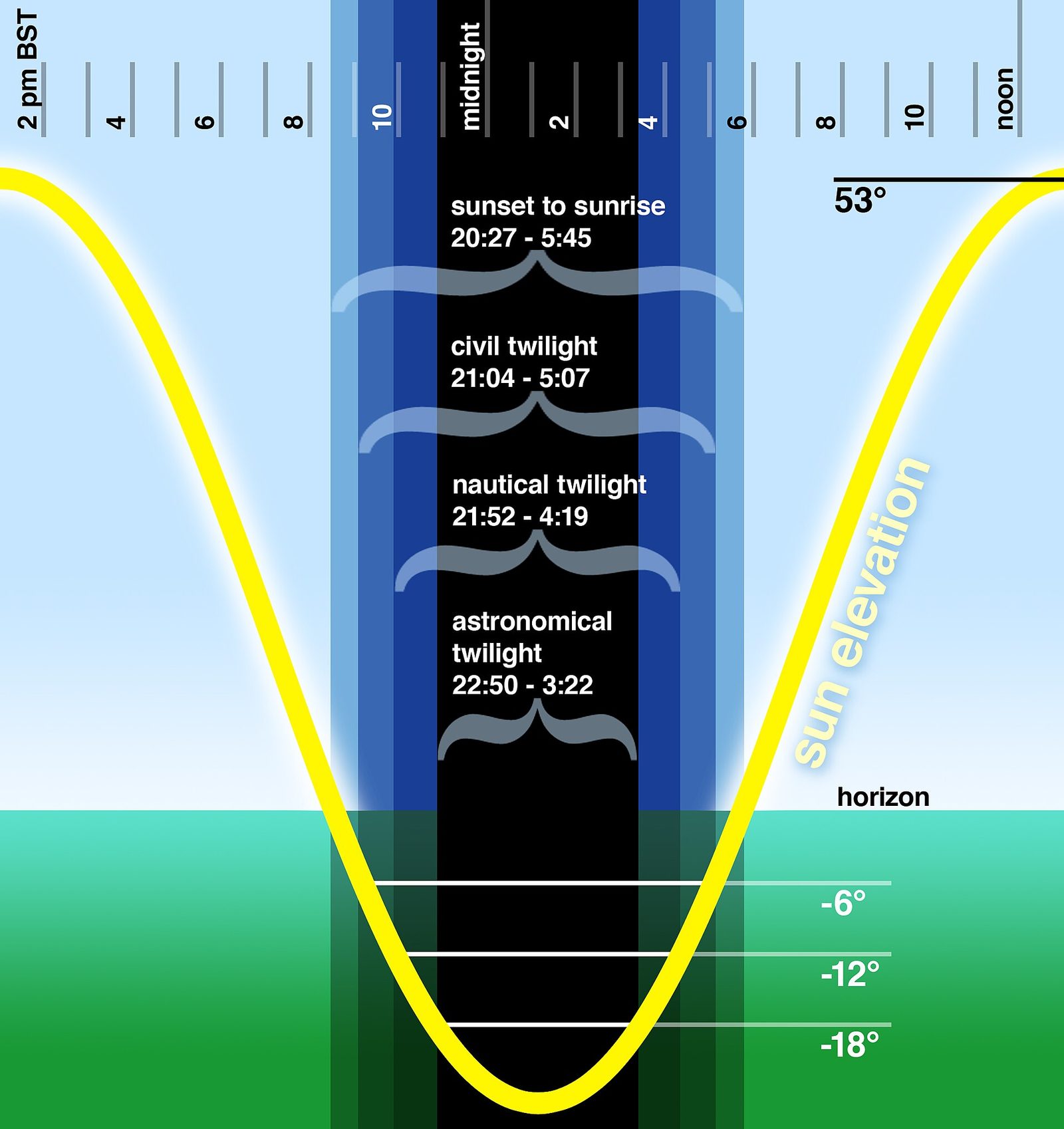
Dawn begins long before sunrise. Even when the Sun is below the horizon, its light is still hitting the upper atmosphere above you, and air molecules scatter some of it down to the ground. Astronomers divide this pre-dawn glow into three stages, measured by how far the centre of the Sun is below the horizon. According to the US National Weather Service, astronomical twilight begins when it is 18 degrees below. Nautical twilight comes at 12 degrees, when sailors can see both stars and the horizon. Civil twilight comes at 6 degrees, when there is enough light to see most things outdoors without a lamp.
That matters to millions of people, because the Muslim dawn prayer, Fajr, begins at true dawn, the first spread of light along the horizon. Astronomers and scholars have long tried to match this to an angle, usually between 15 and 18 degrees. In the north of Britain in summer, the Sun never gets 18 degrees below the horizon at all. The sky never becomes fully dark, and British mosques have had to work out carefully when Fajr, the dawn prayer, begins.
Living things notice dawn too. Human eyes contain special light-sensitive cells, discovered in 2002 (Berson and colleagues, Science), that do not help us see shapes but tell the brain's master clock how bright it is. Morning light through these cells resets our body clock every day, which is why daylight early in the day helps people sleep better at night.
Then there are the birds. In Britain the dawn chorus peaks in April and May. Robins often start first, sometimes before it is light, and by about half past six the chorus is already fading. Why sing at dawn? The air is often cool and still, so song carries further, and it is too dark to forage well. A study of British birds looked at eye size. It found that species with larger eyes, which see better in low light, tend to start singing earlier in the morning (Thomas and colleagues, Proceedings of the Royal Society B, 2002).
So when the morning 'breathes', a great deal is happening: light bending through the upper air, clocks resetting in billions of brains, and song spreading from tree to tree. The verse gives no physics. It gives the feeling, and asks the listener to treat each dawn as a sign.
What each faith says
Judaism
“Hast thou commanded the morning since thy days began, and caused the dayspring to know its place; that it might take hold of the ends of the earth?”
Job 38:12-13 · JPS 1917
In the Hebrew Bible God asks Job whether he has ever 'commanded the morning' or shown the dawn its place. The morning is not a mechanical event but something God sends. Jewish daily life is built around it. The morning prayer, Shacharit, is linked by the Talmud (Berakhot 26b) to Abraham, who 'rose early in the morning' (Genesis 22:3).
Many Jews begin the day, before even getting out of bed, with a short prayer called Modeh Ani, “I give thanks”. 'I give thanks before You, living and enduring King, for You have returned my soul to me with compassion; great is Your faithfulness.' The last words echo Lamentations: God's mercies 'are new every morning'. And the first of the morning blessings thanks God for giving the rooster understanding to tell day from night: the dawn chorus, built into the prayer book.
Christianity
“Because of the tender mercy of our God, by which the dawn from on high will visit us, to shine on those who sit in darkness and the shadow of death; to guide our feet into the way of peace.”
Luke 1:78-79 · WEB
Christians have prayed at dawn since the earliest centuries. In monasteries the morning office, Lauds, “praises”, was sung at first light. Its central song is the Benedictus, the words of Zechariah in Luke's Gospel. It sings that 'the dawn from on high will visit us, to shine on those who sit in darkness'. Morning Prayer in the Church of England still uses it today.
The dawn has a special place in the Christian story. The Gospels place the discovery of the empty tomb at sunrise: 'very early on the first day of the week, they came to the tomb when the sun had risen' (Mark 16:2). The first to come were women, Mary Magdalene and her companions. That is why many churches hold Easter sunrise services outdoors. For Christians, every dawn carries a small echo of the resurrection. Eleanor Farjeon's hymn Morning Has Broken, written for a church hymn book in 1931, is still sung in British schools and churches.
Islam
“Establish worship at the going down of the sun until the dark of night, and (the recital of) the Qur'an at dawn. Lo! (the recital of) the Qur'an at dawn is ever witnessed.”
Qur'an 17:78 · Pickthall (1930)
For Muslims, dawn is a daily appointment. The first of the five prayers, Fajr, is prayed in the grey light before sunrise. The call to prayer at that hour adds a line found at no other time: 'Prayer is better than sleep.' Muhammad ﷺ (peace be upon him) said that the two short units of prayer before the dawn prayer 'are better than the world and everything in it' (Muslim 725).
The Qur'an treats dawn as a time when heaven and earth seem to meet. 'Establish worship at the going down of the sun until the dark of night, and (the recital of) the Qur'an at dawn. Lo! (the recital of) the Qur'an at dawn is ever witnessed.' (17:78, Pickthall). Commentators explain that the angels of the night and the angels of the day are both present at that hour. Surah al-Falaq, recited for protection, begins: 'Say: I seek refuge with the Lord of the daybreak.'
Same and different
All three traditions get up in the dark to meet the dawn with prayer: Shacharit and Modeh Ani, Lauds and Morning Prayer, Fajr. Each sees the morning as something given by God rather than something that simply happens. They differ in what the dawn recalls. For Jews, it recalls God's daily faithfulness and the return of the soul. For Christians, it also recalls the dawn of the resurrection. For Muslims, an hour witnessed by angels, when the first prayer is better than sleep.
A moment to reflect
- When did you last see the sky change from night to day? What did you notice?
- Does starting the day with thanks change the day?
- What is the first thing you do when you wake? What would you like it to be?
- What would it mean for a morning to 'breathe'?
Watch
A short, gentle explainer on the dawn chorus for younger viewers.
Close your eyes and listen to a British wetland wake up.
Tom Scott on the three kinds of twilight, and places where night never fully comes.
The Royal Institution on light and the body clock.
Do it together
On International Dawn Chorus Day, the first Sunday in May, meet at a park gate before sunrise. Stand still for ten minutes and count how many different songs you hear, then share breakfast.
Read Modeh Ani, the Benedictus (Luke 1:68-79) and Surah al-Falaq side by side. Ask what each one is grateful for, and what each one asks for.
For one week, note the time when you can first see the colour of a tree or roof outside your window. Compare with the published sunrise and twilight times and plot the difference.
Many churches hold an outdoor sunrise service on Easter Day, on a hill, a beach or in a churchyard. Anyone may go along, stand at the back and watch the light come up while the first Easter hymns are sung.
Go deeper
- Qur'an 81:15-18 with translations · scripture
- Job 38 (JPS 1917) on Sefaria · scripture
- Luke 1 (WEB) on Bible Gateway · scripture
- US National Weather Service: twilight types · article
- Dawn chorus guide (BBC Wildlife) · article
In pictures
Try this · KS2 · 30 min, early · Science
Dawn chorus diary
You need: a notebook, a watch or phone, a window or back door
- Look up tomorrow's sunrise time.
- Get up about 40 minutes before it and sit quietly by an open window.
- Write down the time you hear the first bird, and how many different songs you hear.
- Write down the time the sun actually rises. Which came first, the singing or the sun?
Safety: Go outside only with an adult.
Before the sun appears the sky is already glowing and the birds are already singing, as if they knew.
Sources (5)
- Civil, nautical and astronomical twilight begin at 6, 12 and 18 degrees below the horizon: US National Weather Service, Twilight types
- Retinal ganglion cells containing melanopsin detect light and set the circadian clock: Berson, Dunn & Takao, Science, 2002
- Dawn chorus peaks in April and May; robins often start first; by 6.30am it is fading: BBC Wildlife (Discover Wildlife), Dawn chorus guide, 2022
- Bird species with larger eyes start singing earlier at dawn: Thomas et al., Proceedings of the Royal Society B, 2002
- In northern latitudes in summer the Sun stays less than 18 degrees below the horizon (persistent twilight): HM Nautical Almanac Office / standard astronomy; see NWS twilight definitions