The Qur'an's longest chapter, 286 verses long and home of the famous Throne Verse, is called al-Baqara: The Cow. Ask most people why and they have no idea. The answer is a short, strange, almost comic story about a simple instruction that becomes complicated because people will not stop asking questions.
A man has been killed, and nobody knows who did it. Moses (peace be upon him) tells his people that God commands them to slaughter a cow. They ask: what kind? How old? What colour? Each answer narrows the choice, until they finally find the one animal that fits, and do it, 'though they almost did not'.
“And when Moses said unto his people: Lo! Allah commandeth you that ye sacrifice a cow, they said: Dost thou make game of us? He answered: Allah forbid that I should be among the foolish!”
Qur'an 2:67 · Pickthall (1930), 2:69, 2:71 · in brief
The story runs from 2:67 to 2:73. Verses 72-73 reveal its purpose. A person had been killed and the people were disputing over who was guilty. They were told to strike the dead body with part of the cow, and the truth came out. 'Thus God brings the dead to life, and shows you His signs, so that you may understand.' A second cow story in the Qur'an, the king's dream of seven fat cows and seven lean ones (12:43), is shared with the Torah's story of Joseph (peace be upon him).
What science shows
Every cow on Earth descends from the aurochs, a huge wild ox that once roamed from Britain to China and North Africa. Bulls stood up to about 1.8 metres at the shoulder, with long forward-curving horns. Genetic studies of ancient bones show that taurine cattle, the kind familiar in Europe and the Middle East, were first domesticated in the Near East about 10,500 years ago. They came from a surprisingly small founding herd (Bollongino and colleagues, Molecular Biology and Evolution, 2012). Humped zebu cattle were domesticated separately in South Asia.
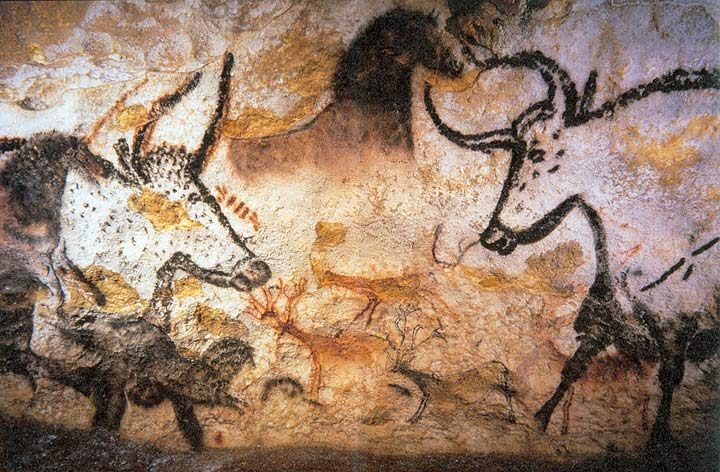
The wild aurochs did not survive. Hunting and loss of forest pushed it back across Europe until the last known animal, a female, died in the Jaktorów forest in Poland in 1627.
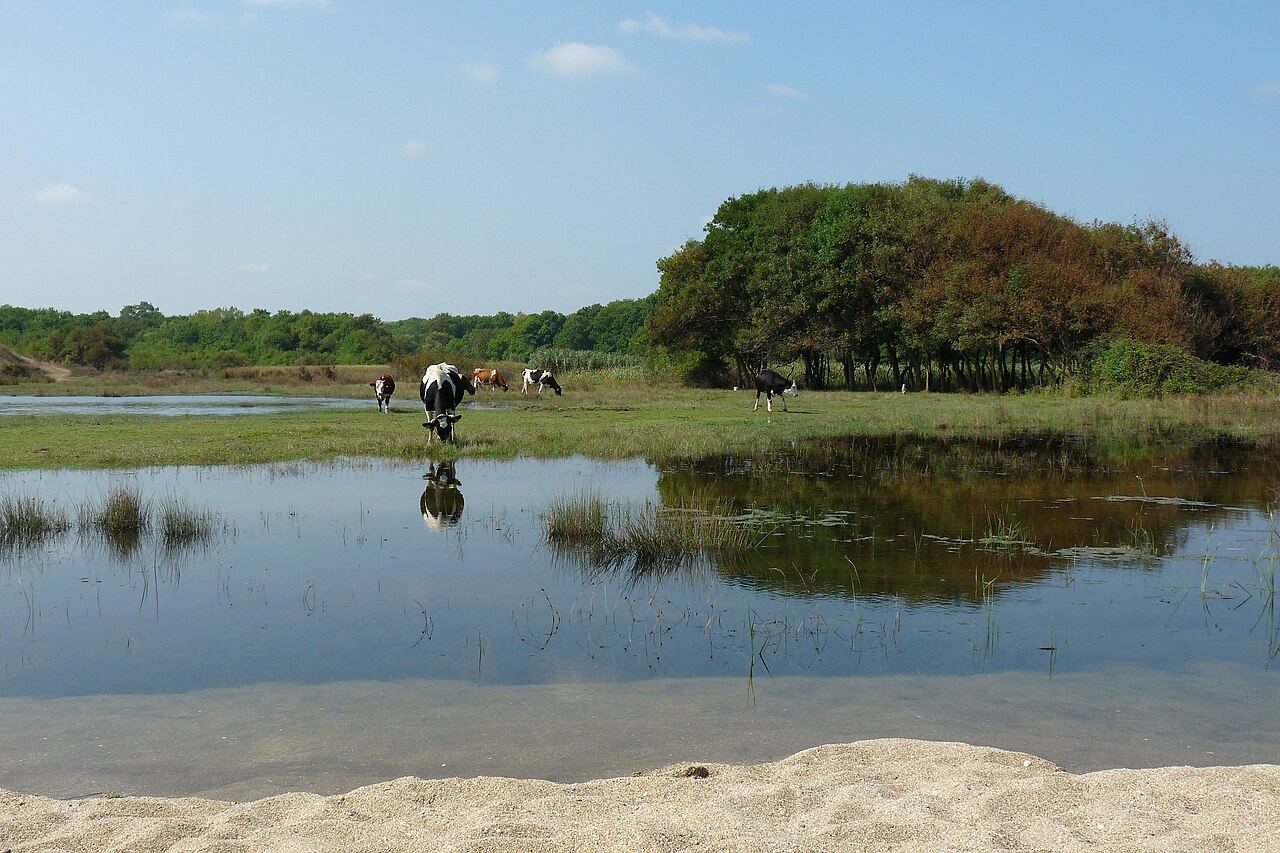
Meanwhile its tame descendants spread across the planet. Today there are well over a billion cattle, kept for milk, meat, leather and, in many parts of the world, for pulling ploughs and turning water-wheels. That is exactly the work the Qur'an's cow had never done. A yoke leaves marks on the neck and shoulders, so 'never been under the yoke' is something a farmer could check with their hands.
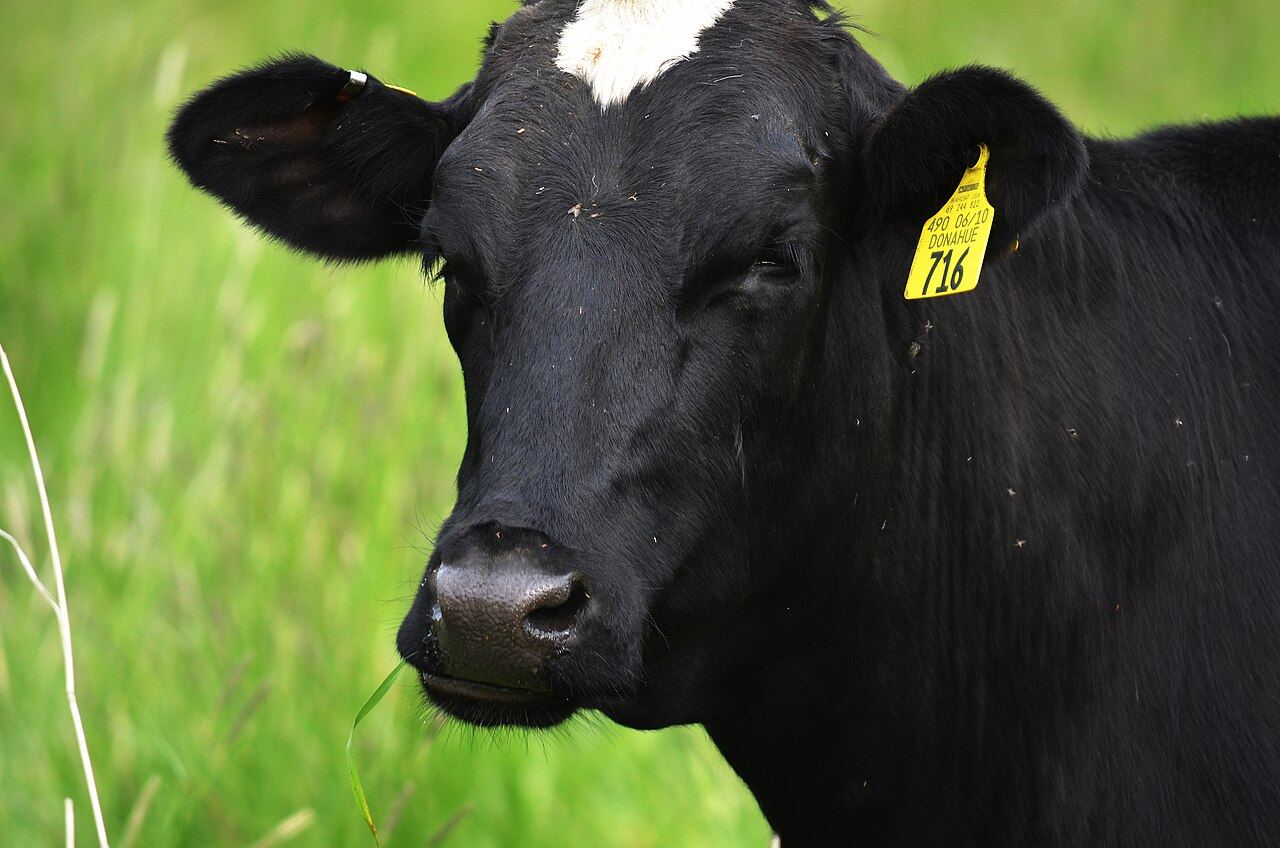
A cow can live on grass, which we cannot digest, because it is a ruminant. Its stomach has four chambers. In the first and largest, the rumen, trillions of microbes break down tough plant fibre (cellulose) that no mammal can digest alone. The cow brings the food back up and chews it again, 'chewing the cud', for hours each day. In effect, every cow carries a fermentation tank that turns a field into milk.
None of this explains the story, which is not natural history. But it helps us see the animal the first listeners saw: valuable, ordinary, everywhere, and so easy to choose. Seen that way, the people's endless questions look less like care and more like reluctance.
What each faith says
Judaism
“The elders of that city shall take a heifer of the herd, which hath not been wrought with, and which hath not drawn in the yoke.”
Deuteronomy 21:3 · JPS 1917
The Torah has two heifers of its own. The first is the red heifer of Numbers 19: 'faultless, wherein is no blemish, and upon which never came yoke', whose ashes were used for purification. Jewish tradition calls this the classic example of a ḥukkah, a statute whose reason is not given. A famous midrash (Numbers Rabbah 19) says that even King Solomon, the wisest of men, understood every law except this one. Every year, on Shabbat Parah, the “Sabbath of the Heifer” a few weeks before Passover, synagogues read the red heifer passage aloud as a call to prepare for the festival.
The second is about an unsolved death. Deuteronomy 21 commands what to do when a body is found in a field and nobody knows who killed it. The elders of the nearest town take a heifer that has never worked or worn a yoke and break its neck in a rough valley. Then they wash their hands and declare, 'Our hands have not shed this blood.' The ritual says that an unsolved death is everyone's responsibility.
Christianity
“For if the blood of goats and bulls, and the ashes of a heifer sprinkling those who have been defiled, sanctify to the cleanness of the flesh: how much more will the blood of Christ… cleanse your conscience from dead works to serve the living God?”
Hebrews 9:13-14 · WEB
Christians read the red heifer of Numbers through the Letter to the Hebrews. The writer looks at the old purification rites, 'the ashes of a heifer sprinkling those who have been defiled'. He says they point beyond themselves to Christ, who 'offered himself without defect to God' to cleanse the conscience. For Christians, the unblemished animal becomes a picture of the sinless one whose sacrifice, they believe, makes people clean.
Jesus warned against piling up questions to avoid obeying. A lawyer, told to love his neighbour, asks 'Who is my neighbour?', 'desiring to justify himself' (Luke 10:29). Jesus answers with the parable of the Good Samaritan. The story still shapes British life: in 1953 the Anglican priest Chad Varah founded Samaritans, the listening charity, in a London church.
Islam
“And (remember) when ye slew a man and disagreed concerning it and Allah brought forth that which ye were hiding. And We said: Smite him with some of it. Thus Allah bringeth the dead to life and showeth you His portents so that ye may understand.”
Qur'an 2:72-73 · Pickthall (1930)
Muslim commentators read the story as a lesson for Muslims, not a jibe at anyone else. The early scholar Ibn ʿAbbās, the Prophet's cousin, is reported to have said that if the people had taken any cow at all, it would have been enough. But they made things hard for themselves, so God made it hard for them. The report is in the commentary on 2:67 by al-Ṭabarī, the great ninth-century historian and interpreter. The Qur'an warns its own community in the same spirit: 'O ye who believe! Ask not of things which, if they were made unto you, would trouble you; but if ye ask of them when the Qur'an is being revealed, they will be made known unto you. Allah pardoneth this, for Allah is Forgiving, Clement.' (5:101, Pickthall).
The second lesson is in verses 72-73. A hidden crime is brought into the open, and the dead speak. The chapter turns this into a sign of resurrection: 'Thus God brings the dead to life.' And verse 74 adds a sharp line about hearts that harden 'like stones, or even harder'. Then comes a gentle one: some stones split open and water flows from them. Even the hardest heart can still let water through.
Same and different
Torah and Qur'an share the unblemished, unyoked heifer and link a heifer to an unsolved killing; scholars, classical and modern, have long set the Qur'an's story beside Deuteronomy 21. Both also tell the dream of the seven fat and seven lean cows. Judaism treats the red heifer as a law beyond human reasoning. Christianity reads it as pointing to Christ's sacrifice. Islam tells the cow story as a warning against delay and endless questions, and as a sign that God can bring the dead to life. Each reading is the tradition's own; none needs the others to be wrong.
A moment to reflect
- When is asking questions a sign of care, and when is it a way of putting something off?
- Have you ever felt responsible for something that was nobody's fault in particular?
- What makes something 'without blemish' in a person rather than an animal?
- Have you ever made a simple task harder than it needed to be? What was really going on?
Watch
The Natural History Museum on the aurochs, ancestor of every cow.
Students investigate a real cow's four-chambered stomach.
Do it together
Visit a city farm or open farm day and watch a cow chewing the cud. Count the chews before it swallows, and ask the farmer how they tell a healthy animal from a sick one.
Read Deuteronomy 21:1-9 and Qur'an 2:67-73 together. Talk about what a community owes to someone who has died when nobody knows who is to blame.
Give small groups a simple instruction, such as 'bring a green leaf'. Let one person keep asking for more detail. Afterwards discuss when questions helped and when they just slowed things down.
Read the parable of the Good Samaritan (Luke 10:25-37). Each person names one neighbour they pass every week but have never really helped. Agree one small, practical thing to do for them before you next meet.
Go deeper
- Qur'an 2:67-74 with translations · scripture
- Numbers 19 (JPS 1917) on Sefaria · scripture
- Deuteronomy 21 (JPS 1917) on Sefaria · scripture
- Hebrews 9 (WEB) on Bible Gateway · scripture
- Bollongino et al. 2012, cattle from a small number of Near-Eastern founders · paper
In pictures
Try this · KS1 · 15 min · Science
Milk into butter
You need: a clean jar with a tight lid, 150 ml double cream (cold), a pinch of salt (optional)
- Pour the cream into the jar and screw the lid on tightly.
- Take turns to shake it hard. Keep going!
- After a few minutes it goes thick, then a lump of butter splits away from a thin liquid.
- Pour off the liquid (buttermilk) and taste the butter on bread.
Safety: Check for milk allergies first.
Grass becomes milk inside a cow, and milk becomes butter in your hands: a long chain of gifts before breakfast.
Sources (5)
- Taurine cattle domesticated from aurochs in the Near East about 10,500 years ago from a small founding population: Bollongino et al., Molecular Biology and Evolution, 2012
- Aurochs extinct in 1627 (last animal in Jaktorów forest, Poland); size and range: Aurochs, Wikipedia (citing IUCN Red List 2023)
- Well over a billion cattle worldwide: FAO, FAOSTAT livestock data
- Ruminants digest cellulose with rumen microbes and chew the cud: Encyclopaedia Britannica, Ruminant
- Num 19:2 red heifer; Deut 21:1-9 heifer for an unsolved killing as the parallel to 2:72-73: Our own word study, 2026