A honeybee lands on the comb after finding a patch of lavender a kilometre away. She has no words, no map and no phone. So she dances. She runs a short straight line, waggling her body, loops round, and runs it again. Her sisters crowd in, follow her steps, and then fly off in exactly the right direction.
A jar of honey on a kitchen table is the end of a story. That story involved tens of thousands of bees, millions of flower visits and a language made of movement. The Qur'an looks at that same creature and says something simple and startling: her Lord inspired her.
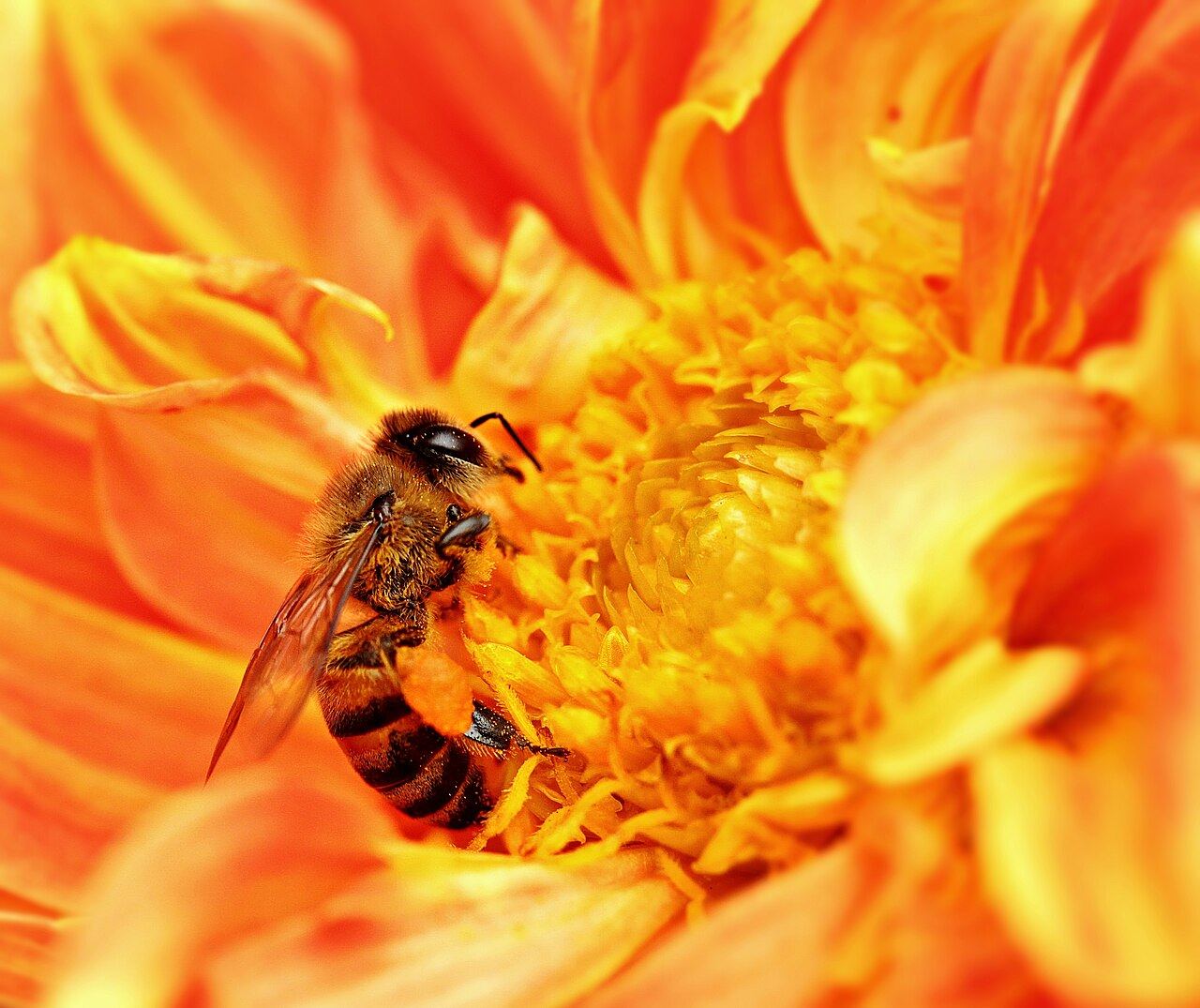
“And thy Lord inspired the bee, saying: Choose thou habitations in the hills and in the trees and in that which they thatch; Then eat of all fruits, and follow the ways of thy Lord, made smooth (for thee). There cometh forth from their bellies a drink divers of hues, wherein is healing for mankind. Lo! herein is indeed a portent for people who reflect.”
Qur'an 16:68-69 · Pickthall (1930)
These verses sit in the sixteenth chapter of the Qur'an, which is named an-Naḥl, The Bee. The chapter is a long list of gifts: rain, cattle, milk, dates, grapes, ships, stars. The verb here, awḥā, “inspired”, comes from the same root as waḥy, revelation to prophets. The Qur'an uses it here for a small insect's know-how.
What science shows
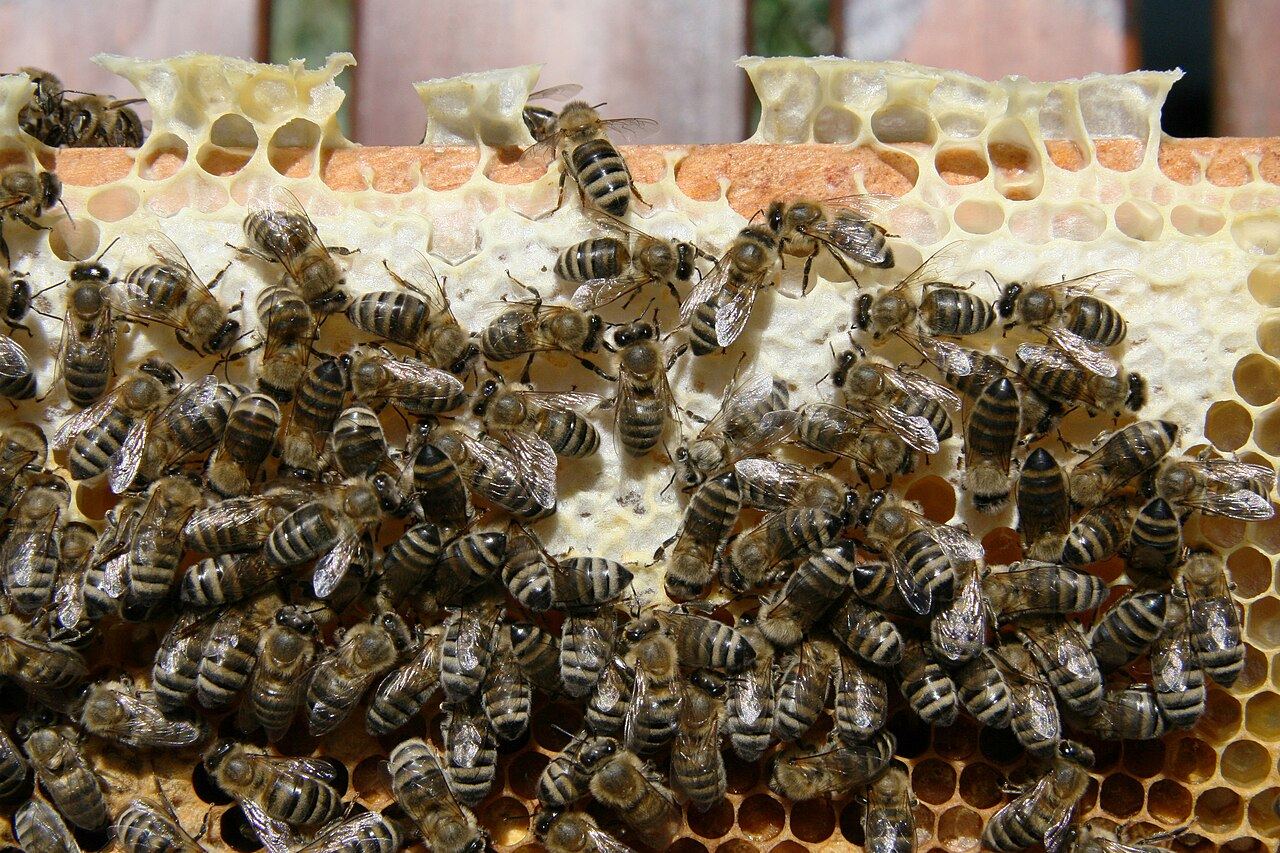
The bee's dance was decoded by the Austrian scientist Karl von Frisch, who shared the Nobel Prize in 1973. When food is close to the hive, a forager does a simple round dance. When it is further away, roughly beyond 50 metres, she does the waggle dance. The angle of her straight run on the vertical comb, compared with straight up, tells the others the angle between the food and the sun. How long she waggles tells them how far to fly.
Researchers are still learning how precise this is. A 2024 review in the Journal of Experimental Biology describes how bees combine the dance with other clues. They use their own memory of the landscape, the scent of the flowers on the dancer, and the sun's movement through the day. Bees even adjust for the fact that the sun keeps moving while they are dancing.
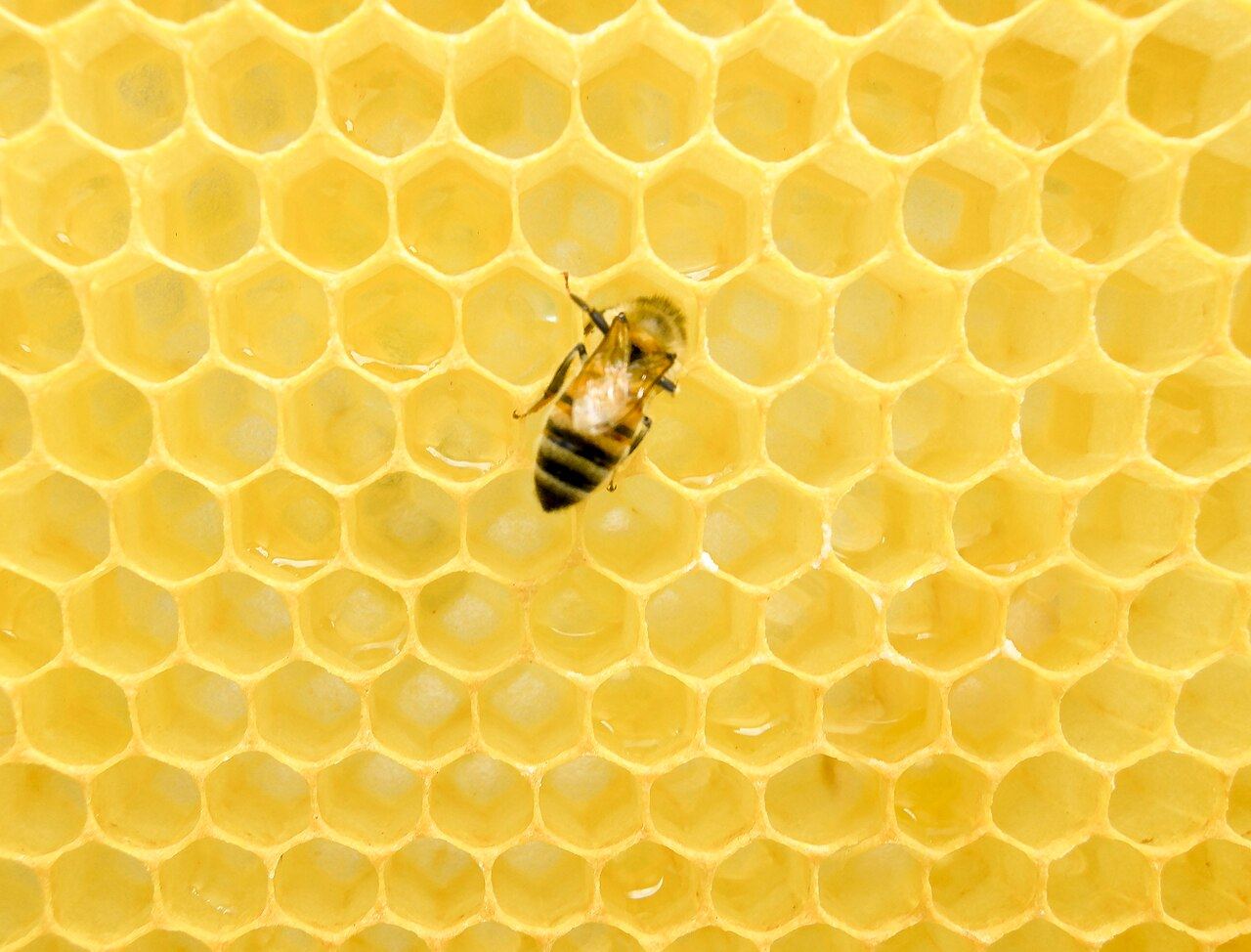
Then there is the comb. Bees build hexagons from wax they make in their own bodies. In 1999 the mathematician Thomas Hales published a proof of the “honeycomb conjecture”. Of all the ways to divide a flat surface into equal areas, a grid of regular hexagons uses the least total wall length. Less wall means less wax, and wax is expensive for a bee to make.
Honey itself really does come in many colours. Beekeepers and food standards grade it on a colour scale from “water white” to “dark amber”. The colour depends on the flowers: pale from clover or lime blossom, darker from heather or buckwheat. A row of British honeys can run from almost clear to nearly black.
Honey also resists germs. It is very sugary and slightly acidic, and most honeys contain an enzyme the bees add, glucose oxidase, which slowly makes small amounts of hydrogen peroxide when honey is diluted. That is why sealed honey keeps for so long. We don't make medical claims on this site: if you are unwell, see a doctor. The wonder is that a creature smaller than your thumb makes a food that can last for years.
What each faith says
Judaism
“More to be desired are they than gold, yea, than much fine gold; sweeter also than honey and the honeycomb.”
Psalm 19:11 · JPS 1917
The Hebrew Bible is full of honey. The promised land is “a land flowing with milk and honey” (Exodus 3:8), and the Psalms say God's laws are “sweeter also than honey and the honeycomb”. In the Book of Judges, Samson finds a swarm of bees and honey inside the body of a lion he had killed. He turns it into a riddle: “Out of the strong came forth sweetness” (Judges 14:14).
Honey also raised a real question for Jewish law. Bees are not a kosher animal, so how can honey be? The Talmud, the rabbis' great written record of law and debate, answers (Bekhorot 7b) that bees do not produce honey from their own bodies; they gather it and store it. So honey is permitted, and at Rosh Hashanah, the Jewish New Year, families dip apple in honey and pray for a sweet year.
Christianity
“Now John himself wore clothing made of camel's hair, with a leather belt around his waist. His food was locusts and wild honey.”
Matthew 3:4 · WEB
In the Gospels, John the Baptist lives in the wilderness on “locusts and wild honey” (Matthew 3:4). It is a sign of a simple life wholly given to God. In Luke's Gospel, when the risen Jesus appears to his disciples, they give him broiled fish and, in many manuscripts, some honeycomb.
The bee also has a place in Christian worship. At the Easter Vigil, Catholic and many Anglican churches sing an ancient hymn called the Exsultet in praise of the Easter candle. In its traditional Latin text it honours the work of the “mother bee” who made the wax. For centuries churches insisted that altar candles be made mostly of beeswax, as a fitting offering from a creature that works so faithfully.
Islam
“Then eat of all fruits, and follow the ways of thy Lord, made smooth (for thee). There cometh forth from their bellies a drink divers of hues, wherein is healing for mankind. Lo! herein is indeed a portent for people who reflect.”
Qur'an 16:69 · Pickthall (1930)
For Muslims, the verse about the bee is a lesson in how God guides every creature in its own way. The bee does not reason its way to the hexagon; it follows the paths “made easy” for it. Classical commentators such as Ibn Kathīr, a fourteenth-century scholar from Damascus, read “inspired” here as an instinct God placed in the bee, not prophecy. The point is that guidance reaches everything, from prophets to insects, each in its own measure. One of God's names is al-Hādī, the Guide.
The Qur'an also describes rivers of “pure honey” in Paradise (47:15). A well-known saying of the Prophet compares the believer to a bee. It takes only what is good, gives only what is good, and lands on a branch without breaking it. It is reported in Musnad Ahmad (6872); scholars grade it sound through supporting reports, though this particular chain is weak. It is a picture of a gentle, useful life.
Same and different
All three traditions treat honey as a gift and an image of sweetness, and all three see wisdom in small creatures. The Qur'an is the only one of the three scriptures that speaks of the bee being guided directly by God, and gives a whole chapter its name. Judaism's interest is partly practical, through food law and festival custom, and Christianity's runs through its worship and its prophets of the wilderness.
A moment to reflect
- The bee communicates without words. What do you communicate without speaking?
- Is instinct a kind of guidance? What would it mean to be guided without knowing it?
- Why do so many traditions use sweetness to describe goodness?
- What would change if you thought of the food on your table as the work of thousands of lives?
Watch
Clear footage of the waggle dance and how bees read it.
The maths of the hexagon, simply animated.
Why bee colonies are under pressure, and why it matters to us.
Go deeper
- Qur'an 16:68-69 with translations · scripture
- Nobel Prize 1973 press release: von Frisch, Lorenz, Tinbergen · article
- Psalm 19 (JPS 1917) on Sefaria · scripture
- Talmud Bekhorot 7b on Sefaria · scripture
- Hales, The Honeycomb Conjecture · paper
- Matthew 3 (WEB) on Bible Gateway · scripture
In pictures
Try this · KS2 · 20 min · Maths
Why hexagons?
You need: paper, a coin or bottle top to draw round, a pencil and scissors, the hexagon template (draw round a hex nut or print one)
- Draw and cut out 7 circles of the same size.
- Push them together on the table. Notice the gaps between them.
- Now cut out 7 hexagons of the same width.
- Fit them together. Are there any gaps now?
- Which shape would waste less wax for a bee?
The bee builds this shape without a ruler, guided, the Qur'an says, by what she was given.
Sources (5)
- Round dance for near food, waggle dance beyond about 50 m; Nobel 1973: Nobel Prize press release, 1973
- How bees combine dance information with memory and the sun: Menzel & Galizia, Journal of Experimental Biology, 2024
- Regular hexagons divide the plane into equal areas with least perimeter: Hales, The Honeycomb Conjecture, 1999 (Discrete & Computational Geometry 2001)
- Honey's antibacterial action: hydrogen peroxide via glucose oxidase, low pH, high sugar: Mandal & Mandal, Asian Pacific Journal of Tropical Biomedicine, 2011
- Honey colour grades from water white to dark amber: USDA, United States Standards for Grades of Extracted Honey