Robert Hooke looked at a thin slice of cork through his home-made microscope in 1665. He saw tiny boxes that reminded him of monks' rooms in a monastery. He called them cells. He had no idea that he was looking at the basic unit of all life, or that his own body was built from tens of trillions of them.
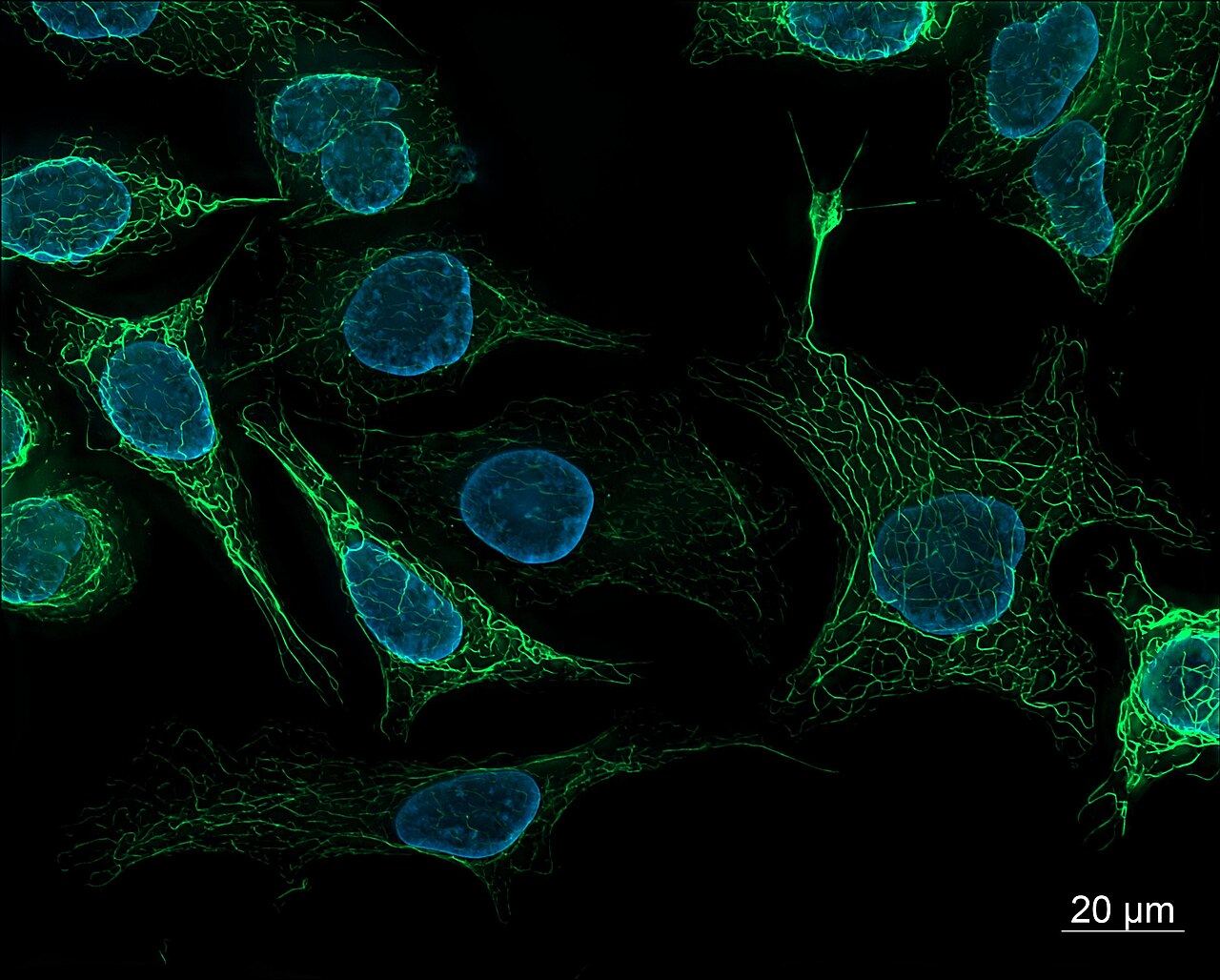
Today we can watch inside a living cell. We see protein 'motors' walking along tracks carrying cargo, and factories folding new molecules. A turbine spins thousands of times a minute to make the energy you are using to read this. A single cell is a city. You are a country of 37 trillion of them.
“Those who disbelieve say: The Hour will never come unto us. Say: Nay, by my Lord, but it is coming unto you surely. (He is) the Knower of the Unseen. Not an atom's weight, or less than that or greater, escapeth Him in the heavens or in the earth, but it is in a clear Record.”
Qur'an 34:3 · Pickthall (1930)
The Arabic dharrah, here rendered 'atom', meant the smallest thing an Arab listener could imagine: a speck of dust in a sunbeam or a tiny ant. The verse says nothing about modern atoms or cells. It says that God's knowledge reaches the smallest things as fully as the largest. A cell, invisible to the eye, is a fitting place to think about that.
What science shows
Hooke's book Micrographia (1665) became a bestseller. Ten years later Antonie van Leeuwenhoek, a cloth merchant in Delft who ground his own lenses, became the first person to see single-celled life. He called them 'animalcules', and found them in drops of rainwater and scrapings from his teeth. In 1838 and 1839 Matthias Schleiden and Theodor Schwann proposed that all plants and animals are made of cells. In 1855 Rudolf Virchow added that every cell comes from another cell.
How many cells are you? A careful 2013 estimate, adding up organ by organ, came to about 37 trillion. Most of them, about 84 per cent by number, are red blood cells. You also carry roughly as many bacterial cells as human ones, mostly in your gut. And you replace yourself steadily: a 2021 study estimated that your body makes about 330 billion new cells a day, nearly 4 million every second.
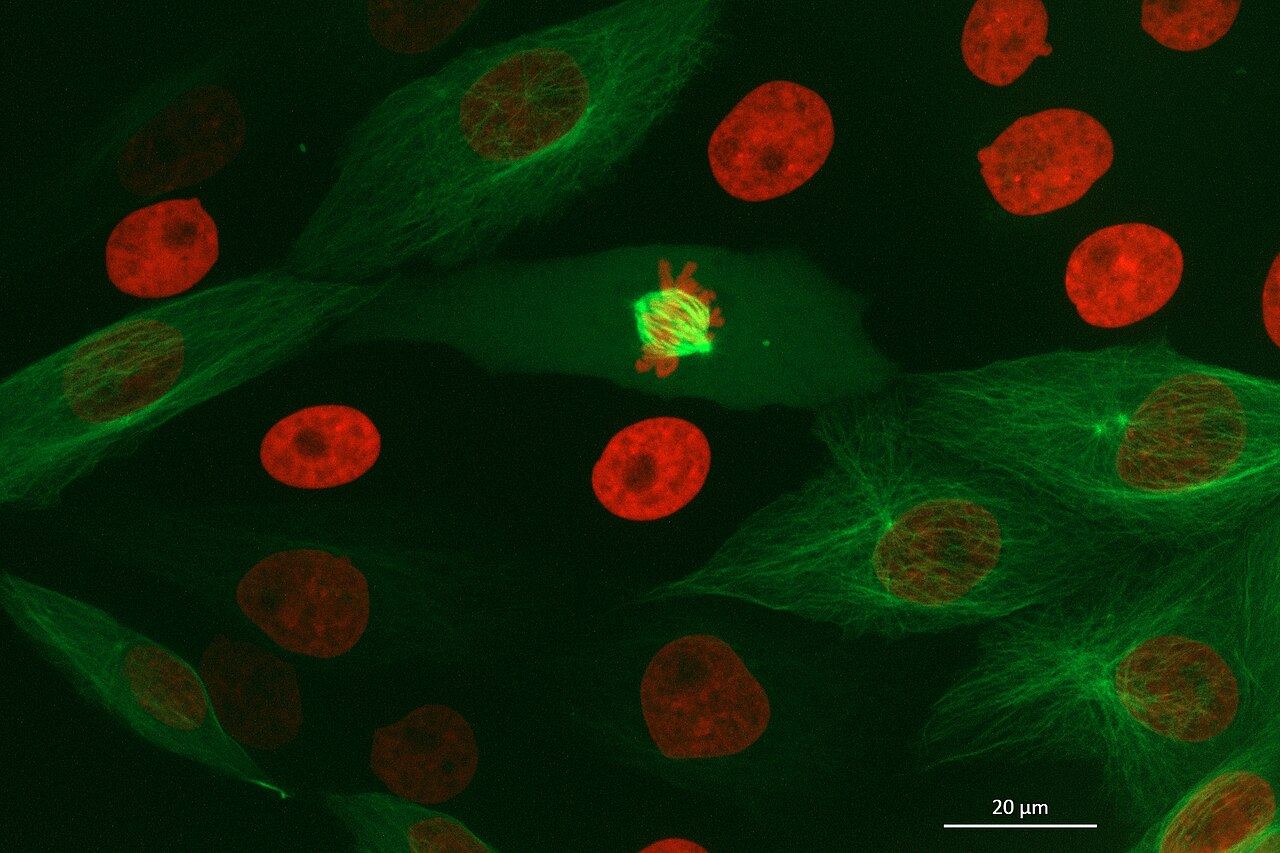
Inside each of your cells is a nucleus holding your DNA, and around it a crowded watery space. Ribosomes read genetic messages and stitch amino acids into proteins, several per second. Mitochondria, which descend from bacteria that began living inside other cells around 1.5 to 2 billion years ago, turn food into usable energy. A cell membrane, two molecules thick, controls what gets in and out.
Some of the machinery is literally mechanical. ATP synthase, an enzyme in the mitochondria, is a rotary motor. A flow of protons turns it like a water wheel, and each turn makes molecules of ATP, the cell's energy currency. Your body makes and recycles roughly its own weight in ATP every day. Kinesin, a two-legged protein, walks along microtubule tracks pulling cargo, taking about 100 steps a second.
Cells also talk. Hormones, nerve signals and chemical messages tell them when to grow and when to divide. When they are damaged or no longer needed, the signals tell them to die in an orderly way called apoptosis. When those controls fail, cells can grow out of control, which is what cancer is. Understanding cell signalling has won dozens of Nobel Prizes and led to new treatments.
Every cell in your body came from a single fertilised egg, which divided again and again. Somehow, as they divided, cells became skin, liver, bone and brain, each switching on a different set of the same genes. How that is orchestrated is one of the great active questions in biology.
What each faith says
Judaism
“How manifold are Thy works, O LORD! In wisdom hast Thou made them all; The earth is full of Thy creatures.”
Psalm 104:24 · JPS 1917
Psalm 104 is a long hymn to the variety of creation, ending with a cry of wonder: 'How manifold are Thy works, O LORD! In wisdom hast Thou made them all.' Jewish tradition treats the inner workings of the body as part of that wisdom. A blessing said each morning, Asher Yatzar, 'who formed', thanks God for forming the human body 'with wisdom', creating in it 'many openings and many hollows' (Berakhot 60b).
Rabbinic teaching also stresses that God's care reaches the smallest creatures. The Talmud says God sits and feeds the whole world, 'from the horns of the wild ox to the eggs of lice' (Shabbat 107b, Avodah Zarah 3b). It is a vivid way of saying that nothing is too small for His attention.
Christianity
“Aren’t two sparrows sold for an assarion coin? Not one of them falls to the ground apart from your Father’s will. But the very hairs of your head are all numbered.”
Matthew 10:29-30 · WEB
Jesus taught that God's care reaches the smallest things. Not one sparrow falls without the Father, and 'the very hairs of your head are all numbered' (Matthew 10:29-30). Christians have often seen the microscope's discoveries as extending this picture into worlds Jesus' listeners could not see.
Many early microscopists were believers. Robert Hooke's patron and colleague Robert Boyle, and the Royal Society's early fellows, often described their work as reading God's 'book of nature'. Today Christian cell biologists take part in discussions about wonder, design and evolution, with a range of views; some work with the Faraday Institute for Science and Religion in Cambridge. Six centuries earlier, the mystic Julian of Norwich saw all that is made as something no bigger than a hazelnut in the palm of her hand. She understood that it lasts because God loves it.
Islam
“And with Him are the keys of the Invisible. None but He knoweth them. And He knoweth what is in the land and the sea. Not a leaf falleth but He knoweth it, not a grain amid the darkness of the earth, naught of wet or dry but (it is noted) in a clear record.”
Qur'an 6:59 · Pickthall (1930)
The Qur'an speaks of God's knowledge reaching what is hidden and tiny: 'And with Him are the keys of the Invisible. None but He knoweth them. And He knoweth what is in the land and the sea. Not a leaf falleth but He knoweth it, not a grain amid the darkness of the earth, naught of wet or dry but (it is noted) in a clear record.' (6:59, Pickthall). God is al-Latif, the Subtle, whose knowledge and kindness reach into the finest details, and al-Khabir, the All-Aware.
A well-known saying is often quoted in Muslim teaching, though its chain of narration is weak: 'Reflect on the creation of God, but do not reflect on the essence of God.' Many Muslims take the cell, with its countless working parts, as exactly the kind of creation worth reflecting on. The Qur'an asks repeatedly, 'Will you not then reflect?'
Same and different
All three faiths teach that God's knowledge and care reach the smallest things, and each has produced scientists who saw the microscope as revealing more of God's work. Judaism is the one with a daily blessing for the body's inner workings. They disagree among themselves, and with non-religious people, about whether the cell's complexity points to direct design. Many believers in each of the three see instead a creation that unfolds through natural processes such as evolution.
A moment to reflect
- Your body is replacing millions of cells every second as you read. Are you the same person you were a year ago?
- What small thing do you see every day that you have never looked at closely?
- When you look at something very small, what do you feel?
- Does knowing how a cell works make it less wonderful, or more?
Watch
BBC Earth Science on the cell, from Hooke to modern discoveries.
The Inner Life of the Cell: a celebrated animation of molecular machines at work.
Veritasium shows the molecular machines inside you, with Drew Berry's animations.
TED-Ed's history of cell theory, from Hooke to Virchow.
Do it together
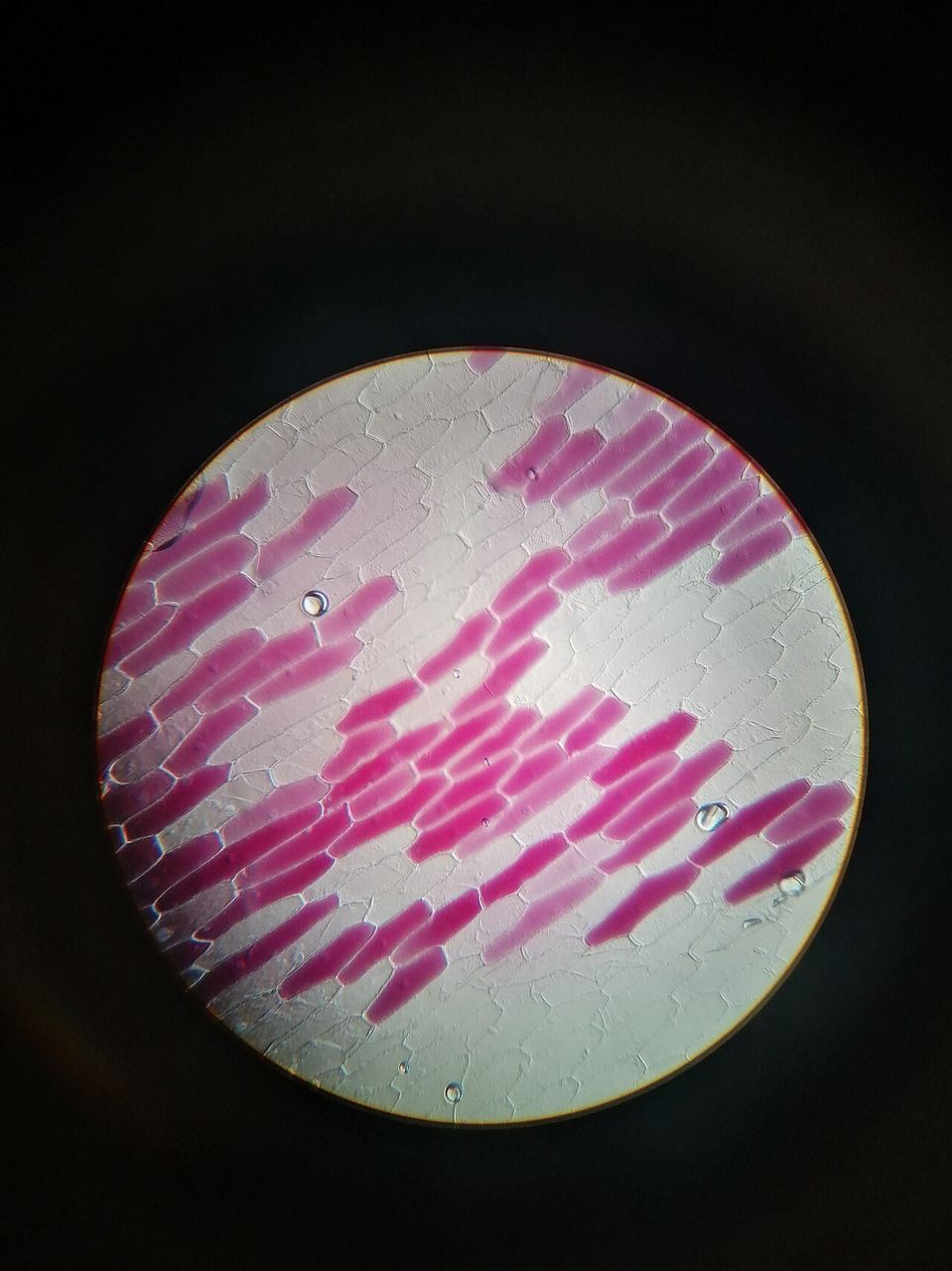
Peel a thin layer from inside an onion, add a drop of iodine or food colouring, and look through a cheap phone-clip microscope. You will see the same box-like cells Hooke saw in 1665.
With a microscope, look at cheek cells from a cotton bud. Then read the Jewish morning blessing Asher Yatzar, Matthew 10:30 and Qur'an 6:59 and talk about care for the very small.
Build a cell from household objects: a jelly membrane, a bead nucleus, beans as mitochondria. Give each part a 'job' and talk about how a community works when everyone does theirs.
Go deeper
- Cell theory (Khan Academy) · article
- An estimation of the number of cells in the human body (2013) · paper
- Hooke's Micrographia, full text (Project Gutenberg) · article
- Surah al-An'am 6:59 (Quran.com) · scripture
- Psalm 104 (Sefaria) · scripture
- Matthew 10 (WEB) on Bible Gateway · scripture
In pictures
Try this · KS3 · 20 min · Science
See onion cells
You need: an onion, tweezers, a glass slide or clear plastic, a drop of iodine or water, a microscope, or a phone camera with a water-drop lens
- Peel the thin, see-through skin from inside one onion layer.
- Lay it flat on the slide with a drop of water (or iodine, with an adult).
- Look under the microscope or phone lens.
- You will see a wall of little boxes. Each one is a cell.
Safety: Iodine stains and must not be swallowed; adults handle it.
You are made of about 37 trillion cells, each a busy city too small to see.
Sources (9)
- Hooke named cells in Micrographia (1665): Britannica, Robert Hooke
- Leeuwenhoek first observed single-celled organisms (1670s): Britannica, Antonie van Leeuwenhoek
- Schleiden, Schwann and Virchow, cell theory: Britannica, cell theory
- About 37.2 trillion cells in the human body: Bianconi et al., Annals of Human Biology 40 (2013)
- Roughly as many bacterial as human cells: Sender, Fuchs and Milo, PLoS Biology 14 (2016)
- Body replaces about 330 billion cells a day; red blood cells dominate cell numbers: Sender and Milo, Nature Medicine 27, 45 (2021)
- ATP synthase is a rotary motor; humans turn over about their body weight in ATP daily: Nobel Prize in Chemistry 1997 (Boyer, Walker)
- Kinesin walks with 8 nm steps at about 100 steps per second: Vale and Milligan, Science 288, 88 (2000)
- Mitochondria descend from bacteria (endosymbiosis): Britannica, mitochondrion