A Belgian priest with a doctorate in physics published a short paper in a little-read journal in 1927. Georges Lemaître argued that the universe is expanding, and later that, if you ran the film backwards, everything would shrink to what he called a 'primeval atom'. Einstein at first told him his physics was 'abominable'. Within a few years the evidence began to arrive.
Today the Big Bang is the best-tested picture of our universe's history. It tells us the universe was once unimaginably hot and dense and has been expanding for about 13.8 billion years. What it does not tell us, and what physicists honestly do not know, is whether there was a first moment, or what, if anything, came before.
“Have not those who disbelieve known that the heavens and the earth were of one piece, then We parted them, and we made every living thing of water? Will they not then believe?”
Qur'an 21:30 · Pickthall (1930)
Classical commentators offered several readings of ratq, 'joined together', and fatq, 'parted'. Some said that sky and earth were once one mass and were separated. Others said the sky was 'closed' and opened with rain, and the earth opened with plants. Some modern writers say the verse 'describes the Big Bang'. We do not make that claim. The verse invites reflection on a creation with a history; the science stands on its own evidence.
What science shows
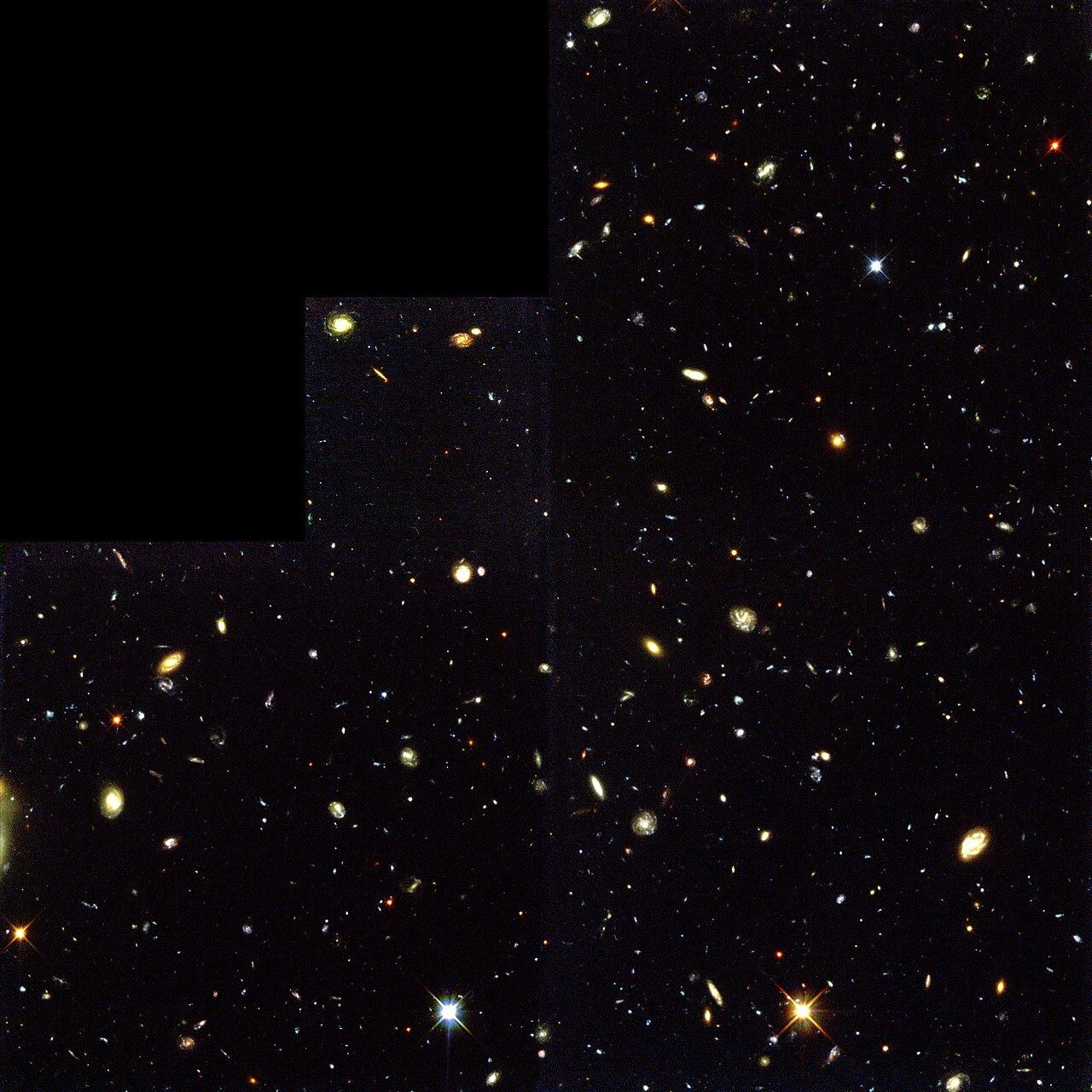
Three main lines of evidence support the Big Bang. First, expansion: galaxies are moving apart, and the further away they are, the faster they recede. Lemaître worked this out in 1927; Edwin Hubble's observations in 1929 made it famous. In 2018 the International Astronomical Union voted to rename the law the 'Hubble-Lemaître law' to honour both.
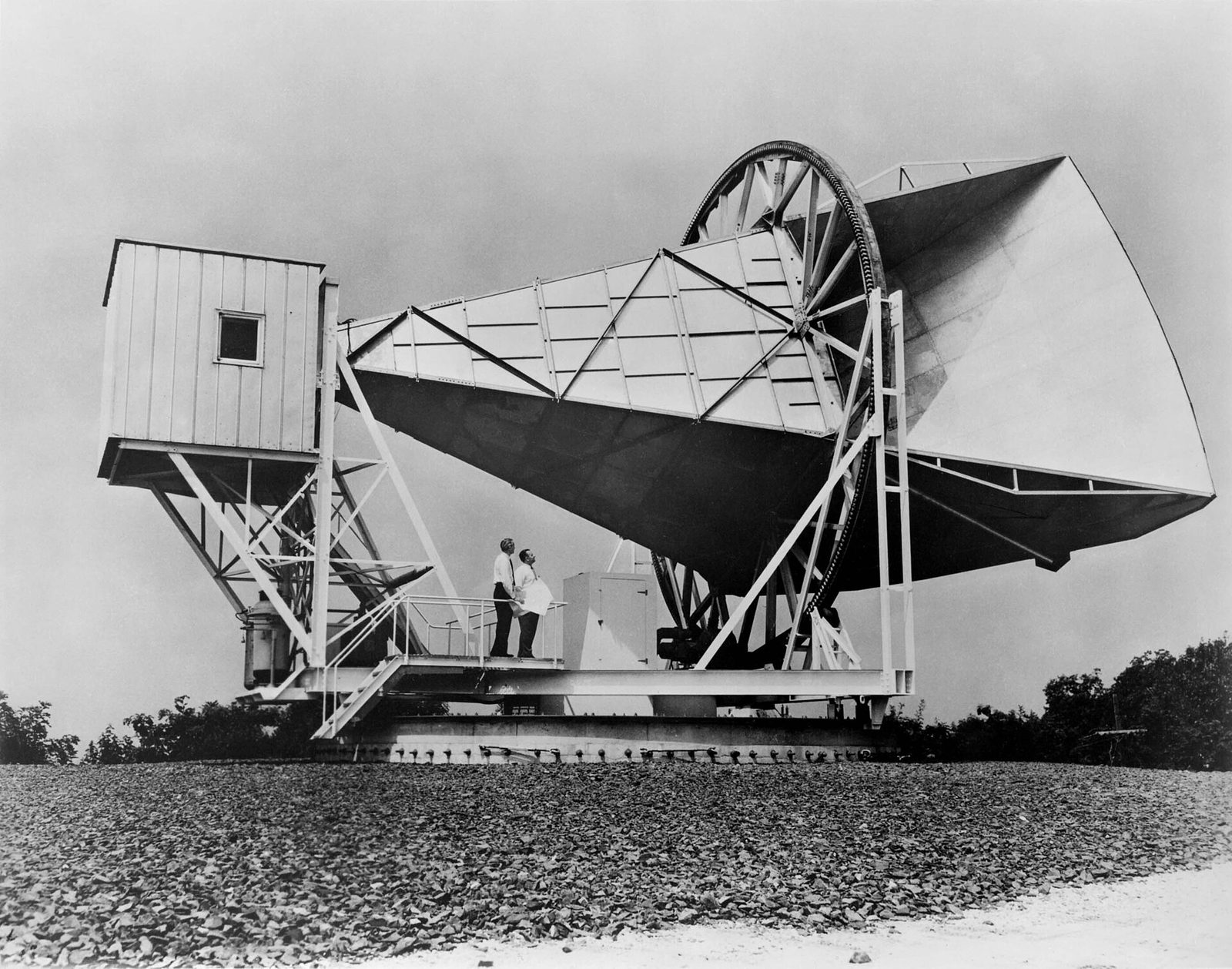
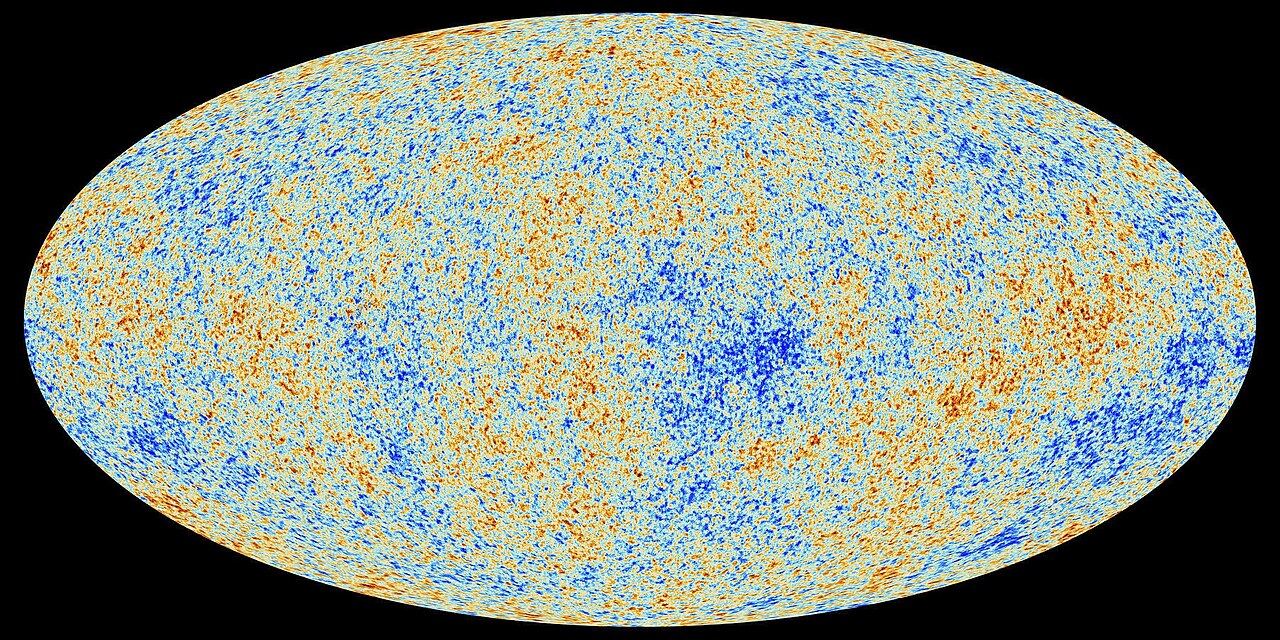
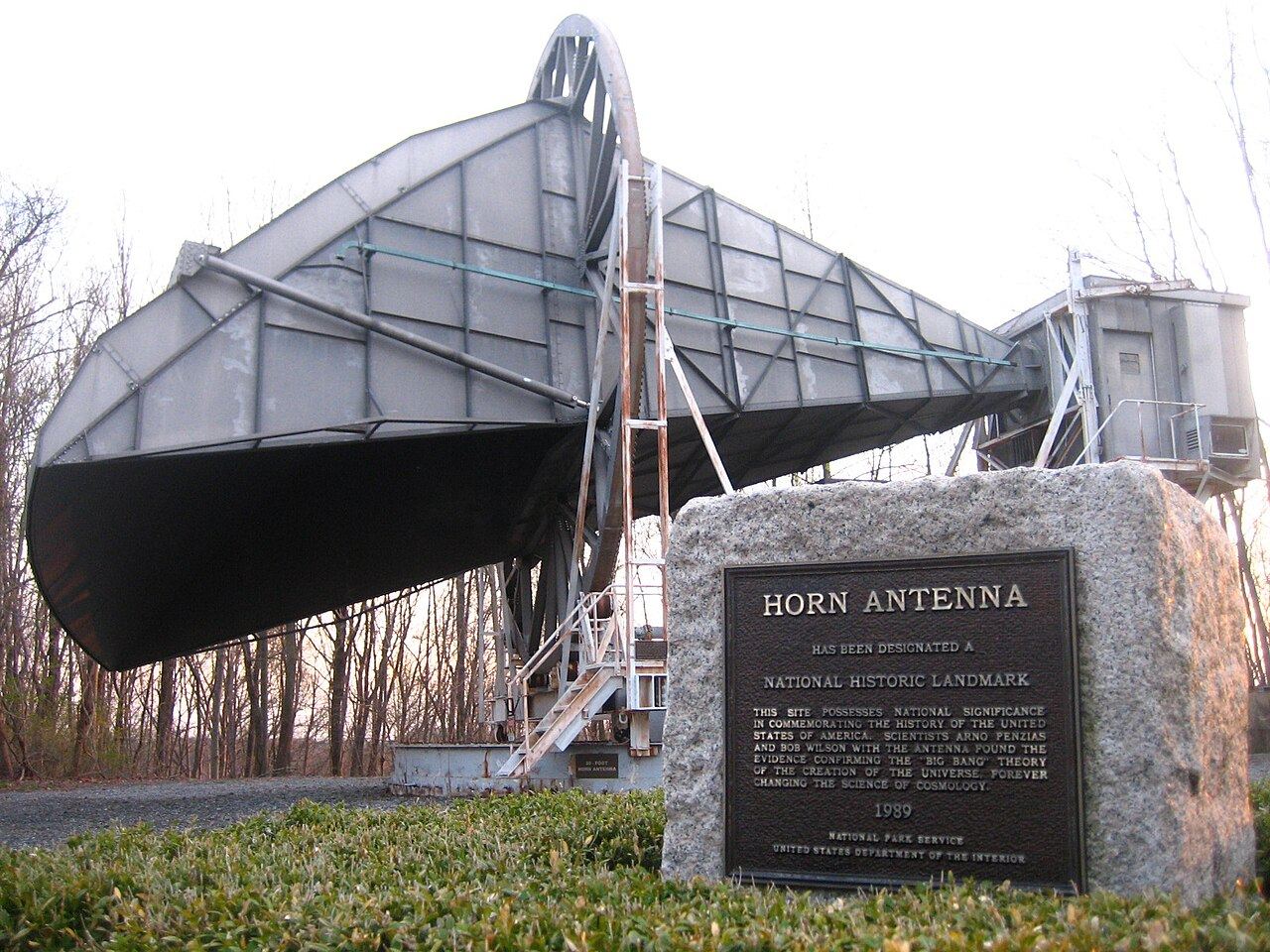
Second, the afterglow. In 1965 Arno Penzias and Robert Wilson, at Bell Labs in New Jersey, found a faint microwave hiss coming from every direction in the sky. It was light released about 380,000 years after the Big Bang, now cooled to about 2.7 degrees above absolute zero. They won the 1978 Nobel Prize. ESA's Planck satellite later mapped its tiny ripples, the seeds of every galaxy.
Third, the elements. The Big Bang model predicts that the early universe should have made mostly hydrogen and helium, about three quarters and one quarter by mass, with a trace of lithium. That is what astronomers find in the oldest stars and gas clouds. (The amount of lithium-7 is a known mismatch that researchers are still working on.)
Was there an absolute beginning? In 2003 Arvind Borde, Alan Guth and Alexander Vilenkin proved that a universe that has, on average, been expanding cannot be extended forever into the past. Vilenkin himself says this does not settle the question of God 'one way or another'. Other physicists propose models with no first moment: Stephen Hawking and James Hartle's 'no-boundary' universe, bouncing or cyclic universes, and others. None is confirmed, because the physics of the very first instant needs a theory of quantum gravity that we do not yet have.
The model is also being stress-tested now. Different ways of measuring the expansion rate disagree (the 'Hubble tension'), and in 2025 the DESI survey reported hints that dark energy may be weakening over time. This is how science works: a strong theory, tested hard at its edges.
A final irony: the name 'Big Bang' was coined by the astronomer Fred Hoyle on BBC radio in 1949. Hoyle preferred a 'steady state' universe with no beginning, partly because a beginning seemed to him too close to the idea of creation.
What each faith says
Judaism
“In the beginning God created the heaven and the earth. Now the earth was unformed and void, and darkness was upon the face of the deep; and the spirit of God hovered over the face of the waters.”
Genesis 1:1-2 · JPS 1917
The Torah opens with 'In the beginning God created the heaven and the earth' (Genesis 1:1). The medieval commentator Nachmanides (Ramban, 1194 to 1270) wrote that God first brought into being, from absolutely nothing, a very fine, formless substance from which everything else was made. Many Jewish readers today find that picture striking, while warning against treating Genesis as a science textbook.
Jewish tradition also holds that the deepest secrets of ma'aseh bereshit, 'the work of creation', are to be studied with humility. The Mishnah (Chagigah 2:1) restricts teaching them in public, a reminder that some questions are approached with reverence rather than certainty. Yet creation is in Jewish prayer every morning, in a blessing that praises God who 'in His goodness renews the work of creation every day'.
Christianity
“In the beginning was the Word, and the Word was with God, and the Word was God. The same was in the beginning with God. All things were made through him. Without him, nothing was made that has been made.”
John 1:1-3 · WEB
Christian teaching holds that God created all things 'from nothing' (in Latin, ex nihilo). In 1951 Pope Pius XII welcomed the new cosmology as fitting the idea of creation. Lemaître, a priest who prayed daily, quietly disagreed with using it that way. He said the theory 'remains entirely outside any metaphysical or religious question' and that a believer should not look to physics for proof of God.
For Christians, the main point of creation is not when it began but that everything depends on God at every moment. Thomas Aquinas argued that even a universe with no beginning would still need God to exist at all. John's Gospel begins with its own 'in the beginning': the Word through whom all things were made. And every Sunday at Mass, Catholics profess faith in one God, 'maker of heaven and earth, of all things visible and invisible'. The words come from the Nicene Creed, which Orthodox, Anglican and many other churches also say.
Islam
“The Originator of the heavens and the earth! When He decreeth a thing, He saith unto it only: Be! and it is.”
Qur'an 2:117 · Pickthall (1930)
The Qur'an describes God as al-Badi', the Originator of the heavens and the earth (2:117): 'when He decrees a thing, He only says to it “Be”, and it is'. It speaks of the sky as once being 'smoke' (41:11) and of the heavens and earth being parted (21:30). Muslim scholars have read these passages in different ways for over a thousand years.
Medieval Muslim theologians developed one of the most famous arguments that the universe had a beginning. It is called the kalam argument, after kalam, 'speech', the Arabic name for theology. Whatever begins to exist has a cause, and an infinite chain of past events is impossible; so the universe began. Al-Ghazali (1058 to 1111) defended it; philosophers such as Ibn Rushd disagreed. The debate, between believers, still runs in philosophy departments today.
Same and different
Judaism, Christianity and Islam all teach that the universe is created by God and depends on Him. Each has a long tradition of arguing about whether creation had a first moment. They agree that scripture is not a physics paper. They differ in their creation texts and in how they describe God's creative Word. For Christians, the Word is also a divine person. For Jews and Muslims, God's word is His command, without any division in God. Islam is the one that gives the command a single word, 'Be', and it is.
A moment to reflect
- Lemaître kept his physics and his prayers apart, yet held on to both. Is there anything in your life you hold that way?
- If physicists showed the universe had no first moment, would that change what you believe? Why or why not?
- Why do you think the question 'what came before?' feels so natural, and so hard to answer?
- What is the difference between how the universe began and why there is a universe at all?
Watch
Kurzgesagt tells the story of the first moments in six minutes.
PBS Space Time sets out the evidence that the Big Bang happened.
ESA's short film on the Planck satellite and the oldest light in the universe.
Did time start at the Big Bang? PBS Space Time explores what physicists do and do not know.
Do it together
Draw dots on a balloon and blow it up. Every dot moves away from every other, and the further apart they start, the faster they separate. That is Lemaître's insight in one breath.
Older analogue televisions and radios tuned between stations pick up static, and a small part of that hiss is the cosmic microwave background. Ask an older relative if they remember it, and talk about listening to light from the beginning of time.
Read Genesis 1, Surah al-Anbiya 21:30-33 and John 1:1-5 side by side. Ask each group what its text is most interested in: when, how, or why.
Go deeper
- IAU vote renames Hubble's law the Hubble-Lemaître law (Astronomy, 2018) · article
- Cosmic microwave background (ESA) · article
- Vilenkin on the beginning (Tufts Now, 2012) · article
- Cosmological Argument (Stanford Encyclopedia of Philosophy) · article
- Surah al-Anbiya 21:30 (Quran.com) · scripture
- Genesis 1 (Sefaria) · scripture
- John 1 (WEB) on Bible Gateway · scripture
In pictures
Try this · KS2 · 10 min · Science
The balloon universe
You need: a balloon, a marker, a tape measure or string
- Blow the balloon up a little. Draw 5 dots on it and label them.
- Measure the distance between two dots.
- Blow it up more. Measure again.
- Every dot moves away from every other dot. No dot is the centre.
Safety: Balloons are a choking hazard; latex allergy check.
The universe has a history: it started hot, dense and small, and a Catholic priest was first to say so.
Sources (9)
- IAU recommends renaming Hubble's law the Hubble-Lemaître law (2018): Astronomy magazine, on IAU resolution iau1812 (October 2018)
- Penzias and Wilson discover the CMB (1965), Nobel 1978: Nobel Prize in Physics 1978
- CMB released about 380,000 years after the Big Bang; temperature about 2.7 K: ESA, Planck and the CMB
- Big Bang nucleosynthesis predicts about 75% hydrogen and 25% helium by mass; lithium problem: NASA WMAP, Tests of Big Bang: light elements
- Borde-Guth-Vilenkin theorem; Vilenkin says it does not prove anything about God: Tufts Now, 29 May 2012
- Hartle-Hawking no-boundary proposal and its disputes: Quanta Magazine, 2019
- DESI 2025 hints of evolving dark energy: DESI collaboration, March 2025
- Hoyle coined 'Big Bang' on BBC radio in 1949: Britannica, Fred Hoyle
- Lemaître's 1958 remark that the theory remains outside metaphysical or religious questions; Pius XII 1951: Lambert, Georges Lemaître (Physics World / Vatican Observatory)