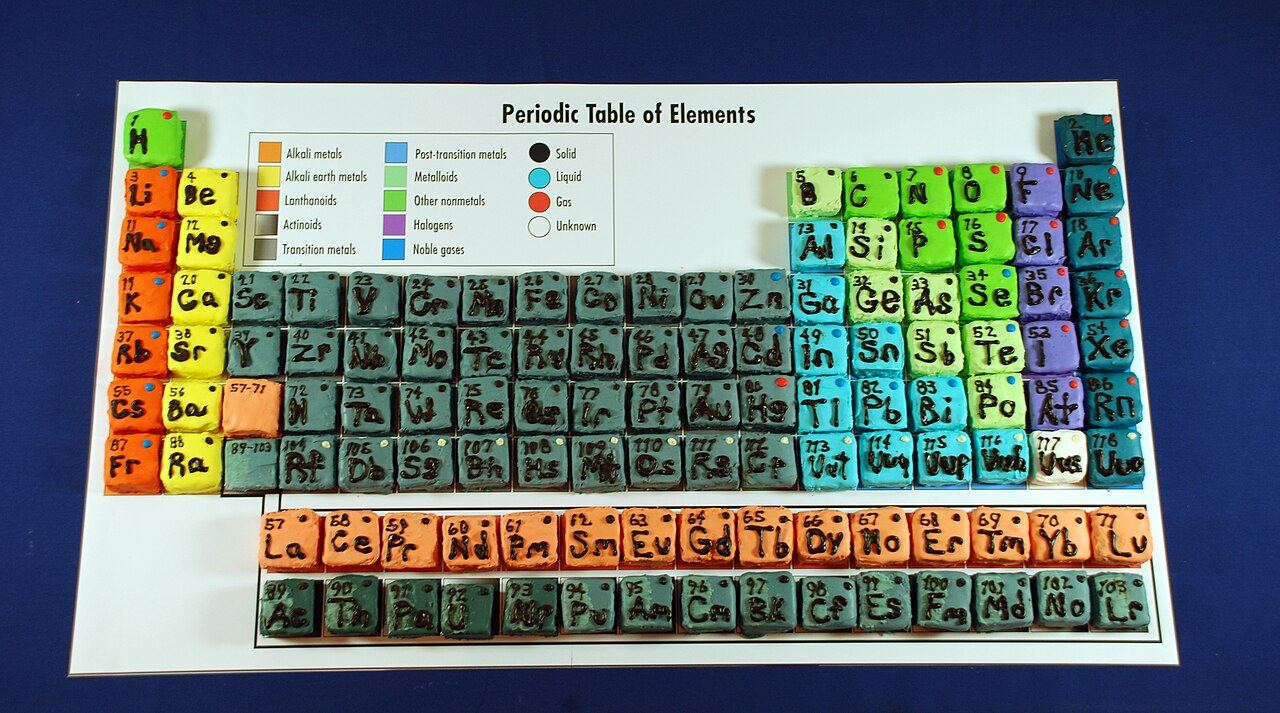
Your phone contains more than half of the elements that exist naturally on Earth. Your body is about 99 per cent made of just six of them. The air, the sea, a sandwich and a star are all assembled from the same short list, 118 elements in all. They are arranged on one chart that hangs in every school science lab.
That chart is not just a list. It is a pattern. In 1869 the pattern was so strong that a chemist could look at its gaps and say: something belongs here, and this is what it will be like. Years later, people dug those elements out of the ground, and he was right.
“And there is not a thing but with Us are the stores thereof. And we send it not down save in appointed measure.”
Qur'an 15:21 · Pickthall (1930)
The verse comes in a passage about the earth spread out, the mountains set firm and 'And the earth have We spread out, and placed therein firm hills, and caused each seemly thing to grow therein.' (15:19, Pickthall). Commentators read 'storehouses' as God's provision: rain, food and every good thing come from Him in measured amounts. Seen next to a chart of the elements, the words 'everything' and 'known measure' take on an extra resonance.
What science shows
An element is a substance made of only one kind of atom. What makes each kind different is the number of protons in its nucleus, its 'atomic number': hydrogen has 1, carbon 6, oxygen 8, gold 79. Henry Moseley showed this in 1913 by shining X-rays at metals, just before he was killed at Gallipoli aged 27. There are no gaps: every number from 1 to 118 is now filled.
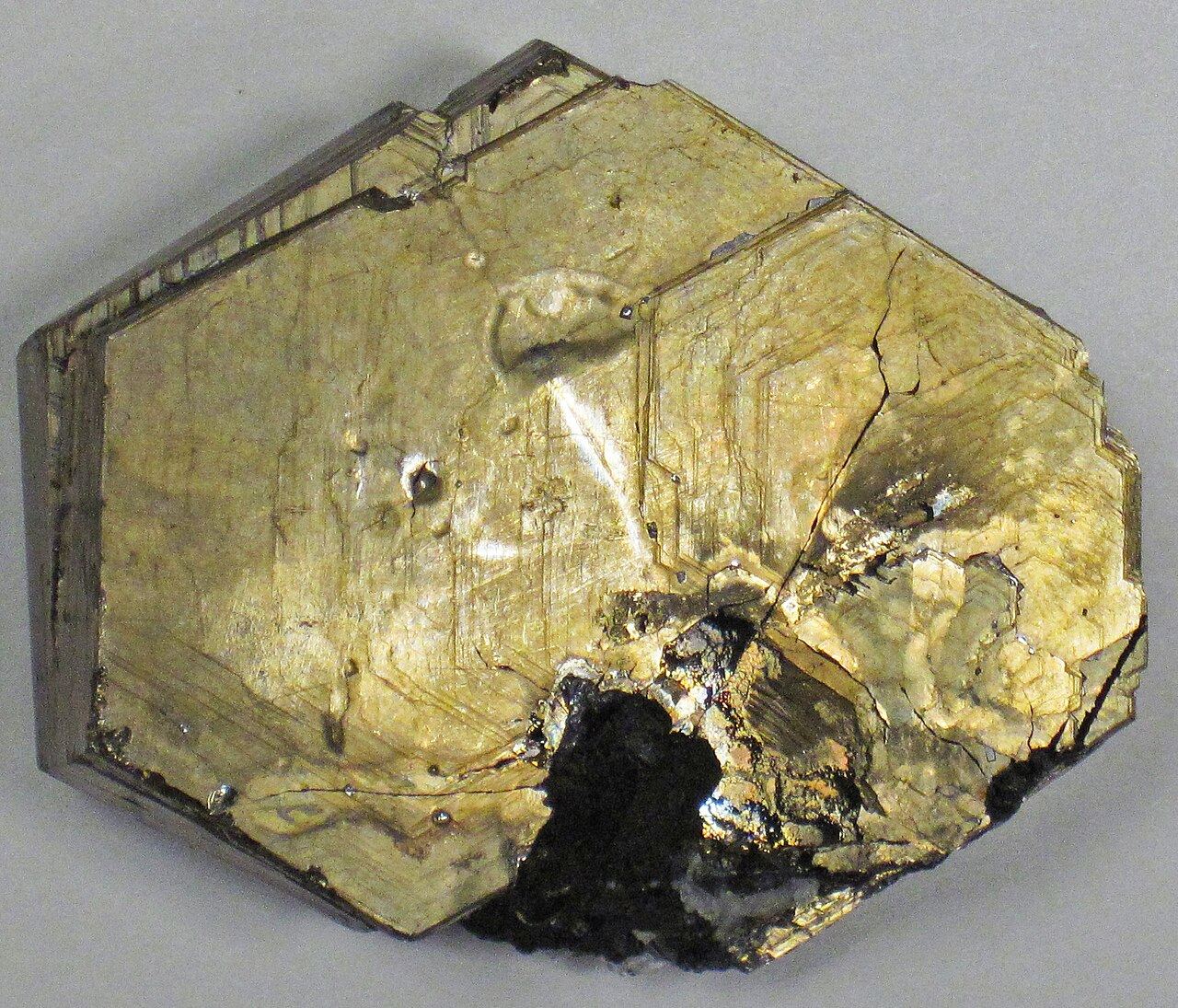
The table's inventor is usually named as Dmitri Mendeleev, a chemistry professor in St Petersburg. On 6 March 1869 his table was presented to the Russian Chemical Society. He arranged the 63 elements then known by weight and grouped them by how they behave, and he left gaps. He predicted that an 'eka-aluminium' would be found, with an atomic weight of about 68. In 1875 the French chemist Paul-Émile Lecoq de Boisbaudran discovered gallium, at 69.7. Scandium (1879) and germanium (1886) filled two more of his gaps.
Why does the pattern repeat? Because of the way electrons arrange themselves around the nucleus, in shells. Elements in the same column have the same number of electrons in their outer shell, so they react in similar ways. Lithium, sodium and potassium all fizz in water; helium, neon and argon hardly react at all. A whole world of chemistry, from salt to steel to DNA, follows from that arrangement.
About 94 elements occur naturally on Earth, some only in traces. The rest have been made in laboratories, a few atoms at a time, and most fall apart in fractions of a second. In 2016 the International Union of Pure and Applied Chemistry (IUPAC) confirmed names for the last four, completing the seventh row: nihonium (113), moscovium (115), tennessine (117) and oganesson (118). Scientists are now trying to make element 119 and 120.
Your body is a periodic table in miniature. By mass you are about 65 per cent oxygen, 18 per cent carbon and 10 per cent hydrogen. Then come about 3 per cent nitrogen, 1.5 per cent calcium and 1 per cent phosphorus. Traces of around twenty other elements, including iron, zinc, iodine and copper, are essential to keep you alive.
In 2019 UNESCO marked the 150th anniversary of Mendeleev's table with the International Year of the Periodic Table. At the University of Nottingham, chemist Sir Martyn Poliakoff and film-maker Brady Haran have made a short film for every element, the Periodic Table of Videos. They have been watched hundreds of millions of times.
What each faith says
Judaism
“It is the glory of God to conceal a thing; but the glory of kings is to search out a matter.”
Proverbs 25:2 · JPS 1917
The Book of Proverbs says: 'It is the glory of God to conceal a thing; but the glory of kings is to search out a matter.' Jewish teachers have often read this as a charter for inquiry. The world holds hidden things, and searching for them is a noble task. The Talmud praises the scholar who 'knows how to calculate the seasons and the courses of the stars' (Shabbat 75a).
Jewish tradition sees the variety of materials in creation as a sign of wisdom. The Book of Job describes miners bringing up silver, gold, iron and copper from the dark (Job 28:1-2). Then it asks where wisdom is found: not in any mine, but with God. Jewish law treats such learning as a gift. On meeting a great scholar of the sciences, a Jew blesses God “who has given of His wisdom to flesh and blood” (Berakhot 58a). Many chemists from Jewish families, including the Nobel laureates Fritz Haber and Ada Yonath, have shaped modern chemistry.
Christianity
“The LORD’s works are great, pondered by all those who delight in them.”
Psalm 111:2 · WEBBE
Robert Boyle (1627 to 1691), often called the father of modern chemistry, was a devout Anglican. In The Sceptical Chymist (1661) he attacked the old idea of four elements and argued for testing what substances are really made of. He saw studying nature as 'priestly' work and left money in his will for lectures defending the Christian faith, the Boyle Lectures, which still run today.
Psalm 111:2, 'The LORD's works are great', was carved in Latin on the doors of Cambridge's first Cavendish Laboratory. It was put there almost certainly at the suggestion of its first professor, James Clerk Maxwell. Many Christians see each element as one of those works: simple, ordered, and endlessly surprising in what it can become.
Islam
“And there is not a thing but with Us are the stores thereof. And we send it not down save in appointed measure.”
Qur'an 15:21 · Pickthall (1930)
Muslim scholars of the 8th to 10th centuries helped turn alchemy into chemistry. Abu Bakr al-Razi (c. 865 to 925), a physician in Rayy and Baghdad, classified substances into groups. He sorted them into animal, vegetable and mineral, with minerals divided further into spirits, metals, stones, salts and others. He also described lab equipment and processes such as distillation. Words like alkali and alembic come into English through Arabic.
The Qur'an speaks of iron as a gift 'We verily sent Our messengers with clear proofs, and revealed with them the Scripture and the Balance, that mankind may observe right measure; and He revealed iron, wherein is mighty power and (many) uses for mankind, and that Allah may know him who helpeth Him and His messengers, though unseen. Lo! Allah is Strong, Almighty.' (57:25, Pickthall), and of God creating 'Lo! We have created every thing by measure.' (54:49, Pickthall). For many Muslims, an orderly table of elements is a sign of al-Khaliq, the Creator, and al-Muhsi, the One who counts and keeps account of everything.
Same and different
All three faiths see searching out the hidden structure of the world as honourable, and each has chemists among its faithful. Their scriptures do not describe atoms or elements; they speak of a Creator whose works can be studied. Where they differ is not chemistry but theology: how God is known, and whether God has made Himself known in a person, a people or a book.
A moment to reflect
- Mendeleev trusted a pattern enough to predict things no one had seen. When have you trusted a pattern?
- Does knowing your body is made of the same elements as rocks and stars change how you think about it?
- What is the most beautiful ordinary material you own, and why do you love it?
- Proverbs says searching out hidden things is glorious. What hidden thing would you most like to understand?
Watch
The story of Mendeleev's gaps and predictions, told in under five minutes.
Crash Course Chemistry on how the table is organised and why the columns behave alike.
A Royal Institution lecture full of live experiments across the table, with Peter Wothers.
Element number 1, hydrogen, from the University of Nottingham's Periodic Table of Videos.
Do it together
Search the house for elements: copper in wires, aluminium foil, iron nails, carbon in pencil lead, helium in a party balloon, neon or sodium in a street light. Who can find the most?
Give each person a card with an element and its atomic number and ask them to arrange themselves into the table by behaviour clues, without a chart. Then reveal Mendeleev's gaps.
Bicarbonate of soda and vinegar, red-cabbage indicator, or salt crystals grown on string are cheap and safe. Run a session for children of different communities together, with a short reflection on wonder at the end.
Jewish tradition has a blessing for meeting a great scholar of the sciences, thanking God “who has given of His wisdom to flesh and blood”. Invite a local scientist, nurse or engineer to talk about their work, and end with a thank-you from each tradition in the room.
Robert Boyle, a devout Anglican, left money for an annual lecture on Christian faith, and the Boyle Lectures still run in London. Hold your own: one person gives a ten-minute talk on a wonder of chemistry, and everyone asks one question.
Go deeper
- Periodic Table (Royal Society of Chemistry) · article
- Periodic Table of Videos (University of Nottingham) · museum
- IUPAC: names of elements 113, 115, 117 and 118 · article
- Al-Razi (Britannica) · article
- Surah al-Hijr 15:19-21 (Quran.com) · scripture
- Talmud Berakhot 58a on Sefaria: blessings on seeing scholars · scripture
- Psalm 111 (WEBBE) on eBible.org · scripture
In pictures
Try this · KS3 · 20 min · Science
Element hunt at home
You need: a copy of the periodic table (print one), a notebook
- Find 10 things at home that are mostly one element: foil (aluminium), a copper wire, a pencil (carbon), a nail (iron)...
- Write each one and find its symbol on the table.
- Colour in the elements you found.
- Which part of the table is nearest your kitchen?
Safety: Don't open chemicals or batteries; look, don't take apart.
Everything you have ever touched is built from a short, tidy list of elements.
Sources (9)
- Atomic number equals protons; Moseley 1913: Britannica, Henry Moseley
- Mendeleev's table presented 6 March 1869; predictions of eka-aluminium (gallium), scandium and germanium: Royal Society of Chemistry, Mendeleev
- Gallium discovered 1875 by Lecoq de Boisbaudran: Royal Society of Chemistry, Gallium
- IUPAC names for elements 113, 115, 117, 118 (2016): IUPAC, 2016
- About 94 elements occur naturally: Royal Society of Chemistry, Chemistry World
- Body composition by mass: oxygen 65%, carbon 18%, hydrogen 10%, nitrogen 3%, calcium 1.5%, phosphorus 1%: Britannica, human body composition (via OpenStax Anatomy & Physiology 2.1)
- International Year of the Periodic Table 2019: UNESCO / IYPT2019
- Boyle's The Sceptical Chymist (1661) and the Boyle Lectures: Britannica, Robert Boyle
- Al-Razi's classification of substances and laboratory methods: Britannica, al-Razi