Imagine a control panel for a universe, with a few dozen dials. One sets the strength of gravity, one the mass of the electron, one the energy of empty space. Physicists can now ask what happens when you turn them. For a number of the dials, turning them a little either way gives a universe with no stable atoms, no long-lived stars, or no carbon.
Some scientists see in that a sign of design. Others see one universe among countless others, or a lucky fact that needs no explanation. All three views are held by serious, careful physicists.
“Lo! We have created every thing by measure.”
Qur'an 54:49 · Pickthall (1930)
The Arabic word qadar means both 'measure' and 'decree'. Classical scholars read the verse mainly as a statement about God's decree, that everything happens by His will and knowledge. A related verse says God 'He unto Whom belongeth the Sovereignty of the heavens and the earth, He hath chosen no son nor hath He any partner in the Sovereignty. He hath created everything and hath meted out for it a measure.' (25:2, Pickthall). We use it here as a companion to wonder, not as a claim that the Qur'an describes the constants of physics.
What science shows
Physics depends on a set of numbers we measure but cannot yet derive: the strengths of the four forces, the masses of particles, and a few cosmological values. The Astronomer Royal, Martin Rees, wrote about six of them in his book Just Six Numbers (1999). They include the ratio of the electric force to gravity, the strength of the force that binds atomic nuclei, and the amount of 'clumpiness' in the early universe.
A famous example involves carbon. Stars make carbon by fusing three helium nuclei, which only works efficiently because carbon-12 has an energy level at about 7.65 MeV. Fred Hoyle predicted that level in 1953 and it was found soon after at Caltech. Historians have since shown that Hoyle did not link it to life at the time; that connection was made in the 1980s. The story is often told wrongly, so we tell it carefully.
The sharpest puzzle is the energy of empty space, the 'cosmological constant' that drives the accelerating expansion of the universe discovered in 1998. Simple estimates from quantum theory give a value larger than the measured one by a factor of around 10 to the power 120, sometimes called the worst prediction in physics. If it were much larger, the universe would have flown apart before galaxies could form.
How seriously should we take all this? Some physicists, such as Luke Barnes and Geraint Lewis in A Fortunate Universe (2016), argue the fine-tuning is real and striking. Others, such as Fred Adams (2019), point out that changing several constants at once can allow stars and life over wider ranges than single-dial changes suggest. Victor Stenger argued that the effect is greatly exaggerated.
There are three main families of explanation. Design: the universe's values are set by a Creator. Multiverse: there are vast numbers of universes with different values, and we inevitably find ourselves in one that allows observers, which philosophers call a selection effect. Brute fact, or deeper law: the values just are what they are, or a future theory will show they had to be. Critics say the multiverse cannot be tested; critics of design say probabilities for 'possible universes' cannot be properly defined.
The Stanford Encyclopedia of Philosophy, a standard academic reference, concludes that the argument remains open. That some of nature's numbers are sensitive is widely accepted. How sensitive, and what that means, is not. That honest uncertainty is where this site sits: wonder, not proof.
What each faith says
Judaism
“Thus saith the LORD: If My covenant be not with day and night, if I have not appointed the ordinances of heaven and earth”
Jeremiah 33:25 · JPS 1917
The prophet Jeremiah uses the fixed order of nature as a picture of God's covenant: God has 'appointed the ordinances of heaven and earth' (Jeremiah 33:25). Jewish tradition speaks of the world being created with wisdom. A classic midrash (Genesis Rabbah 1:1) pictures God looking into the Torah like an architect looking at plans before building the world.
Rabbi Jonathan Sacks, Britain's former Chief Rabbi, often wrote about the 'improbable' fitness of the universe for life, while warning against using science to prove faith. He described science and religion as two different ways of knowing. In his words, 'science takes things apart to see how they work; religion puts things together to see what they mean' (The Great Partnership, 2011).
Wonder at nature is part of Jewish teaching. Maimonides taught that the path to loving God runs through studying the world. When a person looks at God's works and sees in them a wisdom without limit, love and awe follow (Mishneh Torah, Foundations of the Torah 2:2). In the twentieth century Rabbi Abraham Joshua Heschel called the starting point of faith “radical amazement”. Some Orthodox writers, such as the physicist Gerald Schroeder, do argue from fine-tuning; as in every faith, Jewish thinkers disagree about what it shows.
Christianity
“Yes and without these might they have fallen by a single breath, Being pursued by Justice, and scattered abroad by the breath of your power. But by measure and number and weight you did order all things.”
Wisdom of Solomon 11:20 · WEB
The Book of Wisdom, part of the Bible for Catholic and Orthodox Christians, says that God 'ordered all things by measure and number and weight'. Augustine and many medieval scientists loved the verse. Today Christian philosophers such as Robin Collins and Richard Swinburne argue that fine-tuning makes a Creator more likely than not. Other Christians, such as the Anglican physicist-priest John Polkinghorne, preferred to speak of a universe whose fruitfulness fits with faith, rather than a proof.
Christians also include multiverse supporters and sceptics of fine-tuning arguments. Many hold that even if every constant were explained by a deeper law, the question of why there are laws, and a universe at all, would remain. The Catholic Church has kept its own observatory since 1891, and the Vatican Observatory's Jesuit astronomers still do research and teach that faith and science are partners.
Islam
“He unto Whom belongeth the Sovereignty of the heavens and the earth, He hath chosen no son nor hath He any partner in the Sovereignty. He hath created everything and hath meted out for it a measure.”
Qur'an 25:2 · Pickthall (1930)
Measure is a theme the Qur'an returns to often. God 'He unto Whom belongeth the Sovereignty of the heavens and the earth, He hath chosen no son nor hath He any partner in the Sovereignty. He hath created everything and hath meted out for it a measure.' (25:2, Pickthall). And 'And there is not a thing but with Us are the stores thereof. And we send it not down save in appointed measure.' (15:21, Pickthall). One of God's Names is al-Muqtadir, the One who determines, and another is al-Hasib, the One who takes account.
Muslim scientists today hold different views. The astrophysicist Nidhal Guessoum, in Islam's Quantum Question (2011), takes fine-tuning seriously as a theme for reflection while arguing strongly against claims that the Qur'an contains modern science. For many Muslims, a world 'in due measure' is a sign to reflect on, whatever the final physics turns out to be.
Without religion
Non-religious people, whether they call themselves humanists, atheists, agnostics or just not religious, bring their own wonder to these questions. Many find the multiverse or a deeper law more convincing than design, and some, like the physicist Victor Stenger, argued that the fine-tuning is exaggerated. Humanists UK describes humanists as people who trust science and reason to understand the universe and who find meaning in this one life.
For many of them, the strangeness of nature's numbers is a reason for curiosity, not for a Creator. Others stay agnostic: the question is open, and they are content to leave it open while the physics goes on.
Same and different
Judaism, Christianity and Islam each speak of a creation ordered by measure and wisdom, and believers in each find fine-tuning a natural prompt for gratitude. None of them depends on it: the classical arguments for God in every one of these traditions predate modern physics. Within each faith, and among non-religious scientists, there is genuine disagreement about whether fine-tuning is evidence of design at all.
A moment to reflect
- If there were countless universes, would that make ours less remarkable, or more?
- What kind of evidence would show that the universe was designed? What would show it was not?
- Is 'it just is' a satisfying answer to why the laws of nature are as they are?
- Why do you think physicists who share the same data reach such different conclusions?
Watch
PBS Space Time explains the 'naturalness problem' behind fine-tuning, for older students.
Physicist Paul Davies on why fine-tuning is a real puzzle, in five minutes.
Physicist Fred Adams, a sceptic of strong fine-tuning claims, explains what it does and does not mean.
A long, courteous debate between Sabine Hossenfelder, a sceptic, and Luke Barnes, who argues for fine-tuning.
Do it together
Read a chapter of A Fortunate Universe, written by two scientists who agree on the evidence but disagree on the explanation. Discuss how they stay friends, and what that teaches about disagreeing well.
Give groups cards for gravity, the strength of the nuclear force and the energy of space. Each group 'turns a dial' and researches what would change. Then hold a short debate: design, multiverse or brute fact.
Bake a simple cake three times: once by the recipe, once with double the baking powder, once with none. Talk about which ingredients are sensitive and which are forgiving. Then ask: is a universe more like a cake or a soup?
Read a chapter of Rabbi Jonathan Sacks's The Great Partnership, in which he describes science and religion as two ways of knowing. Discuss: which questions belong to which, and are there any that need both?
Read Wisdom 11:20, from the Bible of Catholic and Orthodox Christians: God 'ordered all things by measure and number and weight'. Then measure, count and weigh three ordinary things in the room, and ask what in your own life is set 'just so'.
Go deeper
- Fine-Tuning (Stanford Encyclopedia of Philosophy) · article
- Adams, The degree of fine-tuning in our universe and others (2019) · paper
- Review of A Fortunate Universe (Notre Dame Philosophical Reviews) · article
- Surah al-Qamar 54:49 (Quran.com) · scripture
- Big question: Does science rule out God? · article
- Rabbi Jonathan Sacks, The Great Partnership · book
- Vatican Observatory · article
In pictures

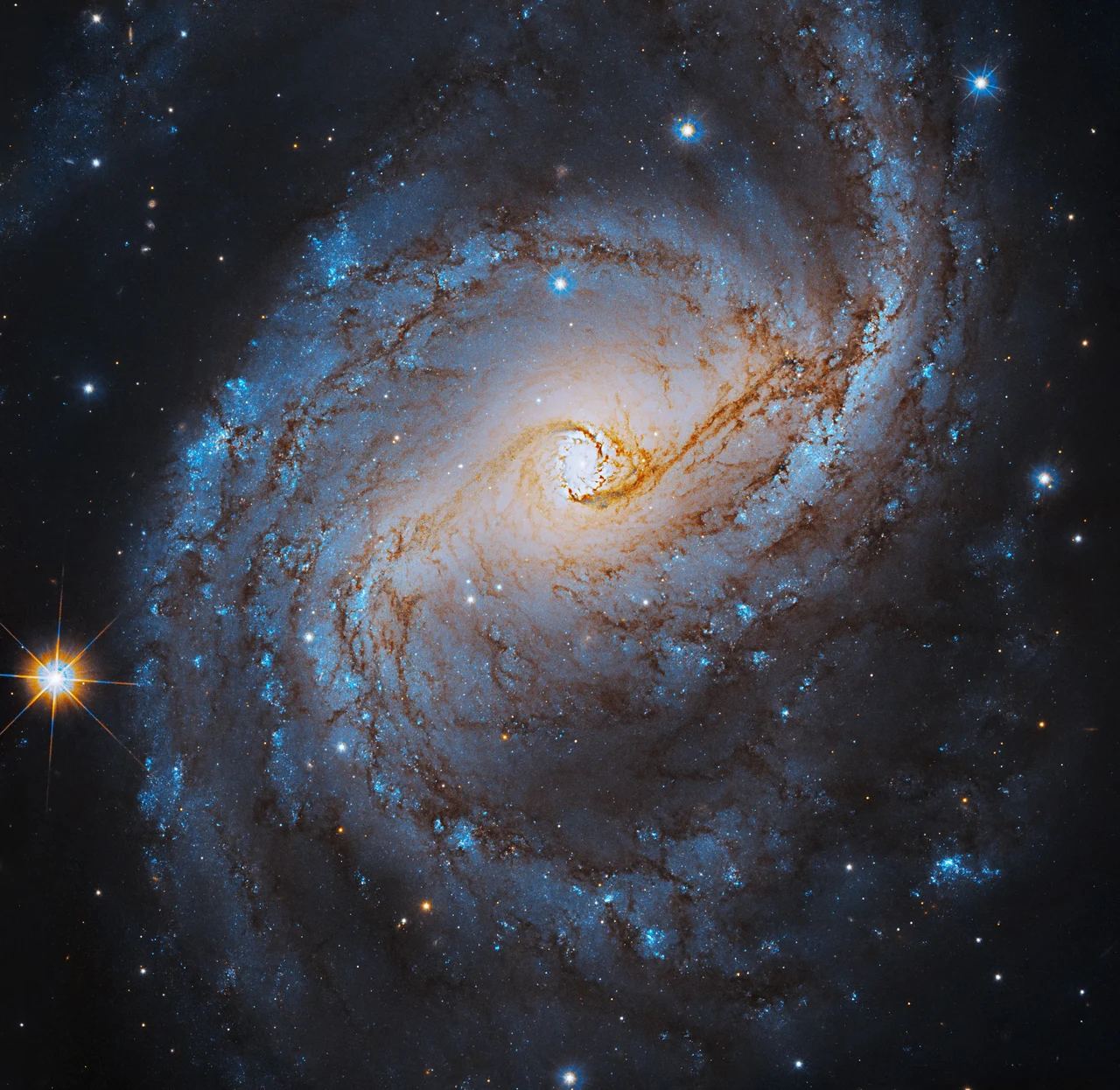
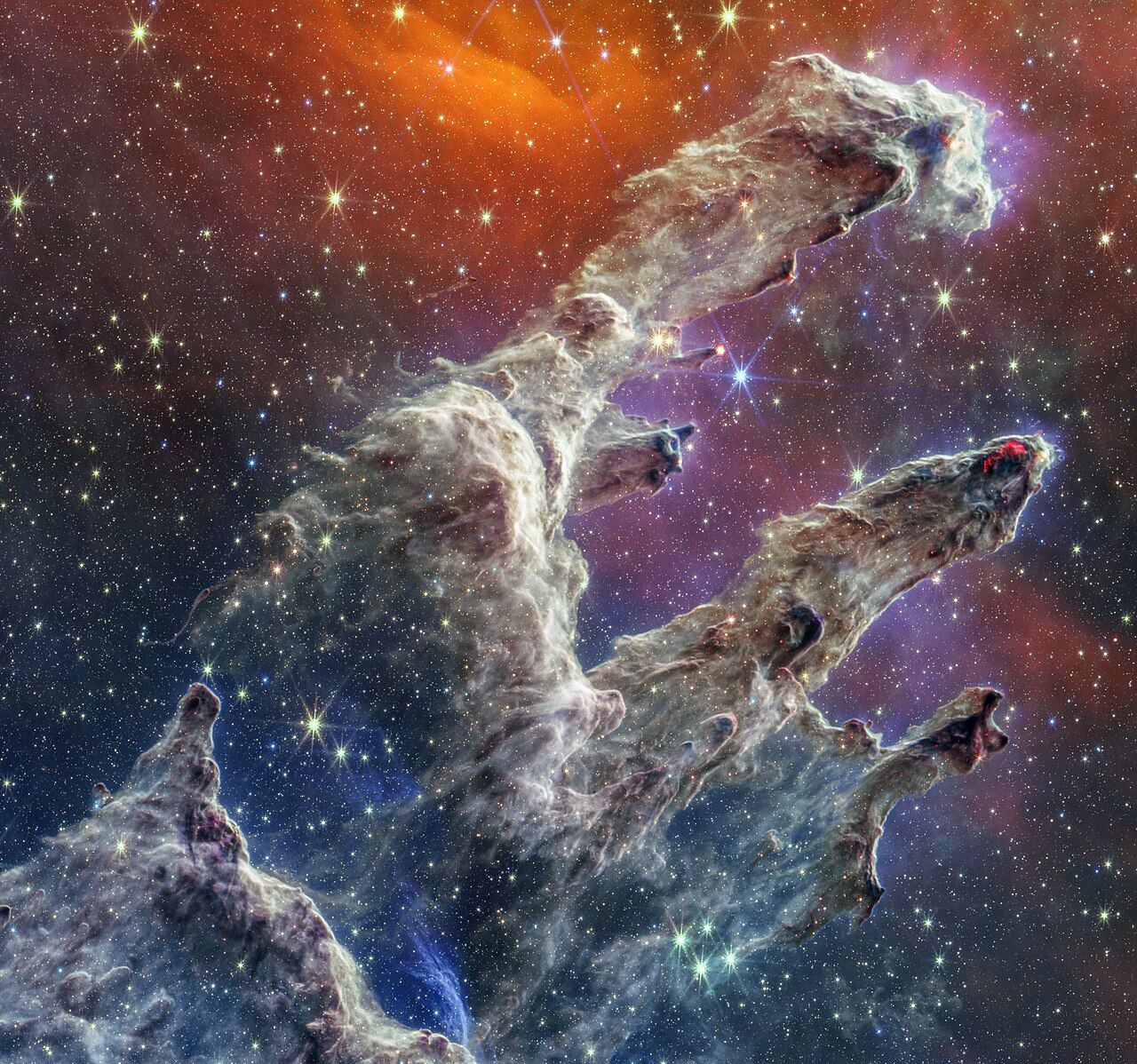
Try this · KS2 · 20 min · Science
The coat-hanger mobile
You need: a coat hanger, string, paper clips, small paper shapes
- Hang the coat hanger from a hook or a door handle.
- Hang shapes from both ends using paper clips until it balances perfectly level.
- Move one paper clip just 1 cm. What happens to the whole mobile?
- Try to find how far you can move it before it tips.
Safety: Keep string away from young children's necks.
Change some of nature's numbers a little and there would be no stars and no us; physicists argue over what that means.
Check yourself
Three quick questions. No score, nothing saved.
1. Which does the page call the sharpest puzzle?
2. The Arabic word qadar means both 'measure' and…
3. Who holds the three views about fine-tuning?
Sources (8)
- Rees, Just Six Numbers (1999), lists six constants: Plus Magazine review, 2003
- Hoyle state of carbon-12 at about 7.65 MeV predicted in 1953: Epelbaum et al., Physical Review Letters 106, 192501 (2011)
- Hoyle did not link the carbon resonance to life in the 1950s: Kragh, Archive for History of Exact Sciences 64 (2010)
- Accelerating expansion discovered 1998 (Nobel Prize 2011): Nobel Prize in Physics 2011
- Cosmological constant problem: theoretical estimates exceed observation by about 120 orders of magnitude: Stanford Encyclopedia of Philosophy, Fine-Tuning
- Adams argues viable universes exist over a range of parameters: Adams, Physics Reports 807 (2019)
- Barnes and Lewis, A Fortunate Universe: one favours design, one a multiverse: NDPR review, 2017
- Design, multiverse and brute-fact responses; selection effects and probability objections: Stanford Encyclopedia of Philosophy, Fine-Tuning