For Schools
How do we know?
Twenty source cards: a claim, the kind of evidence behind it, and a question for the class.
inscription
The oldest dated Arabic inscription naming God is on a Christian church, from 512 CE, about a century before Islam.
Try this: The inscription is in Greek, Syriac and Arabic. Why might a church in Syria use three languages over its door?
inscription
Before Islam, desert nomads called on Allāh 41 times in their rock inscriptions, and on the goddess Allāt 1,437 times.
Try this: Graffiti last longer than speeches. What can a scratched name and prayer tell us that a history book cannot?
manuscript
The earliest dated Arabic Bible manuscript, finished in Damascus in 867 CE, calls God Allāh.
Try this: The scribe dated his Christian book by the Muslim calendar. What does that tell you about life in Damascus in 867?
manuscript
A thousand years ago, Rabbi Saadia Gaon's Arabic translation of the Torah called God Allāh about 1,650 times.
Saadia Gaon's Tafsīr (Derenbourg edition, 1893) on Sefaria; count by our own search of the text ↗
Try this: Saadia wrote Arabic in Hebrew letters. Why might a community write one language in another language's alphabet?
scripture
The Sikh scripture, the Guru Granth Sahib, names God 'Allah' 38 times, not 'over 1,000' as some websites claim.
Our count of all 1,430 pages via the open BaniDB database, checked by hand ↗
Try this: A number goes viral online. What three steps would you take to check it?
scripture
In Malta, a Catholic country, the word for God is Alla, and the Hail Mary, the prayer to Mary, says Omm Alla, 'Mother of God'.
The Maltese Bible (Genesis 1:17); Trimble, Journal of Maltese Studies 9 (1973) ↗
Try this: Maltese comes from medieval Arabic but is written in Latin letters. How can a language change its alphabet but keep its words?
scripture
Muslims speak of God's ninety-nine Names because of a saying of the Prophet Muhammad ﷺ (peace be upon him).
Ṣaḥīḥ al-Bukhārī 2736: 'God has ninety-nine names, one hundred less one' ↗
Try this: Lists of the 99 Names differ slightly. Why might early scholars have compiled different lists from the same sources?
scripture
In Arabic, God's Name ar-Raḥmān (the Most Merciful) and the word for womb, raḥim, come from the same root.
Try this: What does it suggest about mercy that the same root names a mother's womb?
archaeology
The oldest surviving fragments of biblical text are the priestly blessing, 'The LORD bless thee, and keep thee', on two tiny silver scrolls from about 600 BCE.
The Ketef Hinnom silver scrolls, found in Jerusalem in 1979, now in the Israel Museum ↗
Try this: The scrolls were rolled up like charms. Why might someone carry a blessing with them?
archaeology
The name of the God of Israel appears on a stone set up by a king of Moab in about 840 BCE.
The Mesha Stele, now in the Louvre, Paris ↗
Try this: This stone was carved by Israel's enemy. Why can evidence from opponents be especially valuable to historians?
experiment
Honeybees tell each other where food is with a 'waggle dance' that encodes direction and distance.
Karl von Frisch's experiments; Nobel Prize in Physiology or Medicine, 1973 ↗
Try this: How could you design an experiment to test whether bees really 'read' the dance?
experiment
Some spider silk is tougher than Kevlar: Darwin's bark spider silk was the toughest biological material measured in 2010.
Agnarsson, Kuntner and Blackledge, PLOS ONE (2010) ↗
Try this: The Qur'an calls the spider's house 'the frailest of houses' (29:41). How can a web be frail and its silk strong at the same time?
experiment
Water is densest at about 4 °C, so ice floats and lakes freeze from the top down, letting fish survive the winter.
USGS Water Science School, 'Water density' ↗
Try this: Put an ice cube in water and another in cooking oil. What happens, and why does it matter for life on Earth?
experiment
White sunlight is a mixture of colours, which a glass prism can split and recombine.
Isaac Newton, 'A New Theory about Light and Colours' (1672), The Newton Project ↗
Try this: Shine a torch through a glass of water onto white paper. Which colours appear, and in what order?
experiment
The universe is filled with faint microwave light released about 380,000 years after the Big Bang.
ESA, Planck and the cosmic microwave background ↗
Try this: Some of the 'snow' on an old untuned television was this ancient light. How does it feel to see something that old?
archaeology
A flood story much like Noah's (peace be upon him) is told on a clay tablet from ancient Iraq, written in the seventh century BCE.
The Flood Tablet (Tablet XI of the Epic of Gilgamesh), British Museum K.3375 ↗
Try this: When two ancient stories are alike, what different explanations could there be?
manuscript
A complete scroll of the book of Isaiah survives from about the second century BCE, found in a cave near the Dead Sea in 1947.
The Great Isaiah Scroll, Israel Museum, Jerusalem ↗
Try this: Compare a verse of Isaiah in two modern Bibles. What has changed in two thousand years, and what has not?
manuscript
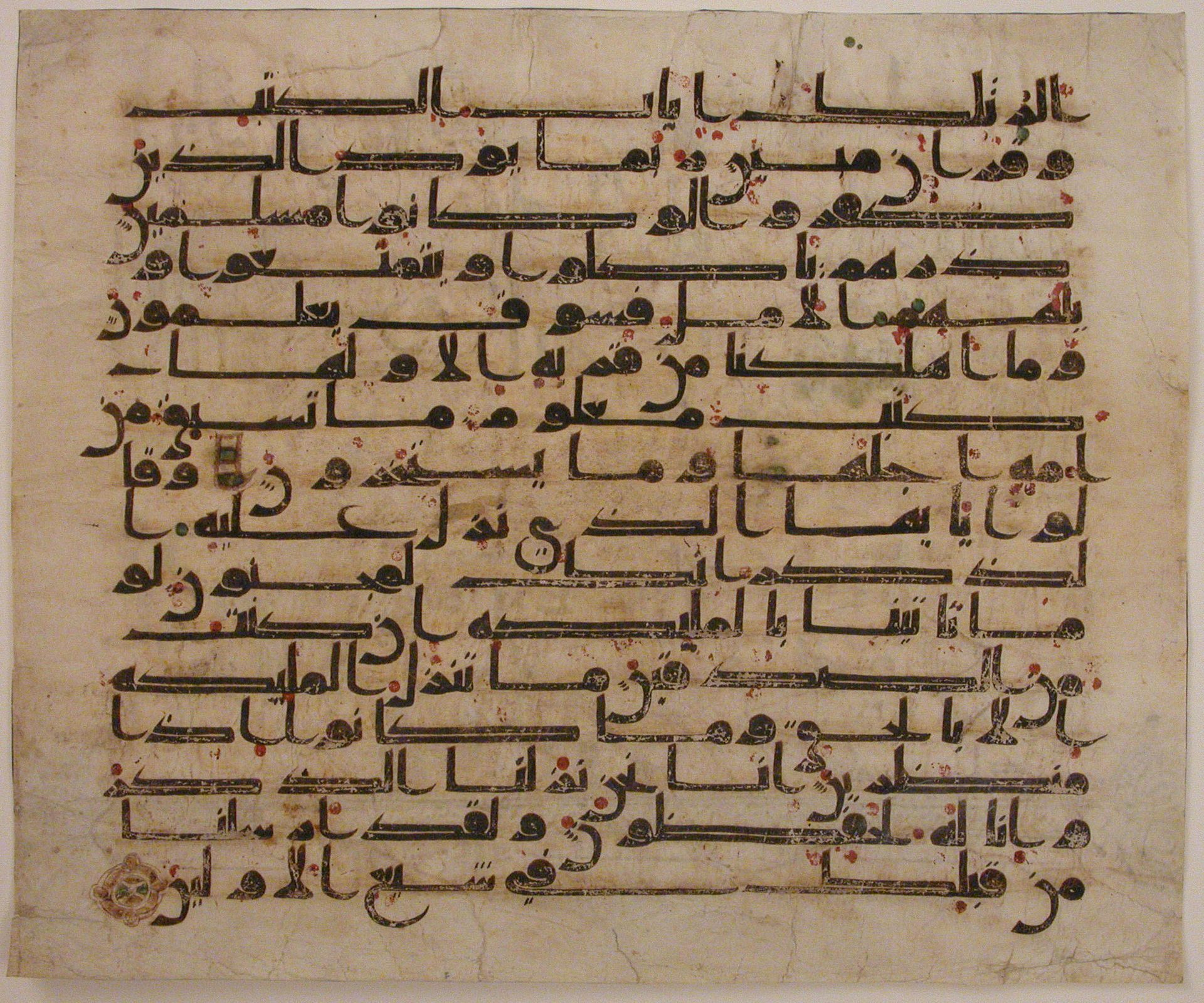
Two leaves of the Qur'an in Birmingham were radiocarbon-dated to between 568 and 645 CE, close to the lifetime of the Prophet Muhammad.
University of Birmingham, 2015: radiocarbon test at the University of Oxford ↗
Try this: Radiocarbon dates the animal skin, not the ink. Why does that difference matter?
manuscript
One of the oldest near-complete Bibles, Codex Sinaiticus, was written in Greek in the fourth century CE.
Try this: The codex is now split between four places. Should old books be reunited, and who should decide?
archaeology
A stone from about the ninth century BCE mentions the 'House of David', the dynasty of King David (peace be upon him).
The Tel Dan Stele, found in northern Israel in 1993–94, Israel Museum ↗
Try this: Scholars debate how to read some of its letters. How should we handle evidence when experts disagree?