Nobody enjoys being tested. So when people hear that life is a test, it can sound like a trick. God sets a hard paper, already knows your marks, then judges you on it. Why bother? Why not just make us good from the start?
Now think of the tests people choose for themselves. Climbers train for months to face a mountain. Musicians practise scales for years. A parent teaching a child to ride a bike has to let go of the saddle. In each case the hardship is not the point; what it makes is the point. Every tradition on this page uses the word “test” or “trial”. Almost none of them means an exam. They mean something closer to a forge, a school or a garden.
“Who hath created life and death that He may try you which of you is best in conduct; and He is the Mighty, the Forgiving.”
Qur’an 67:2 · Pickthall (1930)
The chapter called al-Mulk, “Sovereignty”, opens with this verse, and many Muslims recite it every night before sleep. Notice the measure: not who is richest, cleverest or most successful, but whose deeds are best. And the verse ends not with “the Severe” but with “the Forgiving”.
Heard in all three
“We believe”, and not be tested? We tested those who came before them, so that God will make plain who is truthful and who is lying.”
Qur’an 29:2–3
What hardship does to people, and what it doesn’t
Psychologists talk about “desirable difficulties”. The researcher Robert Bjork found that learning which feels harder at the time, like testing yourself instead of re-reading notes, sticks far better. Muscles grow by being strained and then repaired. Studies of resilience suggest that children who meet manageable challenges, with loving support, often cope better with stress later on.
But researchers are just as clear about the limits. The large Adverse Childhood Experiences study, published in 1998, found that serious childhood hardship, such as abuse or neglect, raised the risk of illness decades later. Too much, too young, with no one to help, does not build people. It harms them.
So the science gives the “life as a school” idea some real support, and a sharp warning. Hardship can make people stronger, but only some hardship, for some people, with help. That is exactly where the sceptic’s reply begins.
What each faith says
Judaism
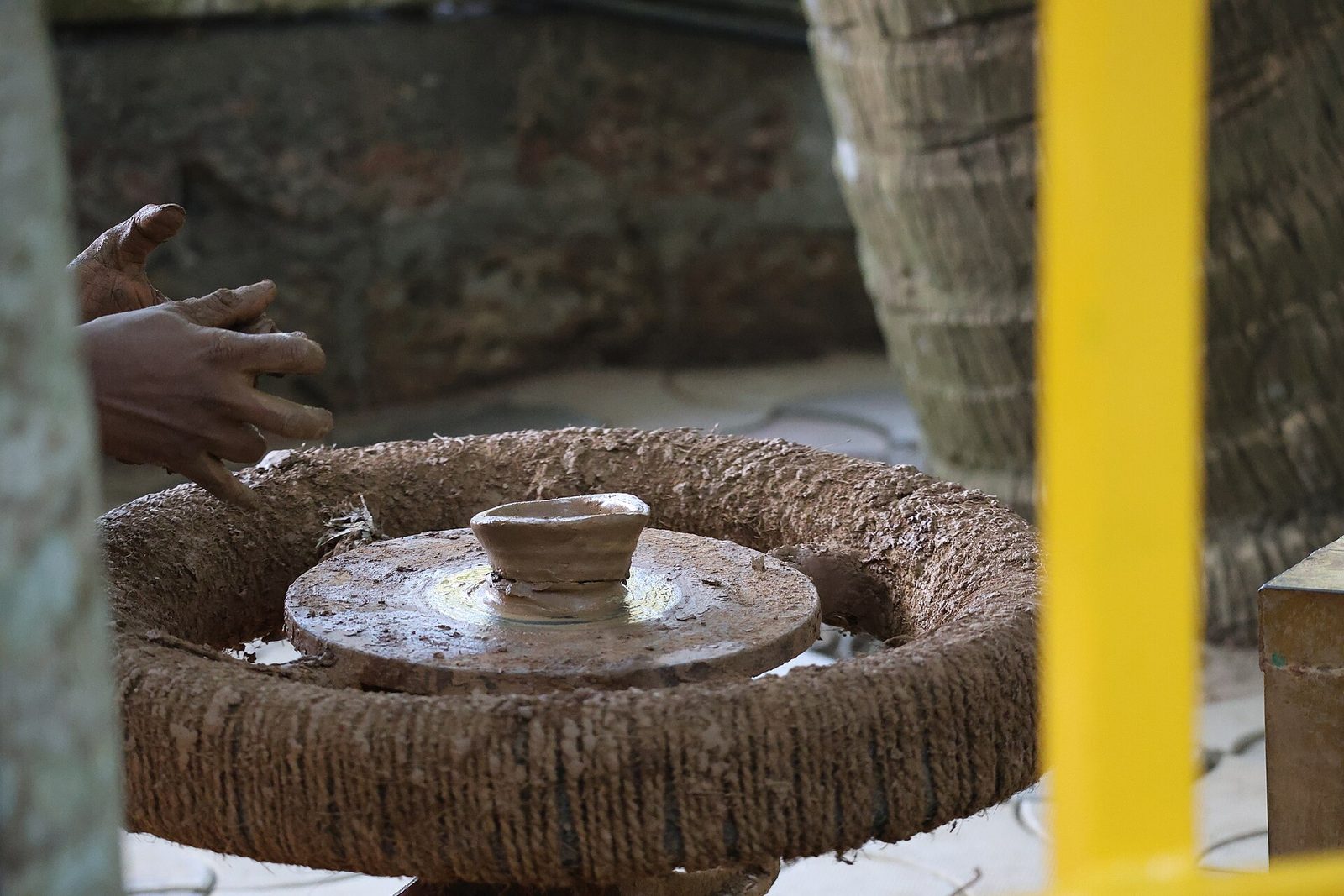
“The Lord tests the righteous… Rabbi Yonatan said: A potter does not test flimsy jugs, as he would not be able to knock on them even once without breaking them. What does he test? Sturdy jugs, as even if he knocks on them several times, they do not break.”
Bereshit Rabbah 32:3 · The Sefaria Midrash Rabbah (2022, CC BY)
The Hebrew Bible says plainly that “God did prove Abraham” (Genesis 22:1). The Israelites’ forty years in the wilderness were, Moses says, “to prove thee, to know what was in thy heart”. The rabbis asked the obvious question: does God not already know? Their answer was a picture from the workshop.
Rabbi Yonatan said a potter does not test flimsy jugs, which would break at the first knock. He taps the strong ones, which only ring. A flax-maker beats good flax because it gets better the more it is worked. So, the midrash says, God tests the righteous, not to find out what is in them, but to bring it out. The book of Job, read at length on our page about suffering, shows how hard such a test can be.
Christianity
“Count it all joy, my brothers, when you fall into various temptations, knowing that the testing of your faith produces endurance. Let endurance have its perfect work, that you may be perfect and complete, lacking in nothing.”
James 1:2–4 · World English Bible (British Edition), public domain
The letter of James begins with a surprising instruction: be glad when trials come, because they produce endurance. Paul says the same: suffering produces perseverance, perseverance produces character, and character produces hope (Romans 5:3–4). He adds that God will not let anyone be tested beyond what they can bear (1 Corinthians 10:13).
In the second century, Irenaeus taught that humans were made young and unfinished, and must grow into God’s likeness, as a child grows up. The modern philosopher John Hick built on this in his “soul-making” view. He borrowed the phrase from the poet John Keats, who wrote to his brother in 1819: “Call the world if you please ‘The vale of Soul-making.’” Keats was not a conventional Christian, but theologians have used his picture ever since.
Islam
“Do men imagine that they will be left (at ease) because they say, We believe, and will not be tested with affliction? Lo! We tested those who were before you. Thus Allah knoweth those who are sincere, and knoweth those who feign.”
Qur’an 29:2–3 · Pickthall (1930)
The Qur’an expects tests: “Do men imagine that they will be left (at ease) because they say, We believe, and will not be tested with affliction?” (29:2, Pickthall). It also says the test is not only hardship. God has raised some people above others in what they have, “He it is Who hath placed you as viceroys of the earth and hath exalted some of you in rank above others, that He may try you by (the test of) that which He hath given you. Lo! Thy Lord is swift in prosecution, and Lo! He verily is Forgiving, Merciful.” (6:165, Pickthall). Wealth, health and talent are tests too, of whether we share and give thanks.
A well-known hadith turns this into a promise. The believer, the Prophet Muhammad said, is in a remarkable position, because every situation is good for them. When something good happens they give thanks, and that is good for them. When hardship comes they are patient, and that is good for them too (Muslim 2999). Thanks and patience are the two answers to every test.
Without religion
The sceptic’s reply is strong. First, an all-knowing God already knows the result, so why set the test? Second, the tests are wildly unequal: some people face a hill, others are born at the foot of a cliff. Third, much suffering crushes rather than builds: a baby who dies of disease is not learning anything. Humanists say we should build character by choice, through challenge and kindness, without calling disasters lessons.
Believers answer each point. The Qur’an says the test is to “make plain” who people are, to themselves and to others, not to inform God. Each person, the traditions say, is judged by what they were given, not by what others had. And no tradition claims every pain is a lesson. Some suffering, they say, can only be met with mercy now and justice later.
Sikhi
Sikh history is full of trials met with chardi kala, “rising spirits”, a positive and fearless state of mind even in the worst times. Guru Arjan, the fifth Guru, was tortured and killed in 1606, and Sikhs remember him accepting God’s will as sweet. Sikhs are taught to see hardship and comfort alike as part of hukam, God’s order, and to meet both with the same remembrance of God.
Hindu traditions
Hindu stories are full of tests. The boy Prahlad keeps trusting God while his own father tries to kill him. King Harishchandra loses his kingdom, his family and his freedom rather than break his word. Many Hindus see life across many births as a long school for the soul, in which karma sets the lessons and devotion and wisdom help the soul to pass them.
Beyond the Abrahamic faiths
The Buddha’s own story begins when a sheltered prince sees old age, sickness and death for the first time. Buddhism does not call suffering a test set by God. But it makes it the starting point of wisdom: the first noble truth is that life involves dukkha, suffering or unsatisfactoriness, and the path is learning not to be ruled by it.
Same and different
The Abrahamic faiths agree that life includes tests, and that God is not a cold examiner but a maker shaping something. The rabbis’ potter, Irenaeus’ growing child and the Qur’an’s “best in deeds” point the same way: the test brings out what is in us. They differ on the end of the story: a world to come, union with God, or, for Hindus and Buddhists, release from the round of rebirth. The sceptic’s reply is the fair limit on all of them. Not every hardship is a lesson, and a faith that says so to a grieving person has stopped listening. The best answer the traditions give is in the hadith: in good times, thanks; in hard times, patience. Neither one asks us to pretend.
A moment to reflect
- Think of something hard you got through. What did it change in you? Would you choose it again?
- The potter taps the strong jugs. Is that comforting, or does it make things harder?
- Wealth and talent can be tests too, says the Qur’an. What would it mean to pass that kind of test?
- Which of the sceptic’s three points do you find strongest? How would you answer it?
Watch
Watch
A Christian telling
Do it together
Keep two jars. Each evening, add a slip to “thanks” for something good, and one to “patience” for something hard you got through. Read them together at the end of the month.
Read Bereshit Rabbah 32:3, James 1:2–4 and Qur’an 29:2–3. Each group draws one picture of what a “test” means in that text, then compares.
Debate the motion “Life cannot be a fair test if people start in such different places.” Use 6:165, 2:286 and the humanist reply.
Go deeper
- Bereshit Rabbah 32:3, the potter and the jugs (Sefaria) · scripture
- Keats, letter to George and Georgiana Keats, 1819 (Project Gutenberg) · book
- Sahih Muslim 2999 (sunnah.com) · scripture
- Qur’an 29:1–3 (Quran.com) · scripture
- Why is there suffering? (this site) · find out more
- The story of Job (this site) · find out more
Sources (10)
- Genesis 22:1, Deuteronomy 8:2, Psalm 11:5: Sefaria API, JPS 1917
- Bereshit Rabbah 32:3 (potter, flax): Sefaria, The Sefaria Midrash Rabbah 2022, CC BY
- James 1:2–4, Romans 5:3–4, 1 Corinthians 10:13: WEB (British Edition) via bible-api.com
- Keats: “Call the world if you please ‘The vale of Soul-making’”: Letters of John Keats (Colvin ed.), Project Gutenberg 35698
- Irenaeus and Hick’s soul-making theodicy: Wikipedia, Irenaean theodicy
- Qur’an 67:2, 29:2–3, 6:165 (Pickthall (1930) where quoted): Quran.com
- Muslim 2999: thanks in good times, patience in hardship: sunnah.com
- Desirable difficulties (Bjork): Wikipedia, Desirable difficulty
- Adverse Childhood Experiences study (Felitti et al., 1998): Wikipedia, Adverse Childhood Experiences Study (Felitti et al., Am J Prev Med 1998)
- Chardi kala; Guru Arjan’s martyrdom 1606: Wikipedia, Chardi Kala; Guru Arjan