Open Serious people still disagree; the evidence is not in.
The actor Stephen Fry was asked on Irish television in 2015 what he would say if he met God. He did not hold back. Why, he asked, should he respect a God who made a world with bone cancer in children? The clip was watched millions of times. Many believers found it painful to hear. Many also admitted that they had asked something similar themselves, in a hospital corridor or at a graveside.
That is the strange thing about this question. It is the strongest argument sceptics have, and it is also a question asked inside scripture, by prophets, to God’s face. So here is the sceptic’s case at full strength. Then each faith answers in its own words, and so do people who live without religion. Nobody pretends the question is easy.
“And surely We shall try you with something of fear and hunger, and loss of wealth and lives and crops; but give glad tidings to the steadfast, Who say, when a misfortune striketh them: Lo! we are Allah's and lo! unto Him we are returning.”
Qur'an 2:155–156 · Pickthall (1930)
These verses, from the long Madinan chapter al-Baqarah, give Muslims the words they say on hearing of a death: inna lillahi wa inna ilayhi raji’un. The Hebrew Bible has its own great text on suffering, the book of Job, where God answers out of the whirlwind: “Where wast thou when I laid the foundations of the earth?” (Job 38:4, JPS 1917).
What science shows about pain and suffering
Science can’t tell us why there is suffering in an ultimate sense. It can tell us some surprising things about pain. Pain is not only a curse; it is also an alarm system. A very rare genetic condition, congenital insensitivity to pain, leaves people unable to feel pain at all. In 2006 researchers at the University of Cambridge traced one form to a single gene, SCN9A, in families in northern Pakistan. Children with the condition often injure themselves badly without knowing it, and many die young. A world without any pain would not be a safe world for creatures like us.
But that cannot explain all suffering. In 2023, about 4.8 million children died before their fifth birthday, most from causes such as premature birth, pneumonia, diarrhoea and malaria, according to the UN’s child mortality group. Much of that is preventable; some is not. Earthquakes, which come from the same moving plates that recycle the Earth’s crust and help keep the planet habitable, have killed millions over history.
Psychologists have also found something called post-traumatic growth: many people, though not all, report deeper relationships, a new sense of priorities or a stronger faith after a crisis. The researchers who named it, Richard Tedeschi and Lawrence Calhoun, are careful to say that this does not make trauma good, and that growth and distress often happen at the same time.
And research on grief shows that people of faith and none find comfort in very similar things: being with others, rituals, memories and time. None of this answers the philosophical question. It does show what every faith tradition already teaches: the first response to suffering is not an argument, but presence and help.
The arguments, fairly
Freedom needs real choices. If God made people free to love, they must also be free to harm. Alvin Plantinga argued in 1974 that this shows God and evil are not logically contradictory.
A world for growing souls. John Hick argued in Evil and the God of Love (1966) that a world with challenge and risk is a place where courage, compassion and trust can grow, a “vale of soul-making”.
We see only part of the picture. Each faith holds that this life is not the whole story, and that God’s knowledge and justice reach beyond what we can see now.
Most suffering is human-made. Maimonides argued in The Guide for the Perplexed (III:12) that evils come in three kinds: those of nature, those people do to each other, and those people bring on themselves. The last two, he said, are by far the most common. He also rejected the claim of the physician al-Razi that there is more evil than good in the world.
Too much, and too pointless. William Rowe asked in 1979 about a fawn trapped in a forest fire, burning for days, unseen by anyone. What freedom or growth does that serve? This is called the evidential problem of evil, and many philosophers think it is the strongest argument against God.
Natural evil. Freedom may explain cruelty, the sceptic says, but not tsunamis, childhood cancer or millions of years of animal suffering before humans existed.
The logical form. A version attributed to Epicurus and restated by David Hume asks: if God is willing to prevent evil but not able, He is not all-powerful; if able but not willing, not good; if both, why is there evil?
Where it stands
Open. Most philosophers agree the strict logical version has been answered, but the evidential version is very much alive. Believers find answers they can live with; sceptics find them insufficient. Both sides take each other seriously.
What each faith says
Judaism
“Where wast thou when I laid the foundations of the earth? Declare, if thou hast the understanding.”
Job 38:4 · JPS 1917
The Hebrew Bible does not hide from this question. Abraham argues with God over the city of Sodom: “Shall not the Judge of all the earth do justly?” (Genesis 18:25). The book of Job gives forty chapters to a good man’s grief and anger. His friends explain his suffering away; at the end God says they did not speak rightly, and Job did (Job 42:7).
Rabbi Yannai taught: “It is not in our power to explain either the ease of the wicked or the suffering of the righteous” (Pirkei Avot 4:15). After the Holocaust, Jewish thinkers wrote some of the most searching responses to suffering of any tradition. Rabbi Harold Kushner, after his son died young, wrote When Bad Things Happen to Good People (1981). Rabbi Jonathan Sacks taught that the question “why?” turns, in faith, into the question “what then shall I do?”
Jewish practice meets grief with presence. Mourners sit shiva, seven days at home when neighbours bring food and come to pray, and say the Kaddish, a prayer that praises God and never mentions death. Hannah poured out her prayer in tears in the sanctuary at Shiloh (1 Samuel 1). It is still read on the Jewish New Year as a model of honest prayer.
Christianity
“He will wipe away every tear from their eyes. Death will be no more; neither will there be mourning, nor crying, nor pain, any more. The first things have passed away.”
Revelation 21:4 · WEB
At the heart of Christianity is a God who suffers. Christians believe that in Jesus, God entered human pain, and on the Cross cried out, “My God, my God, why have you forsaken me?” (Matthew 27:46, quoting Psalm 22). For many Christians, the answer to suffering is not an explanation but a presence: God with us, in the dark.
Christians also look forward to a new creation where “death will be no more” (Revelation 21:4). The fourteenth-century English mystic Julian of Norwich, who lived through plague, heard the words “all shall be well, and all shall be well, and all manner of thing shall be well.” C. S. Lewis wrote The Problem of Pain (1940) as a philosopher, and A Grief Observed (1961) as a widower. The second is much less sure, and many readers find it more honest.
Christian practice keeps faith with the dying. Dame Cicely Saunders, an Anglican nurse and doctor, founded St Christopher’s Hospice in London in 1967, the start of the modern hospice movement. Her motto for patients was that they matter to the end of their lives.
Islam
“Allah tasketh not a soul beyond its scope.”
Qur'an 2:286 · Pickthall (1930)
The Qur’an describes life as a test: God “Who hath created life and death that He may try you which of you is best in conduct” (67:2, Pickthall). It promises that “Allah tasketh not a soul beyond its scope.” (2:286, Pickthall), and that “But lo! with hardship goeth ease, Lo! with hardship goeth ease.” (94:5–6, Pickthall). The Prophet Muhammad ﷺ (peace be upon him) said that even the prick of a thorn that troubles a believer wipes away some of their sins (Bukhari 5641), and that a believer’s affair is good either way: grateful in good times, patient in hard ones (Muslim 2999).
Islam also teaches mercy greater than suffering. The Prophet said that God divided mercy into a hundred parts, and sent down only one into the world, by which every mother is tender to her child. The other ninety-nine He kept for the Day of Judgement (Bukhari 6000). Muslim scholars such as Sherman Jackson have written frankly about suffering, and the tradition honours the prophets who wept: Jacob (peace be upon him) went blind with grief for Joseph (peace be upon him) (Qur’an 12:84).
Without religion
“… in the absence of an afterlife and any discernible purpose to the universe, human beings can act to give their own lives meaning by seeking happiness in this life and helping others to do the same.”
Humanists UK, ‘What is humanism?’ · original English
For many non-religious people, suffering is the reason they do not believe. Stephen Fry, a patron of Humanists UK, made that case on Irish television. The New Testament scholar Bart Ehrman was once an evangelical Christian. In God’s Problem (2008) he tells how he lost his faith because he could no longer square suffering with a loving God. He now calls himself an agnostic.
But the non-religious answer is not only an argument. Without the promise of a life to come, many humanists say, this life and these people matter all the more. Humanist funerals celebrate the life that was lived. Humanist pastoral carers now sit with patients and prisoners alongside chaplains of every faith. And Epicurus, whose name is attached to the problem of evil, also taught that friendship is among the greatest goods a person can have.
Same and different
All three faiths refuse to say suffering is unreal or unimportant, and all three put protest and lament inside scripture itself: Abraham’s argument, Job’s cry, Jesus’ words from the Cross, Jacob’s grief. All three hope for justice beyond this life, and all three insist that the believer’s first duty is to help. They differ in emphasis: Judaism keeps the argument with God open; Christianity centres on God sharing our suffering in Christ; Islam frames hardship as a test held within God’s overwhelming mercy. Non-religious people share the moral outrage that drives the question, and that shared outrage is itself common ground.
A moment to reflect
- When you have suffered, what helped most: an explanation, a person, or something else?
- Is it more honest to argue with God, to accept, or to stop believing? Can it be more than one?
- Have you ever complained out loud, to God, to the sky or to a friend? Did it help?
- What would a good answer to Stephen Fry sound like, or is there none?
Watch
A clear, fair introduction to the problem of evil and the main replies.
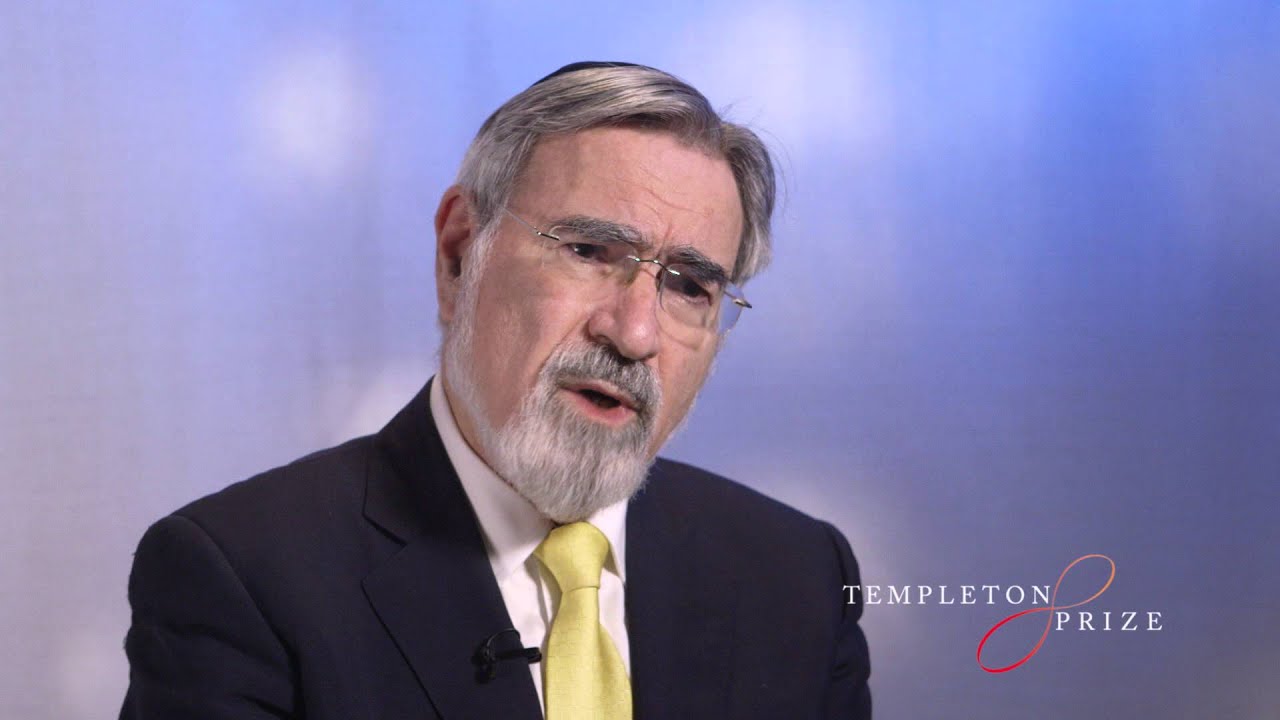 Doesn’t all the evil in the world show there is no God? Rabbi Lord Jonathan Sacks, Templeton Prize · Templeton PrizePlays on “When people blame God” →
Rabbi Jonathan Sacks answers whether evil shows there is no God.
The New Testament scholar N. T. Wright on how a good God and evil can be thought about together.
Dr Omar Suleiman on suffering in the Islamic tradition.
Do it together
Read Psalm 13 (“How long, O LORD?”) and Qur’an 21:83 (Job’s prayer) together. Then each person writes their own short lament, honest and private. Nobody has to share it.
Choose one local cause together: a food bank, a hospice, a refugee drop-in. Volunteer as a mixed group for one session and talk afterwards about what you saw.
Hold a discussion where a person of faith and a non-religious person each explain how they cope with loss. The rule: no one tries to convert anyone. Listen for what you share.
If a Jewish neighbour is sitting shiva, visitors are welcome: you need not say anything clever, only come, sit and listen. Many churches and mosques have the same custom of visiting the bereaved. Talk as a group about how your traditions, or none, keep company with grief.
Go deeper
- The Problem of Evil (Stanford Encyclopedia of Philosophy) · article
- The Book of Job (Sefaria) · scripture
- Pirkei Avot 4:15 (Sefaria) · scripture
- Qur'an 2:155–157 (Quran.com) · scripture
- Good, evil and suffering, GCSE RS (BBC Bitesize) · article
- Maimonides, Guide for the Perplexed III:12 (Sefaria) · book
- Julian of Norwich, Revelations of Divine Love (Christian Classics Ethereal Library) · book
- Non-Religious Pastoral Support Network · article
Check yourself
Three quick questions. No score, nothing saved.
1. Roughly how many young children died worldwide in 2023, according to the page?
2. Muslims say 'inna lillahi wa inna ilayhi raji'un' on hearing of a death. What does it mean?
3. Which is one of the arguments on the 'for' side?
Sources (7)
- SCN9A and congenital inability to experience pain, northern Pakistan families: Cox et al., Nature 444:894–898, 2006
- 4.8 million under-five deaths in 2023: UN IGME, Levels and Trends in Child Mortality 2024
- Post-traumatic growth: Tedeschi and Calhoun, Journal of Traumatic Stress 9(3), 1996
- Logical and evidential problems; Plantinga, Hick, Rowe: Tooley, The Problem of Evil, SEP
- Stephen Fry on The Meaning of Life, RTÉ, Feb 2015: Irish Times, 1 Feb 2015
- Mercy in a hundred parts: Sahih al-Bukhari 6000, Sunnah.com
- Thorn prick removes sins: Sahih al-Bukhari 5641, Sunnah.com