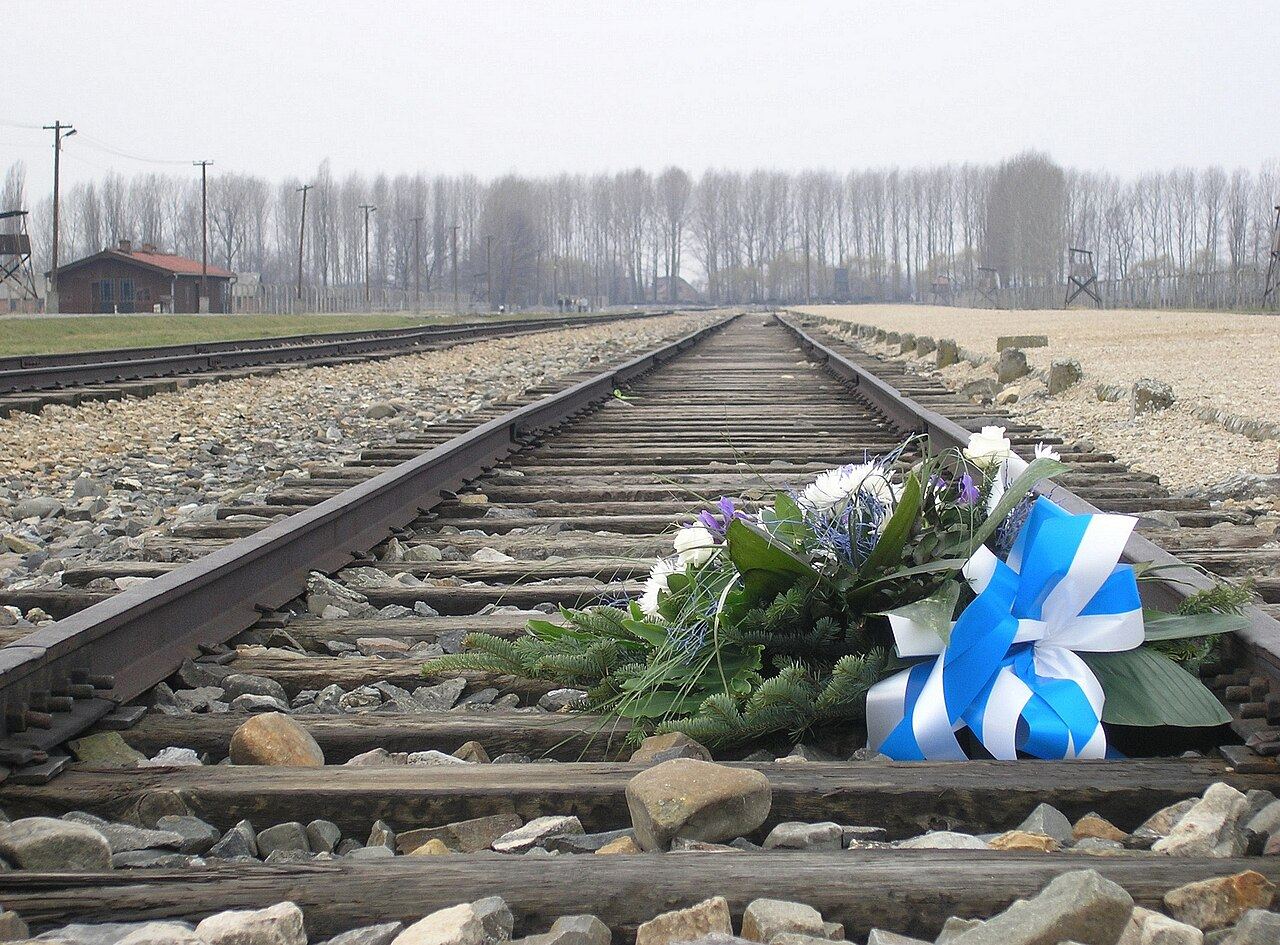
Elie Wiesel was fifteen when he arrived at Auschwitz in 1944. In his memoir Night, he describes the first night in the camp and the smoke from the chimneys, and says he will never forget the moments that murdered his God and his soul. Later he described watching a group of prisoners hold a trial. The defendant was God. After days of argument they found Him guilty. Then, Wiesel said, one of them noticed it was time for evening prayers, and they prayed.
That story holds the whole question. Can you accuse God and still pray to Him? Can anyone believe after the gas chambers? It is not a question for outsiders to answer quickly. This page sets out how Jewish thinkers have answered it, how Christians have faced their own churches' part in the hatred that led there, the people of every faith who rescued Jews, and how Britain remembers.
“Awake, why sleepest Thou, O Lord? Arouse Thyself, cast not off for ever.”
Psalm 44:24 · JPS 1917
Psalm 44 is the prayer of a people who say they have not forgotten God, yet are “killed all the day” (44:23). Some Jewish communities recited it in times of persecution. It is a psalm of faith that dares to shout at God. The Torah itself speaks of a time when God will “hide My face” (Deuteronomy 31:18), hester panim.
What history records
Between 1941 and 1945 Nazi Germany and its collaborators murdered about six million Jews, two in every three Jews in Europe, among them about 1.5 million children. The Nazis also murdered Roma and Sinti people, whose ancestors came from India centuries ago, as well as disabled people, and they persecuted gay men, Jehovah's Witnesses, political opponents and millions of Poles and Soviet prisoners of war.
Hatred of Jews had deep roots in Christian Europe, though Nazi race ideology was not Christian teaching. Some Christians resisted. The Lutheran pastor Dietrich Bonhoeffer was hanged in 1945 for his part in the resistance. The Protestant villagers of Le Chambon-sur-Lignon in France sheltered thousands of refugees, many of them Jewish children. Many more Christians stayed silent or took part.
Muslims rescued Jews too. In Albania, a mostly Muslim country, around 200 Jews lived before the war. Families sheltered Jewish refugees under besa, a code of honour meaning “keeping the promise”, and there were more Jews in Albania at the end of the war than at the start. The Turkish consul on Rhodes, Selahattin Ülkümen, saved Jewish families there and has been honoured by Yad Vashem. Noor Inayat Khan, a British Indian Sufi Muslim woman, went to occupied France as a secret radio operator. She was captured and murdered at Dachau in 1944, and was awarded the George Cross.
Some stories are contested, and honesty matters. Accounts say the Grand Mosque of Paris hid Jews and gave some of them Muslim papers. Estimates range from a handful of people to more than a thousand. The historian Robert Satloff found strong evidence for up to about 100. Yad Vashem recognises people as Righteous Among the Nations only when the evidence is documented. More than 28,000 people have been honoured so far. The medal carries the Mishnah's words: whoever saves a single life saves an entire world.
In the UK, Holocaust Memorial Day is held on 27 January, the anniversary of the liberation of Auschwitz-Birkenau in 1945. It was first held in 2001, and since 2005 a trust set up by the government has led it. It also remembers later genocides, in Cambodia, Rwanda, Bosnia and Darfur. The theme for 2027 is “No Place for Prejudice”.
Watch
Watch
A Jewish telling
What each faith says
Judaism
“Only take heed to thyself, and keep thy soul diligently, lest thou forget the things which thine eyes saw, and lest they depart from thy heart all the days of thy life; but make them known unto thy children and thy children's children.”
Deuteronomy 4:9 · JPS 1917
Jewish responses are many, and they argue with each other. The philosopher Emil Fackenheim, a refugee who came to Britain in 1939 after being held in Sachsenhausen, proposed a “614th commandment” to add to the Torah's 613: Jews must not hand Hitler a posthumous victory by giving up Jewish life. Rabbi Eliezer Berkovits, in Faith After the Holocaust (1973), drew on hester panim, the hiding of God's face. A God who gives people real freedom, he argued, must sometimes hold back, even from the cruellest, and so the responsibility is ours.
Rabbi Kalonymus Kalman Shapira taught his students every Sabbath in the Warsaw Ghetto. His sermons were buried in a milk can and found after the war, published as Esh Kodesh (Holy Fire). He taught that God weeps with His people in hidden places. Some, such as Richard Rubenstein, concluded that the traditional God of history could not survive Auschwitz. Many survivors simply went on keeping the Sabbath and raising children, which was its own answer.
Christianity
“The Church… decries hatred, persecutions, displays of anti-Semitism, directed against Jews at any time and by anyone.”
Nostra Aetate 4 (1965) · Vatican English text
Christians have had to face what centuries of church teaching against Jews made possible. In 1965 the Catholic Church's declaration Nostra Aetate rejected the charge that the Jewish people as a whole were guilty of Jesus's death, and condemned antisemitism. In 1998 the Vatican's document We Remember called Catholics to repent of the failures of Christians during the Shoah. In March 2000 Pope John Paul II led a public prayer asking God's forgiveness for Christians' sins against the Jewish people.
Protestant churches have done similar work. Lutheran churches have rejected Martin Luther's writings against Jews, and in 2019 the Church of England published God's Unfailing Word, which admits that Christian contempt for Jews helped prepare the ground for the Holocaust.
Islam
“For that cause We decreed for the Children of Israel that whosoever killeth a human being for other than manslaughter or corruption in the earth, it shall be as if he had killed all mankind, and whoso saveth the life of one, it shall be as if he had saved the life of all mankind.”
Qur'an 5:32 · Pickthall (1930)
The Qur'an's teaching that saving one life is like saving all of humanity (5:32) is also found in the Mishnah, the same saying engraved on Yad Vashem's medal for rescuers. Albanian Muslim families who sheltered Jews often described it simply as their duty to a guest and their word of honour. Muslim communities in Britain now take part in Holocaust Memorial Day, and Muslim speakers have stood beside survivors in schools. Remembering is part of standing against all hatred, including hatred of Jews.
Without religion
For many people, the Holocaust ended any belief that history is guided by a loving God. The Italian chemist and survivor Primo Levi, a secular Jew, is reported to have said that because there was Auschwitz, there could be no God. The philosopher Hannah Arendt, watching the trial of Adolf Eichmann in 1961, wrote of “the banality of evil”: great crimes carried out by ordinary officials doing their jobs. Humanists stress that remembering is a human duty, and that prejudice must be challenged long before it turns murderous.
Sikhi
Sikh teaching holds that standing up for another people's right to live and worship is a sacred duty. The ninth Guru, Guru Tegh Bahadur, gave his life in 1675 defending the freedom of Hindus who were not his own community. Sikh soldiers served in large numbers in the Second World War. Sikhs pray for sarbat da bhala, the good of all, at the end of every Ardas.
Hindu traditions
Hindu communities in Britain mark Holocaust Memorial Day alongside other faiths. Many Hindus draw comfort from the Bhagavad Gita's teaching that the true self cannot be destroyed: weapons do not cut it and fire does not burn it (2:23). The Roma, among the Nazis' victims, descend from people who left India around a thousand years ago, a link many Indian and Roma groups now remember together.
Beyond the Abrahamic faiths
Jehovah's Witnesses were sent to the camps for refusing to give the Nazi salute or serve in the army. About 1,500 of them died. People of every faith and none are among the Righteous Among the Nations. What they shared was not a creed but the decision, at risk of their own lives, not to look away.
Same and different
Jewish responses range from Fackenheim's command to keep living Jewishly, to Berkovits's hidden face, to Rubenstein's broken faith. Christians have had to confess their churches' part. Muslims, Sikhs, Hindus and others bring rescuers' stories and teachings about the worth of every life. Non-religious voices see the clearest evidence that no one is steering. They disagree deeply about God. They agree on one command, the oldest in Deuteronomy: do not forget, and teach your children.
A moment to reflect
- The prisoners in Wiesel's story found God guilty, then prayed. What do you make of that?
- Fackenheim said giving up Jewish life would hand Hitler a victory. Why might living, not arguing, be the strongest answer?
- Why do you think it matters that we check the evidence for rescue stories, even good ones?
- What could prejudice look like at your school or in your street, and what would it take to say “not here”?
Watch
Watch
A Jewish telling
Do it together
Hold a short gathering for Holocaust Memorial Day. Read the name and story of one person who was murdered and one who rescued. Keep a minute's silence. The Holocaust Memorial Day Trust publishes free resources each year.
Look at the Yad Vashem exhibition on Albanian rescuers. Talk about besa (the word of honour), the mitzvah to save a life, and Qur'an 5:32. What promise would you keep even at a cost?
Watch or read the recorded testimony of a survivor or a Kindertransport child, from the Holocaust Educational Trust or the Association of Jewish Refugees. Write one question you would have asked them.
Go deeper
- Holocaust Memorial Day Trust (find out more) · find out more
- Besa: A Code of Honor (Yad Vashem exhibition) · exhibition
- Nostra Aetate, full text (Vatican) · document
- Holocaust Encyclopedia (United States Holocaust Memorial Museum) · article
- Holocaust Educational Trust (find out more) · find out more
- Children who survived: the Kindertransport (Wikipedia) · article
In pictures
Sources (12)
- Psalm 44:24, Deuteronomy 31:18 and 4:9 text: Sefaria, JPS 1917
- Fackenheim: 614th commandment, posthumous victory; Sachsenhausen, escape to Britain: Wikipedia, Emil Fackenheim
- Berkovits: hester panim and free will: Wikipedia, Eliezer Berkovits
- Kalonymus Kalman Shapira, Esh Kodesh, Warsaw Ghetto: Wikipedia, Kalonymus Kalman Shapira
- Nostra Aetate promulgated 28 October 1965: Vatican; Wikipedia, Nostra aetate
- We Remember (1998) calls for repentance: Wikipedia, We Remember: A Reflection on the Shoah
- Albania: about 200 Jews before the war; more at the end; besa means to keep the promise: Yad Vashem, Besa: A Code of Honor
- Paris Grand Mosque: estimates vary from a few to over 1,500; Satloff's ‘as many as 100’: The Forward, ‘Muslims Who Helped Save French Jews’
- Noor Inayat Khan: SOE, executed at Dachau 1944, George Cross: Wikipedia, Noor Inayat Khan; CWGC
- HMD first held 2001; trust since 2005; 27 January = liberation of Auschwitz: Wikipedia, Holocaust Memorial Day (UK)
- HMD 2027 theme ‘No Place for Prejudice’; remembers Cambodia, Rwanda, Bosnia, Darfur: Holocaust Memorial Day Trust
- Six million Jews; 1.5 million children: United States Holocaust Memorial Museum