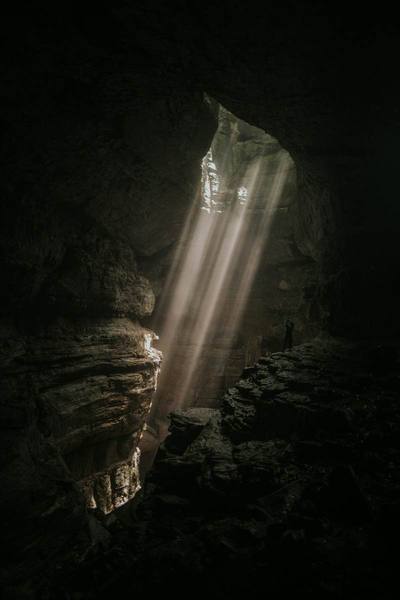
Moses asked. The Qur'an tells how, on the mountain, he said: “My Lord, show Yourself to me, so that I may look at You.” God answered: “You will not see Me. But look at the mountain. If it stays in its place, then you will see Me.” When God's glory appeared to the mountain, it crumbled to dust, and Moses fell down unconscious (7:143). In the Torah's version, God hides Moses in a cleft of the rock and lets him see only His back (Exodus 33:21–23).
Most of us never get that close. We pray and hear nothing. We look up and see stars, not a face. If God is real and wants to be known, why not write His name across the sky? In 1993 the Canadian philosopher J. L. Schellenberg turned that feeling into a careful argument. Here it is at full strength, then the replies, then each faith's own answer.
“Verily Thou art a God that hidest Thyself, O God of Israel, the Saviour.”
Isaiah 45:15 · JPS 1917
The prophet says it almost in wonder, in the middle of chapters about God's power over all nations. Blaise Pascal quoted the Latin, Vere tu es Deus absconditus, again and again. The same chapter has God say, “I form the light, and create darkness” (45:7).
What would count as evidence?
Schellenberg's argument, set out in Divine Hiddenness and Human Reason (1993), runs like this. A perfectly loving God would always be open to a relationship with every person who is capable of one. So anyone who sincerely wants to believe, and is not resisting, would find enough evidence to believe. But there are such people: honest seekers who look and do not find. So, Schellenberg concludes, a perfectly loving God does not exist. Many philosophers think this is one of the strongest arguments against God, alongside the problem of evil.
Believers have several replies. One is about freedom. If God were as obvious as the sun, faith would be forced. Nobody could choose to love God, any more than you choose to believe in gravity. The philosopher John Hick called this “epistemic distance”: God leaves enough room for us to come freely. Søren Kierkegaard told a parable in 1844 about a king who loved a humble girl. If he came in his royal robes, she would bow, but she could never love him as an equal. So he came dressed as a servant. A second reply is that God is not hidden at all, only too great to be seen directly, like the sun you cannot look at but by whose light you see everything. A third reply questions whether there really are seekers with no resistance at all, and many philosophers find that reply unconvincing.
Many people do report sensing a presence. Since 1969, the Religious Experience Research Centre, founded at Oxford by the biologist Sir Alister Hardy and now at the University of Wales Trinity Saint David, has collected thousands of first-hand accounts from people of every faith and none. Sceptics say such experiences are what we would expect from minds built to detect agents, and believers say they are exactly what we would expect if God is near. The experiences are real; what they show is still argued over.
Pascal's answer, written in the 1650s, still frames the debate. God gives enough light to those who want to see, and enough darkness to those who do not.
What each faith says
Judaism
“And I will take away My hand, and thou shalt see My back; but My face shall not be seen.”
Exodus 33:23 · JPS 1917
The Hebrew Bible is full of the hidden God. Psalmists cry, “How long wilt Thou hide Thy face from me?” (Psalm 13:2). The Torah warns of hester panim, a time when God will hide His face (Deuteronomy 31:18). Maimonides taught that we can say only what God is not: no human word can contain Him. There is a well-known Hasidic story. A rabbi's grandson came to him in tears because, in a game of hide and seek, his friend had stopped looking for him. The rabbi wept too. God says the same, he said: “I hide, and no one comes to look for Me.”
Christianity
“There is enough light for those who only desire to see, and enough obscurity for those who have a contrary disposition.”
Blaise Pascal, Pensées 430 · W. F. Trotter, public domain
“No one has seen God at any time,” says John's Gospel (1:18). Christians believe God's answer to hiddenness was to come close in a person. When Philip asked Jesus to show them the Father, Jesus replied, “He who has seen me has seen the Father” (John 14:9). Christians also speak openly of times when God seems absent: Jesus's own cry on the Cross, the “dark night of the soul” described by John of the Cross, and Mother Teresa's decades of darkness. Pascal saw hiddenness as part of God's design: clear enough for the sincere, hidden enough to leave them free.
Islam
“Vision comprehendeth Him not, but He comprehendeth (all) vision. He is the Subtile, the Aware.”
Qur'an 6:103 · Pickthall (1930)
The Qur'an describes believers first as those “Who believe in the Unseen, and establish worship, and spend of that We have bestowed upon them.” (2:3, Pickthall), al-ghayb. Life is a test, and a test whose answer is written in the sky is no test at all. When people demanded that an angel be sent down, the Qur'an replied that if one were, the matter would be settled at once and there would be no more time to choose (6:8). Muslims also believe that in the next life the righteous will see their Lord, as clearly as people see the full moon (Bukhari 554).
At the same time, Islam teaches that God is everywhere evident. He is al-Zahir, the Manifest, and al-Batin, the Hidden (57:3), and “We verily created man and We know what his soul whispereth to him, and We are nearer to him than his jugular vein.” (50:16, Pickthall). The thirteenth-century Egyptian scholar Ibn Ata'illah asked in his Aphorisms how anything could veil God, when He is the one who makes everything appear. Muslims call the world's evidence ayat, signs: God is hidden from the eyes but not from the mind.
Without religion
For many non-religious people, hiddenness is the simplest explanation of all: God does not show Himself because there is no God to show. Schellenberg himself is not a theist, though he takes religion seriously and thinks humans may be at a very early stage of understanding it. Bertrand Russell argued in 1952 that it is up to the person making a claim to prove it. If he said a small china teapot was orbiting the Sun, too small for any telescope to see, nobody would be obliged to believe him just because they could not disprove it.
Sikhi
The Mool Mantar, the opening of the Guru Granth Sahib, calls God ajooni, unborn, and Sikhs speak of God as nirankar, without form. Sikh scripture describes God as both gupt and pargat, hidden and manifest: hidden from the eyes, present in all creation. The Guru Granth Sahib also says God cannot be reached by cleverness. God is known through naam, constant remembrance, and through grace.
Hindu traditions
The Kena Upanishad says Brahman is “that which cannot be seen by the eye, but by which the eye sees”. In chapter 11 of the Bhagavad Gita, Arjuna asks Krishna to show his true, cosmic form. Krishna does, and Arjuna sees all worlds, all time and all death pouring into him. He trembles and begs Krishna to return to his gentle, familiar shape. Like Moses on the mountain, the seeing was more than a person could bear.
Beyond the Abrahamic faiths
The Buddha refused to answer some questions, such as whether the world is eternal or what happens to an enlightened person after death. He compared someone who demands every answer first to a man shot with a poisoned arrow who will not let the doctor remove it until he knows who shot it, and what the bow was made of. He would die first, the Buddha said (Majjhima Nikaya 63). For Buddhists, some silences are a kindness.
Same and different
The Abrahamic faiths agree that no one can see God directly in this life. Moses, Isaiah, John's Gospel and the Qur'an all say so, and the Gita tells the same story through Arjuna. They differ on what fills the gap. Christians point to Jesus, Muslims and Jews to signs, scripture and remembrance, Sikhs to naam, and Hindus to the self within. Non-believers say the simplest answer is that no one is there. Underneath lies a real disagreement. Is God hidden like someone who has left, or like the sun, too bright to look at but lighting everything you see?
A moment to reflect
- If God appeared in the sky tomorrow, would people be more loving, or just more obedient?
- Kierkegaard's king came dressed as a servant so that he could be loved freely. Does that story help you, or not?
- The Qur'an calls God both the Manifest and the Hidden. How can something be both?
- What would count as evidence for you, and is there anything that would not?
Do it together
Play hide and seek, then tell the Hasidic story of the boy whose friend stopped looking. Ask: how did he feel? Why might God want to be looked for?
Act out Kierkegaard's parable in three versions: the king arrives in his robes, the king arrives as a servant, the king never comes. Discuss which version allows real love, and how this connects to Schellenberg's argument.
Read Exodus 33:18–23, Qur'an 7:143 and Bhagavad Gita chapter 11 together. What does each person ask for, what do they get, and what do they learn?
Go deeper
- Hiddenness of God (Stanford Encyclopedia of Philosophy) · article
- Qur'an 7:143 (Quran.com) · scripture
- Exodus 33 (Sefaria) · scripture
- Pascal, Pensées (Project Gutenberg) · book
- Sir Alister Hardy and the Religious Experience Research Centre (Wikipedia) · find out more
In pictures



Sources (11)
- Isaiah 45:15 and 45:7, Exodus 33:20–23, Psalm 13:2, Deuteronomy 31:18 text: Sefaria, JPS 1917
- Schellenberg's argument (1993); replies from Hick, Kierkegaard, Pascal, Rea: Stanford Encyclopedia of Philosophy, Hiddenness of God
- Pascal: ‘enough light… enough obscurity’; Deus absconditus: Pascal, Pensées, trans. Trotter, Project Gutenberg #18269
- John 1:18, John 14:9 text: World English Bible (British Edition) via bible-api.com
- Qur'an 7:143, 2:3, 6:8, 6:103, 50:16, 57:3 (Pickthall (1930) where quoted): Quran.com
- Believers will see their Lord as they see the moon: Sahih al-Bukhari 554
- Ibn Ata'illah, Hikam: how can anything veil Him: Poetry Chaikhana (translation of the Hikam aphorism)
- Parable of the poisoned arrow: Majjhima Nikaya 63, Cula-Malunkyovada Sutta (Access to Insight)
- Kena Upanishad 1.6: Wikipedia, Kena Upanishad
- Religious Experience Research Centre, founded by Sir Alister Hardy in 1969: Wikipedia, Alister Hardy
- Russell's teapot (1952): Wikipedia, Russell's teapot