Stand-in photograph: Gary Lee Todd, Ph.D. · CC0 1.0
The name in three scripts
ArabicشعيبShuʿaybthe Qur'an's name
HebrewיִתְרוֹYitroJethro: a possible counterpart, debated
One-minute snapshot
In a minute
MidianRead time 1 min Qur'an
Shu'ayb (peace be upon him) was sent to Midian and to “the dwellers in the wood”. His message was the One God and honest trade: give full measure and weight, and do not cheat people of their goods. They mocked him, and an earthquake destroyed them. Many Muslim scholars identify him with Jethro, the priest of Midian who sheltered Moses (peace be upon him) and gave him his daughter in marriage. Others think they were different people. The Druze honour him as their chief prophet.
Many Muslim scholars identify Shu'ayb with Jethro, the priest of Midian in Exodus; others think they were different men. The identification is debated, so the Jewish column describes Jethro as a possible counterpart.
Watch
Films from each tradition
Each told by its own community, in its own words, side by side. More on F-ILM.
A Jewish telling
Covenant & Conversation | Yitro | Rabbi SacksThe Rabbi Sacks Legacy · 8 minRabbi Sacks on Yitro: Jethro, Moses' father-in-law, teaches him to share leadership.
A Muslim telling
Three Orders for the Prophet | Surah Summaries #11 Surah Hud | Imam Nadim BashirEPIC MASJID · 19 minEPIC Masjid, Surah Hud summary: includes Shu'ayb and Madyan's honest measures.
Side by side
Three tellings
Quotations: Torah and Hebrew Bible, JPS 1917 · New Testament, World English Bible (British Edition) · Qur'an, Pickthall (1930). Translations and sources
THebrew Bible · Jethro?
In Jewish tradition's own words.
Shu'ayb is not named. Jethro, the priest of Midian, takes in Moses and gives him his daughter Zipporah.
He rejoices at the Exodus and blesses God.
He advises Moses to share the work of judging the people.
“And Jethro rejoiced for all the goodness which the LORD had done to Israel, in that He had delivered them out of the hand of the Egyptians.”Exodus 18:9 · JPS 1917
A Torah portion is named after him, Yitro; it contains the Ten Commandments. The Talmud says he was a counsellor of Pharaoh who fled rather than join the decree against Israel's sons (Sotah 11a).
He calls for full measure and weight, and an end to corruption in the land.
They mock his prayers and threaten to drive him out.
An earthquake seizes them; Shu'ayb and the believers are saved.
“O my people! Give full measure and full weight in justice, and wrong not people in respect of their goods. And do not evil in the earth, causing corruption.”Qur'an 11:85 · Pickthall (1930)
The Qur'an does not name the old man of Midian whose daughter Moses (peace be upon him) marries (28:23–28). Ibn Kathir reports both views on whether he was Shu'ayb.
The Druze hold an annual pilgrimage to the shrine of Nabi Shu'ayb near Hittin in Galilee.
Now Moses was keeping the flock of Jethro his father-in-law, the priest of Midian; and he led the flock to the farthest end of the wilderness, and came to the mountain of God, unto Horeb.
Now Jethro, the priest of Midian, Moses’father-in-law, heard of all that God had done for Moses, and for Israel His people, how that the LORD had brought Israel out of Egypt.
And Moses told his father-in-law all that the LORD had done unto Pharaoh and to the Egyptians for Israel’s sake, all the travail that had come upon them by the way, and how the LORD delivered them.
And Jethro said: ‘Blessed be the LORD, who hath delivered you out of the hand of the Egyptians, and out of the hand of Pharaoh; who hath delivered the people from under the hand of the Egyptians.
The passage continues; open it in the player or your own Bible or Qur'an.
And unto Midian (We sent) their brother, Shu'eyb. He said: O my people! Serve Allah. Ye have no other God save Him. Lo! a clear proof hath come unto you from your Lord; so give full measure and full weight and wrong not mankind in their goods, and work not confusion in the earth after the fair ordering thereof. That will be better for you, if ye are believers.
Lurk not on every road to threaten (wayfarers), and to turn away from Allah's path him who believeth in Him, and to seek to make it crooked. And remember, when ye were but few, how He did multiply you. And see the nature of the consequence for the corrupters!
And if there is a party of you which believeth in that wherewith I have been sent, and there is a party which believeth not, then have patience until Allah judge between us. He is the Best of all who deal in judgment.
The chieftains of his people, who were scornful, said: Surely we will drive thee out, O Shu'eyb, and those who believe with thee, from our township, unless ye return to our religion. He said: Even though we hate it?
We should have invented a lie against Allah if we returned to your religion after Allah hath rescued us from it. It is not for us to return to it unless Allah our Lord should (so) will. Our Lord comprehendeth all things in knowledge. In Allah do we put our trust. Our Lord! Decide with truth between us and our folk, for Thou art the best of those who make decision.
So he turned from them and said: O my people! I delivered my Lord's messages unto you and gave you good advice; then how can I sorrow for a people that rejected (truth)?
And unto Midian (We sent) their brother Shu'eyb. He said: O my people! Serve Allah. Ye have no other God save Him! And give not short measure and short weight. Lo! I see you well-to-do, and lo! I fear for you the doom of a besetting Day.
O my people! Give full measure and full weight in justice, and wrong not people in respect of their goods. And do not evil in the earth, causing corruption.
They said: O Shu'eyb! Doth thy way of prayer command thee that we should forsake that which our fathers (used to) worship, or that we (should leave off) doing what we will with our own property. Lo! thou art the mild, the guide to right behaviour.
He said: O my people! Bethink you: if I am (acting) on a clear proof from my Lord and He sustaineth me with fair sustenance from Him (how can I concede aught to you)? I desire not to do behind your backs that which I ask you not to do. I desire naught save reform so far as I am able. My welfare is only in Allah. In Him I trust and unto Him I turn (repentant).
And, O my people! Let not the schism with me cause you to sin so that there befall you that which befell the folk of Noah and the folk of Hud, and the folk of Salih; and the folk of Lot are not far off from you.
They said: O Shu'eyb! We understand not much of that thou tellest, and lo! we do behold thee weak among us. But for thy family, we should have stoned thee, for thou art not strong against us.
And, O my people! Act according to your power, lo! I (too) am acting. Ye will soon know on whom there cometh a doom that will abase him, and who it is that lieth. And watch! Lo! I am a watcher with you.
The passage continues; open it in the player or your own Bible or Qur'an.
Qur'an 26:176–191 · The Qur'an · Pickthall (1930)
176
كَذَّبَ أَصْحَٰبُ لْـَٔيْكَةِ ٱلْمُرْسَلِينَ
The dwellers in the wood (of Midian) denied the messengers (of Allah),
177
إِذْ قَالَ لَهُمْ شُعَيْبٌ أَلَا تَتَّقُونَ
When Shu'eyb said unto them: Will ye not ward off (evil)?
And unto Midian We sent Shu'eyb, their brother. He said: O my people! Serve Allah, and look forward to the Last Day, and do not evil, making mischief, in the earth.
And when he came unto the water of Midian he found there a whole tribe of men, watering. And he found apart from them two women keeping back (their flocks). He said: What aileth you? The two said: We cannot give (our flocks) to drink till the shepherds return from the water; and our father is a very old man.
Then there came unto him one of the two women, walking shyly. She said: Lo! my father biddeth thee, that he may reward thee with a payment for that thou didst water (the flock) for us. Then, when he came unto him and told him the (whole) story, he said: Fear not! Thou hast escaped from the wrongdoing folk.
He said: Lo! I fain would marry thee to one of these two daughters of mine on condition that thou hirest thyself to me for (the term of) eight pilgrimages. Then if thou completest ten it will be of thine own accord, for I would not make it hard for thee. Allah willing, thou wilt find me of the righteous.
He said: That (is settled) between thee and me. Whichever of the two terms I fulfil, there will be no injustice to me, and Allah is Surety over what we say.
Common ground
Where they agree
If the identification holds: a God-fearing, wise man of Midian, linked with Moses (peace be upon him).
Honest dealing as part of faith.
Said plainly, ranked never
Where they differ
The Qur'an's Shu'ayb is a messenger who warns a dishonest people, who are destroyed. The Bible's Jethro is a priest and counsellor, with no such story.
Whether they are the same man is debated by Muslim scholars themselves.
Era and place
The world of Shu'ayb
Where
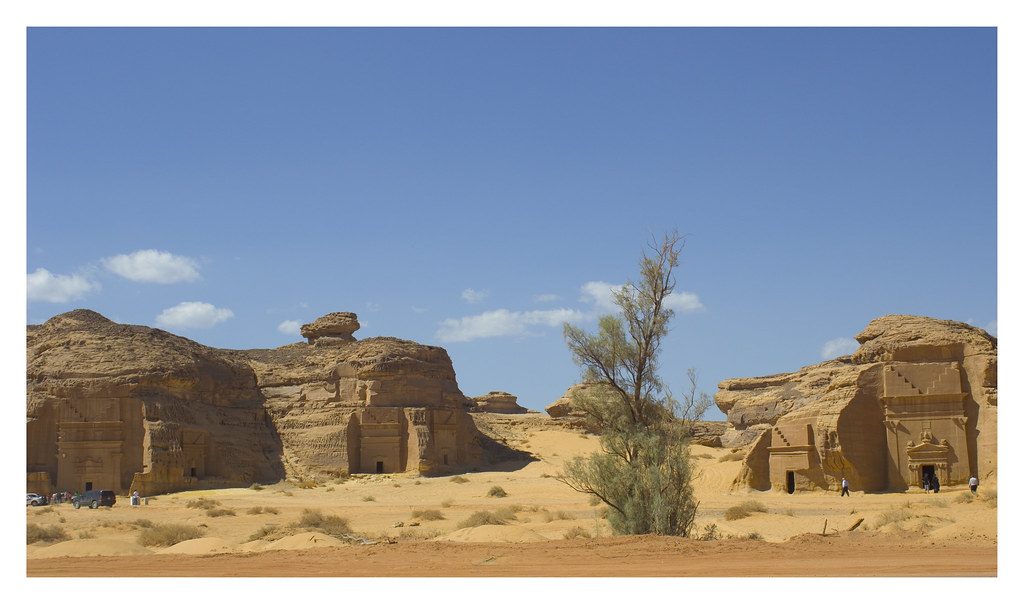
Midian: north-west Arabia and southern Jordan (al-Bad', near Tabuk). Rock-cut tombs at al-Bad' are popularly called Maghāyir Shuʿayb, “Shu'ayb's caves”; they are later Nabataean work.
When
The time of Moses (peace be upon him), if the identification holds.
What archaeology can and cannot say
Qurayyah painted pottery of the Late Bronze and early Iron Ages is linked by some scholars with the Midianites.
Gallery
The world of Shu'ayb
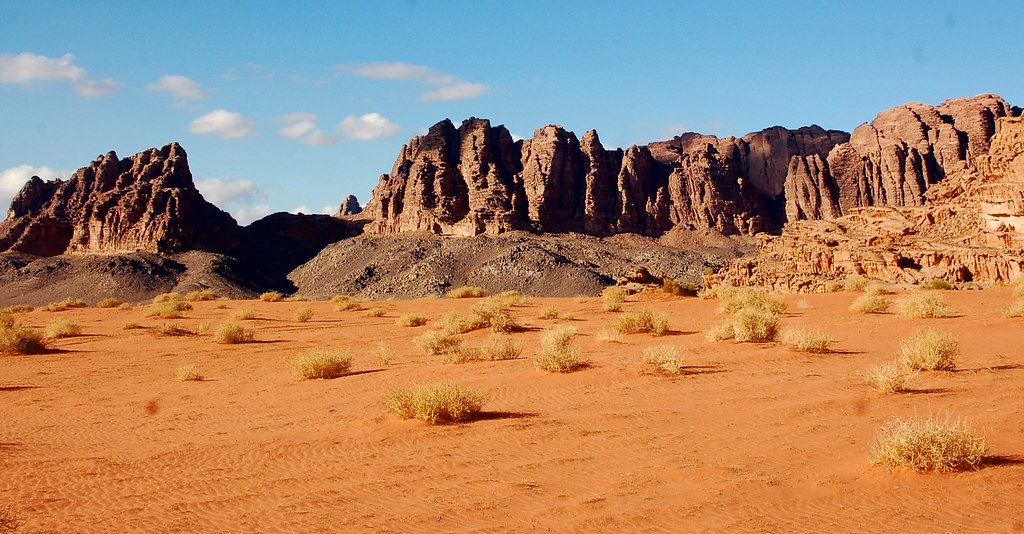
Wadi Rum in southern Jordan, on the edge of ancient MidianThe Seven Pillars of Wisdom, Wadi Rum, twiga_swala, CC BY-SA 2.0Nabataean rock-cut tombs at Hegra, like those at al-Bad' called “Shu'ayb's caves”Mada'in Saleh Al-Hijr Hegra (مدائن صالح), Basheer Olakara, CC BY 2.0The Sinai mountains, where Moses kept Jethro's flock (Exodus 3:1)Sinai Mountains, Prince Roy, CC BY 2.0Frankincense trees: the incense trade that crossed MidianFrankincense Trees in Dhofar, riyadh.albalushi, CC BY 2.0
Go deeper
Go deeper
Midrash and Jewish tradition
Jethro is honoured as a wise outsider who recognised God's hand in the Exodus (Exodus 18). The Talmud (Sotah 11a; Sanhedrin 106a) makes him one of Pharaoh's counsellors who fled.
Christian tradition
Christians read Jethro's advice to Moses (Exodus 18) as a lesson in sharing leadership. The New Testament does not mention him.
Tafsir and hadith
Ibn Kathir, on 11:84 and 28:23, sets out Shu'ayb's preaching on fair trade and reports the scholars' disagreement over whether Moses (peace be upon him)' father-in-law was Shu'ayb.
And unto Midian (We sent) their brother Shu'eyb. He said: O my people! Serve Allah. Ye have no other God save Him! And give not short measure and short weight. Lo! I see you well-to-do, and lo! I fear for you the doom of a besetting Day.
And when he came unto the water of Midian he found there a whole tribe of men, watering. And he found apart from them two women keeping back (their flocks). He said: What aileth you? The two said: We cannot give (our flocks) to drink till the shepherds return from the water; and our father is a very old man.
Reference works: Encyclopaedia Judaica (2nd ed.); The Oxford Dictionary of the Christian Church; Encyclopaedia of Islam (3rd ed.); Ibn Kathir, Qisas al-Anbiya.