The Companion al-Nuʿmān ibn Bashīr told this story from the pulpit when he was grown up.
When he was a boy, his father gave him a gift. His mother, ʿAmra bint Rawāḥa, said she would not accept it unless the Prophet Muhammad ﷺ (peace be upon him) was asked to witness it. So his father went to the Prophet. He said: I have given a gift to my son by ʿAmra, and she has told me to ask you to be a witness.
No, said the father.
Then the Prophet said: fear God, and be fair between your children. (Bukhari 2587)
The father went home and took the gift back.
The story is loved because it brings justice down to a family kitchen. It was not a court case or a crime. It was a father's kindness to one child that would have been unfair to the others. The Prophet would not lend his name to it. Muslims are taught that God's justice, al-Muqsiṭ, is meant to show up in the smallest everyday choices: who gets what, and who is left out.
Judaism
“Ye shall do no unrighteousness in judgment, in meteyard, in weight, or in measure. Just balances, just weights, a just ephah, and a just hin, shall ye have: I am the LORD your God, who brought you out of the land of Egypt.”
Leviticus 19:35-36 · JPS 1917
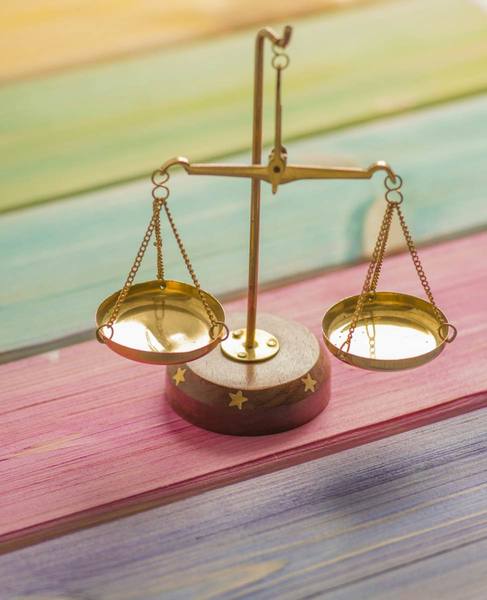
The Torah demands honest scales: “Ye shall do no unrighteousness in judgment, in meteyard, in weight, or in measure. Just balances, just weights... shall ye have.” Weights and measures were a matter of holiness, not just business.
The Psalms promise that God “will judge the world in righteousness, He will minister judgment to the peoples with equity” (Psalm 9:9). The prophet Amos condemned those who cheated the poor with false scales (Amos 8:5).
The Hebrew for charity, tzedakah, comes from tzedek, justice: giving to the poor is treated as fairness owed, not a favour done. When Rabbi Abraham Joshua Heschel marched for civil rights at Selma in 1965, he wrote afterwards that he felt his legs were praying.
Christianity
“For with whatever judgement you judge, you will be judged; and with whatever measure you measure, it will be measured to you.”
Matthew 7:2 · WEB
Jesus warned that the measure we use for others will be used for us. Christians believe God judges with perfect fairness and also with mercy.
Christian charities such as Christian Aid and CAFOD were among the groups that founded the UK's Fairtrade Foundation in 1992, drawing on Christian teaching about justice for the poor.
Islam
“And whoso doeth good an atom's weight will see it then.”
Qur'an 99:7 · Pickthall (1930)
The Qur'an does not use al-Muqsiṭ as a Name of God word for word, but it says God loves the muqsiṭīn, those who act justly (5:42). It also says He is “Maintaining His creation in justice” (3:18, Pickthall). It ties the scales of the sky to the scales of the market. “And the sky He hath uplifted; and He hath set the measure, That ye exceed not the measure.” (55:7-8, Pickthall).
A hadith promises that the just will be seated on pulpits of light at the right hand of the Most Merciful (Muslim 1827). A hadith qudsi, God's words in the Prophet's telling, says: “I have forbidden injustice for Myself, and made it forbidden among you” (Muslim 2577).
Same and different
Leviticus' just weights, Matthew's measure and the Qur'an's balance all tie God's justice to honest dealing between people. All three teach that God sees what courts cannot. They describe the place of mercy in judgement in their own ways, Christians especially through Christ. Judaism and Islam each build fairness into giving: tzedakah, from the word for justice, and zakāt, the yearly due on wealth that is one of Islam's five pillars.
families / schoolsFair sharesGive a group a bag of mixed sweets and ask them to share it fairly. Talk about what 'fair' means: equal, by need, by effort? Read the story of al-Nuʿmān and Leviticus 19:35-36.
faith groups / neighboursFair-trade shopRun a fair-trade stall after Friday prayers, a Sabbath kiddush or Sunday service, and share where the products come from. Invite all three communities to take part.

 Episode 1